
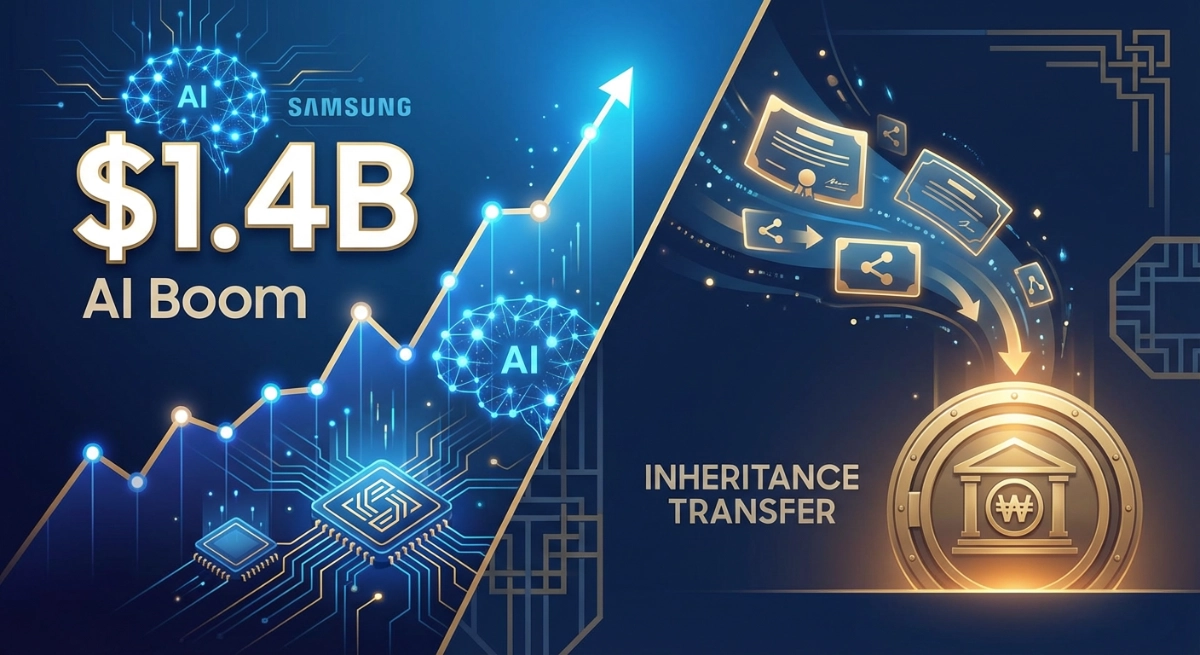
Samsung Heirs Sell $1.4B Stake as AI Boom Drives Stock Rally
Hong Ra-hee to dispose of shares amid inheritance tax obligations while tech giant posts record earnings
The widow of late Samsung Group Chairman Lee Kun-hee is selling $1.4 billion worth of Samsung Electronics shares, marking a strategic move to meet final inheritance tax obligations even as the company benefits from surging AI-driven demand for memory chips.
Key Points
- Hong Ra-hee signed an agreement to sell 15 million Samsung electronics shares valued at approximately 2.1 trillion won ($1.4 billion).
- Stock sale aims to cover final installment of record 12 trillion won ($8.4 billion) inheritance tax bill due in April 2026
- Samsung Electronics reported record Q4 2025 operating profit of 20 trillion won as AI boom supercharges memory chip prices
- Samsung shares have rallied more than 145% over past year on surging AI infrastructure demand
Background
Following Lee Kun-hee’s death in October 2020, his heirs faced what remains South Korea’s largest-ever inheritance tax bill. The Samsung family has been paying approximately 12 trillion won in taxes through a six-year installment plan that began in 2021 and concludes in April 2026.
South Korea imposes one of the world’s highest inheritance tax rates at 50 percent, which increases to 60 percent when company shares are transferred with management control rights—more than double the OECD average of 27.1 percent.
What Happened
According to regulatory filings dated January 9, 2026, Hong Ra-hee signed a securities disposal trust agreement with Shinhan Bank to sell 15 million Samsung Electronics shares by June 30. Based on the contract date closing price of 139,000 won, the shares are valued at approximately 2.1 trillion won, though actual proceeds could be higher given the stock’s recent gains (ℹ️ KED Global).
The filing specified the funds will be used for tax payments and loan repayment. Once completed, Hong’s stake in Samsung Electronics will decrease from 1.49 percent to 1.23 percent.
This sale follows a previous block trade in October 2025, when Hong and her daughters—Lee Boo-jin and Lee Seo-hyun—sold approximately 1.8 trillion won worth of Samsung Electronics shares (ℹ️ KED Global).
Why It Matters
The timing of the stock sale coincides with Samsung’s strongest financial performance in years. The company reported a preliminary Q4 2025 operating profit of 20 trillion won ($13.8 billion), up 208 percent year-over-year, driven by skyrocketing memory chip prices fueled by artificial intelligence infrastructure expansion (ℹ️ Bloomberg).
Samsung shares have surged more than 145 percent over the past 12 months as memory makers benefit from redirecting production toward high-end chips for AI data centers. This supply shift has created shortages in standard memory for laptops and servers, pushing both DRAM and NAND prices sharply higher.
Counterpoint Research projects server DRAM prices will rise 40-50 percent quarter-over-quarter in Q1 2026, with an additional 20 percent increase expected in Q2 2026.
The family’s decision to sell during this rally reflects the immense financial pressure of South Korea’s inheritance tax system. The Samsung heirs have employed multiple strategies to meet their obligations, including property sales—such as the 22.8 billion won sale of Lee’s former residence in July 2025—and stock-backed loans (ℹ️ The Korea Herald).
What’s Next
The Samsung family faces its last deadline for the inheritance tax installment in April 2026. Shinhan Bank has authorization to sell Hong’s shares in phases through June 30, using a structure designed to minimize market impact.
Samsung Electronics will release its complete audited Q4 2025 financial report on January 29, 2026, including detailed segment breakdowns and net profit figures. Analysts expect Samsung to focus on expanding high-bandwidth memory (HBM) production capacity throughout 2026 as it works to narrow the competitive gap with SK Hynix and Micron in AI chip supply.
Source: KED Global, Bloomberg, The Korea Herald—Published January 19-25, 2026
Original articles:
- https://www.kedglobal.com/stocks/newsView/ked202601190002
- https://finance.yahoo.com/news/samsung-profit-triples-ai-supercharges-015130351.html
About the Author
James Carter is a productivity coach and technology writer who helps readers understand how AI and emerging technologies impact business and finance. With a focus on practical insights and real-world applications, James breaks down complex tech developments into actionable information for everyday professionals.