
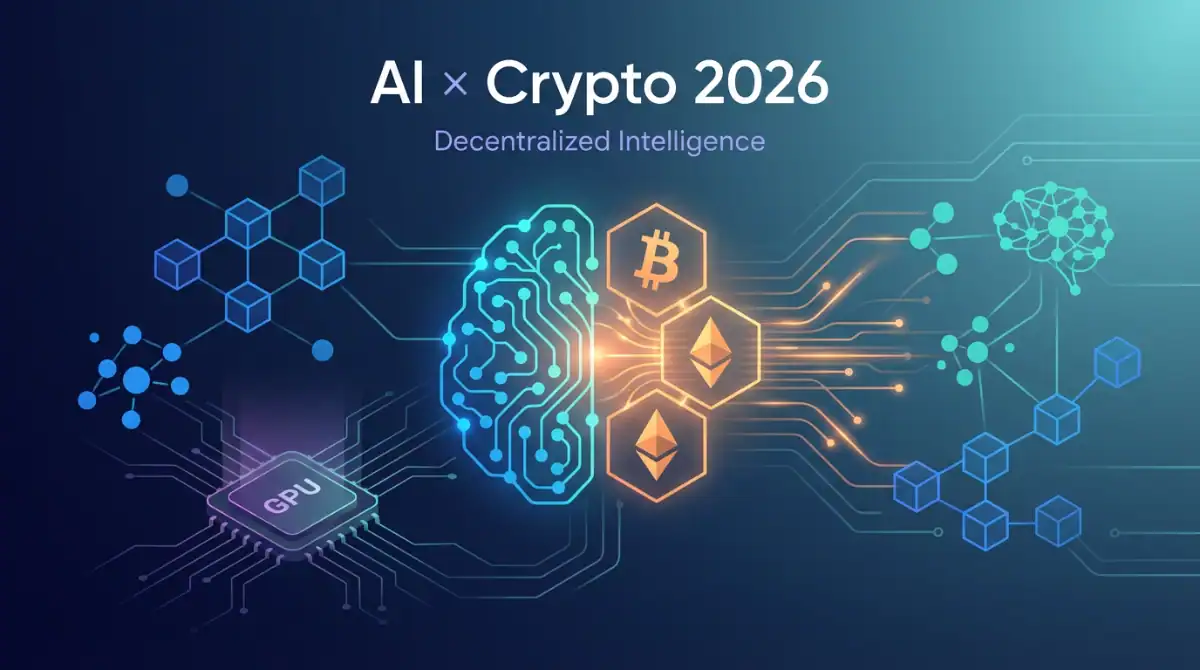
Top AI Cryptocurrencies Poised for Growth in 2026
Key Points
- AI cryptocurrencies are emerging as a dominant sector, with projects like Bittensor (TAO) and NEAR Protocol (NEAR) leading by market capitalization
- The convergence of artificial intelligence and blockchain is moving from experimentation to real-world applications across decentralized compute, data markets, and autonomous agents
- Leading projects provide infrastructure for GPU rendering, machine learning networks, and AI-powered decentralized applications
- Market analysts predict continued growth despite volatility, with institutional adoption accelerating in 2025
- Privacy-focused AI computing and decentralized model training represent breakthrough use cases for the technology
Background
The fusion of artificial intelligence and blockchain technology has evolved from a speculative concept into one of the most compelling narratives in the cryptocurrency market. Throughout 2025, AI-focused tokens demonstrated remarkable resilience and innovation, with several projects achieving market capitalizations exceeding $1 billion.
This technological convergence addresses fundamental challenges in both industries. AI development requires massive computational resources, while blockchain networks need intelligent automation to scale effectively. Together, they’re creating entirely new categories of decentralized services that weren’t possible just a few years ago.
What Happened
Recent market analysis from multiple authoritative sources reveals that AI cryptocurrencies have established themselves as a major sector heading into 2026. Bittensor (TAO) currently holds the largest market capitalization among AI-focused crypto assets, operating as an open-source protocol that powers a decentralized machine-learning network (ℹ️ CoinDCX).
NEAR Protocol (NEAR) has strengthened its position as a leading AI-friendly blockchain, driven by high throughput and rapid finality that makes it attractive for real-time AI execution and autonomous on-chain systems (ℹ️ CoinDCX). The platform’s sharded architecture supports AI agent-based applications with sub-second transaction finality.
Render Network (RNDR) continues to dominate the decentralized GPU rendering space, connecting artists needing computational power with GPU owners willing to share resources. The platform supports high-bandwidth decentralized applications across gaming, healthcare, and finance (ℹ️ Yahoo Finance).
According to Silicon Valley Bank’s 2026 crypto outlook, for every venture capital dollar invested into crypto companies in 2025, 40 cents went to companies also building AI products—a dramatic jump from just 18 cents the previous year. (ℹ️ SVB)
Why It Matters
The AI crypto convergence represents more than just market speculation—it’s solving real infrastructure problems. Decentralized GPU networks like Render and Akash Network are providing alternatives to expensive centralized cloud services, which is particularly important as AI workloads continue to grow exponentially.
These projects are creating new economic models where individuals can monetize idle computing resources while AI developers access affordable infrastructure. The Graph (GRT) exemplifies this utility by indexing blockchain data so AI agents and analytics tools can query information in seconds rather than hours (ℹ️ CoinCodex).
For everyday users and developers, this shift means AI services become more accessible and less controlled by centralized tech giants. Privacy-preserving networks like Oasis (ROSE) enable AI training on sensitive data without compromising security—critical for medical, financial, and behavioral datasets.
Industry experts project this sector will continue expanding throughout 2026. As blockchain networks enter a phase where intelligence is built directly into systems through automated learning and data-driven optimization, these tokens provide the economic incentives that make decentralized AI networks viable (ℹ️ ZebPay).
What’s Next
Market analysts expect the AI cryptocurrency sector to see continued institutional adoption through 2026. Coinbase’s investment research head, David Duong, describes the AI-crypto convergence as “a fundamental shift towards the next stage of technological progress” rather than a temporary trend (ℹ️ DL News).
Emerging developments include AI agents capable of autonomous on-chain transactions, enhanced privacy computing for sensitive workloads, and expanded integration between traditional finance and decentralized AI infrastructure. Projects combining these technologies are attracting significant venture capital attention.
However, investors should approach this sector with realistic expectations. While the technology shows genuine promise, cryptocurrency markets remain volatile. Experts recommend focusing on projects with measurable usage metrics—active users, network jobs, developer activity, and actual revenue generation—rather than hype alone.
The path forward involves careful evaluation of token economics, real utility, and competitive positioning against centralized alternatives. As traditional cloud providers continue lowering prices, decentralized networks must prove clear advantages in cost, accessibility, or censorship resistance to sustain long-term growth.
Source: Multiple authoritative sources including CoinCodex, Yahoo Finance, CoinDCX, ZebPay, Silicon Valley Bank—Published January 27-February 1, 2026
Original articles:
- https://coincodex.com/article/27553/best-ai-crypto-coins/
- https://finance.yahoo.com/news/7-best-ai-cryptocurrencies-buy-000107093.html
- https://coindcx.com/blog/crypto-highlights/top-ai-crypto-tokens/
- https://zebpay.com/blog/top-5-ai-crypto-coins-of-2026
- https://www.svb.com/industry-insights/fintech/2026-crypto-outlook/
About the Author
Alex Rivera is a creative technologist passionate about making emerging technologies accessible to everyone. With a background in blockchain development and content creation, Alex specializes in transforming complex AI and crypto concepts into engaging, easy-to-understand narratives. Through hands-on experimentation and community engagement, Alex helps non-technical users navigate the exciting intersection of artificial intelligence and decentralized technology.