
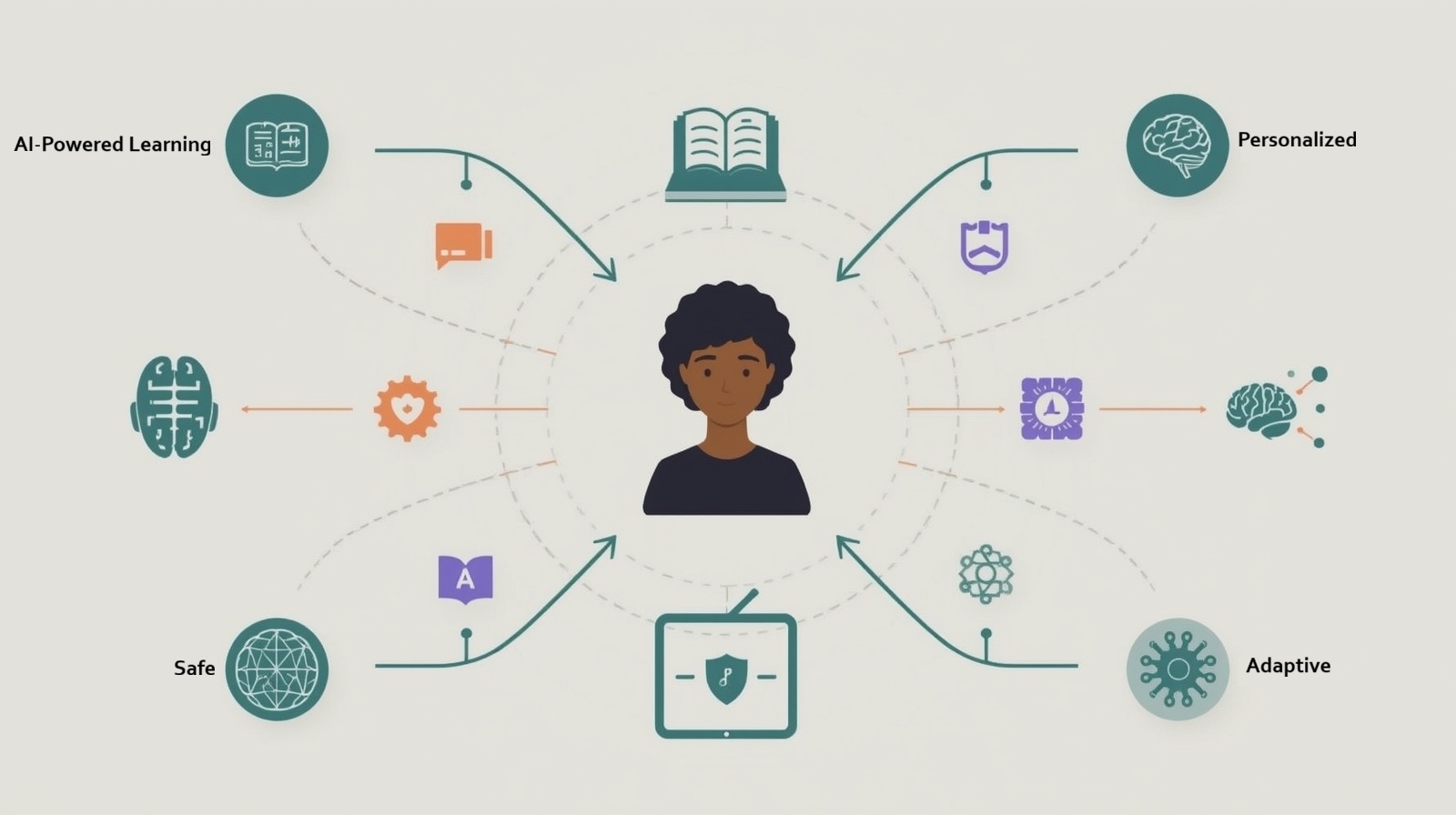
AI-Powered Personalized Learning: A Safe and Student-Friendly Guide
AI-Powered Personalized Learning is transforming how we study, practice, and grow as learners. Whether you’re a middle school student struggling with math, an adult learner picking up a new language, or a teacher looking to support diverse classroom needs, AI-driven educational technology adapts to your unique learning style, pace, and goals. We’ve both experienced the frustration of one-size-fits-all education—Nadia from her work in AI ethics and digital safety, and Rihab through years of navigating traditional classrooms. That’s why we’re excited to share how this technology works, what benefits it brings, and most importantly, how to use it safely and effectively.
Think of personalized learning as having a patient tutor who remembers everything about how you learn best—your strengths, your challenges, even the time of day when you’re most focused. Unlike traditional education, where everyone follows the same path at the same speed, AI-Powered Personalized Learning creates a custom roadmap just for you. The technology analyzes how you interact with content, identifies patterns in your responses, and adjusts the difficulty, format, and pace accordingly.
This isn’t science fiction—it’s happening now in classrooms, online courses, and learning apps around the world. But as with any powerful technology, understanding how it works and using it responsibly matters tremendously.
The Ultimate Guide to AI-Powered Personalized Learning
When we talk about The Ultimate Guide to AI-Powered Personalized Learning, we’re referring to a comprehensive approach that puts the learner at the center of the educational experience. Traditional education often follows a linear path: the teacher presents information, the students absorb it, and everyone takes the same test. Personalized learning flips this model entirely.
AI systems collect data points about your learning journey—which questions you answer correctly, where you hesitate, how long you spend on certain topics, and even which explanation formats help you understand best. Machine learning algorithms process this information to build a detailed profile of your learning preferences and knowledge gaps. Based on this profile, the system recommends specific content, adjusts difficulty levels, and suggests practice activities tailored to your needs.
For students like Rihab who might grasp visual explanations quickly but struggle with text-heavy content, the AI recognizes this pattern and prioritizes video tutorials and infographics. For learners who excel with hands-on practice, the system provides more interactive exercises. This adaptability makes education more efficient and less frustrating.
From our perspective, the ultimate guide includes not just understanding how the technology works but also knowing your rights regarding data privacy, recognizing when AI recommendations might contain bias, and maintaining a balanced approach that combines AI tools with human guidance.
How AI Identifies Individual Learning Styles for Personalized Education
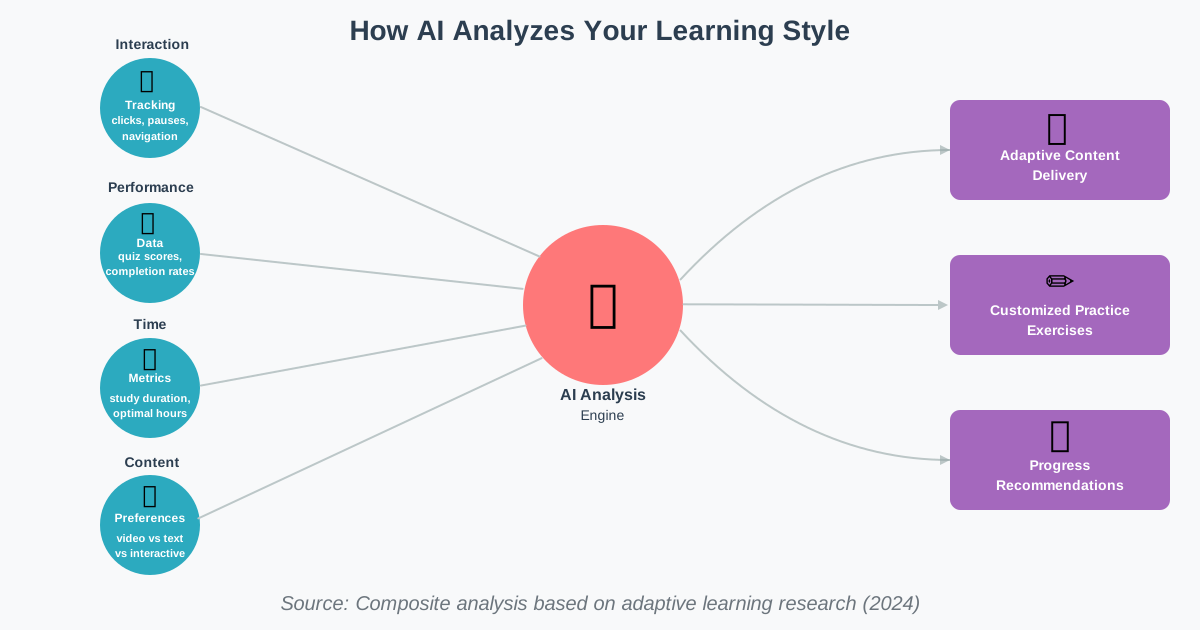
Understanding How AI Identifies Individual Learning Styles for Personalized Education reveals the sophisticated analysis happening behind your screen. AI systems use several methods to identify your unique learning profile, and knowing these processes helps you engage with the technology more effectively and safely.
First, the AI tracks your interaction patterns. When you repeatedly pause videos at complex points, the algorithm notes you might need supplementary explanations. When you complete visual puzzles quickly but struggle with word problems, it identifies a preference for spatial reasoning over linguistic processing.
Second, these systems analyze your performance data over time. A single quiz result doesn’t define you, but patterns across weeks or months reveal meaningful trends. The AI distinguishes between topics you’ve truly mastered and areas where you might have gotten lucky with correct guesses.
Third, advanced systems incorporate psychometric assessments—carefully designed questions that reveal cognitive preferences without feeling like traditional tests. These assessments might present the same information in multiple formats and observe which version leads to better retention.
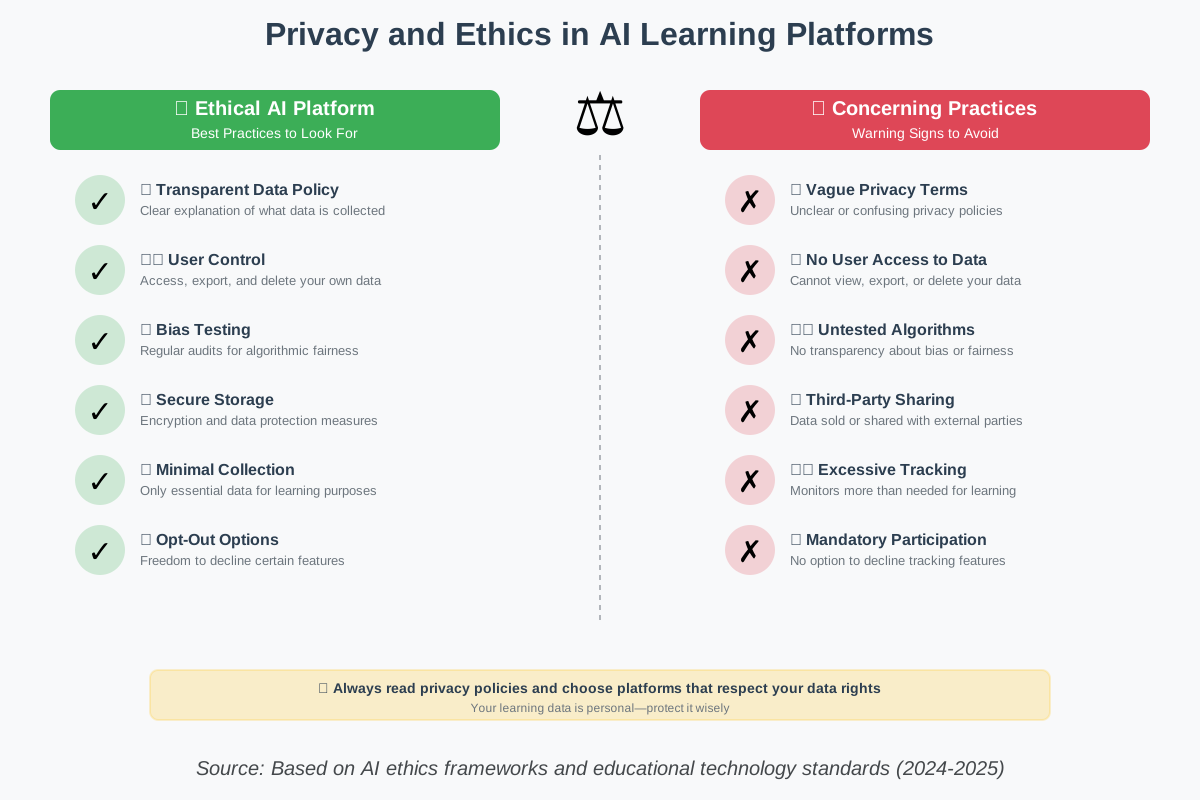
From an ethical standpoint, this data collection requires transparency. Reputable platforms clearly explain what data they collect and how they use it. We always recommend reading privacy policies and choosing platforms that allow you to review and control your data. Your learning journey is personal, and you deserve to know who has access to information about it.
The Role of AI in Adaptive Testing and Personalized Assessment
The Role of AI in Adaptive Testing and Personalized Assessment represents one of the most practical applications of this technology. Traditional tests give everyone the same questions regardless of their skill level, which can feel either too easy or impossibly hard. Adaptive testing changes this completely.
Here’s how it works in practice: You start with a medium-difficulty question. Answer it correctly, and the next question becomes slightly harder. Miss it, and the system presents something more foundational. This continues throughout the assessment, with the AI constantly calibrating to find your true skill level.
The benefits are significant. Tests become shorter because the AI needs fewer questions to accurately gauge your knowledge. They’re less stressful because you’re not wasting time on material that’s way above or below your level. Most importantly, the results provide detailed insights about specific strengths and weaknesses rather than just a single score.
We’ve seen this technology help students prepare for standardized tests more effectively. Instead of practicing hundreds of questions randomly, adaptive platforms focus your energy on areas where you actually need improvement. This targeted approach saves time and reduces the overwhelming feeling that often comes with test preparation.
However, a word of caution from the ethics perspective: Adaptive systems make assumptions based on your early responses. If you’re having an off day or the first few questions don’t align with what you know, the test might underestimate your abilities. Good platforms offer reset options and allow multiple attempts to ensure accurate assessment.
Personalized Learning Paths: Creating Individualized Education with AI
When we discuss Personalized Learning Paths: Creating Individualized Education with AI, we’re talking about the technology’s ability to map out your unique educational journey. Imagine standing at the base of a mountain with multiple trails to the summit—some steep and direct, others winding and scenic. Your personalized learning path is the route that matches your hiking experience, fitness level, and preferences.
AI creates these paths by analyzing several factors: your current knowledge level, your learning goals, your available time, and your preferred learning methods. The system then sequences content in a logical order that builds understanding step by step, ensuring you have the foundation needed before tackling advanced concepts.
For example, if you’re learning a new language, a traditional course might follow a textbook order: greetings, numbers, basic grammar, more grammar, and reading passages. Your personalized path might start with conversational phrases if you’re planning a trip soon, incorporate music and videos because you’re an auditory learner, and delay complex grammar until you’ve built confidence through practice.
What makes this powerful is the AI’s ability to adjust the path as you progress. Struggled with a concept? The system adds review activities and approaches the topic from different angles. Mastered something quickly? It accelerates you past redundant practice toward new challenges.
From a student perspective, this feels incredibly motivating. Instead of feeling stuck in a predetermined curriculum that doesn’t match your pace, you see continuous progress on a journey designed for you. From a safety perspective, we recommend checking that your learning platform allows you to view and adjust your path—you should never feel locked into the AI’s decisions without human oversight or the ability to request changes.
AI-Powered Tutoring Systems: A Personalized Learning Revolution
The emergence of AI-Powered Tutoring Systems: A Personalized Learning Revolution has democratized access to one-on-one educational support that was once available only to privileged students who could afford human tutors. These intelligent systems provide immediate feedback, patient explanations, and unlimited practice opportunities.
Modern AI tutors do more than just present information—they engage in dialogue, ask probing questions, and adapt their teaching style based on your responses. If you’re learning algebra and make a mistake, the AI tutor doesn’t just mark it wrong. Instead, it analyzes where your thinking went off track and provides targeted guidance to correct that specific misunderstanding.
We’ve observed how these systems help reduce the anxiety many students feel about asking “dumb questions.” An AI tutor never judges, never gets impatient, and is available at 2 AM when inspiration strikes or confusion sets in. This psychological safety encourages deeper learning and more risk-taking in the learning process.
However, AI tutors have limitations. They can’t pick up on frustration in your voice, notice when you’re genuinely confused versus just tired, or provide the emotional encouragement that human teachers offer. The revolution isn’t about replacing human educators—it’s about supplementing them. Think of AI tutors as tireless teaching assistants that handle repetitive practice and basic explanations, freeing human teachers to focus on mentorship, creativity, and complex discussions.
Safety tip: When using AI tutoring systems, verify information from multiple sources, especially for critical subjects. AI can occasionally provide incorrect information confidently, so cross-checking with textbooks, teachers, or reputable educational resources remains important.
The Ethics of AI in Personalized Learning: Addressing Bias and Privacy Concerns
This topic is close to our hearts, especially from Nadia’s work in AI ethics. The Ethics of AI in Personalized Learning: Addressing Bias and Privacy Concerns represents crucial conversations we need to have as this technology becomes more prevalent in education.
First, let’s address algorithmic bias. AI systems learn patterns from data, and if that data reflects historical inequities or stereotypes, the AI can perpetuate them. For instance, an AI trained primarily on data from well-resourced schools might struggle to effectively serve students from different educational backgrounds. Some systems have been found to make different content recommendations based on factors like student names or zip codes—proxies for race or socioeconomic status.
Responsible developers work actively to identify and mitigate these biases, but as users, we need awareness too. If an AI system seems to consistently underestimate your abilities or steers you away from challenging content, question whether bias might be at play. Advocate for yourself and seek human review of AI recommendations that feel limiting.
Privacy concerns are equally significant. Personalized learning requires collecting detailed information about your thinking processes, mistakes, and progress. This data is incredibly intimate—it reveals not just what you know, but how you think and learn. Several important questions arise: Who owns this data? How long is it stored? Who can access it? Could it affect your future educational or employment opportunities?
Our recommendations for protecting your privacy while using AI learning platforms:
- Read privacy policies before creating accounts, focusing on data collection, storage, and sharing practices
- Choose platforms that offer data export and deletion options
- Understand what data is collected—some systems even track keystroke patterns and facial expressions
- Ask whether AI analysis is done locally on your device or sent to cloud servers
- Be cautious about connecting educational platforms to other accounts or services
- For parents and teachers: Understand that children’s learning data requires extra protection under laws like COPPA
The best educational AI respects your privacy while still providing personalization. It collects only necessary data, stores it securely, gives you control over your information, and uses it solely to improve your learning experience.
AI-Driven Content Recommendation for Personalized Learning
AI-Driven Content Recommendation for Personalized Learning works similarly to how streaming services suggest movies you might enjoy, but with significantly higher stakes. Instead of entertainment, we’re talking about shaping your education and knowledge base.
These recommendation systems analyze your learning history, performance data, stated interests, and even content that similar learners found valuable. The AI then suggests articles, videos, practice exercises, or courses that align with your needs and goals. Done well, this saves enormous amounts of time that would otherwise be spent searching for appropriate materials.
In our experience, good recommendation systems feel almost magical—they surface resources you didn’t know existed but that perfectly address your current learning challenge. For instance, if you’re studying environmental science and showing strong interest in ocean ecosystems, the AI might recommend a documentary on coral reef restoration, a virtual lab exploring pH levels in marine environments, or a citizen science project tracking local water quality.
However, recommendation algorithms can also create “filter bubbles” that limit your exposure to diverse perspectives and topics. If the AI only suggests content similar to what you’ve already studied, you might miss opportunities to explore adjacent fields or challenge your assumptions.
Our advice for using AI recommendations effectively:
- Treat suggestions as starting points, not complete learning paths
- Deliberately seek out content outside your comfort zone
- Manually search for alternative viewpoints and approaches
- Combine AI recommendations with guidance from teachers, mentors, or librarians
- Pay attention to the sources of recommended content—prioritize reputable, authoritative materials
Remember that AI doesn’t know your long-term goals or values unless you explicitly tell it. The system optimizes for engagement and perceived learning progress, which doesn’t always align with deep understanding or intellectual growth.
The Future of Education: AI and Personalized Learning in the Classroom
When we envision The Future of Education: AI and Personalized Learning in the Classroom, we see a hybrid model that combines the best of human teaching with AI capabilities. This isn’t a distant fantasy—it’s emerging in schools and universities right now.
In future classrooms, teachers act as learning designers and mentors rather than primary information deliverers. AI handles routine tasks: delivering customized content, providing immediate feedback on practice exercises, tracking individual progress, and alerting teachers when students need additional support. This frees educators to focus on what humans do best—building relationships, facilitating discussions, nurturing creativity, and providing emotional support.
Students might start each day with an AI-generated learning agenda based on their progress and goals. Some might watch video lessons while others work on hands-on projects, all in the same physical or virtual space. The teacher circulates, having meaningful conversations with individuals and small groups, knowing the AI is ensuring everyone receives appropriate challenge and support.
This future also includes AI-powered tools that make education more accessible. Real-time translation helps non-native speakers follow along. Speech-to-text assists students with dyslexia or motor difficulties. Visual descriptions support blind learners. Adjustable pacing accommodates different processing speeds.
From an ethical perspective, we must ensure this future remains equitable. Will all schools have access to these technologies, or will AI-powered personalized learning widen the gap between privileged and under-resourced communities? How do we train teachers to effectively partner with AI tools? What happens to students who thrive with traditional instruction and struggle with technology-mediated learning?
These questions require ongoing dialogue among educators, technologists, policymakers, families, and students. The future isn’t predetermined—we shape it through the choices we make today about how to develop and implement these tools.
Personalized Learning Analytics: Using AI to Track Student Progress and Identify Areas for Improvement
Personalized Learning Analytics: Using AI to Track Student Progress and Identify Areas for Improvement transforms vague notions of “doing well” or “struggling” into specific, actionable insights. Modern analytics dashboards show not just grades but detailed patterns in learning behavior and progress.
These systems track metrics like time spent on different topics, accuracy rates across question types, improvement velocity, and even signs of frustration or disengagement. The AI identifies subtle patterns that might escape human observation—for example, noticing that a student consistently makes errors late in study sessions, suggesting fatigue rather than lack of understanding.
For students, this visibility can be incredibly motivating. Instead of waiting weeks for a test to reveal knowledge gaps, you receive continuous feedback that helps you adjust your approach. You can see concrete evidence of progress, which builds confidence and persistence.
Teachers benefit by receiving early warnings when students fall behind or disengage. Rather than discovering problems during midterm exams, they get real-time alerts that enable timely intervention. Analytics can also reveal when entire classes struggle with particular concepts, suggesting the need for instructional adjustments.
However, constant measurement can become oppressive. Some students feel uncomfortable knowing every click and pause is being tracked. The pressure to optimize every metric can undermine the joy of learning and discourage productive struggling—that valuable time spent wrestling with difficult concepts that eventually leads to breakthrough understanding.
From both a student and ethical perspective, we advocate for balanced analytics implementation:
- Focus on growth and improvement rather than absolute performance
- Include qualitative measures like curiosity, creativity, and collaboration—not just completion rates and test scores
- Give students agency to turn off certain tracking features
- Use analytics to support learning, never to punish or embarrass
- Remember that not everything valuable in education can be measured by algorithms
Learning is messy, nonlinear, and deeply personal. Analytics should illuminate your journey without dictating it.
AI for Personalized Language Learning: Enhancing Fluency and Comprehension
AI for Personalized Language Learning: Enhancing Fluency and Comprehension represents one of the most mature and effective applications of educational AI. Language learning apps have pioneered personalized approaches that adapt to your vocabulary level, grammar understanding, and communicative goals.
These systems assess your current proficiency and create lesson sequences that introduce new vocabulary and grammar structures at an optimal pace—challenging enough to promote growth but not so difficult that you become discouraged. They track which words you struggle to remember and schedule targeted review sessions using spaced repetition algorithms that optimize memory retention.
More advanced platforms incorporate speech recognition to evaluate your pronunciation and conversational AI for practice dialogues. Imagine practicing job interview scenarios in Spanish or ordering food in Mandarin, receiving immediate feedback on grammar and pronunciation, without the intimidation of speaking to a native speaker before you’re ready.
The personalization extends to content themes. If you’re learning German for a business trip, the AI prioritizes professional vocabulary and formal expressions. If you’re learning Korean because you love K-dramas, it emphasizes conversational phrases and cultural context. This relevance dramatically increases motivation and practical applicability.
From our perspective as both learners and advocates for safe AI use, language learning platforms generally handle data more ethically than many other educational technologies. However, voice data requires special consideration—it’s biometric information that could potentially identify you. Ensure your chosen platform encrypts voice recordings and clearly states retention policies.
Tips for maximizing AI language learning while staying safe:
- Practice regularly but in short sessions—consistency beats marathon study sessions
- Use AI for foundations and pattern recognition, then seek human conversation partners for authentic practice
- Don’t rely solely on apps—supplement with cultural immersion through media, literature, and native speaker interactions
- Understand that AI excels at vocabulary and grammar but may struggle with idioms, regional variations, and cultural nuance
- Protect your voice data by using platforms with strong privacy policies and avoiding sharing recordings outside secure environments
Personalized STEM Education with AI: Engaging Students in Science, Technology, Engineering, and Math
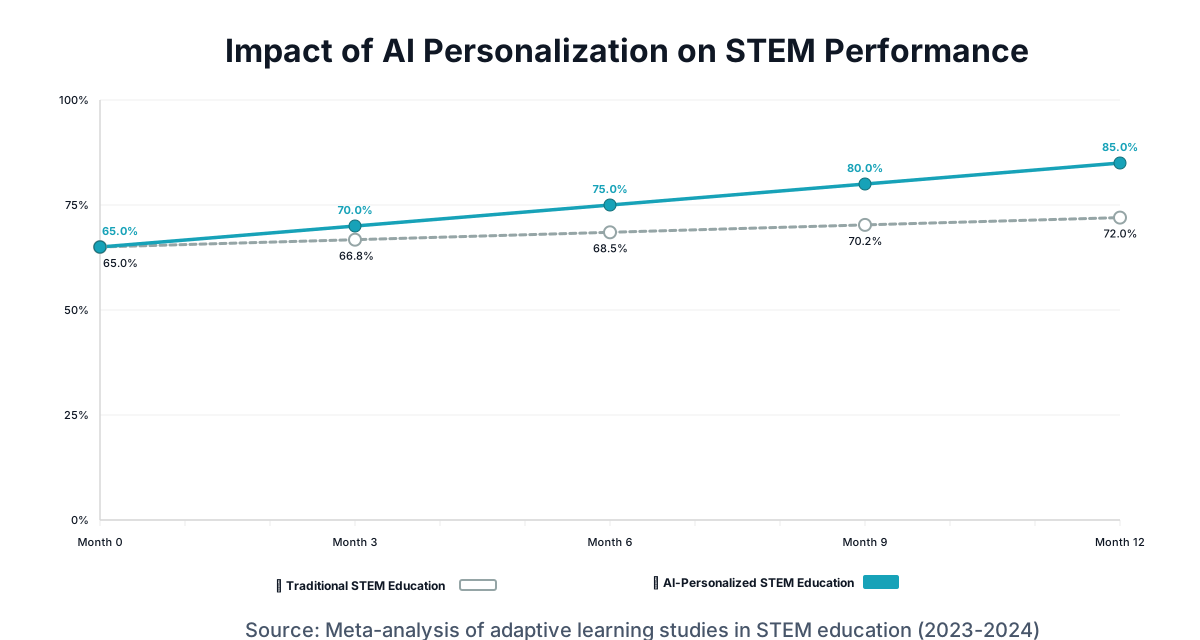
Personalized STEM Education with AI: Engaging Students in Science, Technology, Engineering, and Math addresses a critical educational challenge—making abstract scientific concepts concrete and engaging for diverse learners. STEM subjects often intimidate students because they seem to require innate talent rather than learnable skills. AI-powered personalization helps break down this barrier.
In mathematics, AI systems identify whether a student struggles with conceptual understanding or procedural execution. Someone might understand fractions conceptually but make arithmetic errors, while another might calculate perfectly but miss the underlying meaning. The AI provides targeted support addressing the actual problem rather than forcing everyone through identical remediation.
Science platforms use AI to create virtual laboratories where students experiment safely with concepts too dangerous, expensive, or time-consuming for physical classrooms. Want to see what happens when you adjust variables in a chemical reaction or observe star formations across millions of years? AI simulations make this possible, with personalized guidance that adapts to your experimentation approach.
Engineering and technology education benefits from AI-powered coding tutors that provide instant feedback on programming challenges. Instead of waiting for a teacher to review your code, the AI identifies bugs, suggests optimizations, and explains why certain approaches work better than others. This immediate feedback loop accelerates learning and reduces the frustration that drives many beginners away from programming.
What excites us most about AI in STEM education is its potential to engage students who previously felt excluded from these fields. Personalized pacing means students aren’t left behind when topics move too quickly, and adaptive challenge prevents boredom for fast learners. Visual, interactive representations help those who struggle with abstract symbolic thinking. Real-time translation and accessibility features support linguistically and physically diverse learners.
However, a caution from the ethical perspective: Over-reliance on simulations and virtual environments shouldn’t replace hands-on experimentation and physical manipulation of materials. The messy, unpredictable nature of real-world science teaches valuable lessons about troubleshooting, uncertainty, and the gap between theory and practice. Balance AI tools with tangible experiences.
AI-Powered Personalized Learning for Students with Disabilities
AI-Powered Personalized Learning for Students with Disabilities represents some of the most transformative applications of this technology. Educational AI can provide accommodations and support that were previously impossible or required significant human resources.
For students with dyslexia, AI-powered text-to-speech tools read content aloud with natural-sounding voices, adjustable speeds, and synchronized highlighting that helps track along. Specialized fonts and spacing can be automatically applied. The AI can even rephrase complex sentences into simpler structures while preserving meaning.
Students with ADHD benefit from AI that breaks lengthy lessons into manageable chunks, provides frequent breaks and variety in activity types, and uses gamification elements to maintain engagement without overwhelming. The system learns optimal session lengths for each individual and suggests study times when focus typically peaks.
For learners with physical disabilities limiting their ability to type or write, voice-to-text technology enables full participation in written assignments and tests. AI can even learn to recognize individual speech patterns, improving accuracy for those whose speech differs from standard patterns.
Students on the autism spectrum often appreciate the predictability and patience of AI tutors, which never show frustration or judgment and maintain consistent communication styles. Visual schedules, clear expectations, and structured routines can be personalized to individual comfort levels.
Blind and visually impaired students access education through screen readers enhanced by AI that provides detailed descriptions of images, diagrams, and mathematical equations. Some systems even generate tactile graphics or 3D-printed models of visual concepts.
What moves us most about these applications is how they shift the focus from student deficits to environmental barriers. The question becomes not “What’s wrong with the student?” but “How can we adapt the learning environment to be accessible?” AI makes this adaptation scalable and individualized in ways that were previously impossible.
However, important ethical considerations remain. Assistive technologies shouldn’t isolate students with disabilities or reduce human interaction. Social learning, peer collaboration, and teacher relationships remain crucial. Additionally, AI systems must be tested with diverse users to ensure they actually serve the needs of disabled students rather than making assumptions about what would be helpful.
Families and educators should:
- Involve students with disabilities in selecting and customizing their AI tools
- Ensure assistive AI integrates with rather than replaces human support
- Advocate for universal design principles that build accessibility into all educational technology from the beginning
- Protect the privacy of health and disability information collected by these systems
- Remember that disability communities are diverse—personalization means tools adapt to individuals, not categories
The Benefits of Personalized Learning: How AI Improves Student Outcomes
When examining The Benefits of Personalized Learning: How AI Improves Student Outcomes, research evidence increasingly supports significant advantages across various measures. Let’s explore these benefits with both enthusiasm and a critical perspective.
Academic performance improvements show up consistently across studies. Students using AI-powered personalized platforms demonstrate higher test scores, faster skill acquisition, and better long-term retention compared to traditional instruction alone. The effect is particularly pronounced for students who previously struggled—personalization helps them fill foundational gaps that were holding them back.
Engagement and motivation increase because the learning experience feels relevant and appropriately challenging. When content matches your current level and interests, you’re more likely to persist through difficulties rather than giving up in frustration or boredom. The immediate feedback loop helps you see progress, which fuels continued effort.
Time efficiency represents another major benefit. Instead of sitting through explanations of concepts you already understand or skipping foundations you actually need, personalized learning optimizes how you spend study time. Students often master material in 30-40% less time compared to traditional paced instruction.
Confidence building happens as students experience consistent success at their appropriate challenge level. Repeated failure damages self-concept and leads many to conclude they “just aren’t good at” certain subjects. Personalized learning that meets students where they are helps break this cycle.
Equity potential exists—when implemented thoughtfully, AI can help level the playing field by providing high-quality, adaptive instruction to students regardless of their school’s resources or their ability to afford private tutoring. However, this potential only materializes if access to technology and quality platforms is distributed equitably.
From our perspective, we must temper enthusiasm with realism. Benefits depend heavily on implementation quality. A poorly designed AI learning platform with biased algorithms and inadequate content helps no one. Additionally, focusing solely on measurable outcomes like test scores risks overlooking important but harder-to-quantify aspects of education—creativity, critical thinking, collaboration, and character development.
We’ve also observed potential downsides. Some students become overly dependent on AI guidance and struggle when faced with unstructured learning situations. Others experience increased anxiety from constant performance monitoring. The absence of productive struggle—wrestling with difficult concepts without immediate answers—may impede development of resilience and problem-solving skills.
The true benefits emerge when personalized AI enhances rather than replaces comprehensive education that includes human relationships, creative exploration, social learning, and development of non-cognitive skills.
Personalized Learning Platforms: Choosing the Right AI-Powered Solution
Navigating Personalized Learning Platforms: Choosing the Right AI-Powered Solution can feel overwhelming given the rapid proliferation of options. Whether you’re a student, parent, or educator, making informed choices requires understanding what to look for and what questions to ask.
Consider these key factors when evaluating platforms:
Pedagogical Approach: How does the platform teach? Does it align with sound educational principles or just gamify repetitive drills? Look for evidence of research-based instructional methods and involvement of educators in platform design.
Personalization Depth: How sophisticated is the adaptation? Does it simply adjust difficulty, or does it truly personalize learning paths, content formats, and instructional approaches based on comprehensive learner profiles?
Content Quality: Who created the educational content? Look for platforms developed in partnership with subject matter experts and qualified educators. Check whether content aligns with recognized standards if you’re supplementing school curriculum.
Privacy and Data Practices: This cannot be emphasized enough. Does the platform clearly explain data collection and use? Can you access, export, or delete your data? Who owns the data? Is it shared with third parties? Does it comply with relevant privacy laws?
Accessibility Features: Can the platform accommodate diverse learners? Look for text-to-speech, adjustable display options, keyboard navigation, and compatibility with assistive technologies.
Progress Transparency: Can you see detailed information about learning progress, not just scores? Do you understand how the AI makes recommendations? Can you override or adjust the AI’s decisions?
Teacher/Parent Involvement: Does the platform facilitate rather than replace human guidance? Look for features that enable collaboration between AI, learners, and human educators.
Technical Requirements: What devices and internet connectivity does the platform require? Consider whether it works offline for students with limited connectivity.
Cost and Value: Free platforms may monetize through advertising or data collection. Paid platforms should clearly justify their cost with superior features or content. Be wary of aggressive upselling or manipulative pricing tactics.
Our recommendation process:
- Start with free trials to test usability and pedagogical fit before committing
- Read reviews from actual users, particularly those with similar needs
- Ask for evidence of effectiveness—reputable platforms should provide research data
- Test customer support responsiveness and helpfulness
- For school or institutional adoption, involve multiple stakeholders including students in the selection process
Remember that the best platform for someone else may not suit you. Learning preferences, goals, and comfort with technology vary widely. Trust your experience—if a platform feels confusing, stressful, or ineffective, keep looking regardless of its reputation.
AI and Personalized Learning: Bridging the Achievement Gap
The potential for AI and Personalized Learning: Bridging the Achievement Gap generates both hope and concern among educators and equity advocates. This technology could help address educational inequities—or it could widen them. The outcome depends on intentional choices about access, design, and implementation.
Achievement gaps exist along lines of race, socioeconomic status, language background, and geographic location. These gaps reflect not innate ability differences but rather disparities in resources, opportunities, and support systems. High-quality personalized learning could help by:
Providing consistent access to excellent instruction regardless of school funding or teacher availability. Students in under-resourced schools often face larger class sizes, less experienced teachers, and fewer advanced course offerings. AI platforms can partially compensate by delivering adaptive, high-quality instruction to any student with internet access.
Identifying and addressing specific learning gaps early before they compound. Students who fall behind in foundational skills face increasing difficulty as education builds on assumed prior knowledge. Personalized systems detect gaps quickly and provide targeted remediation.
Removing some implicit biases that affect human interactions. Research shows that teacher expectations sometimes vary based on student demographics, influencing opportunities and support provided. AI systems, when properly designed, apply consistent standards regardless of student background.
Enabling students to learn at their own pace without the stigma of being “behind.” In traditional classrooms, students working below grade level may feel embarrassed or labeled. Personalized platforms allow quiet progress without public comparison.
However, serious risks exist. The digital divide means many students lack reliable internet access, appropriate devices, or technical support at home. If schools increasingly rely on AI platforms, these students face new barriers to educational access.
Data bias in AI systems can perpetuate or amplify existing inequities. Algorithms trained primarily on data from affluent students may not serve diverse learners effectively. Biased systems might steer underestimated students toward less challenging content, creating self-fulfilling prophecies of underachievement.
Overemphasis on standardized metrics might narrow curriculum in under-resourced schools to teachable, testable content, while wealthy schools continue offering rich, varied educational experiences that include arts, creativity, and critical thinking.
From our perspective, bridging the achievement gap requires:
- Universal access to technology and high-speed internet as educational infrastructure
- Inclusive design processes that center the voices of marginalized communities
- Transparent testing for bias in algorithms with public accountability
- Investment in teacher training so educators can effectively integrate AI tools
- Maintenance of comprehensive education that includes social-emotional learning, creativity, and critical consciousness
- Recognition that technology is a tool, not a solution—addressing achievement gaps ultimately requires confronting systemic inequities in funding, housing, healthcare, and opportunity
We must remain vigilant that AI-powered personalized learning serves to dismantle rather than reinforce educational inequities.
Personalized Learning in Corporate Training: Using AI to Enhance Employee Skills
Personalized Learning in Corporate Training: Using AI to Enhance Employee Skills extends beyond traditional education into professional development. Companies increasingly adopt AI-powered platforms to onboard new employees, upskill existing staff, and prepare workers for evolving job requirements.
Corporate learning faces unique challenges. Employees have limited time for training amid work responsibilities. Their existing knowledge and experience vary dramatically. Training must deliver practical, immediately applicable skills rather than theoretical knowledge. Personalized AI addresses each of these challenges effectively.
Modern corporate learning platforms assess employees’ current skills through short diagnostic evaluations, then create customized training paths that build on existing knowledge while addressing specific gaps. Someone with strong technical skills but limited management experience receives different content than a seasoned manager learning new software.
These systems deliver training in bite-sized modules that fit into busy schedules—a 10-minute video during lunch, an interactive exercise between meetings, or a quick knowledge check at day’s end. The AI tracks completion and understanding, adjusting pace and content based on how quickly individuals demonstrate mastery.
AI tutors provide immediate answers to workplace questions, functioning as on-demand expert assistance. Need to remember how to generate a specific type of report? The AI walks you through it step-by-step, with the process documented for future reference.
From an employee perspective, personalized corporate learning feels more respectful of your time and existing expertise compared to sitting through generic training sessions covering material you already know. You see clear connections between learning activities and job performance.
From an employer perspective, benefits include reduced training costs, faster time-to-productivity for new hires, and data insights about skill gaps across the organization. However, ethical concerns arise around surveillance and data use. Detailed tracking of employee learning can feel invasive, and performance data might influence promotion or termination decisions in opaque ways.
Our guidance for employees:
- Understand what learning data your employer collects and how it’s used
- Ask whether training performance affects evaluations or advancement
- Advocate for learning opportunities focused on growth rather than deficit remediation
- Seek clarity on whether training time counts as work hours
- Request human mentorship alongside AI tools
Our guidance for employers:
- Be transparent about data collection and use
- Focus metrics on skill development rather than surveillance
- Ensure training access doesn’t disadvantage employees with caregiving responsibilities or limited personal internet access
- Combine AI platforms with human coaching and mentorship
- Recognize that meaningful skill development requires time and shouldn’t be squeezed into unpaid personal time
AI-Driven Feedback Systems for Personalized Learning
AI-Driven Feedback Systems for Personalized Learning transform one of education’s most resource-intensive and impactful elements—formative feedback that helps learners improve. Traditional education struggles to provide timely, detailed feedback to every student on every assignment. AI systems can offer immediate, personalized responses to student work at scale.
These systems analyze written essays for argument structure, evidence quality, and writing mechanics, providing specific suggestions for improvement. They evaluate problem-solving processes in mathematics, identifying not just wrong answers but the step where reasoning went astray. They assess programming code for bugs, inefficiencies, and style, explaining why certain approaches work better than others.
Advanced feedback systems go beyond marking correct or incorrect—they ask probing questions that guide students to discover errors themselves. “You concluded X, but look again at the data in paragraph two. What do you notice?” This Socratic approach develops metacognitive skills and independent learning.
The immediacy of AI feedback creates tight learning loops. Submit an essay draft, receive detailed suggestions within seconds, revise and resubmit, and repeat. This rapid iteration accelerates improvement and allows experimentation. Students can try different approaches without waiting days for teacher review.
However, AI feedback has important limitations we need to acknowledge. Current systems struggle with nuanced, creative, or ambiguous work. They excel at evaluating whether a mathematical process follows correct steps but falter when assessing the originality of a creative writing piece or the validity of a philosophical argument.
AI feedback can also be demotivating when delivered insensitively. Receiving a list of twenty errors feels overwhelming and discouraging, even if technically accurate. Good feedback systems prioritize issues, offer encouragement, and highlight strengths alongside areas for improvement.
From a learning perspective, we recommend:
- Use AI feedback for low-stakes practice and early drafts, but seek human feedback for final or high-stakes work
- Don’t accept AI feedback uncritically—discuss suggestions with teachers or peers when confused
- Focus on patterns in feedback rather than individual comments—if the AI repeatedly notes an issue, that’s a skill to develop
- Remember that some of the most valuable learning comes from explaining your thinking to humans who ask “why?” in ways AI cannot
- Balance efficiency with depth—sometimes struggling with a problem before receiving feedback builds more understanding than immediate correction
AI-driven feedback systems work best as supplements to rather than replacements for human coaching and mentorship.
Personalized Learning Resources: AI Tools and Technologies for Educators
For teachers exploring Personalized Learning Resources: AI Tools and Technologies for Educators, the landscape includes both purpose-built educational platforms and general AI tools adaptable for teaching. Understanding what’s available helps educators make informed choices about technology integration.
Intelligent Tutoring Systems like Carnegie Learning, ALEKS, and DreamBox provide subject-specific personalized instruction with detailed teacher dashboards showing student progress and areas needing intervention.
Adaptive Assessment Platforms such as i-Ready and MAP Growth continuously evaluate student knowledge and automatically adjust test difficulty, providing precise measurements of academic growth.
AI Writing Assistants like Grammarly and tools built into learning management systems offer real-time feedback on student writing, though with varying levels of sophistication.
Content Creation Tools use AI to help teachers develop customized materials. Platforms can generate practice problems at specific difficulty levels, create reading passages matched to student interests and reading levels, or produce differentiated versions of lessons.
Translation and Accessibility Tools enable multilingual classrooms and support diverse learners. Real-time translation, text-to-speech, and automatic captioning break down language barriers.
Classroom Management AI helps teachers identify students who might be struggling, disengaged, or in need of additional challenge based on patterns in work submission, quiz performance, and platform interactions.
General AI Assistants like ChatGPT, Claude, and others can be adapted for educational purposes—generating lesson ideas, creating rubrics, explaining concepts in different ways, or suggesting discussion questions.
Implementing these tools effectively requires more than just adoption—it demands thoughtful integration that enhances rather than complicates teaching. Our recommendations for educators:
Start Small: Don’t attempt to revolutionize your entire practice at once. Choose one tool addressing a specific challenge you face—perhaps providing faster feedback on writing or offering struggling students extra practice.
Maintain Pedagogical Control: AI tools should serve your educational goals, not dictate them. You remain the expert on what your students need.
Build Your Skills: Invest time learning chosen tools thoroughly. Most platforms offer free professional development resources.
Involve Students: Teach students how to use AI tools effectively and ethically. Digital literacy includes understanding AI capabilities and limitations.
Protect Student Privacy: Carefully vet tools for data practices before use. Some free platforms fund themselves through data collection or advertising.
Combine AI with Human Teaching: Technology works best when it handles routine tasks, freeing you for the irreplaceable human elements—building relationships, facilitating discussions, nurturing curiosity, and providing emotional support.
Evaluate Impact: Regularly assess whether tools are genuinely helping students learn. Student performance data and student voice should guide decisions about continued use.
Create Community: Connect with other educators using similar tools. Sharing experiences, strategies, and challenges accelerates everyone’s learning curve.
The most successful educational technology implementations we’ve observed share a common characteristic—they’re led by teachers who view technology as a means to amplify good teaching rather than as a substitute for it.
The Challenges of Implementing AI-Powered Personalized Learning
Honestly addressing The Challenges of Implementing AI-Powered Personalized Learning helps set realistic expectations and prepares us to navigate obstacles effectively. Despite enormous potential, significant barriers exist at individual, institutional, and systemic levels.
Technical Infrastructure: Many schools and homes lack reliable high-speed internet, adequate devices, or technical support necessary for sophisticated AI platforms. Even in well-resourced settings, integration with existing learning management systems, gradebooks, and administrative software often proves difficult.
Cost: Quality personalized learning platforms require significant investment for licenses, hardware, and training. Schools serving low-income communities often cannot afford premium options, potentially widening rather than narrowing achievement gaps.
Teacher Preparation: Most educators received no training in AI tools or personalized learning approaches during their preparation programs. Professional development takes time and resources that schools often lack. Some teachers resist technology adoption due to concerns about being replaced or simply feeling overwhelmed by constant change.
Curriculum Alignment: Standardized curricula and mandated pacing guides often conflict with true personalization. Teachers face pressure to cover specific content by specific dates, limiting their ability to let students progress at individual paces.
Assessment Disconnects: If personalized learning helps students master material in non-traditional sequences but standardized tests assume everyone learned the same content in the same order, assessment results may not accurately reflect student knowledge.
Data Privacy Concerns: Parents and advocacy groups increasingly question educational data collection practices. Districts face legal and ethical obligations to protect student information while balancing desires to use data-driven tools.
Equity Issues: Beyond access, questions arise about whether AI systems serve diverse learners equally well or perpetuate biases. Limited representation of marginalized communities in technology development means their needs may be overlooked.
Social-Emotional Considerations: Some students feel isolated or stressed by technology-heavy learning. Human connection, peer collaboration, and face-to-face interaction remain crucial for holistic development. Finding the right balance is delicate.
Content Limitations: AI excels at certain subjects and skills (mathematics, language learning, factual knowledge) but struggles with others (creative writing, artistic expression, philosophical reasoning). Overreliance on what’s easily automated could narrow educational focus.
Change Management: Implementing personalized learning represents fundamental change in classroom practice, requiring shifts in schedules, physical space organization, assessment approaches, and pedagogical mindsets. Change is hard, even when the destination is valuable.
From our perspective, acknowledging these challenges isn’t pessimistic—it’s realistic and necessary for successful implementation. We recommend:
- Pilot Programs: Start small with willing teachers and evaluate thoroughly before expanding
- Inclusive Design: Center voices of students, families, and educators most affected by implementation decisions
- Phased Investment: Build sustainable funding models rather than relying on temporary grants
- Comprehensive Training: Support teachers with ongoing professional development, not just initial training
- Flexible Frameworks: Allow adaptation to local contexts rather than imposing one-size-fits-all approaches
- Continuous Evaluation: Regularly assess impact on student learning, wellbeing, and equity
- Balanced Implementation: Maintain focus on comprehensive education, including social-emotional learning, creativity, and critical thinking
Technology is powerful but not magical. Successful implementation requires sustained commitment, adequate resources, and genuine attention to human elements of education.
AI-Personalized Early Childhood Education: Fostering a Love of Learning
When we consider AI-Personalized Early Childhood Education: Fostering a Love of Learning, we must proceed with particular care. Young children are in critical developmental stages where screen time, play-based learning, and social-emotional growth require thoughtful balance.
Early childhood education traditionally emphasizes hands-on exploration, imaginative play, social interaction, and physical activity—all crucial for developing brains and bodies. AI tools must enhance rather than replace these foundational experiences.
Appropriate applications include:
Adaptive Literacy Programs: Apps that adjust phonics lessons based on letter recognition and sound blending abilities, using engaging characters and stories to make early reading feel like play rather than work.
Numeracy Games: Interactive activities that teach counting, pattern recognition, and basic math concepts at each child’s pace, with immediate encouragement and adjustment when frustration appears.
Creative Expression Tools: Drawing and music apps that provide scaffolding and suggestions while preserving space for imagination and originality.
Language Development: For multilingual learners or children with speech delays, AI can provide additional practice with pronunciation and vocabulary in low-pressure contexts.
However, serious concerns about early childhood AI use persist. Screen time recommendations for young children remain conservative—the American Academy of Pediatrics suggests limited, high-quality programming with parent co-viewing for children 2-5 years old. Excessive screen use correlates with developmental delays, attention difficulties, and reduced physical activity.
Young children need unstructured play, physical movement, and face-to-face interaction for healthy development. They learn language best through conversation with responsive adults, not through apps. They develop fine motor skills through manipulating physical objects. They build social skills through negotiating playground conflicts and collaborative pretend play.
Additionally, data collection from young children raises heightened ethical concerns. Parents may not fully understand what information is gathered or how it might be used. Early childhood learning data creates records that could follow individuals throughout life.
Our strong recommendations for early childhood AI use:
- Prioritize Human Interaction: Technology should supplement, not replace, interaction with parents, caregivers, and teachers
- Limit Screen Time: Follow pediatric guidelines and prioritize active, hands-on learning
- Co-Engage: Adults should participate in technology activities with children, not use AI as a babysitter
- Quality Content: Choose apps specifically designed for developmental appropriateness by early childhood experts
- Protect Privacy: Understand data collection and avoid platforms with questionable practices
- Balance Activities: Ensure children spend significantly more time in physical play, outdoor exploration, creative activities, and social interaction than using technology
- Observe Impact: Watch for signs that technology use affects attention span, physical activity, or social engagement
The goal is fostering genuine love of learning—curiosity, persistence, creativity, and joy in discovery. These emerge from rich, varied experiences in responsive environments, not from algorithms optimizing skill acquisition. AI tools have a place in early childhood education, but a carefully limited one.
Personalized Learning and Motivation: How AI Keeps Students Engaged
Examining Personalized Learning and Motivation: How AI Keeps Students Engaged reveals both the potential and pitfalls of technology-mediated motivation. Understanding intrinsic versus extrinsic motivation helps us evaluate AI approaches.
Intrinsic motivation comes from internal satisfaction—learning because you find the material interesting, enjoy the challenge, or value the knowledge. Extrinsic motivation relies on external rewards or consequences—learning to earn points, avoid punishment, or please others.
Effective AI systems enhance intrinsic motivation through several mechanisms:
Optimal Challenge: AI maintains engagement by keeping tasks at the edge of your abilities—not so hard you fail repeatedly (frustrating) nor so easy you’re bored, but right in the zone where success requires effort but is achievable.
Autonomy: Good platforms offer choices about learning paths, content themes, and activity types. This agency increases investment in the learning process.
Progress Visibility: Seeing concrete evidence of improvement—skills mastered, levels advanced, knowledge accumulated—provides satisfaction and encourages persistence.
Relevance: Personalization can connect content to individual interests and goals, answering the perpetual student question, “When will I ever use this?”
Immediate Feedback: Knowing instantly whether you’re on the right track maintains engagement and enables quick correction before errors become ingrained.
However, many AI platforms rely heavily on extrinsic motivators that can undermine long-term learning:
Gamification Elements: Points, badges, leaderboards, and streaks make learning feel like a game, which increases short-term engagement but can shift focus from learning to winning. Students might rush through material to accumulate points rather than deeply understanding it.
Variable Rewards: Some platforms use unpredictable rewards (like social media notifications) that trigger addictive engagement patterns. This keeps users returning but doesn’t necessarily increase meaningful learning.
Social Comparison: Leaderboards comparing student progress can motivate some but demoralize others, particularly those who are behind. Public performance metrics increase anxiety for many learners.
Artificial Urgency: Streaks and time-limited challenges create pressure to log in daily, which maintains platform usage but can make learning feel like an obligation rather than a joy.
From an educational perspective, we worry about over-reliance on external motivators. Research consistently shows that once external rewards are removed, intrinsically motivated behavior persists while extrinsically motivated behavior often stops. If students only engage with mathematics when earning digital badges, what happens when badges aren’t available?
Our recommendations for sustainable motivation:
- Choose platforms emphasizing mastery over competition and points
- Set personal learning goals independent of platform metrics
- Reflect on learning content itself rather than just completion statistics
- Take breaks from technology to rediscover intrinsic interest in subjects
- Connect learning to real-world applications that matter to you
- Celebrate understanding rather than just speed or volume of completion
- Maintain curiosity by exploring tangential questions and topics even when they’re not “assigned”
The most engaged learners we’ve encountered use AI tools as resources for pursuing their own questions and goals rather than as games to win. Motivation works best when technology serves your learning agenda rather than when you serve the technology’s engagement agenda.
AI-Powered Personalized Learning for Test Preparation
AI-Powered Personalized Learning for Test Preparation represents a major market for educational technology, with platforms specifically designed to help students prepare for standardized tests like the SAT, ACT, GRE, professional certifications, and more.
These specialized systems excel at test preparation for several reasons:
Diagnostic Precision: Initial assessments identify specific strengths and weaknesses across all test sections and question types. Rather than working through entire test prep books, you focus energy on areas that actually need improvement.
Adaptive Practice: The AI serves questions matched to your current level, gradually increasing difficulty as you improve. This prevents the discouragement of repeatedly failing hard questions before you’re ready and the inefficiency of drilling easy questions you’ve already mastered.
Strategy Instruction: Beyond content knowledge, test success often depends on test-taking strategies—time management, question prioritization, and elimination techniques. Personalized platforms teach these strategies and track which ones you actually use effectively.
Performance Analytics: Detailed data shows not just what you missed but why—calculation errors versus conceptual misunderstanding, careless mistakes versus knowledge gaps, and timing issues versus genuine difficulty.
Efficiency: Instead of the 100+ hours traditional test prep courses require, adaptive systems can achieve similar or better score improvements in 40-60 hours by focusing on personal needs.
From a student perspective, this targeted approach reduces the overwhelming anxiety of test preparation. Instead of drowning in massive prep books, you have a clear, manageable path forward.
However, we have concerns about the test preparation industrial complex, whether AI-powered or not:
Equity Issues: Expensive test prep platforms (often $100-1000+) advantage wealthy students over peers who cannot afford them, potentially widening rather than narrowing socioeconomic achievement gaps.
Narrowed Focus: Optimizing for specific test performance might come at the expense of deep understanding or broader knowledge. You might learn to recognize correct answers on SAT math questions without truly understanding mathematical concepts.
Gaming the System: Test prep can become about learning patterns in test construction rather than mastering actual knowledge or skills the test supposedly measures.
Stress Amplification: While AI makes prep more efficient, the constant performance tracking and optimization pressure can increase anxiety for some students.
From an ethical perspective, we question whether access to powerful test prep AI should depend on family income. Some organizations offer free or reduced-cost options—Khan Academy’s SAT prep, for example—but quality and comprehensiveness vary.
Our guidance for test preparation:
- Use Free Resources First: Explore free options before investing in expensive platforms
- Set Time Boundaries: Test prep should enhance rather than consume your life
- Focus on Learning: Prioritize genuine understanding over gaming test patterns
- Address Test Anxiety: Use AI platforms’ timing features to build comfort with test conditions
- Supplement with Content Learning: Don’t let test prep replace actual coursework and knowledge building
- Advocate for Equity: Support policies that reduce the advantage expensive test prep provides
Ultimately, we hope for a future where educational opportunities depend less on standardized test performance, reducing the pressure on test preparation generally.
Personalized Learning Through Virtual Reality and AI
The convergence of Personalized Learning Through Virtual Reality and AI creates immersive educational experiences impossible in traditional settings. VR technology places you inside learning environments, while AI adapts those environments to your actions and needs.
Imagine studying ancient Rome not by reading about it but by walking through a virtual reconstruction, where an AI guide adjusts explanations based on your questions and interests. Or practicing surgical procedures in a risk-free VR environment where the AI difficulty adapts to your skill level and provides real-time coaching.
Current applications include:
Science Simulations: Explore inside a human cell, manipulate chemical reactions at the molecular level, or observe geological processes across millennia. The AI adapts simulation complexity and provides scaffolding based on your understanding.
Language Learning: Practice conversations in virtual restaurants, airports, or business meetings where AI characters respond to your speech with appropriate reactions and corrective feedback.
Skills Training: Practice welding, equipment operation, or emergency response procedures in safe virtual environments. The AI adjusts scenario difficulty and provides coaching based on your performance.
Historical/Cultural Experiences: Visit reconstructed historical periods or distant cultures, with AI guides personalizing information to your background knowledge and interests.
Accessibility Applications: VR can provide experiences otherwise inaccessible to students with mobility limitations or geographic constraints.
The combination of immersion and personalization creates powerful learning opportunities. You’re not passively receiving information but actively exploring and experimenting, with the AI ensuring experiences match your readiness level.
However, significant limitations exist. VR equipment remains expensive and often uncomfortable for extended use. Motion sickness affects many users. Creating high-quality VR content requires substantial resources. Schools often lack space, equipment, and technical support for VR implementation.
More concerning from an ethical and safety perspective, extended VR use affects developing brains and bodies. Vision problems, physical discomfort, and disorientation are common. Young children shouldn’t use VR at all due to developmental concerns. Privacy issues intensify—VR systems track head movements, hand gestures, gaze direction, and even emotional responses, creating incredibly detailed behavioral data.
Our recommendations for VR learning:
- Age Appropriate: Follow manufacturer guidelines, typically 13+ for most VR systems
- Time Limited: Restrict sessions to 20-30 minutes with breaks
- Physical Safety: Ensure adequate physical space and supervision
- Balance with Reality: VR should supplement, not replace, real-world experiences and human interaction
- Verify Privacy: Understand what data VR systems collect and how it’s used
- Quality Content: Choose educational VR developed by experts, not just commercial games
- Accessibility: Ensure VR options don’t create new barriers for students who cannot use the technology
VR combined with AI creates exciting possibilities but requires careful, limited implementation prioritizing student well-being alongside learning outcomes.
AI-Personalized Learning and the Development of Critical Thinking Skills
A crucial question emerges: Can AI-Personalized Learning and the Development of Critical Thinking Skills work together, or does AI optimization undermine deeper cognitive development? This tension matters enormously for long-term educational outcomes.
Critical thinking involves analyzing information, evaluating evidence, identifying assumptions, considering multiple perspectives, and constructing reasoned arguments. It develops through grappling with complex, ambiguous problems that lack clear solutions.
AI’s strengths—providing correct answers quickly, optimizing learning paths, and breaking complex topics into manageable steps—can actually hinder critical thinking development if implemented poorly. When AI immediately corrects errors, students miss opportunities to struggle productively with confusion. When it breaks everything into bite-sized chunks, students don’t practice synthesizing complex information. When it optimizes for correct answers, students focus on finding “right” responses rather than exploring multiple valid approaches.
However, thoughtfully designed AI can support critical thinking development:
Socratic Dialogue Systems: Instead of providing answers, AI asks probing questions that guide students to reason through problems themselves. “What evidence supports that claim?” “Have you considered alternative explanations?” “What assumptions are you making?”
Argument Analysis Tools: AI can help students identify logical fallacies, evaluate evidence quality, and strengthen reasoning without doing the thinking for them.
Multiple Perspective Exposure: AI can ensure students encounter diverse viewpoints on issues, preventing filter bubbles and encouraging consideration of alternative positions.
Metacognitive Scaffolding: Systems that prompt reflection on learning strategies and thinking processes help students develop awareness of their own cognition.
Open-Ended Problem Support: Rather than providing step-by-step solutions, AI can offer hints and resources while leaving the creative problem-solving work to students.
The key distinction is between AI that does cognitive work for students versus AI that provides scaffolding and resources while students do the thinking. The former is efficient but shallow; the latter is more effortful but develops lasting capabilities.
From our educational perspective, critical thinking development requires:
- Productive Struggle: Time wrestling with difficult concepts without immediate answers
- Ambiguity Tolerance: Experience with problems that have multiple valid solutions or insufficient information
- Error Analysis: Opportunities to learn from mistakes through reflection rather than just correction
- Synthesis Practice: Connecting ideas across domains and building original arguments
- Evaluation Skills: Assessing source credibility and evidence quality independently
We recommend balancing AI use with learning experiences that explicitly develop critical thinking. Use AI for practice and foundation building, but regularly engage with open-ended projects, debates, original research, and complex problems that resist algorithmic solutions.
Remember that education aims not just to transmit knowledge but to develop thinking capabilities. The most sophisticated AI remains a tool—effective or not depending on how we use it.
Personalized Learning and the Role of Teachers in an AI-Driven World
Perhaps the most important discussion concerns Personalized Learning and the Role of Teachers in an AI-Driven World. Despite anxieties about automation, we’re convinced that effective AI integration elevates rather than eliminates teaching roles—but it does transform them.
What AI Can’t Replace:
Human teachers provide elements no algorithm can reproduce. They notice when a student’s unusual quietness signals family stress, not lack of understanding. They inspire through personal passion for subjects. They build relationships that make students feel seen, valued, and believed in. They model adult thinking, curiosity, and ethical reasoning. They create classroom communities where students learn from and support each other. They respond with empathy to emotional struggles. They exercise judgment about when to push students beyond comfort zones and when to provide relief.
How Teaching Roles Evolve:
As AI handles routine instruction and practice, teachers become:
Learning Designers: Curating resources, designing projects, and creating experiences that combine AI tools with human interaction, hands-on activities, and social learning.
Progress Monitors: Using AI-generated analytics to identify students needing intervention, celebrate achievements, and adjust instruction—but interpreting data with human wisdom about context and individual circumstances.
Individual Mentors: With AI providing basic instruction and practice, teachers have more time for one-on-one or small-group work addressing specific needs and interests.
Facilitators: Guiding discussions, mediating peer collaboration, posing thought-provoking questions, and helping students make connections across domains.
Social-Emotional Supporters: Helping students navigate academic stress, build resilience, develop growth mindsets, and maintain motivation.
Digital Literacy Educators: Teaching students to use AI tools effectively and critically, understand their limitations, and maintain agency over their learning.
From our experiences—Nadia in technology ethics and Rihab in education—we see teachers as more essential than ever, but with roles that demand different skills. Teacher preparation programs need updating to prepare educators for AI-augmented teaching. Professional development should focus on effective technology integration, data interpretation, and facilitation skills.
What Teachers Need:
- Adequate Training: Ongoing support in using AI tools effectively, not just initial workshops
- Planning Time: Integrating technology well requires time for learning, experimentation, and reflection
- Technical Support: Reliable infrastructure and responsive tech assistance when problems arise
- Professional Autonomy: Trust to make pedagogical decisions about when and how to use AI
- Realistic Expectations: Recognition that effective technology integration is complex, not automatic
- Resource Adequacy: Access to quality AI platforms rather than being expected to make do with inadequate free tools
What Students Need from Human Teachers:
Ask students about their favorite teachers, and you hear about someone who believed in them, made them feel capable, connected material to their lives, or inspired new interests. These profoundly human connections cannot be automated.
In an AI-driven educational world, teachers remain irreplaceable architects of learning experiences, guides through intellectual and personal growth, and advocates ensuring technology serves students rather than the reverse.
AI-Personalized Learning: The Impact on Student Creativity and Innovation
Concerns about AI-Personalized Learning: The Impact on Student Creativity and Innovation center on whether algorithmic optimization cultivates or constrains creative thinking. This matters deeply because innovation—the ability to generate novel ideas and approaches—drives progress in every field.
Creativity develops through certain conditions: exposure to diverse ideas, time for unstructured exploration, encouragement to take risks and fail, practice generating multiple solutions, and environments that value originality over correctness.
Potential Benefits:
AI can support creativity by:
- Freeing cognitive resources from rote memorization and procedural practice for higher-order creative work
- Providing rapid feedback on technical execution, allowing more time for creative refinement
- Exposing students to diverse examples and approaches they wouldn’t encounter otherwise
- Adapting challenge levels to maintain that sweet spot where creativity flourishes—neither overwhelmed nor bored
- Offering tools that help realize creative visions (AI-assisted design, composition, coding)
Potential Risks:
However, AI can also stifle creativity:
- Optimization for efficiency may discourage the “wasted” time essential for creative insight
- Focus on measurable outcomes sidelines creative work that’s harder to quantify
- Providing answers quickly reduces the productive struggle where creative solutions emerge
- Narrowing focus to algorithmic recommendations limits exposure to unexpected, serendipitous discoveries
- Standardizing learning paths toward predetermined outcomes reduces space for original thinking
The relationship between AI and creativity depends entirely on implementation. If personalized learning means efficiently drilling students on testable skills, creativity suffers. If it means freeing students from frustrating struggles with basics so they can pursue creative projects matched to their readiness level, creativity thrives.
From our perspective, protecting and nurturing creativity in an AI-augmented educational environment requires:
- Unstructured Time: Preserve space for exploration without predetermined outcomes
- Process Over Product: Value creative thinking processes even when results aren’t “correct”
- Multiple Solutions: Encourage finding diverse approaches rather than converging on single answers
- Interdisciplinary Connections: Help students draw inspiration across subject boundaries
- Risk-Taking Culture: Make it safe to attempt bold ideas that might fail
- Human Evaluation: Ensure creative work is assessed by humans who can recognize originality, not just algorithms checking against rubrics
We need to actively resist the tendency toward total optimization. Education should include inefficiency, wandering, play, and experimentation—the “unproductive” activities where creativity actually develops.
Balance AI’s strengths in personalization and efficiency with deliberate protection of the messy, non-linear, creative aspects of learning that make education fulfilling and innovation possible.
Personalized Learning: AI-Driven Solutions for Homeschooling
For families practicing Personalized Learning: AI-Driven Solutions for Homeschooling, AI technology offers unprecedented resources for providing high-quality, individualized education at home. Homeschooling parents often feel overwhelmed by the responsibility of teaching multiple subjects across multiple grade levels—AI helps manage this complexity.
Advantages of Homeschooling:
- Expertise Supplementation: Parents don’t need mastery of every subject. AI tutors provide instruction in areas where parents feel less confident
- Individualized Pacing: Each child progresses at their own speed without comparison to same-age peers
- Flexible Scheduling: Learning adapts to family rhythms rather than rigid school schedules
- Special Needs Accommodation: Personalized platforms accommodate diverse learning needs without formal IEP processes
- Multi-Child Management: Parents can oversee multiple children’s education simultaneously, with AI handling individualized instruction
- Progress Documentation: Automated tracking simplifies record-keeping required by homeschool regulations
- Socialization Support: Online platforms can connect homeschooled students with peers for collaborative projects
Popular AI Platforms for Homeschooling:
Comprehensive curricula like Khan Academy offer full courses with adaptive practice across subjects. Subject-specific platforms provide depth in particular areas. Assessment tools help parents evaluate progress and identify gaps.
However, homeschooling with AI requires careful implementation:
Beware Isolation: AI should supplement, not replace, human interaction. Homeschooled children need regular social experiences with peers and diverse adults Maintain Balance: Technology shouldn’t dominate. Include plenty of hands-on activities, outdoor time, creative projects, and community engagement Parental Involvement: AI enables but doesn’t eliminate the need for parental guidance, encouragement, and teaching Socioemotional Development: Prioritize relationship-building, emotional skills, and values education that AI cannot provide Quality Control: Not all AI platforms are equally effective. Research thoroughly and evaluate impact Physical Activity: Counterbalance screen time with abundant physical movement and exercise Critical Literacy: Teach children to evaluate AI-provided information critically
From both educational and ethical perspectives, we see AI as a powerful homeschooling tool when used as part of a comprehensive approach. The flexibility and personalization AI enables can create ideal learning conditions for some students.
However, homeschooling parents using AI must remain intentional about:
- Creating adequate socialization opportunities
- Ensuring exposure to diverse perspectives and people
- Teaching collaboration and community participation skills
- Balancing technology with hands-on, creative, and physical activities
- Maintaining their own roles as primary educators despite AI support
AI doesn’t homeschool children—parents do. Technology is one tool among many for families committed to providing thoughtful, comprehensive, individualized education.
AI-Powered Personalized Learning for Adult Learners
AI-Powered Personalized Learning for Adult Learners addresses the growing need for lifelong learning in rapidly evolving job markets and knowledge landscapes. Adults return to education with different needs, constraints, and advantages compared to traditional students.
Unique Adult Learning Needs:
- Time Constraints: Balancing learning with work, family, and other responsibilities requires maximum efficiency
- Prior Knowledge: Adults bring significant experience that should be recognized and built upon rather than ignored
- Practical Focus: Adults want immediately applicable knowledge and skills, not theoretical foundations for future use
- Self-Direction: Adult learners typically know what they need to learn and appreciate control over their learning process
- Motivation Challenges: Fatigue, competing priorities, and confidence issues can interrupt learning continuity
How AI Addresses These Needs:
Personalized platforms for adults assess prior knowledge quickly, allowing experienced professionals to skip fundamentals and focus on gaps or new developments. Microlearning formats deliver content in brief sessions fitting into busy schedules. Just-in-time learning provides information exactly when needed for work projects. Flexible pacing accommodates unpredictable schedules.
Common Adult Learning Applications:
Professional Development: Keeping skills current in fields like technology, healthcare, finance, or education where knowledge rapidly evolves
Career Transitions: Learning skills for career changes, with AI mapping pathways from current expertise to new roles
Degree Completion: Returning to finish interrupted education with credit for prior learning and personalized pathways to graduation
Certification Preparation: Studying for professional certifications with adaptive prep focused on individual knowledge gaps
Personal Enrichment: Learning languages, creative skills, or subjects of personal interest with accommodations for learning pace
We’ve observed AI-powered adult learning platforms successfully serving people who struggled in traditional educational settings. The self-paced, judgment-free environment feels safer for adults carrying insecurities from past academic difficulties.
However, adult learners should be aware of potential issues:
Credential Recognition: Not all online, AI-powered certificates carry weight with employers. Research credential value before investing time and money
Quality Variability: Adult learning is a massive market with many low-quality offerings. Vet platforms carefully
Isolation: Self-directed online learning can feel lonely. Seek ways to connect with other learners or join cohort-based programs
Discipline Challenges: Without external structure, maintaining motivation requires strong self-regulation
Technology Barriers: Some adults feel intimidated by technology. Choose user-friendly platforms and seek help when needed
Our recommendations for adult learners:
- Define Clear Goals: Know what you’re trying to achieve before selecting platforms
- Create Structure: Set specific study times and protect them from competing demands
- Build Community: Find study partners, online forums, or local groups studying similar topics
- Apply Learning: Immediately use new knowledge in work or personal projects to reinforce retention
- Celebrate Progress: Acknowledge achievements along the way, not just final goals
- Be Patient: Learning takes time regardless of AI efficiency. Trust the process
- Verify Credentials: If seeking job advancement, confirm employers value the credentials you’re earning
AI-powered personalized learning opens tremendous opportunities for adults to continually develop skills and knowledge throughout life. The technology respects adult learners’ expertise, autonomy, and time constraints while providing structured support.
Personalized Learning and Gamification: Using AI to Make Education Fun
The intersection of Personalized Learning and Gamification: Using AI to Make Education Fun applies game design elements to educational contexts, using AI to personalize game mechanics to individual preferences and motivations. When done well, gamification increases engagement and persistence. When done poorly, it manipulates learners and undermines intrinsic motivation.
Positive Gamification Elements:
- Progress Visualization: Seeing skill advancement through visual leveling systems makes abstract learning progress concrete
- Achievable Challenges: Breaking learning into quests or missions with clear objectives provides structure and satisfaction
- Narrative Context: Embedding practice in storylines makes repetitive exercises more engaging
- Collaborative Goals: Team challenges build community and make learning social
- Autonomy: Choosing which skills to develop or paths to follow increases investment
Concerning Gamification Elements:
- Excessive Competition: Leaderboards comparing students can demotivate those behind and create unhealthy competition
- Compulsion Loops: Streaks and daily goals create obligation rather than genuine interest
- Extrinsic Rewards: Points and badges for every action shift focus from learning to collecting
- Time Pressure: Unnecessary urgency creates stress without educational benefit
- Shallow Engagement: Flashy graphics and sounds can distract from actual learning
AI enhances gamification by personalizing game elements to individual preferences. Some students respond to competitive elements; others prefer collaborative challenges or individual achievement. Some enjoy narrative framing; others find it juvenile. Adaptive systems adjust gaming elements to what actually motivates each learner.
However, we worry about manipulative gamification that exploits psychological vulnerabilities to maximize platform engagement rather than optimize learning. Some educational apps borrow from social media and gaming industries’ most addictive features—variable rewards, artificial scarcity, social pressure—to keep students “engaged” in ways that serve platform metrics more than learning goals.
From both educational and ethical perspectives, we recommend:
For Students and Parents:
- Choose platforms where learning drives engagement, not just game mechanics
- Notice whether you’re motivated by understanding content or just collecting points
- Take breaks if gamification creates stress or obligation rather than enjoyment
- Remember that fastest progress or highest scores don’t necessarily mean deepest learning
- Seek variety in learning activities beyond a single gamified app
For Educators and Designers:
- Use gamification to enhance intrinsic motivation, not replace it
- Focus on mastery, growth, and learning community rather than competition
- Provide opt-out options for students who find gamification stressful or distracting
- Test whether gamification increases actual learning or just time-on-platform
- Be transparent about game mechanics and never manipulate users
The goal is education that feels engaging and rewarding because learning itself is satisfying, not because external rewards and pressures compel continued use. AI-powered gamification works best when it makes learning more enjoyable while respecting learners’ autonomy and wellbeing.
AI-Powered Personalized Learning: A Case Study Analysis
To make these concepts concrete, let’s examine AI-Powered Personalized Learning: A Case Study Analysis through three real-world implementations showing diverse approaches, outcomes, and lessons learned.
Case Study 1: Elementary School Mathematics Intervention
A Title I elementary school serving predominantly low-income students implemented an AI adaptive math platform for students performing below grade level. The system assessed each student’s specific gaps in foundational skills and provided individualized practice.
Results: After one school year, participating students gained an average of 1.5 grade levels in mathematics compared to 0.7 grade levels for comparison students receiving traditional intervention. Engagement remained high throughout the year. Teacher surveys indicated the platform freed them to provide targeted small-group instruction.
Lessons: Success factors included adequate device access, consistent dedicated time for platform use, teacher training on data interpretation, and combining AI practice with human instruction. Challenges included initial student frustration with diagnostic assessments and technical glitches requiring responsive IT support.
Case Study 2: High School Language Learning
A suburban high school implemented an AI language learning platform for Spanish courses, allowing students to progress at individual paces rather than following a single curriculum calendar.
Results: Student proficiency levels at year-end showed greater variance than traditional classes—some students progressed much faster while others moved more slowly. Overall average proficiency increased slightly. Student satisfaction surveys showed mixed results—advanced students loved the flexibility while some struggling students felt lost without structured group instruction.
Lessons: Personalized pacing works well for self-motivated students but requires additional scaffolding for students who struggle with self-directed learning. Teachers needed to develop new skills in managing asynchronous progress and providing differentiated support. The school ultimately implemented a hybrid model combining some personalized pacing with periodic whole-class activities to maintain community.
Case Study 3: Corporate Cybersecurity Training
A financial services company implemented AI-powered personalized training for employees in cybersecurity awareness. The system assessed baseline knowledge, delivered customized modules, and used simulated phishing attacks to test learned skills.
Results: Successful phishing attack rates decreased from 28% to 8% over six months. Employee training completion rates increased significantly compared to previous mandatory courses. Training time decreased by 40% as employees skipped content they already knew.
Lessons: Adults appreciated efficiency and relevance of personalized training. Immediate application in workplace context strengthened retention. However, some employees felt uncomfortable with simulated attacks and performance monitoring. The company adjusted by making simulations less deceptive and emphasizing learning over punishment.
Cross-Case Insights:
All three cases showed that successful AI-powered personalized learning requires:
- Reliable technology infrastructure
- Adequate training and ongoing support for users
- Combination of AI and human instruction/facilitation
- Attention to motivation and engagement beyond just algorithms
- Flexibility to adapt implementation based on actual user experiences
- Recognition that personalization doesn’t automatically improve outcomes—thoughtful design and implementation matter enormously
These cases also reveal that personalization means different things in different contexts and not all learners benefit equally. Individual needs, preferences, and circumstances significantly affect outcomes.
Frequently Asked Questions About AI-Powered Personalized Learning
Taking Your Next Steps with AI-Powered Personalized Learning
We hope this comprehensive guide has helped you understand both the tremendous potential and important considerations surrounding AI-Powered Personalized Learning. As with any powerful technology, success depends on thoughtful, informed use that prioritizes genuine learning and well-being over efficiency and optimization alone.
Whether you’re a student exploring new ways to learn, an educator considering technology integration, a parent supporting your child’s education, or an adult learner pursuing new knowledge, remember these key principles:
Start with goals. What do you actually want to learn or achieve? Let your learning objectives guide technology choices rather than letting technology dictate your goals.
Prioritize quality and ethics. Choose platforms with transparent data practices, inclusive design, research-based pedagogy, and genuine commitment to learner well-being.
Maintain balance. AI tools work best as part of comprehensive education that includes human relationships, hands-on experiences, creative exploration, physical activity, and social learning.
Protect your data. Understand what information is collected and how it’s used. Exercise your rights to privacy and control over personal information.
Stay critical. Question AI recommendations, verify information from authoritative sources, and maintain agency over your learning process.
Seek human support. Technology supplements but never replaces the guidance, encouragement, and mentorship that caring educators provide.
Focus on understanding. Prioritize deep comprehension over surface-level completion metrics. Learning should build lasting knowledge and capabilities, not just temporary test performance.
Advocate for equity. Support policies and practices ensuring AI-powered personalized learning serves all students, not just the privileged.
Education is fundamentally human—it’s about growth, discovery, connection, and becoming more fully ourselves. AI-Powered Personalized Learning offers powerful tools for this journey when implemented with wisdom, care, and attention to what really matters. Use it well, use it safely, and never forget that you—not the algorithm—are in charge of your learning.
We invite you to explore personalized learning thoughtfully, experiment carefully, and share your experiences with us and your learning community. Together, we can help shape AI technology that truly serves educational flourishing for everyone.
References:
1. U.S. Department of Education, Office of Educational Technology. “Artificial Intelligence and the Future of Teaching and Learning.” (2023)
2. Learning Policy Institute. “Personalized Learning: What Does Research Say?” Educational research synthesis. (2024)
3. International Society for Technology in Education (ISTE). “ISTE Standards for Students in AI-Enhanced Learning Environments.” (2024)
4. UNESCO. “Artificial Intelligence in Education: Guidance for Policy-Makers.” (2023)
5. Stanford Graduate School of Education. “Adaptive Learning Systems: Research and Evaluation.” Digital Learning Research Series. (2024)
6. American Academy of Pediatrics. “Media and Young Minds Policy Statement.” Updated guidelines for screen time. (2024)
7. Data & Society Research Institute. “Educational AI and Student Privacy.” Research report on data practices in education technology. (2024)
8. MIT Teaching Systems Lab. “Research on Adaptive Learning Technologies in K-12 Education.” (2023-2024)
About the Authors
Nadia Chen and Rihab Ahmed collaborated to write this article for howAIdo.com.
Main Author: Nadia Chen is an expert in AI ethics and digital safety who helps non-technical users navigate artificial intelligence responsibly. Her work focuses on protecting privacy, identifying bias, and promoting safe experimentation with emerging technologies. Nadia believes that understanding how AI works—including its limitations and risks—empowers people to use these powerful tools effectively while protecting their rights and well-being.
Co-Author: Rihab Ahmed is an educator and student who uses AI to study smarter and learn more effectively. As both a teacher and lifelong learner, Rihab understands the challenges non-technical people face when adopting new educational technologies. She’s passionate about making learning accessible, efficient, and enjoyable for students of all ages and backgrounds, showing that everyone can benefit from thoughtfully designed AI learning tools.
Together, we bring complementary perspectives—ethical considerations and practical learning experience—to help you navigate AI-powered personalized learning safely and successfully. We’re committed to empowering learners to take advantage of these technologies while remaining critical, informed, and in control of their educational journeys.