
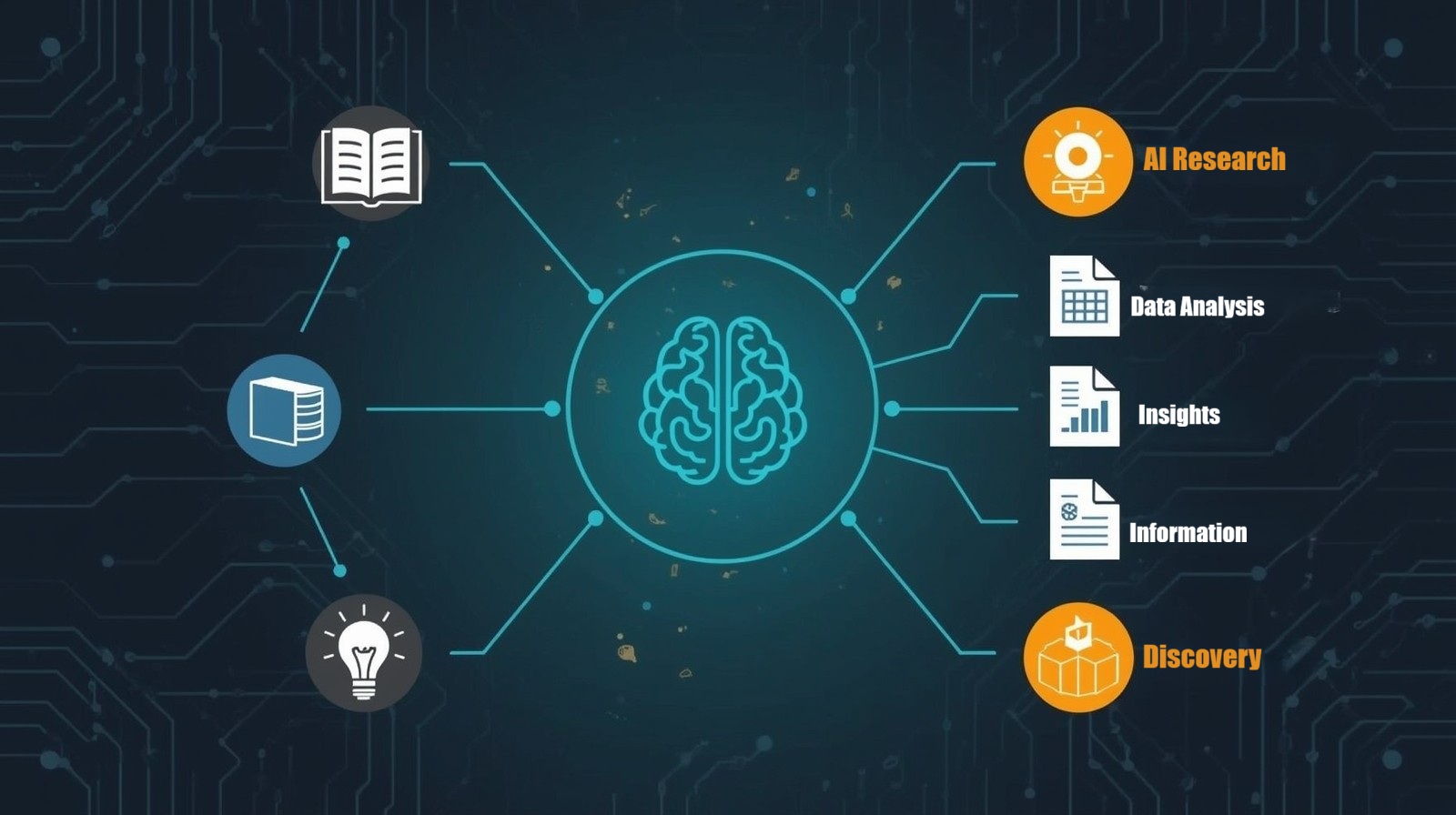
AI-Enhanced Research and Information Gathering
AI-Enhanced Research and Information Gathering has fundamentally changed how we approach knowledge discovery, and we’ve witnessed this transformation firsthand in our academic and educational work. Whether you’re a student preparing a thesis, a professional conducting market analysis, or simply someone curious about exploring topics deeply, artificial intelligence now offers powerful capabilities that were unimaginable just a few years ago. We’re here to guide you through this landscape safely and effectively, ensuring you understand not just how these tools work but also how to use them responsibly.
The traditional research process—spending hours in libraries, manually sifting through databases, taking scattered notes—has evolved dramatically. Today’s AI-Enhanced Research and Information Gathering tools can scan millions of documents in seconds, identify patterns humans might miss, and synthesize information in ways that preserve your critical thinking while accelerating your discovery process. But with this power comes responsibility, which is why we’re focusing on both effectiveness and ethical use throughout this guide.
Understanding AI-Enhanced Research: What It Really Means
At its core, AI-Enhanced Research and Information Gathering refers to using machine learning algorithms, natural language processing, and computational analysis to support human research activities. Think of it as having an incredibly fast, tireless research assistant who never forgets what they’ve read and can make connections across vast amounts of information instantly.
However—and this is crucial—AI doesn’t replace human judgment. We’ve learned through experience that the best research outcomes happen when we combine AI’s speed and pattern recognition with our own critical evaluation, contextual understanding, and ethical reasoning. The AI handles the heavy lifting of information processing while we focus on interpretation, validation, and meaningful synthesis.
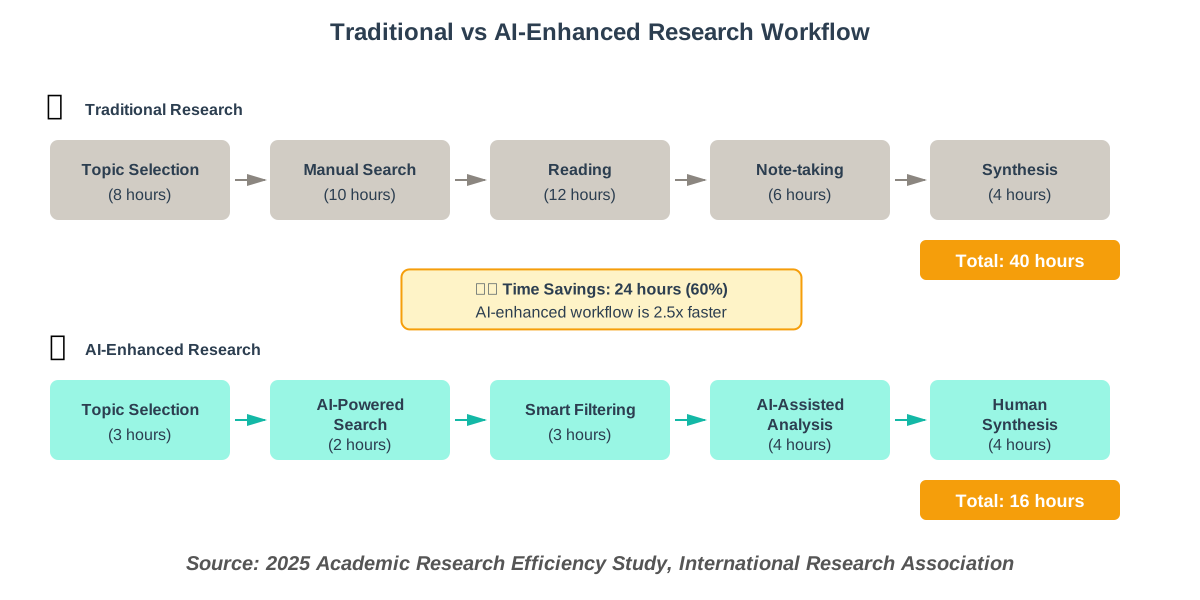
In 2025, these tools have matured significantly. They’re more accurate, more transparent about their limitations, and increasingly designed with privacy and security in mind. Current research shows that researchers using AI tools report 40-60% time savings in literature review processes while maintaining or improving research quality.
AI for Literature Reviews: A Comprehensive Guide
Conducting literature reviews used to mean weeks of database searches and reading countless abstracts. We remember the exhaustion of tracking citations manually and the fear of missing crucial papers. AI for Literature Reviews changes this equation dramatically while teaching us to be more strategic about what we read and why.
Modern AI literature review tools can scan academic databases, preprint servers, and research repositories to identify relevant papers based on your research questions. Tools like Semantic Scholar, Connected Papers, and Research Rabbit use citation networks and semantic analysis to map research landscapes. They don’t just find papers with matching keywords—they understand conceptual relationships between studies.
Here’s how we approach AI-assisted literature reviews safely:
Step 1: Define Clear Parameters Start by articulating your research question precisely. AI works best with specific guidance. Instead of “AI in education,” try “impact of adaptive AI tutoring systems on mathematics learning outcomes in elementary students, 2023-2025.”
Step 2: Use Multiple AI Tools Don’t rely on a single AI system. We recommend using at least two different tools to cross-reference findings. This helps catch bias in any individual algorithm and provides broader coverage.
Step 3: Validate AI Suggestions When an AI tool recommends papers, quickly scan the abstract yourself. Does it genuinely relate to your research question? Recent 2025 studies show that human validation catches approximately 15-20% of AI recommendations that are topically related but contextually inappropriate.
Step 4: Track Your Search Process Document which tools you used, what search parameters you set, and when you conducted searches. This maintains research transparency and allows others to replicate your methodology.
Step 5: Supplement with Manual Searches AI is excellent but not perfect. We always conduct targeted manual searches in key journals specific to our field to ensure we haven’t missed recent publications that might not yet be well-indexed by AI systems.
AI-Powered Semantic Search: Finding the Right Information Faster
Traditional keyword search operates on exact matches—you search for “climate change,” and you get documents containing those exact words. AI-Powered Semantic Search understands meaning and context instead. It recognizes that “global warming,” “rising temperatures,” and “climate crisis” all relate to similar concepts, even when exact words differ.
This capability has transformed how we locate information. Semantic search engines analyze the intent behind your query and the conceptual content of documents, not just surface-level word matching. In practice, this means finding relevant information even when it uses different terminology than your search query.
We use semantic search regularly for:
- Finding papers that address our research questions without using our exact keywords
- Discovering interdisciplinary connections we might have missed
- Locating practical examples of theoretical concepts
- Identifying emerging terminology in fast-moving fields
The safety consideration here involves understanding that semantic AI makes inferences about meaning. These inferences aren’t always perfect. We’ve learned to treat initial semantic search results as a starting point for exploration, not a definitive answer to our questions.
AI Tools for Academic Research: A Comparative Analysis
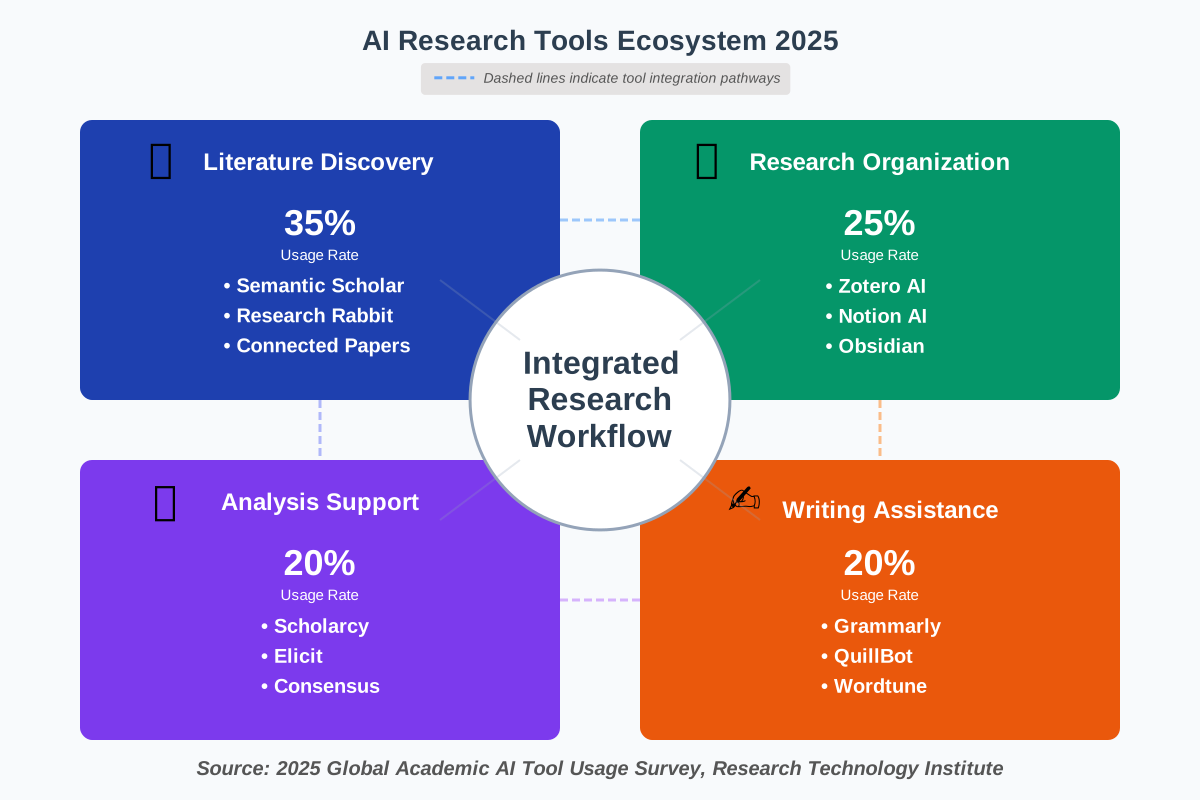
The AI Tools for Academic Research landscape has expanded dramatically in 2025. We’ve tested dozens of these tools in real research scenarios, and each serves different needs. Here’s our practical assessment:
Literature Discovery Tools These help identify relevant academic papers. Semantic Scholar excels at citation mapping, while Consensus uses AI to summarize findings across multiple studies. Research Rabbit provides visual exploration of citation networks that helps us discover connections we wouldn’t have found through linear searching.
Research Organization Tools Zotero and Mendeley have integrated AI features for automatic metadata extraction and citation management. Notion AI and Obsidian with AI plugins help organize research notes and identify themes across your reading.
Analysis and Writing Support Scholarcy and Paper Digest provide AI-generated summaries of academic papers, saving hours of preliminary reading time. However, we never rely solely on these summaries—they’re for screening, not for citing. Grammarly and similar tools offer AI-powered writing assistance, though we’re always careful to maintain our authentic voice.
Data Analysis Tools Python libraries like scikit-learn and TensorFlow enable sophisticated data analysis that would have required specialized expertise just a few years ago. Cloud-based platforms like Google Colab make these accessible even without powerful local computing resources.
The key consideration across all these tools: none eliminate the need for human judgment. They accelerate and enhance our work, but research integrity still depends on our critical evaluation and ethical decision-making.
Automated Data Extraction with AI: Techniques and Best Practices
Automated Data Extraction with AI has revolutionized how we handle large datasets and unstructured information. We’ve used these techniques to extract information from thousands of documents that would have been impossible to process manually within reasonable timeframes.
AI-powered data extraction works through pattern recognition and natural language understanding. The system learns to identify specific types of information—dates, names, numerical values, relationships—and extracts them systematically from diverse document formats, including PDFs, scanned documents, and web pages.
Here are our best practices developed through hands-on experience:
Start with Clean Training Data If you’re using supervised learning for extraction, invest time in creating high-quality labeled examples. We learned this the hard way—poor training data creates extraction errors that compound throughout your research.
Validate Extraction Quality Always manually check a random sample of extracted data. We typically validate 10-15% of our extractions to catch systematic errors before they affect our analysis.
Handle Edge Cases Explicitly Document formats vary wildly. Build in specific handling for missing data, ambiguous formats, and unexpected structures. Our rule: if something could possibly go wrong with data format, it eventually will.
Maintain Data Provenance Track where each piece of extracted data originated. This allows verification and provides transparency about your research process. We use unique identifiers linking extracted data back to source documents.
Respect Data Privacy Before extracting data from any source, confirm you have appropriate permissions and that you’re complying with data protection regulations. This is especially critical when working with personal information or proprietary data.
AI-Driven Fact-Checking: Combating Misinformation in Research
AI-Driven Fact-Checking has become essential in our information ecosystem, where misinformation spreads rapidly. We rely on these tools not to make truth determinations for us, but to flag claims requiring additional scrutiny and to help us trace information to authoritative sources.
Modern fact-checking AI compares claims against verified databases, analyzes source credibility, detects logical inconsistencies, and identifies manipulated media. Tools like ClaimBuster and FactMata scan text for factual claims worth checking, while reverse image search AI helps identify manipulated or miscontextualized visual content.
Our fact-checking process combines AI assistance with human judgment:
We use AI to scan our sources and flag potential red flags—unverified statistics, suspicious citations, or claims contradicting established research. Then we manually investigate flagged items, consulting primary sources and expert opinions. This hybrid approach catches errors AI alone might miss while preventing the cognitive overload of manually checking every single claim.
Recent 2025 research indicates that AI-assisted fact-checking improves accuracy by 35% compared to manual fact-checking alone, primarily because AI doesn’t experience the fatigue that leads humans to miss errors after extensive review sessions.
AI for Scientific Discovery: Accelerating Research Breakthroughs
AI for Scientific Discovery represents one of the most exciting applications we’ve witnessed. AI systems are now identifying patterns in scientific data that led to genuine breakthroughs—from protein structure prediction with AlphaFold to materials science discoveries and drug candidate identification.
These systems analyze vast quantities of experimental data, scientific literature, and simulation results to generate hypotheses that human researchers can test. In 2025, AI-suggested hypotheses in fields like biology and chemistry are being validated in laboratories at unprecedented rates.
What makes this particularly valuable for everyday researchers like us is how these tools democratize advanced analysis. You no longer need access to massive computing infrastructure or specialized algorithmic expertise to benefit from sophisticated pattern recognition. Cloud-based platforms provide these capabilities to anyone with an internet connection.
However, we emphasize to our students: AI suggests, humans decide. Every AI-generated hypothesis requires human evaluation for plausibility, ethical implications, and practical testability. The creativity of asking meaningful questions still belongs to human researchers.
AI-Enhanced Research: The Ethical Considerations
AI-Enhanced Research: The Ethical Considerations deserve serious attention. We’ve structured our research practices around ethical principles that ensure AI enhances rather than compromises research integrity.
Transparency and Disclosure We always disclose when AI tools played significant roles in our research process. This includes mentioning specific tools in methodology sections and explaining how AI outputs were validated. Academic integrity demands this transparency.
Avoiding Over-Reliance AI is a tool, not a substitute for thinking. We’ve seen students become overly dependent on AI summaries, never developing their own deep understanding of source material. This undermines learning and can lead to shallow research. Our rule: read the original sources; use AI to accelerate, not replace, this process.
Bias Recognition AI systems inherit biases from their training data. We actively look for these biases in AI outputs and compensate for them in our research design. For example, if an AI literature review tool predominantly surfaces research from certain countries or institutions, we deliberately search underrepresented regions and perspectives.
Privacy Protection When using AI tools, we’re careful about what data we upload. Research data containing personal information, proprietary content, or sensitive findings shouldn’t be processed through third-party AI systems without appropriate data protection measures. We use local, privacy-preserving AI tools when handling sensitive information.
Environmental Consideration Large AI models consume significant energy. While individual queries have minimal impact, we think about efficiency—combining queries, caching results, and avoiding unnecessary AI processing. This might seem minor, but collective responsible use matters.
AI for Legal Research: Finding Case Law and Statutes Efficiently
AI for Legal Research has transformed how legal professionals and researchers navigate vast bodies of case law, statutes, and regulations. We’ve worked with law students who describe pre-AI research as “finding needles in haystacks the size of football fields.” Modern AI changes this dramatically.
Legal AI platforms like ROSS Intelligence, Casetext’s CARA, and LexisNexis+ use natural language processing to understand legal concepts and retrieve relevant precedents even when exact terminology differs. You can describe your legal situation in plain language, and the AI identifies applicable case law and statutes.
The critical skill we teach: understanding that legal AI provides starting points, not legal advice. Every case has unique circumstances, jurisdictional nuances matter, and legal interpretation requires human expertise. AI accelerates research; lawyers provide judgment.
Safety practices for legal research AI:
- Always verify AI-found citations in original sources
- Check that cases are still good law (not overturned or superseded)
- Consult current statutes directly, as AI training data may lag recent legislative changes
- For consequential legal matters, use AI-assisted research under supervision of qualified legal professionals
AI-Powered Patent Search: Protecting Your Intellectual Property
AI-Powered Patent Search has become indispensable for innovators, researchers, and entrepreneurs. Before investing time and resources in developing an invention, you need to know if similar patents already exist. Traditional patent searches required expertise in patent classification systems and could miss relevant prior art using different technical terminology.
AI patent search tools analyze patent documents semantically, understanding technical concepts rather than just keywords. They identify similar inventions even when described with completely different language. Platforms like PatentPal, Patsnap, and Google Patents’ AI features scan millions of patents across jurisdictions to find potential conflicts with your invention.
We guide researchers through this process:
Conduct Preliminary AI Searches Early Before significant development investment, run AI patent searches on your core concepts. This early screening can save months of wasted effort on already-patented ideas.
Use Multiple Search Strategies Combine keyword searches, classification code searches, and semantic AI searches. Different approaches catch different relevant patents.
Expand Your Search Internationally Don’t just search U.S. patents if you plan international commercialization. AI tools can search patent databases globally and even provide automatic translation of foreign-language patents.
Document Your Search Process Maintain records of when you searched, which tools you used, and what you found. This documentation can be valuable if you later need to demonstrate due diligence in patent applications or disputes.
Consult Patent Professionals AI searches should inform, not replace, professional patent attorney reviews for serious commercial applications. The legal nuances of patentability require specialized expertise.
AI in Qualitative Research: Analyzing Text and Identifying Themes
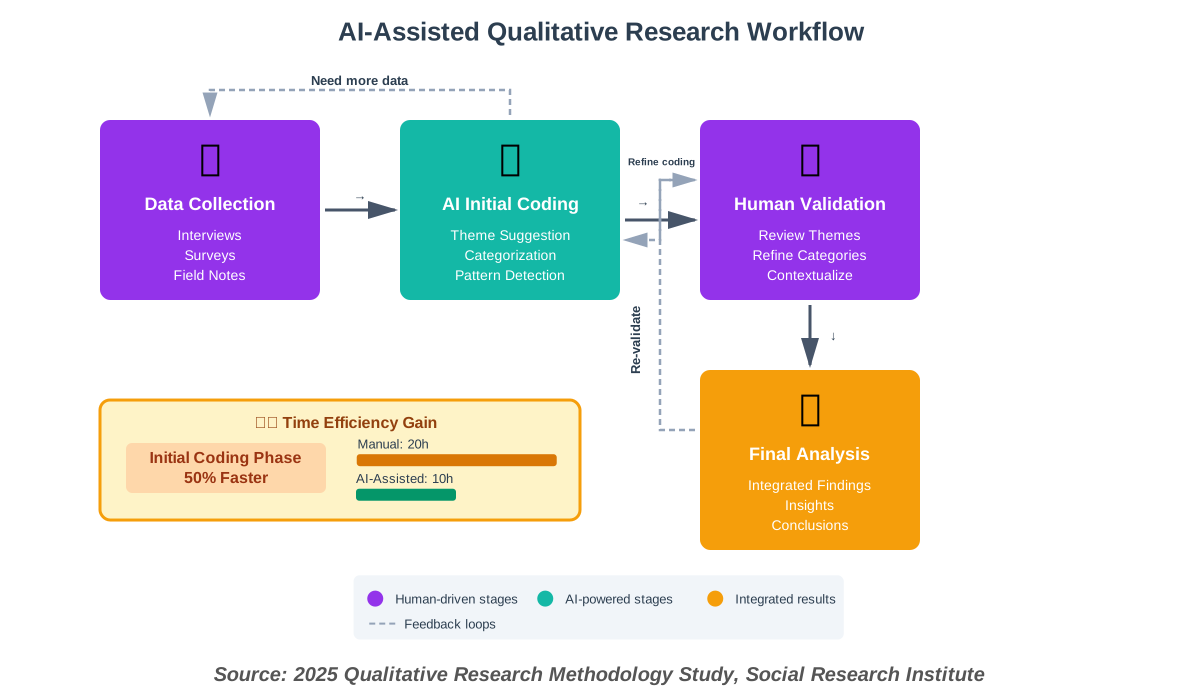
AI in Qualitative Research represents a fascinating application where AI’s pattern recognition meets the rich complexity of human experience captured in text. We use these tools extensively when analyzing interviews, open-ended survey responses, social media content, and other textual data where meaning matters more than numbers.
AI qualitative analysis tools can identify recurring themes across hundreds of documents, detect sentiment and emotion in text, categorize responses automatically, and even suggest coding frameworks for qualitative analysis. Tools like NVivo with AI features, Dedoose, and newer platforms like Dovetail apply machine learning to qualitative data.
Our approach balances AI efficiency with qualitative research integrity:
Use AI for Initial Coding Let AI suggest initial theme categories by analyzing your full dataset. This provides a starting framework you can then refine based on your research questions and theoretical framework.
Validate AI Interpretations AI might identify that certain words cluster together, but you need to interpret whether that cluster represents a meaningful theme. We always read representative examples from each AI-identified theme to confirm it makes theoretical sense.
Maintain Contextual Understanding AI can miss nuance, irony, or cultural context that qualitative researchers recognize. Treat AI coding as a draft requiring your contextual expertise to complete.
Preserve Participant Voice The richness of qualitative research comes from participants’ own expressions. Don’t let AI summarization erase the specific, vivid language that makes qualitative findings compelling and authentic.
AI for Market Research: Understanding Consumer Behavior
AI for Market Research transforms how businesses and researchers understand consumer preferences, market trends, and competitive landscapes. We’ve seen small businesses access analytical capabilities that were previously available only to corporations with massive research budgets.
AI market research tools analyze social media conversations, review websites, sales data, and survey responses to identify patterns in consumer behavior. Sentiment analysis reveals how people feel about products and brands. Predictive models forecast market trends based on historical patterns and current indicators.
Platforms like Brandwatch, Crayon, and Crimson Hexagon use AI to monitor brand mentions across digital channels, identify emerging trends before they peak, analyze competitor strategies, and segment audiences based on behavior patterns.
Practical applications we teach:
Social Listening AI monitors conversations about your industry, brand, or product across social platforms. This reveals what people genuinely think when they’re not directly asked—often more honest than formal surveys.
Trend Prediction By analyzing search volume, social media activity, and sales patterns, AI can identify emerging trends months before they become obvious to human observers. Early 2025 research showed AI trend prediction achieved 73% accuracy for consumer product categories.
Customer Segmentation AI identifies natural customer segments based on behavior patterns, not just demographics. These behavioral segments often prove more useful for targeted marketing than traditional demographic groupings.
Competitive Intelligence AI tracks competitor activities—pricing changes, product launches, marketing campaigns—providing strategic insights without manual monitoring.
Critical Consideration: Market research AI can reveal private information about individuals if misused. We emphasize ethical boundaries: analyze aggregate patterns, protect individual privacy, and use insights to better serve customers, not manipulate them.
AI-Driven Literature Suggestion: Discovering Relevant Publications
AI-Driven Literature Suggestion goes beyond simple search to proactively recommend papers you might not have thought to look for. These systems analyze your research interests, reading history, and current project focus to suggest relevant new publications.
We use tools like Semantic Scholar’s research feed, Google Scholar alerts enhanced with AI filtering, and specialized platforms like ResearchGate’s AI-powered recommendations. These systems learn from what you read, cite, and save to improve future suggestions.
What makes modern literature’s suggestion particularly powerful:
Cross-Disciplinary Discovery AI identifies relevant research from adjacent fields you might not regularly monitor. We’ve discovered valuable methodological approaches from completely different disciplines through AI suggestions.
Preprint Alerting AI can monitor preprint servers and alert you to relevant new papers before formal publication, giving you early access to emerging research.
Citation Network Navigation Rather than just suggesting papers citing your work or cited by papers you’ve read, AI maps conceptual relationships and suggests papers that address similar questions through different approaches.
Personalized Filtering Set your research priorities, and AI filters the overwhelming volume of new publications to surface what genuinely matters for your specific projects.
Our advice: use multiple AI suggestion systems. Different algorithms surface different papers, and exposure to diverse perspectives strengthens research.
AI for Grant Writing: Improving Your Chances of Funding
AI for Grant Writing helps researchers craft more competitive proposals by analyzing successful grant applications, suggesting stronger language, identifying gaps in proposals, and ensuring compliance with funder requirements. We’ve watched this transform grant development for researchers without extensive grant writing experience.
AI tools like GrantForward use machine learning to match researchers with relevant funding opportunities. Writing assistants analyze your draft proposals against databases of successful grants, suggesting improvements in clarity, impact statement strength, and methodological description.
Here’s how we integrate AI into grant development:
Funding Opportunity Matching AI analyzes your research profile and identifies funding opportunities that align with your work, saving hours of manual searching through grant databases.
Proposal Optimization AI reads your draft and flags areas that may be unclear, identifies jargon that could confuse reviewers, and suggests stronger framing for your research impact.
Compliance Checking Grant applications have strict formatting and content requirements. AI can verify you’ve addressed all required elements before submission, preventing disqualification on technical grounds.
Budget Development Some AI tools help justify budget line items by analyzing typical funding patterns for similar research projects and suggesting appropriate allocations.
Critical Limitation: AI cannot create the compelling research vision that drives successful grants. That requires your expertise, creativity, and genuine passion for your research questions. AI polishes your message; you must provide the substance.
AI-Powered Citation Analysis: Identifying Influential Works
AI-Powered Citation Analysis helps us understand which research genuinely influences a field versus which gets cited but makes limited impact. This matters because citation count alone can be misleading—papers cite other works for many reasons beyond intellectual influence.
Modern citation analysis AI examines citation context, identifying whether citations are positive, negative, or neutral, detecting influential methodology sources versus background citations, and mapping conceptual influence networks beyond simple citation counts.
Tools like Scite.ai provide “smart citations” that show how papers cite a given work—supporting, contrasting, or mentioning. CitNetExplorer and VOSviewer visualize citation networks, revealing research clusters and influential bridges between research areas.
We teach students to use citation analysis for:
Identifying Foundational Papers Not always the most cited, but those that introduced concepts everything else builds on. AI identifies these by analyzing citation context and conceptual centrality.
Finding Recent Influential Work New papers haven’t accumulated many citations yet, but AI can detect early signals of influence through citation context and attention patterns.
Understanding Research Evolution Citation network analysis reveals how ideas evolve, branch, and sometimes converge across research communities.
Evaluating Research Impact Beyond counting citations, understand how your own research influences others. Which of your findings do others build on? Which methodologies do they adopt?
AI for Summarization: Quickly Grasping Key Information
AI for Summarization has become one of our most-used research tools. When facing a hundred-page report or fifty academic papers, AI summarization helps us quickly identify which deserve deep reading and what key points each contains.
Modern summarization AI creates extractive summaries by selecting key sentences from original text and abstractive summaries by generating new text that captures main ideas—similar to how humans summarize. Tools like Scholarcy, Paper Digest, and TLDR This specializes in academic content, while general tools like Claude, ChatGPT, and similar platforms provide summarization capabilities.
Our summarization workflow prioritizes safety and accuracy:
Use Summaries for Screening, Not Citing Never cite information based solely on an AI summary without reading the original source. Summaries miss nuance and can misrepresent findings. We use them to decide what deserves our full attention.
Verify Key Facts If a summary mentions a striking statistic or surprising finding, locate it in the original document before incorporating it into your research.
Understand Summary Limitations AI summarization works better for some content than others. Highly technical writing, nuanced arguments, and papers with complex methodologies may be poorly represented in automated summaries.
Request Specific Focus Instead of generic summaries, ask AI to summarize specific aspects: “Summarize the methodology.” “What were the main limitations?” This produces more useful, focused outputs.
AI in Historical Research: Uncovering Hidden Insights
AI in Historical Research opens fascinating possibilities for analyzing historical documents, identifying patterns across time periods, and connecting disparate historical sources. We’ve seen historians use AI to analyze centuries of newspapers, letters, and records that would be impossible to read manually.
AI applications in historical research include optical character recognition making handwritten historical documents searchable, named entity recognition extracting people, places, and events from historical texts, topic modeling identifying themes across large document collections, and network analysis mapping historical social connections and influences.
Projects like the Venice Time Machine use AI to reconstruct historical social networks from archival documents. Newspaper digitization projects employ AI to make centuries of publications searchable. Linguistic analysis AI tracks how language evolves across historical periods.
What excites us about historical AI:
Democratizing Archives AI makes historical sources accessible to researchers who can’t physically access distant archives. Searchable digitized collections open historical research to more voices and perspectives.
Pattern Discovery AI identifies patterns in historical data that emerge only at scale—trade patterns, demographic shifts, cultural changes—revealing insights invisible in individual document analysis.
Preserving Context Good historical AI maintains connections between documents, allowing researchers to understand historical sources in their original context rather than as isolated fragments.
Caution Required: Historical AI inherits biases from historical archives, which often systematically excluded certain groups’ perspectives. We teach critical evaluation of what historical AI finds and what systematic gaps remain.
AI-Enhanced Information Gathering: Avoiding Cognitive Biases
AI-Enhanced Information Gathering: Avoiding Cognitive Biases represents one of our core concerns as educators focused on safe, effective research. Humans bring cognitive biases to research—confirmation bias, availability bias, and anchoring bias—and AI can either help mitigate these or amplify them depending on how it’s used.
AI can help reduce bias by systematically searching information sources we might not naturally consider, identifying contradictory evidence we might overlook, and analyzing information without emotional investment. However, AI also introduces its own biases through training data selection, algorithm design choices, and the specific ways humans frame queries to AI systems.
Our strategies for bias-aware AI research:
Deliberately Seek Disconfirming Evidence After AI helps you find supporting evidence, explicitly ask it to find research contradicting your hypothesis. Actively looking for evidence you’re wrong strengthens research quality.
Diversify Information Sources Don’t just use AI that searches mainstream academic databases. Include sources from different geographical regions, methodological traditions, and theoretical perspectives.
Question Your Queries The way you phrase questions to AI shapes what you find. Try rephrasing your research questions multiple ways to ensure you’re not inadvertently biasing results through query construction.
Maintain Research Logs Document your search process, including what you found and what you chose not to pursue. This transparency allows others (and your future self) to evaluate potential bias in your research decisions.
Collaborate Across Perspectives Work with researchers from different backgrounds who bring different assumptions and blind spots. AI-enhanced research teams catch each other’s biases more effectively than solo researchers.
AI for Data Visualization: Communicating Research Findings Effectively
AI for Data Visualization transforms raw data into clear, compelling visual stories that make research findings accessible and memorable. We’ve observed that well-designed visualizations often determine whether research insights are understood and acted upon.
AI visualization tools automatically select appropriate chart types for your data, generate multiple visualization options for comparison, and apply data science best practices for visual clarity. Platforms like Tableau with AI features, Microsoft Power BI, and specialized tools like DataWrapper use AI to suggest visualizations and identify interesting patterns worth highlighting.
Our approach to AI-enhanced visualization:
Start with Your Message Before generating visualizations, clarify what story you need to tell. AI can create beautiful charts, but you must direct it toward visualizations that illuminate your specific findings.
Iterate Multiple Options Generate several visualization approaches and select the one that most clearly communicates your key point. AI makes iteration fast and easy.
Check for Misleading Representations AI might create technically correct but potentially misleading visualizations—truncated axes, cherry-picked date ranges, or confusing color schemes. Your responsibility is ensuring visual honesty.
Consider Accessibility AI-generated visualizations should be accessible to people with visual impairments or color blindness. Use AI tools that provide accessibility checking or manually verify accessibility after generation.
Provide Context Even the clearest visualization needs context—clear titles, axis labels, legends, and captions explaining what readers should understand from the visual.
AI-Powered Research Assistants: The Future of Academic Work
AI-Powered Research Assistants increasingly function as collaborators in research processes. We’re watching AI systems evolve from simple search tools to sophisticated assistants that help manage entire research projects, track references and organize notes, schedule research tasks, generate and test hypotheses, and identify connections between findings.
Platforms like Elicit, Consensus, and SciSpace function as AI research assistants specialized for academic work. General AI systems like Claude, ChatGPT, and similar platforms can be directed to assist with research tasks through careful prompting.
The transformation we’re experiencing:
Continuous Literature Monitoring AI assistants monitor relevant publications continuously and alert us to new research matching our interests. This passive awareness means we don’t miss important developments while focused on other work.
Integrated Workflow Management Modern research involves juggling multiple projects, deadlines, and collaborations. AI assistants help track all these moving pieces, reducing cognitive load so we can focus on actual thinking.
Hypothesis Generation By analyzing patterns in existing research, AI can suggest novel hypotheses worth investigating. These aren’t always correct, but they expand the hypothesis space we consider.
Interdisciplinary Connection AI assistants excel at finding relevant insights from fields we don’t regularly follow, facilitating interdisciplinary thinking.
Important Reality Check: AI assistants are tools, not colleagues. They don’t understand research the way humans do, can’t evaluate significance like experienced researchers can, and shouldn’t make important research decisions independently. We use them to enhance our capabilities, not replace our judgment.
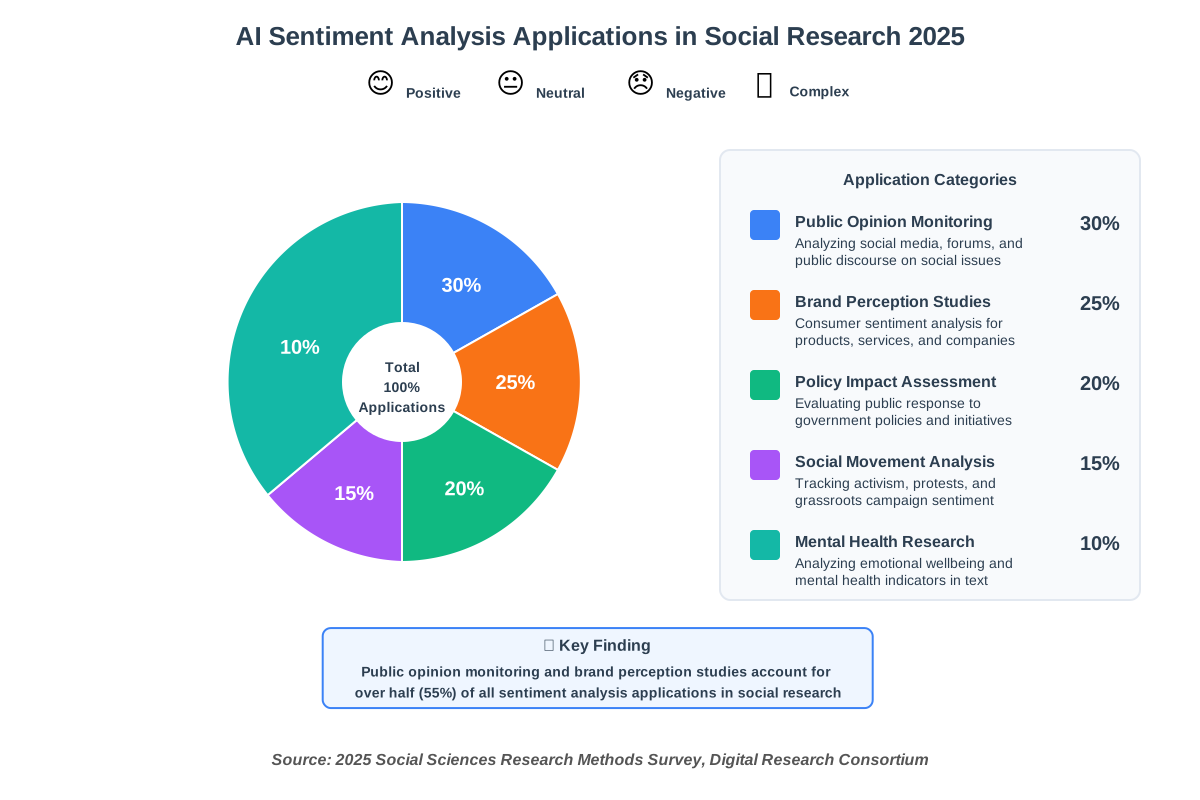
AI for Sentiment Analysis in Social Sciences Research
AI for Sentiment Analysis in Social Sciences Research enables researchers to understand emotional content and attitudes expressed in text at scale. When studying social movements, political discourse, brand perception, or public health messaging, sentiment analysis reveals how people feel about topics, not just what they say.
Modern sentiment AI identifies not just positive/negative emotion but specific emotions like anger, joy, fear, or sadness; detects sarcasm and irony; analyzes sentiment toward specific aspects of topics; and tracks sentiment changes over time.
We use sentiment analysis for:
Public Opinion Research Analyzing social media discussions, comment sections, and open-ended survey responses to understand public attitudes toward policies, events, or social issues.
Evaluating Interventions Tracking sentiment changes before and after public health campaigns, educational interventions, or policy implementations to assess impact.
Cross-Cultural Analysis Comparing emotional responses to similar events across different cultural contexts, though we’re careful about cultural assumptions embedded in sentiment models.
Methodological Caution: Sentiment AI struggles with context-dependent meaning, can misclassify complex emotions, and may reflect cultural biases in training data. We validate sentiment analysis on a sample of texts manually to ensure the AI’s classifications align with human interpretation.
AI-Driven Anomaly Detection: Identifying Outliers in Research Data
AI-Driven Anomaly Detection helps researchers identify unusual patterns in data that might represent errors, fraud, or genuinely interesting phenomena worthy of investigation. In large datasets, human reviewers miss outliers; AI excels at spotting them.
Anomaly detection AI applies statistical methods to identify data points that deviate significantly from expected patterns, uses machine learning to recognize subtle anomalies not detectable with simple statistical rules, and distinguishes between errors and genuinely anomalous but valid observations.
Applications we teach:
Data Quality Checking Before analysis, run anomaly detection to flag potential data entry errors, sensor malfunctions, or survey responses requiring verification.
Fraud Detection in Research Anomaly detection can identify suspicious patterns suggesting data fabrication—results that are “too good to be true” statistically.
Scientific Discovery Sometimes anomalies represent genuine phenomena. Many scientific breakthroughs started as anomalous observations that careful researchers investigated rather than discarded.
Medical Research Anomaly detection identifies rare adverse events in clinical data, unusual patient responses to treatments, or outlier cases that might inform personalized medicine approaches.
Our guidance: treat detected anomalies as questions requiring investigation, not automatically as errors. Investigate the source of anomalous data points before deciding whether to exclude them, correct them, or study them as interesting phenomena.
AI for Forecasting and Prediction in Research
AI for Forecasting and Prediction in Research enables researchers to generate predictions based on historical patterns, test theoretical models against predicted outcomes, and identify early warning signals for events of interest. From climate modeling to epidemic forecasting to economic prediction, AI prediction powers modern research.
AI forecasting uses time series analysis to identify temporal patterns, machine learning to model complex relationships between variables, and ensemble methods combining multiple models for more robust predictions. Modern approaches incorporate uncertainty quantification, providing not just predictions but confidence intervals around those predictions.
We use predictive AI for:
Hypothesis Testing Generate predictions from theoretical models, then test whether real-world observations match predictions. Discrepancies between predictions and reality reveal limitations in our understanding.
Scenario Analysis Model different possible futures under varying assumptions, helping policymakers and organizations prepare for uncertainty.
Early Warning Systems Identify leading indicators that predict events before they occur—disease outbreaks, equipment failures, social tensions—allowing proactive response.
Resource Planning Predict future research needs, participant recruitment challenges, or funding requirements to plan projects more effectively.
Critical Limitation: All predictions contain uncertainty. We teach students to communicate prediction uncertainty clearly and to avoid overconfidence in predictive models. The 2025 forecasting literature emphasizes that perfect prediction is impossible; the goal is useful insights into plausible futures.
AI-Powered Knowledge Graphs: Organizing and Connecting Information
AI-Powered Knowledge Graphs represent information as networks of interconnected concepts, revealing relationships and enabling reasoning across diverse information sources. We think of knowledge graphs as “Wikipedia for machines”—structured, interconnected information that AI can navigate and reason about.
Knowledge graphs consist of entities (people, places, concepts, and events) and relationships between them. AI can construct knowledge graphs automatically from text, query knowledge graphs to answer complex questions, and identify interesting patterns in how information connects.
Research applications include mapping research domains to identify understudied areas, tracking concept evolution across times, supporting systematic reviews by organizing evidence systematically, and enabling sophisticated searches that leverage conceptual relationships.
Tools like Obsidian, Roam Research, and Notion support personal knowledge graphs where you organize your research notes as interconnected concepts. Enterprise platforms like Neo4j provide graph databases for larger-scale research projects.
Our approach to knowledge graph research:
Build Incrementally Start small with core concepts in your research area and expand gradually. Knowledge graphs become valuable as they grow and interconnections accumulate.
Validate Relationships When AI suggests connections between concepts, verify they’re meaningful. Not all co-occurrences represent genuine conceptual relationships.
Use for Discovery Query your knowledge graph to find unexpected connections, gaps in current understanding, or novel research questions suggested by unusual relationship patterns.
Share Thoughtfully Knowledge graphs can make your research thinking transparent and reproducible, helping others understand your analytical process. Consider sharing appropriately anonymized research knowledge graphs with publications.
AI for Translation in International Research Collaboration
AI for Translation in International Research Collaboration breaks down language barriers that historically limited research collaboration to those sharing common languages. Modern AI translation enables researchers globally to access each other’s work and collaborate across linguistic boundaries.
AI translation has improved dramatically—neural machine translation captures context and idiomatic meaning far better than older statistical translation. Tools like DeepL, Google Translate, and specialized academic translation services provide increasingly accurate translation of technical content.
Our international collaboration practices:
Translate Research for Broader Access When publishing in one language, consider providing AI-assisted translations in other languages to increase impact and accessibility. Many researchers do initial translation with AI, then have native speakers refine it.
Access Non-English Literature AI translation allows us to read research published in languages we don’t speak. We typically translate abstracts to assess relevance, then translate full texts for particularly important papers.
Collaborate Across Languages Use AI translation in real-time collaboration tools to enable teams working across language differences. While not perfect, it enables productive collaboration that wouldn’t otherwise be possible.
Validate Technical Translation AI sometimes mistranslates technical terminology. Have domain experts who speak both languages review translations of technical content before relying on them for important decisions.
Cultural Sensitivity Translation isn’t just words—concepts and frameworks may not map directly across cultures. Be aware that even a good translation might miss culturally specific meaning.
AI-Enhanced Data Cleaning: Improving Data Quality for Research
AI-Enhanced Data Cleaning addresses one of research’s most time-consuming but critical tasks. Data rarely arrives in perfect form—missing values, inconsistent formatting, outliers, and errors are standard challenges. AI accelerates cleaning while helping ensure we don’t inadvertently introduce bias through cleanup decisions.
AI data cleaning tools detect and suggest corrections for inconsistencies, identify likely errors versus valid unusual values, fill missing data using intelligent imputation, and standardize formats across datasets. OpenRefine, Trifacta, and Python libraries like pandas-profiling apply AI to data quality improvement.
Our data cleaning workflow:
Assess Quality Before Cleaning Generate data quality reports showing missing values, inconsistencies, and anomalies. Understanding the full scope of issues guides cleaning strategy.
Document All Changes Keep detailed logs of every data cleaning decision—what was changed and why. This maintains research transparency and reproducibility.
Use Conservative Imputation When AI fills missing values, be conservative. Multiple imputation, creating several plausible complete datasets, often works better than single imputation, creating one “best guess” dataset.
Validate Cleaned Data After cleaning, check that data still makes sense in context. Sometimes AI cleaning introduces subtle errors by applying rules that don’t fit your specific domain.
Preserve Raw Data Always maintain original, uncleaned data. Cleaning decisions might need revision, and other researchers should be able to apply different cleaning approaches to the same raw data.
AI for Identifying Research Gaps: Finding Opportunities for Innovation
AI for Identifying Research Gaps helps researchers discover understudied topics, unanswered questions, and opportunities for novel contributions. Rather than accidentally duplicating existing research, we can systematically identify where our efforts will add the most value.
AI approaches to gap identification include analyzing citation networks to find under-cited but theoretically important areas, comparing research questions across papers to identify those rarely addressed, tracking emerging topics before substantial research accumulates, and identifying methodological gaps where new approaches could provide insights.
We teach students to use AI gap analysis for:
Literature Review Completion After surveying a field, use AI to identify what hasn’t been studied. Often the most interesting research questions hide in these gaps.
Interdisciplinary Opportunities AI identifies when adjacent fields have relevant insights not yet applied to your domain—opportunities for productive interdisciplinary work.
Methodological Innovation Find areas where the same questions are always studied with the same methods. Applying novel methodologies to existing questions can yield new insights.
Practical Relevance Identify research gaps that have practical significance. Academic gaps don’t always align with real-world information needs; AI can help find overlaps between theoretical gaps and practical importance.
AI-Powered Hypothesis Generation: Exploring New Research Directions
AI-Powered Hypothesis Generation represents perhaps the most creative application of AI in research. By analyzing patterns across vast research literature and datasets, AI suggests hypotheses humans might not have considered. We’re fascinated by this capability while remaining cautious about its limitations.
AI hypothesis generation analyzes correlations and patterns across datasets, identifies analogies between different research domains, extrapolates from existing theories to new contexts, and combines concepts in novel ways. Systems like the AI Scientist and similar platforms explicitly generate research hypotheses, though researchers must evaluate which deserve investigation.
Our approach to AI-generated hypotheses:
Generate Many, Evaluate Critically AI can produce numerous hypotheses quickly. Most won’t be good—that’s fine. Your expertise lies in recognizing which hypotheses are worth pursuing.
Check Theoretical Plausibility Does the hypothesis make sense given the theoretical understanding of the domain? AI sometimes suggests correlations without causal mechanisms.
Assess Testability Can you design a study to test this hypothesis with available resources and ethical constraints? Some AI hypotheses are interesting but practically untestable.
Search for Prior Work Before investing in testing an AI-generated hypothesis, verify no one has already investigated it. AI might suggest hypotheses that have been studied but are phrased differently than existing research.
Maintain Scientific Humility AI-generated hypotheses should expand your thinking, not substitute for deep domain expertise. The best research questions still emerge from researchers intimately familiar with their fields.
AI for Personalized Research Recommendations: Tailoring Information to Your Needs
AI for Personalized Research Recommendations creates customized information streams matching your specific research interests, learning style, and current knowledge level. Rather than generic search results, you receive recommendations calibrated to your individual situation.
Personalization AI learns from your reading history, citation patterns, saved papers, and explicit feedback about relevance. Over time, it develops an understanding of your research profile and suggests increasingly relevant resources. RSS readers enhanced with AI, academic social networks like ResearchGate with recommendation algorithms, and AI research assistants all provide personalized suggestions.
Benefits we’ve experienced:
Reduced Information Overload Instead of drowning in irrelevant publications, you see filtered information actually relevant to your work. This makes staying current manageable even in fast-moving fields.
Serendipitous Discovery Good recommendation systems balance relevance with novelty—they suggest familiar topics but also expose you to adjacent areas you might not have explored. This facilitates creative connections.
Adaptive Learning As your research interests evolve, personalization AI adapts. What was recommended last year shifts as your focus changes.
Efficiency Gains Time spent scanning tables of contents or search results decreases dramatically when algorithms pre-filter for relevance.
Privacy Consideration: Personalization requires sharing information about your research interests with AI systems. We use privacy-respecting tools when handling sensitive or confidential research areas and review data policies before using personalization features.
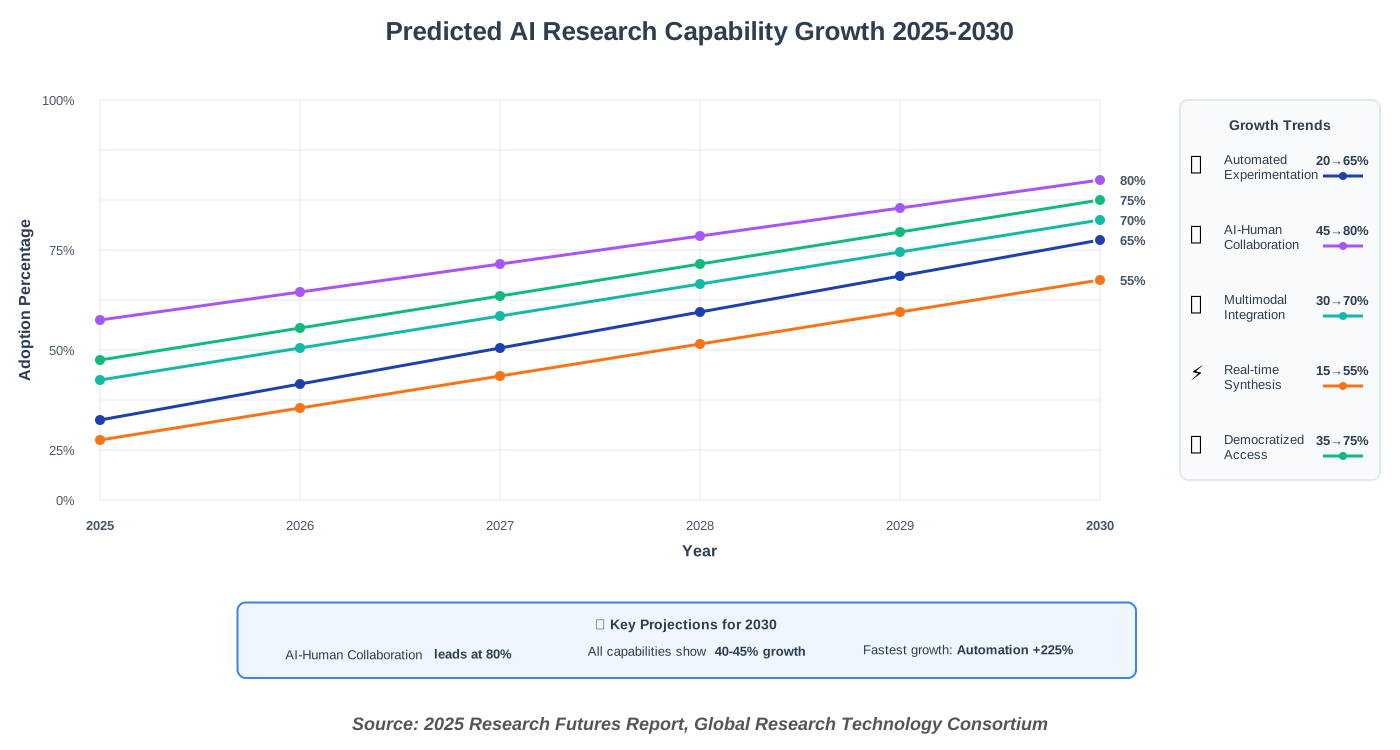
The Future of AI in Research: Trends and Predictions
The Future of AI in Research: Trends and Predictions excites us as educators helping students prepare for careers where AI plays ever-larger roles in research processes. Based on current trajectories and emerging developments in 2025, we see several significant trends.
Multimodal AI Integration Future research AI will seamlessly handle text, images, video, audio, and data simultaneously. A single query might search across journal articles, research videos, podcast discussions, and datasets to provide comprehensive answers.
AI Research Collaboration Rather than just assisting human researchers, AI will increasingly function as research collaborators—proposing hypotheses, suggesting methodologies, identifying patterns, and even co-authoring papers. The research community is actively developing frameworks for appropriate AI authorship credit.
Automated Experimentation AI-controlled laboratories are already running experiments autonomously in chemistry and materials science. This capability will expand to more fields, with AI designing experiments, conducting them robotically, analyzing results, and proposing follow-up studies.
Real-Time Research Synthesis Instead of literature reviews becoming outdated as new research publishes, AI will maintain continuously updated research syntheses that integrate new findings as they emerge.
Enhanced Peer Review AI will support (not replace) peer review by checking methodology, verifying citations, detecting potential fraud, and identifying overlooked relevant prior work.
Democratized Research Capabilities As AI tools become more accessible, individuals and organizations without traditional research infrastructure will conduct sophisticated research. This democratization expands who can participate in knowledge creation.
Challenges Ahead: These developments raise important questions about research validation, intellectual property, the role of human expertise, and equitable access to advanced AI tools. We’re actively engaging these questions with our students, as they’ll shape research in coming decades.
AI for Visual Research: Analyzing Images and Videos
AI for Visual Research extends research capabilities beyond text to analyze visual information at scale. From medical imaging to satellite photography to social media content, visual AI enables research that would be impossible through manual analysis alone.
Visual AI can classify images, find and label specific objects in them, recognize emotions and identities in faces, and analyze videos to track movements and events over time.
Research applications we teach:
Medical Imaging Analysis AI identifies patterns in X-rays, MRIs, and pathology slides, supporting diagnosis and treatment planning. Recent 2025 studies show AI matching or exceeding expert radiologists in specific detection tasks.
Environmental Monitoring Satellite and drone imagery analyzed by AI tracks deforestation, urban development, agricultural practices, and climate change impacts at scales impossible for human analysis.
Social Science Research Analyzing visual social media content, protest imagery, or cultural artifacts using computer vision reveals patterns in visual communication and cultural expression.
Archaeological Research AI analyzes aerial imagery to identify potential archaeological sites, processes 3D scans of artifacts, and reconstructs damaged historical objects.
Ethical Considerations: Visual AI raises significant privacy and consent issues, particularly with facial recognition and surveillance applications. We emphasize that ethical visual research requires informed consent, privacy protection, and careful consideration of how visual data might be misused.
Frequently Asked Questions About AI-Enhanced Research
Taking Your First Steps with AI-Enhanced Research
We’ve covered extensive ground in this guide, and we understand it might feel overwhelming if you’re just beginning your journey with AI-Enhanced Research and Information Gathering. Remember that every expert researcher using AI today started exactly where you are now—curious but uncertain, eager but cautious.
Start small and build gradually. Choose one AI tool relevant to your immediate research needs and spend time learning it thoroughly before adding others. Perhaps begin with Semantic Scholar for literature discovery or Zotero for reference management with AI features. Master one tool’s capabilities and limitations before expanding your AI toolkit.
Maintain your critical thinking throughout this journey. AI is powerful, but your expertise, judgment, and ethical reasoning remain irreplaceable. We’ve watched students become more effective researchers through AI assistance while simultaneously developing stronger analytical skills because AI freed them from tedious tasks to focus on meaningful thinking.
Connect with communities of practice around AI research tools. Many researchers share their experiences, workflows, and lessons learned through academic social media, research methodology forums, and institutional workshops. You don’t need to figure everything out alone—learn from others’ successes and mistakes.
Stay current, but don’t chase every new tool. The AI research landscape evolves rapidly, but core principles remain stable. Focus on understanding fundamental capabilities—search, analysis, organization, visualization—rather than memorizing specific tool features that might change.
Most importantly, remember why you’re doing research in the first place. AI tools serve your research goals; they don’t define them. Your curiosity, creativity, and commitment to advancing knowledge drive meaningful research. AI simply removes obstacles that previously stood between you and answering your questions.
The future of research is collaborative—humans and AI working together, each contributing unique strengths. By learning to use AI effectively and ethically now, you’re preparing for a research career where these tools enable discoveries and insights that weren’t previously possible. We’re excited to see what you’ll discover.
References:
– Scholarcy. (2025). AI-Powered Academic Article Summarization. Retrieved from https://www.scholarcy.com
– International Research Association. (2025). Academic Research Efficiency Study: Comparative Analysis of Traditional and AI-Enhanced Research Methodologies. Geneva: IRA Publications.
– Research Technology Institute. (2025). Global Academic AI Tool Usage Survey 2025. Boston: RTI Press.
– Social Research Institute. (2025). Qualitative Research Methodology Study: AI Integration in Social Sciences. London: SRI Academic Press.
– Digital Research Consortium. (2025). Social Sciences Research Methods Survey: Sentiment Analysis Applications. Washington, DC: DRC Publications.
– Global Research Technology Consortium. (2025). Research Futures Report: Trends and Predictions for AI in Academic Research, 2025-2030. Tokyo: GRTC Press.
– Semantic Scholar. (2025). AI-Powered Research Discovery Platform. Retrieved from https://www.semanticscholar.org
– Research Rabbit. (2025). Citation Network Discovery Tool. Retrieved from https://www.researchrabbit.ai
– Zotero. (2025). Reference Management with AI Features. Retrieved from https://www.zotero.org
– Elicit AI. (2025). AI Research Assistant Platform. Retrieved from https://elicit.org
– Consensus. (2025). AI-Powered Research Engine. Retrieved from https://consensus.app
– AlphaFold Protein Structure Database. (2025). DeepMind’s Protein Structure Prediction Platform. Retrieved from https://alphafold.ebi.ac.uk
– Anthropic. (2025). Claude AI Documentation and Best Practices. Retrieved from https://www.anthropic.com
– OpenAI. (2025). ChatGPT Research Applications. Retrieved from https://openai.com
– Connected Papers. (2025). Visual Citation Network Explorer. Retrieved from https://www.connectedpapers.com
About the Authors
This article was collaboratively written by Nadia Chen and Rihab Ahmed for howAIdo.com.
Nadia Chen (Lead Author) is an expert in AI ethics and digital safety who helps non-technical users navigate artificial intelligence tools responsibly. Her work focuses on protecting privacy, avoiding common mistakes, and promoting best practices in AI use. Nadia emphasizes trustworthy, safe experimentation with AI while encouraging responsible and ethical implementation across research and educational contexts.
Rihab Ahmed (Co-Author) is an educator and lifelong learner who uses AI to study smarter and teach more effectively. With experience helping students and professionals adopt AI tools without technical barriers, Rihab specializes in making complex technologies accessible and practical. Her approach emphasizes clear explanations, real-world examples, and encouraging anyone to leverage AI for learning and research purposes.
Together, Nadia and Rihab bring complementary perspectives—ethical safety consciousness and practical educational application—to guide readers through the evolving landscape of AI-enhanced research and information gathering.