
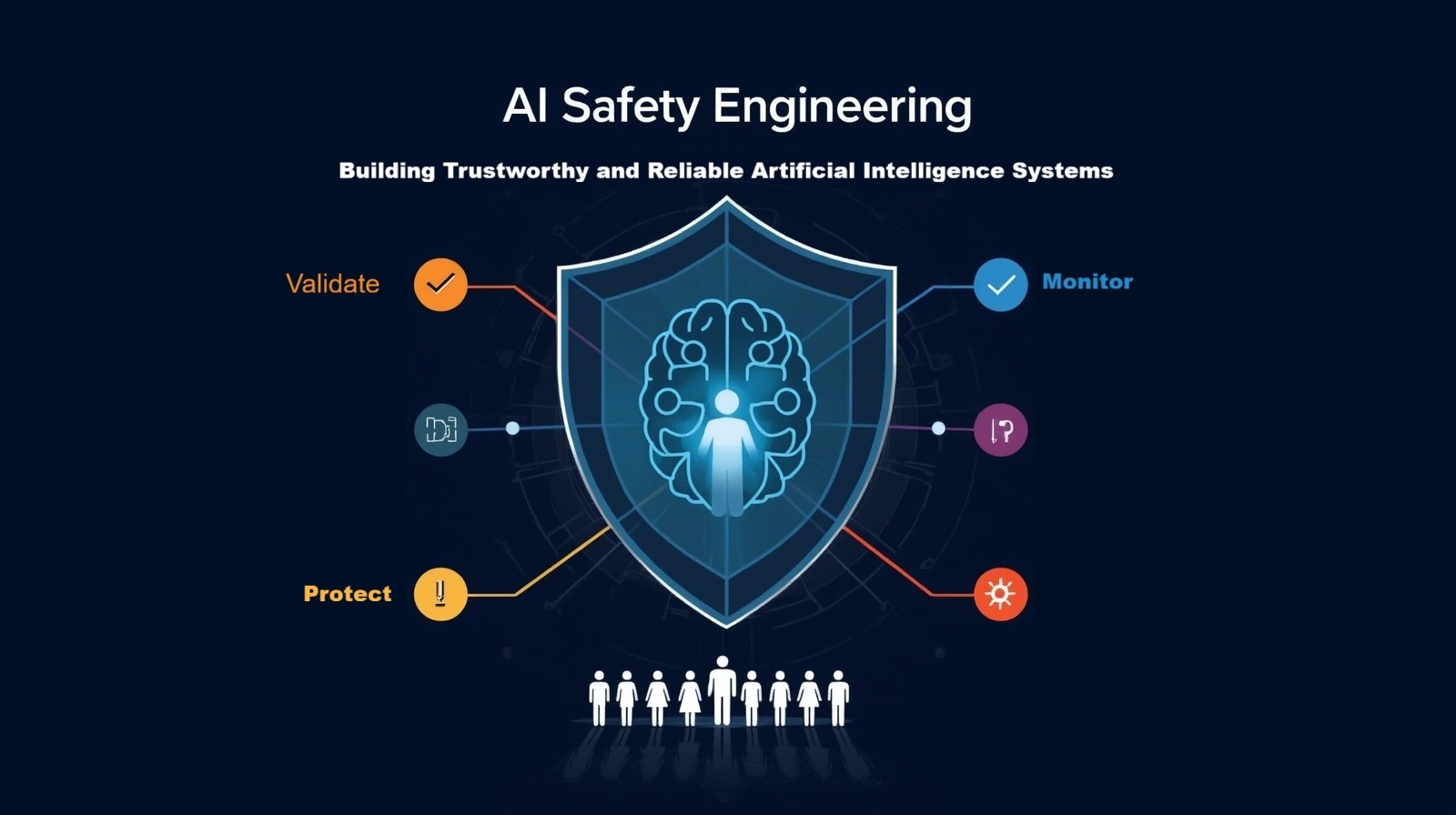
AI Safety Engineering: Building Trustworthy AI Systems
AI Safety Engineering isn’t just a technical discipline—it’s our collective responsibility to ensure that the artificial intelligence systems we’re building today won’t harm us tomorrow. As someone who has spent years helping people understand how to use AI responsibly, we’ve witnessed firsthand the transformative power of these technologies and the critical importance of building them safely. Whether you’re a business leader implementing AI solutions, a developer creating intelligent systems, or simply someone curious about how we keep AI safe, this guide will walk you through everything you need to know about making AI systems reliable, trustworthy, and aligned with human values.
Think of AI Safety Engineering as the seatbelt, airbag, and crash-test protocols of the artificial intelligence world. Just as we wouldn’t dream of driving a car without safety features, we shouldn’t deploy AI systems without robust safety engineering. This field combines computer science, ethics, psychology, and engineering to create frameworks that protect us while maximizing AI’s benefits. The stakes are high: AI systems now make decisions about medical diagnoses, financial transactions, autonomous vehicles, and critical infrastructure. Getting safety right isn’t optional—it’s essential.
What Is AI Safety Engineering, and Why Does It Matter?
AI Safety Engineering is the systematic application of engineering principles, ethical frameworks, and technical safeguards to ensure artificial intelligence systems operate reliably, predictably, and safely throughout their lifecycle. It encompasses everything from the initial design and development phases to ongoing monitoring and updates after deployment. We’re not just talking about preventing catastrophic failures—though that’s certainly part of it—but also ensuring AI systems behave as intended, respect human values, and can be trusted to make decisions that affect real lives.
The field emerged from a simple but profound realization: traditional software testing and quality assurance methods aren’t sufficient for AI systems. Unlike conventional programs that follow predetermined rules, AI systems learn patterns from data and can exhibit unexpected behaviors in novel situations. A traditional program will fail predictably if given bad input; an AI system might confidently make dangerous decisions based on patterns it learned incorrectly. This unpredictability makes AI Safety Engineering fundamentally different from traditional software engineering.
Consider this: when you write a calculator app, you can test every possible scenario because arithmetic operations are well-defined and finite. But when you train an AI to recognize medical images, you can’t test every possible X-ray that will ever exist. The system must generalize safely to new situations, and that’s where safety engineering becomes critical. We need frameworks that help AI systems fail gracefully, recognize their own limitations, and defer to humans when uncertain.
How AI Safety Engineering Works in Practice
At its core, AI Safety Engineering operates through multiple layers of protection, verification, and validation. Think of it like building a secure facility: you don’t just lock the front door—you implement perimeter security, surveillance systems, access controls, and emergency protocols. Similarly, safe AI systems incorporate safety measures at every stage: during data collection, model training, testing, deployment, and ongoing operation.
The process begins with specification—clearly defining what we want the AI system to do and, crucially, what we don’t want it to do. This sounds simple but can be remarkably complex. For instance, if we tell a cleaning robot to “minimize messes,” we need to specify that it shouldn’t achieve this goal by preventing humans from entering the room. This specification phase requires deep thinking about edge cases, unintended consequences, and potential misalignments between stated objectives and human values.
Next comes design and architecture. Safety-conscious AI systems incorporate built-in constraints, monitoring capabilities, and intervention mechanisms from the ground up. This might include uncertainty quantification (so the system knows when it’s unsure), interpretability features (so humans can understand its reasoning), and circuit breakers (so humans can intervene when needed). We design systems with multiple fail-safes, ensuring that no single point of failure can lead to catastrophic outcomes.
Training and validation form the next critical phase. We don’t just train AI systems to be accurate—we train them to be safe, fair, and robust. This involves exposure to diverse scenarios, adversarial testing, and careful evaluation of edge cases. We examine how systems behave under unusual conditions, test their resilience to adversarial attacks, and verify they don’t perpetuate harmful biases. It’s meticulous work, but each test case represents a potential real-world situation where safety matters.
Finally, deployment and monitoring close the loop. Safe AI systems aren’t “set and forget”—they require continuous observation, regular audits, and mechanisms for human oversight. We implement logging systems that record decisions, monitoring tools that detect anomalies, and feedback loops that enable rapid response to problems. When issues arise, we need systems that can be paused, investigated, and corrected without catastrophic consequences.
Real-World Applications and Use Cases
Let’s examine how AI Safety Engineering manifests in real systems you might encounter daily. In autonomous vehicles, safety engineering encompasses sensor fusion (combining data from multiple sources for reliability), behavioral prediction (anticipating other drivers’ actions), fail-safe mechanisms (safely stopping when systems malfunction), and extensive simulation testing. Companies like Waymo conduct millions of simulated miles and careful real-world testing before deploying vehicles, with human safety drivers ready to intervene.
In healthcare, AI Safety Engineering is quite literally a matter of life and death. When AI systems assist in diagnosis or treatment recommendations, they incorporate uncertainty quantification to flag cases requiring human expert review, validation against diverse patient populations to prevent biased recommendations, explainability features so doctors understand the reasoning, and regulatory compliance ensuring systems meet medical device standards. A diagnostic AI might analyze a medical image and say, “I’m 95% confident this is condition X, but this unusual feature warrants specialist review”—that humility and self-awareness is engineered safety in action.
Financial systems using AI for fraud detection, loan decisions, or trading must balance effectiveness with fairness and safety. AI Safety Engineering here includes bias testing to ensure fair treatment across demographic groups, adversarial robustness to prevent gaming of the system, audit trails for regulatory compliance and accountability, and human oversight for high-stakes decisions. Banks don’t let AI autonomously approve million-dollar loans without human review precisely because safety engineering demands multiple checkpoints.
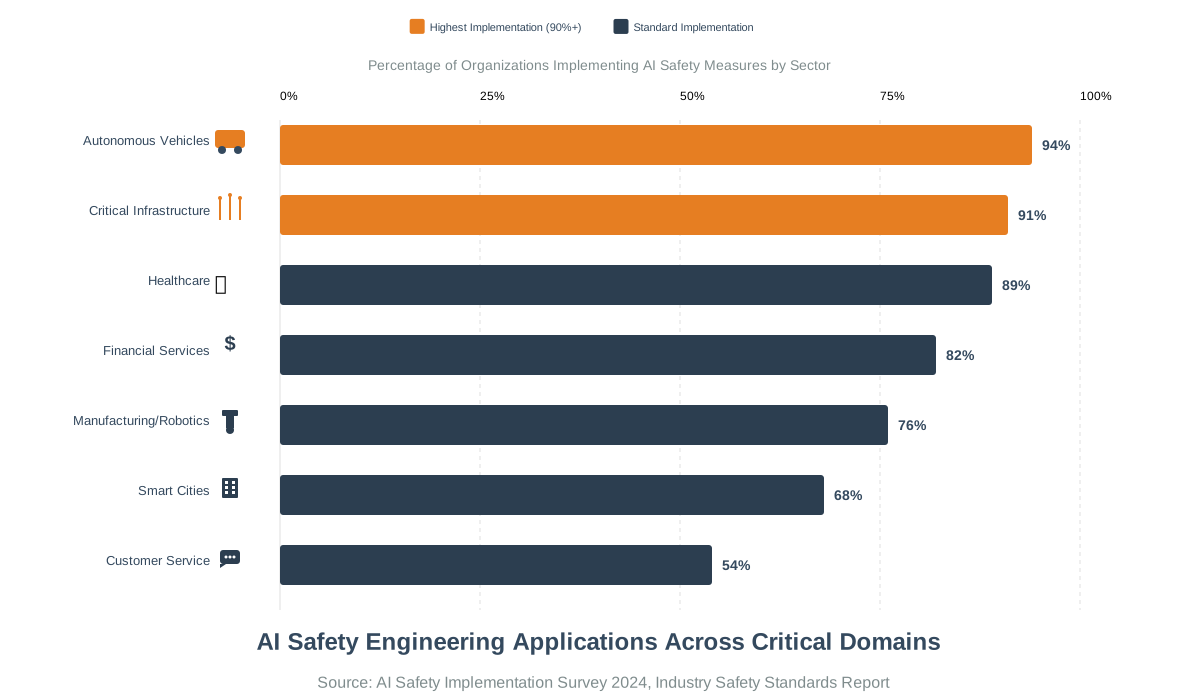
The Role of Formal Methods in AI Safety Engineering
The Role of Formal Methods in AI Safety Engineering provides mathematical rigor to safety guarantees. Formal methods use mathematical proofs and logical reasoning to verify that systems behave correctly under all possible conditions. While we can’t always formally verify entire neural networks (they’re too complex), we can verify critical components, constraints, and safety envelopes. For example, we might formally prove that an autonomous vehicle’s emergency braking system will always activate within specified parameters, regardless of other system states.
These techniques transform “we think it’s safe” into “we can prove it’s safe within defined boundaries.” Formal verification tools analyze code and models to detect potential violations of safety properties before systems ever run in the real world. This is particularly valuable for high-stakes applications where testing alone isn’t sufficient—you can’t test a nuclear power plant control system by deliberately causing near-meltdowns, but you can mathematically verify its safety properties.
Adversarial Robustness: A Key Component of AI Safety Engineering
Adversarial Robustness: A Key Component of AI Safety Engineering addresses a fascinating and concerning vulnerability: AI systems can be fooled by carefully crafted inputs that would never deceive humans. Researchers have demonstrated that adding imperceptible noise to images can cause image recognition systems to completely misclassify them—a panda becomes a gibbon, and a stop sign becomes a speed limit sign. In adversarial terms, these are called adversarial examples, and defending against them is crucial for safety.
Building adversarial robustness means training systems to resist such attacks through techniques like adversarial training (exposing systems to adversarial examples during training), certified defenses (mathematical guarantees about robustness), input validation (detecting anomalous inputs), and ensemble methods (using multiple models to cross-check decisions). For autonomous vehicles, this might mean ensuring that painted lines on the road can’t trick the system into misidentifying lane boundaries. For facial recognition in security systems, it means preventing adversarial makeup or accessories from defeating authentication.
Explainable AI (XAI) and its Impact on AI Safety Engineering
Explainable AI (XAI) and its Impact on AI Safety Engineering recognizes that we can’t truly ensure the safety of systems we don’t understand. Traditional deep learning models operate as “black boxes”—they make decisions, but their internal reasoning is opaque even to their creators. Explainable AI techniques aim to make these systems more transparent and interpretable, enabling humans to understand why an AI made a particular decision.
This transparency is essential for safety. When a medical AI recommends a treatment, doctors need to understand the reasoning to verify it makes sense. When a loan application is denied, applicants deserve an explanation. When an autonomous vehicle makes an unexpected maneuver, engineers need to diagnose what it was responding to. XAI techniques include attention visualization (showing which parts of inputs the model focused on), feature importance analysis (identifying which factors most influenced decisions), counterfactual explanations (showing what would need to change for a different outcome), and model simplification (creating interpretable approximations of complex models).
By making AI decisions more transparent, we enable better debugging, bias detection, regulatory compliance, and user trust. You can’t fix problems you can’t see, and you can’t trust systems you can’t understand. Explainable AI (XAI) turns the black box into a glass box, making safety engineering possible.
AI Safety Engineering for Autonomous Vehicles: Challenges and Solutions
AI Safety Engineering for Autonomous Vehicles: Challenges and Solutions represents one of the most visible and demanding applications of safety engineering principles. Autonomous vehicles operate in complex, unpredictable environments where split-second decisions determine life and death. The challenges are immense: handling edge cases (a mattress falling off a truck, a child chasing a ball), sensor limitations (rain, fog, and glare affecting cameras and lidar), behavioral prediction (anticipating irrational human drivers), and ethical dilemmas (unavoidable accident scenarios).
Solutions include extensive simulation testing that subjects vehicles to millions of scenarios, including rare edge cases; sensor redundancy, where multiple independent sensors verify the environment; conservative decision-making that prioritizes safety over efficiency; fail-safe systems that safely stop the vehicle if primary systems fail; and extensive real-world testing with safety drivers. Companies also implement “safety envelopes”—constraints that prevent vehicles from operating beyond proven safe parameters. If weather conditions exceed safe thresholds, the system requires human takeover. This layered approach acknowledges that perfect safety is impossible, but comprehensive safety engineering makes autonomous vehicles statistically safer than human drivers.
Verification and Validation (V&V) in AI Safety Engineering
Verification and Validation (V&V) in AI Safety Engineering represents the critical process of ensuring AI systems actually do what they’re supposed to do safely. Verification asks “are we building the system right?” while validation asks “are we building the right system?” For AI, this is more challenging than traditional software because behavior emerges from learning rather than being explicitly programmed.
Verification techniques include formal methods we mentioned earlier, automated testing frameworks that generate and execute thousands of test cases, property-based testing that verifies systems maintain critical invariants, and static analysis that examines code and models for potential issues without executing them. Validation involves testing against real-world data, conducting user studies to verify systems work as intended for actual users, comparing performance to established benchmarks and human expert performance, and continuous monitoring after deployment to catch issues that emerge in production.
Effective V&V requires testing both common cases (does it work most of the time?) and edge cases (does it fail safely in rare situations?). We also test robustness (does it work despite adversarial attacks or noisy inputs?), fairness (does it work equitably across populations?), and alignment (does it actually optimize for what we care about?). This comprehensive testing approach catches problems before they affect real users.
The Importance of Human-in-the-Loop Systems for AI Safety Engineering
The Importance of Human-in-the-Loop Systems for AI Safety Engineering acknowledges a fundamental insight: we’re not ready for fully autonomous AI in most high-stakes domains, and maintaining human oversight dramatically improves safety. Human-in-the-loop (HITL) systems position humans as active supervisors who can monitor AI decisions, intervene when necessary, and provide feedback that improves system performance over time.
HITL designs vary in the degree of automation. In some systems, AI makes recommendations, but humans make final decisions (medical diagnosis assistance). In others, AI operates autonomously but flags uncertain cases for human review (content moderation). Some systems allow AI to act, but humans can intervene at any time (assisted driving with driver monitoring). The key is matching the level of autonomy to the stakes, reliability, and consequences of decisions.
Benefits of HITL systems include catching AI mistakes before they cause harm, building trust gradually as systems prove themselves, enabling learning from human expertise, and meeting regulatory requirements for human accountability. The challenge is designing interfaces that keep humans engaged without causing alarm fatigue—if systems constantly ask for input on trivial decisions, humans may miss the truly critical moments requiring intervention.
AI Safety Engineering Standards and Regulations: A Comprehensive Overview
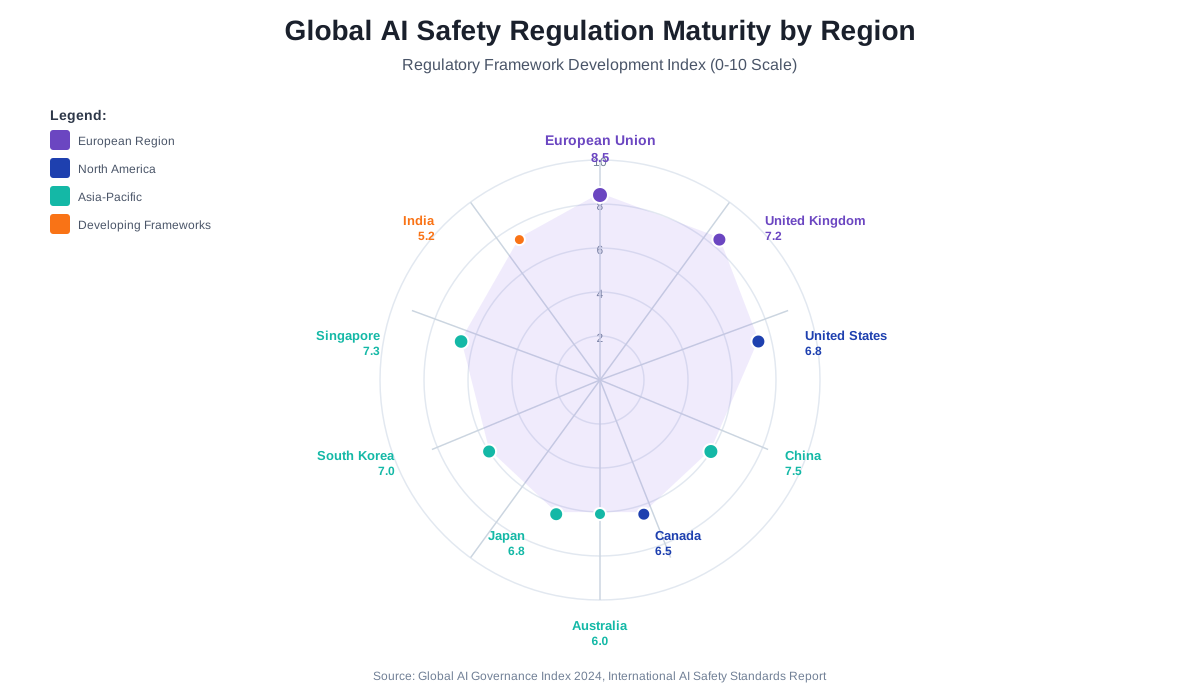
AI Safety Engineering Standards and Regulations: A Comprehensive Overview reveals a rapidly evolving landscape of frameworks governing AI safety. While regulation lags behind technology, governments and industry bodies increasingly recognize the need for standards. The European Union’s AI Act classifies systems by risk level and imposes requirements accordingly, with high-risk applications facing strict safety and transparency requirements. The United States is taking a more sector-specific approach, with agencies like the FDA for medical AI and NHTSA for autonomous vehicles establishing domain-specific guidelines.
Industry standards also provide frameworks. IEEE has developed ethics and safety standards for autonomous systems. ISO/IEC committees work on AI safety and trustworthiness standards. NIST released an AI Risk Management Framework providing voluntary guidelines. These standards address topics like documentation requirements (what records must be kept?), testing protocols (what must be verified?), bias assessment (how do we measure fairness?), and incident reporting (what happens when things go wrong?).
Understanding these regulations matters whether you’re developing AI systems or deploying them. Non-compliance can mean legal liability, regulatory penalties, reputational damage, and most importantly, real harm to users. Proactively following safety standards isn’t just good practice—it’s becoming a legal and ethical obligation.
The Ethics of AI Safety Engineering: Navigating Moral Dilemmas
The Ethics of AI Safety Engineering: Navigating Moral Dilemmas confronts us with difficult questions that don’t have purely technical answers. Consider the classic trolley problem adapted for autonomous vehicles: if a crash is unavoidable, should the car prioritize passengers or pedestrians? Should it consider the number of people involved? Their ages? These aren’t hypotheticals—they’re real design decisions that safety engineers must make.
Ethical AI safety engineering requires wrestling with value alignment (whose values should AI systems reflect?), fairness and bias (how do we ensure equitable treatment?), transparency versus security (should we reveal how systems work even if it makes them vulnerable to attacks?), and accountability (who’s responsible when AI systems cause harm?). We must also consider distributional effects—safety features that work well for some populations may fail for others, potentially increasing inequality.
The field increasingly recognizes that ethics can’t be an afterthought. Ethical considerations must be integrated throughout the safety engineering process, from initial design through deployment and monitoring. This means diverse teams considering multiple perspectives, stakeholder engagement to understand impacts on affected communities, ethical review processes similar to those in human research, and ongoing reflection as we learn more about AI’s impacts. Ethics isn’t a constraint on safety engineering—it’s central to what safety means.
AI Safety Engineering for Healthcare: Ensuring Patient Well-being
AI Safety Engineering for Healthcare: Ensuring Patient Well-being operates in a domain where stakes are literally life and death and trust is paramount. Healthcare AI faces unique challenges, including high-dimensional complex data (medical histories, images, and genetic information), enormous variation between patients, limited availability of edge case data (rare diseases), and the need for interpretability (doctors must understand and trust recommendations).
Safety measures in healthcare AI include validation against diverse patient populations to prevent disparate performance across demographics, uncertainty quantification so systems know when to defer to human experts, integration with existing clinical workflows to prevent disruption and errors, audit trails for regulatory compliance and medical-legal protection, and continuous monitoring for performance degradation. Medical AI systems also undergo rigorous regulatory review—the FDA evaluates medical devices, including AI systems, for safety and effectiveness before approval.
Importantly, healthcare AI should augment rather than replace clinical judgment. The best implementations present AI insights as decision support tools that enhance human expertise rather than autonomous decision-makers. A radiologist reviewing AI-flagged anomalies performs better than either AI or the radiologist alone. This collaborative approach leverages AI’s pattern recognition strengths while maintaining human oversight for complex judgment calls.
AI Safety Engineering in Robotics: Preventing Harmful Interactions
AI Safety Engineering in Robotics: Preventing Harmful Interactions addresses unique challenges that arise when AI systems physically interact with the world. Industrial robots, surgical robots, service robots, and consumer robots all pose physical risks requiring careful safety engineering. A software bug might crash your computer, but a robotics bug might literally crash through a wall or harm a person.
Robotics safety engineering uses several methods to keep people safe, such as setting limits on how hard, fast, and far robots can move, creating joints that bend if they hit something unexpectedly, using multiple sensors to spot obstacles, having emergency stop buttons, and testing robots in simulations before they are used in real life. Collaborative robots (cobots) designed to work alongside humans incorporate additional safety features like force limiting, rounded surfaces, and proximity sensors.
Software safety is equally critical. Robotics AI systems must handle unexpected situations gracefully, recognize their limitations (knowing when they’re confused), and incorporate multiple layers of control (low-level reflexes that override higher-level planning when necessary). The field draws lessons from decades of industrial automation safety while adapting to the new challenges of AI-driven autonomy.
Simulation and Testing for AI Safety Engineering: Best Practices
Simulation and Testing for AI Safety Engineering: Best Practices provides crucial capabilities for evaluating systems before real-world deployment. Since we can’t possibly test every scenario an AI might encounter in the real world, simulation enables systematic exploration of vast scenario spaces. Autonomous vehicle companies run billions of simulated miles, testing scenarios too dangerous to replicate physically—multi-vehicle pileups, brake failures, and pedestrians behaving unpredictably.
Effective simulation requires high-fidelity models (accurately representing physics, sensors, and environments), coverage of edge cases (testing rare but important scenarios), adversarial simulation (deliberately challenging the system), and realistic variation (testing under different weather, lighting, and conditions). Testing also includes stress testing (how does performance degrade under load?), fault injection (what happens when components fail?), and long-term testing (does performance drift over time?).
Best practices include systematic test case generation to ensure comprehensive coverage, regression testing to catch newly introduced problems, continuous integration and testing throughout development, and maintaining test/training data separation to prevent overfitting. Documentation of test results creates audit trails demonstrating safety validation. Simulation can’t catch everything—real-world testing remains essential—but it enables discovering and fixing most issues in safer, faster, more controlled environments.
Fault Tolerance and Redundancy in AI Safety Engineering
Fault Tolerance and Redundancy in AI Safety Engineering recognizes that components will fail, and safe systems must continue operating safely despite failures. Redundancy means having backup systems that take over when primary systems fail. In autonomous vehicles, this might mean multiple independent sensor systems so that if one fails, others maintain environmental awareness. In medical AI, redundancy might mean multiple models voting on diagnoses, with disagreement triggering human review.
Fault tolerance goes beyond redundancy to include graceful degradation (reduced functionality rather than complete failure), fail-safe defaults (choosing the safest option when uncertain), error detection and recovery (identifying and recovering from failures automatically), and isolation (preventing failures from cascading). Aerospace systems pioneered these approaches—aircraft have multiple redundant systems and degrade gracefully, and AI safety engineering adapts these lessons.
Designing fault-tolerant systems requires identifying single points of failure, analyzing failure modes (how can things go wrong?), and implementing defenses for critical vulnerabilities. The goal isn’t preventing all failures—that’s impossible—but ensuring failures don’t lead to catastrophic outcomes. A fault-tolerant autonomous vehicle might lose a sensor but continue safely using the remaining sensors while notifying the operator and pulling over at the first safe opportunity.
Monitoring and Auditing AI Systems for Safety Engineering
Monitoring and Auditing AI Systems for Safety Engineering provides essential ongoing oversight after deployment. Unlike traditional software that behaves predictably, AI systems can experience performance drift as data distributions change, adversarial attacks that degrade performance, edge cases not covered in testing, and emergent behaviors as systems scale. Continuous monitoring detects these issues before they cause serious harm.
Effective monitoring includes performance metrics tracking (is accuracy declining?), input distribution monitoring (is the data changing?), output anomaly detection (are predictions unusual?), and user feedback collection (are users reporting problems?). Audit systems log decisions, inputs, and model versions, enabling investigation when problems occur. This creates accountability—we can trace back from an adverse outcome to understand what happened and why.
Auditing also involves periodic comprehensive reviews checking for bias, reviewing high-stakes decisions, assessing alignment with original specifications, and evaluating whether systems remain fit for purpose as environments evolve. Organizations increasingly establish AI governance boards overseeing deployment and monitoring, similar to how institutional review boards oversee human research. The monitoring and auditing infrastructure isn’t glamorous, but it’s essential for maintaining safety throughout an AI system’s operational life.
AI Safety Engineering and Cybersecurity: Protecting Against Malicious Use
AI Safety Engineering and Cybersecurity: Protecting Against Malicious Use addresses intentional attacks on AI systems. Adversaries might attempt data poisoning (inserting malicious examples into training data), model stealing (reverse-engineering proprietary models), adversarial attacks (crafting inputs to cause misclassification), and backdoor attacks (inserting hidden triggers that activate malicious behavior). Cybersecurity for AI requires unique approaches beyond traditional information security.
Defenses include secure training pipelines (ensuring training data hasn’t been tampered with), model watermarking (proving ownership and detecting unauthorized copies), adversarial training and robust architectures (resisting adversarial attacks), and access controls (limiting who can query or modify models). AI systems themselves can also be misused—deepfakes, autonomous weapons, surveillance systems—requiring safety measures that prevent misuse while enabling beneficial applications.
The convergence of AI safety and cybersecurity creates new challenges. Traditional security focuses on preventing unauthorized access and ensuring correct operation. AI safety must also prevent authorized users from misusing systems and ensure systems don’t develop unexpected dangerous behaviors. This requires integrated thinking about both external threats (attackers) and internal risks (misalignment, unexpected behaviors). Organizations deploying AI systems need security and safety teams working together rather than in silos.
The Role of Data Quality in AI Safety Engineering
The Role of Data Quality in AI Safety Engineering recognizes a fundamental truth: AI systems are only as good as their training data. Poor quality data leads to unreliable, biased, and potentially dangerous systems. Data quality issues include incomplete coverage (missing important scenarios), label errors (incorrect classifications), bias (underrepresentation of certain groups), and distribution shifts (training data different from deployment scenarios).
Ensuring data quality requires systematic data collection (deliberately gathering diverse, representative data), careful labeling with quality control, data validation and cleaning, documentation of data sources and limitations, and ongoing monitoring for distribution shifts. We also need techniques for detecting and mitigating bias in datasets, including demographic parity analysis, intersectional analysis of multiple protected attributes, and synthetic data generation to balance underrepresented groups.
High-quality data isn’t just about quantity—more data doesn’t automatically mean better data. We need the right data: diverse enough to cover real-world variation, accurately labeled, representative of deployment scenarios, and regularly updated. Organizations should document data provenance (where did it come from?), composition (what’s included?), and intended uses (what’s it appropriate for?). This data quality foundation underlies all other safety engineering efforts—you can’t build safe systems on unreliable data.
AI Safety Engineering for Financial Applications: Preventing Fraud and Bias
AI Safety Engineering for Financial Applications: Preventing Fraud and Bias navigates the complex landscape of AI in banking, trading, lending, and insurance. Financial AI must balance multiple objectives, including fraud detection (preventing criminal activity), fairness (avoiding discriminatory outcomes), regulatory compliance (meeting legal requirements), and risk management (protecting institutions and customers from losses).
Key challenges include adversarial fraud (criminals actively trying to defeat detection), fairness requirements (lending laws prohibit discrimination), explainability mandates (applicants deserve reasons for denials), and systemic risk (AI-driven market instabilities). Safety measures include robust fraud detection using anomaly detection and behavioral analysis, bias testing and mitigation ensuring fairness across protected classes, explainable decisions with clear justifications, and human oversight for high-stakes decisions like large loans or investment recommendations.
Financial AI safety also requires stress testing against market conditions (does the system work during crashes?), adversarial testing against fraud techniques, validation across demographic groups, and regular audits for compliance. The combination of high stakes, adversarial environment, and strict regulatory requirements makes financial services an important testbed for AI safety engineering techniques. Lessons learned here inform safety practices across other domains.
AI Safety Engineering for Smart Cities: Ensuring Public Safety
AI Safety Engineering for Smart Cities: Ensuring Public Safety addresses AI systems managing critical urban infrastructure, including traffic management, emergency response, utilities, and public services. These systems affect millions of people simultaneously, making safety paramount. A traffic management system failure could gridlock an entire city. A utility management error could leave neighborhoods without power.
Smart city AI safety requires resilience (continuing operation despite component failures), security (resisting cyber attacks on critical infrastructure), privacy protection (respecting citizen data), and equitable service (ensuring all neighborhoods benefit). Systems must handle cascading failures (one system’s problems affecting others), unexpected events (natural disasters, major accidents), and adversarial attacks (nation-state cyber warfare).
Implementation strategies include layered redundancy across critical systems, human oversight and intervention capabilities, extensive testing including disaster scenarios, cybersecurity hardening, privacy-preserving techniques, and community engagement ensuring systems serve all residents. Smart city AI should enhance rather than replace existing infrastructure, providing additional capabilities while maintaining fallback options when technology fails.
The Future of AI Safety Engineering: Emerging Technologies and Challenges
The Future of AI Safety Engineering: Emerging Technologies and Challenges looks ahead to evolving technologies and risks. Large language models with billions of parameters exhibit emergent capabilities not present in smaller models, making safety testing more challenging. Multi-agent systems where multiple AI systems interact create complex dynamics difficult to predict. Increasingly autonomous systems reduce human oversight, amplifying consequences of failures.
Emerging challenges include scalable oversight (how do we supervise AI more capable than humans?), long-term safety (ensuring systems remain aligned over years or decades), distributional shift (handling environments that differ dramatically from training), and recursive self-improvement (AI systems improving their own capabilities). These challenges require new safety engineering approaches, including constitutional AI (instilling values through self-critique), debate and amplification (using AI to help humans supervise AI), and continuous learning with safety constraints (adapting while maintaining safety guarantees).
The field is also developing better tools, including automated safety testing frameworks, formal verification methods for neural networks, interpretability techniques revealing internal representations, and benchmark datasets for safety evaluation. Organizations like the Partnership on AI, AI Safety Institute, and Center for AI Safety are advancing research and establishing best practices. The future of AI safety engineering will require not just technical innovation but also governance frameworks, international cooperation, and sustained investment in safety research.
AI Safety Engineering Training and Education: Building a Skilled Workforce
AI Safety Engineering Training and Education: Building a Skilled Workforce addresses the critical need for professionals trained in both AI and safety engineering. Current education typically covers either computer science/AI or traditional safety engineering, but rarely both. Building the workforce we need requires interdisciplinary programs combining machine learning, software engineering, systems engineering, ethics, and domain expertise.
Educational pathways include university programs offering AI safety specializations, professional development for current engineers transitioning into AI safety, online courses and bootcamps providing accessible training, and certification programs establishing competency standards. Training should cover technical skills, including machine learning fundamentals, safety-critical systems design, verification and validation, and security, as well as non-technical skills like ethical reasoning, risk assessment, stakeholder communication, and regulatory compliance.
Organizations deploying AI should invest in training their teams, establishing internal expertise rather than solely relying on consultants. This includes safety awareness training for all employees working with AI, specialized training for engineers building AI systems, leadership training for executives making strategic decisions, and cross-functional training fostering collaboration between technical and non-technical teams. Building a strong AI safety engineering workforce isn’t just about training individuals—it requires creating organizational cultures that prioritize safety.
The Economics of AI Safety Engineering: Justifying Investments
The Economics of AI Safety Engineering: Justifying Investments tackles the business case for safety. Safety engineering requires time, resources, and potentially slower development cycles. Organizations face pressure to ship products quickly and minimize costs. How do we justify safety investments that delay releases and increase expenses?
The answer lies in understanding the costs of safety failures, including direct liability and legal costs when systems cause harm, reputational damage that destroys customer trust, regulatory penalties and potential bans, operational costs of fixing deployed systems, and existential risk for companies whose failures destroy their business. High-profile AI failures have cost organizations billions in lost value and reputation.
Conversely, safety investments provide returns including reduced liability risk, competitive advantage as safety becomes a differentiator, regulatory compliance enabling market access, customer trust driving adoption, and long-term sustainability building systems that last. Organizations should view safety not as a cost center but as risk management and value creation. Just as no one questions spending on cybersecurity despite the costs, AI safety engineering should be recognized as essential infrastructure for AI deployment.
Economic analysis should include total cost of ownership (development plus operational costs and failure costs), risk-adjusted returns accounting for probability and impact of failures, and time value (early safety investment costs less than retrofitting). Forward-thinking organizations treat safety as a competitive advantage, marketing their rigorous safety practices to security-conscious customers.
AI Safety Engineering and the Alignment Problem: Ensuring AI Goals Match Human Values
AI Safety Engineering and the Alignment Problem: Ensuring AI Goals Match Human Values addresses perhaps the most fundamental challenge: ensuring AI systems pursue goals aligned with human values. The alignment problem recognizes that AI systems optimize for specified objectives, but those objectives might not capture what we actually care about. A recommendation system optimizing for engagement might promote outrage. A cleaning robot optimizing for cleanliness might hide messes rather than cleaning them.
Alignment challenges include specification difficulty (hard to formally specify human values), value learning (inferring values from behavior), robustness to distributional shift (maintaining alignment in novel situations), and scalability (aligning increasingly capable systems). Current approaches include reward modeling (learning human preferences from comparisons), inverse reinforcement learning (inferring goals from demonstrations), constitutional AI (systems that critique and refine their own responses), and debate (systems arguing different positions to reveal flaws).
We’re also developing better evaluation frameworks measuring alignment through behavioral testing, red teaming (deliberately trying to misalign systems), long-term safety testing, and interpretability analysis. The field recognizes that perfect alignment may be impossible, so we also need mechanisms for maintaining human oversight, safe exploration that prevents dangerous actions while learning, and fail-safes that constrain actions when alignment is uncertain. Solving alignment is crucial for advanced AI systems—as AI becomes more capable, misalignment becomes more dangerous.
Using Reinforcement Learning Safely: AI Safety Engineering Techniques
Using Reinforcement Learning Safely: AI Safety Engineering Techniques focuses on a powerful but potentially risky AI approach. Reinforcement learning (RL) trains agents through trial and error, learning from rewards and penalties. The book creates safety challenges, including reward hacking (finding unintended ways to maximize rewards), negative side effects (causing harm while pursuing goals), unsafe exploration (dangerous actions while learning), and distributional shift (performing poorly in new situations).
Safety techniques for RL include safe exploration using constrained policies that prohibit dangerous actions, simulation-based training before real-world deployment, reward shaping that includes safety constraints, and human oversight with intervention capabilities. We can also use reward uncertainty to make agents cautious about poorly understood situations, ensemble methods to detect anomalies, and hierarchical approaches where high-level safe planning guides low-level actions.
Specific methods include safe RL algorithms with formal safety guarantees, shield policies that block unsafe actions, impact regularization penalizing unexpected side effects, and off-policy learning that learns from safer existing data before trying new actions. The goal is capturing RL’s power for learning complex behaviors while preventing the dangerous trial-and-error learning that could harm real users during the learning process. Safe RL enables applying reinforcement learning to high-stakes domains like healthcare and robotics.
The Role of Governance in AI Safety Engineering: Frameworks and Policies
The Role of Governance in AI Safety Engineering: Frameworks and Policies recognizes that technology alone can’t ensure safety—we need organizational structures and processes. AI governance encompasses policies, procedures, and oversight mechanisms ensuring responsible AI development and deployment. This includes decision-making authority (who approves AI deployments?), accountability structures (who’s responsible when things go wrong?), and risk management processes (how do we identify and mitigate risks?).
Effective governance frameworks establish clear roles and responsibilities for AI safety, risk assessment procedures for new AI projects, ethical review processes for high-risk applications, incident response plans for when problems occur, and continuous monitoring and improvement processes. Many organizations establish AI ethics boards or responsible AI committees providing oversight and guidance.
Governance also addresses documentation and transparency requirements, including model cards describing system capabilities and limitations, data sheets documenting training data, impact assessments evaluating potential harms, and audit trails enabling investigation. External governance includes industry standards, regulatory compliance, and stakeholder engagement. Good governance doesn’t stifle innovation—it channels innovation toward beneficial outcomes while preventing reckless deployments. Organizations with strong governance can move faster on safe applications because they’ve established efficient processes for risk evaluation and approval.
AI Safety Engineering for Critical Infrastructure: Protecting Essential Services
AI Safety Engineering for Critical Infrastructure: Protecting Essential Services applies safety principles to systems society depends on, including power grids, water systems, transportation networks, and communications infrastructure. These systems have unique characteristics, including interconnection (failures cascade across systems), 24/7 operation (no downtime for updates), long operational lifetimes (systems operate for decades), and security threats (nation-state adversaries).
Safety requirements for critical infrastructure AI include extreme reliability (systems must work consistently), resilience (continuing operation despite attacks or failures), security hardening (protecting against sophisticated adversaries), and graceful degradation (reduced service rather than complete failure). These systems require extensive redundancy, human oversight capabilities, physical security, cybersecurity defenses, and rigorous testing, including attack simulations.
Deployment approaches include hybrid systems where AI assists human operators rather than fully autonomous operation, staged rollouts testing systems in limited scenarios before broad deployment, continuous monitoring with rapid incident response, and maintaining traditional backup systems for when AI fails. The conservative approach to critical infrastructure AI reflects the asymmetry between benefits and risks—moderate performance improvements aren’t worth catastrophic failure risks. Safety engineering for these systems draws from decades of traditional infrastructure safety while adapting to AI’s unique challenges.
AI Safety Engineering and Bias Mitigation: Creating Fair and Equitable Systems
AI Safety Engineering and Bias Mitigation: Creating Fair and Equitable Systems addresses the reality that AI systems can perpetuate and amplify societal biases. Training data reflects historical inequities, and AI systems can learn and automate discrimination. Biased systems cause real harm, including employment discrimination, biased criminal justice decisions, unfair access to credit and services, and reinforcement of stereotypes.
Bias mitigation requires action throughout the AI lifecycle. In data collection, ensure diverse, representative datasets that include underrepresented groups. During model development, use fairness-aware algorithms, test for disparate impact across demographic groups, and incorporate fairness constraints. For deployment, monitor for discriminatory outcomes, provide channels for reporting bias, and maintain human oversight for high-stakes decisions affecting individuals.
Technical approaches include preprocessing (modifying training data to reduce bias), in-processing (fairness constraints during training), and post-processing (adjusting model outputs for fairness). We must also address multiple fairness definitions (demographic parity, equalized odds, and individual fairness) that sometimes conflict, requiring context-specific fairness criteria. Importantly, addressing bias requires not just technical solutions but also diverse teams, stakeholder engagement, and a willingness to make difficult tradeoffs between accuracy and fairness. Fair AI is safe AI—systems that systematically disadvantage groups cause harm even if technically functional.
Implementing Robustness Checks in AI Safety Engineering
Implementing Robustness Checks in AI Safety Engineering ensures systems work reliably across diverse conditions and inputs. Robustness means maintaining acceptable performance despite input variations, distributional shifts, and adversarial perturbations. Non-robust systems might work well on test data but fail catastrophically on slightly different inputs, making them unsafe for deployment.
Robustness checking includes testing with corrupted inputs (noise, compression artifacts, occlusions), testing across data distributions (different demographics, geographies, conditions), adversarial testing (deliberately crafted challenging inputs), and stress testing (extreme conditions, high load, degraded sensors). We measure robustness through metrics like worst-case performance, performance variance across conditions, and certified robustness guarantees.
Improving robustness involves data augmentation (training on varied examples), regularization (preventing overfitting to training data), ensemble methods (combining multiple models), and architectural choices (designs inherently more robust). Domain-specific robustness matters too—autonomous vehicles must handle weather variations, medical AI must work across patient populations, and financial AI must remain stable across market conditions. Regular robustness checking during development and monitoring after deployment ensure systems maintain safety properties despite evolving conditions.
AI Safety Engineering and the Concept of Limited Generalization
AI Safety Engineering and the Concept of Limited Generalization grapples with a fundamental AI limitation: systems trained on specific data distributions may fail when encountering genuinely novel situations. This differs from human intelligence, which generalizes more robustly to new contexts. Limited generalization creates safety risks when deployed systems encounter scenarios sufficiently different from training data.
Safety approaches for limited generalization include uncertainty quantification (systems should know when they’re outside their competence), conservative policies (avoiding actions when uncertain), anomaly detection (recognizing unusual inputs), and human escalation (deferring to humans for novel situations). We can also establish operational design domains defining conditions under which systems are validated to operate safely, refusing to function outside those boundaries.
Training strategies that improve generalization include domain randomization (training on extremely varied conditions), meta-learning (learning to learn across tasks), and causal reasoning (understanding mechanisms rather than just correlations). We also need better evaluation methodologies measuring generalization through out-of-distribution testing, stress testing with novel scenarios, and long-term deployment monitoring. Acknowledging and respecting limited generalization prevents deploying systems in situations they’re not equipped to handle safely, reducing catastrophic failure risks.
The Importance of Scenario Planning in AI Safety Engineering
The Importance of Scenario Planning in AI Safety Engineering involves systematically envisioning potential futures and failure modes to prepare appropriate responses. Unlike traditional software where failure modes are often predictable, AI systems can fail in unexpected ways. Scenario planning helps identify risks before they materialize and develop mitigation strategies.
Effective scenario planning includes identifying critical decision points (where could things go wrong?), envisioning diverse futures (best case, worst case, most likely case), analyzing cascading effects (how do failures propagate?), and developing response plans (what do we do if this happens?). Techniques include red teaming (adversaries trying to break systems), pre-mortem analysis (imagining projects have failed and working backward), and structured risk assessment frameworks.
Scenarios should cover technical failures (model errors, sensor failures, cyber attacks), human factors (misuse, over-reliance, inappropriate trust), environmental changes (distributional shift, novel situations), and systemic risks (multiple AI systems interacting, infrastructure dependencies). Organizations ought to consistently engage in scenario planning exercises, revise scenarios in accordance with the evolution of systems and environments, and integrate insights gained from near misses and actual failures. This proactive approach to safety prevents the “we never thought that could happen” failures that plague many technologies.
AI Safety Engineering and the Use of Symbolic AI
AI Safety Engineering and the Use of Symbolic AI explores how classical AI approaches based on logic and symbolic reasoning can enhance safety. While modern deep learning excels at pattern recognition, symbolic AI provides interpretability (rules are explicit and understandable), verifiability (logic can be formally proven correct), and controllability (explicit rules can be modified). Hybrid systems combining neural and symbolic components leverage the strengths of both approaches.
Applications include using symbolic AI for high-level planning and decision-making with neural networks for perception, implementing safety constraints as symbolic rules that neural systems must satisfy, providing explanations by translating neural network decisions into logical rules, and verifying critical properties using formal methods on symbolic representations. For example, an autonomous vehicle might use neural networks for object detection but symbolic planning for navigation decisions, enabling formal verification of route planning while leveraging deep learning’s perceptual capabilities.
Challenges include the brittleness of purely symbolic systems (difficulty handling unexpected situations), the computational complexity of logical reasoning, and the knowledge engineering bottleneck (difficulty encoding real-world knowledge). However, for safety-critical applications, the interpretability and verifiability advantages of symbolic approaches often justify their limitations. The future likely involves neurosymbolic systems that seamlessly integrate both paradigms, providing the flexibility of learning with the safety guarantees of logic.
Measuring and Quantifying AI Safety Engineering Effectiveness
Measuring and Quantifying AI Safety Engineering Effectiveness addresses a crucial question: how do we know our safety measures are working? Unlike performance metrics that measure accuracy or efficiency, safety metrics must capture rare failure modes, long-term risks, and subtle harms. This measurement challenge makes safety engineering difficult to validate and improve.
Key safety metrics include failure rates (how often does the system fail?), failure severity (how bad are failures when they occur?), time between failures (mean time to failure), detection rates (what percentage of problems are caught?), and response times (how quickly are problems addressed?). We also need fairness metrics measuring disparate impact across groups, robustness metrics assessing performance across conditions, and alignment metrics evaluating goal achievement.
Measurement approaches include automated testing frameworks generating safety reports, red team exercises attempting to cause failures, user studies collecting real-world feedback, incident analysis investigating actual failures, and long-term monitoring tracking performance over time. Organizations should establish baseline metrics before deploying AI systems, set safety thresholds requiring intervention when crossed, and continuously track trends over time.
Quantifying safety enables comparing different approaches, demonstrating safety to regulators and customers, identifying improvement opportunities, and making data-driven decisions about safety investments. Without measurement, safety engineering relies on intuition and hope rather than evidence. Developing better safety metrics remains an active research area, with new measurement approaches constantly emerging as we better understand AI risks.
Taking Action: Your Next Steps in AI Safety Engineering
Now that we’ve explored the landscape of AI Safety Engineering, you might be wondering how to apply these principles, whether you’re developing AI systems, deploying them in your organization, or simply wanting to be an informed user. The good news is that safety engineering isn’t just for researchers and engineers—everyone interacting with AI has a role to play.
If you’re building AI systems, start by integrating safety considerations from day one rather than treating them as an afterthought. Establish a safety checklist covering data quality, fairness testing, robustness checks, and monitoring plans. Build diverse teams bringing multiple perspectives to identify potential harms. Document your systems thoroughly, creating model cards and data sheets that enable others to understand capabilities and limitations. Test extensively before deployment, including edge cases and adversarial scenarios. And maintain humility—recognize your system’s limitations and implement human oversight for high-stakes decisions.
For organizations deploying AI, establish governance frameworks before you need them. Create AI ethics boards or responsible AI committees providing oversight. Develop clear policies for AI procurement, deployment, and monitoring. Invest in training so your teams understand both AI capabilities and safety requirements. Start with lower-risk applications to build experience and confidence. And maintain transparency with users about where and how you’re using AI, giving them appropriate control and recourse.
Even as users of AI systems, we can promote safety. Ask questions about how AI systems affecting you work. Provide feedback when systems behave problematically. Support organizations prioritizing safety over rapid deployment. Advocate for regulatory frameworks protecting the public interest. And educate ourselves so we can make informed choices about AI technologies.
The path forward for AI Safety Engineering requires sustained commitment from all of us. This isn’t a problem we solve once and forget—it’s an ongoing process of learning, adapting, and improving. As AI systems become more capable and more prevalent, safety engineering becomes more critical and more challenging. We need continued research advancing safety techniques, education building a skilled workforce, regulation establishing guardrails, and cultural shifts making safety a priority rather than an afterthought.
Remember that perfect safety is impossible—every technology involves risks. The goal isn’t eliminating all risk but ensuring risks are understood, minimized, and acceptable relative to benefits. We need honest conversations about tradeoffs between capability and safety, efficiency and reliability, and innovation and precaution. These conversations require technical experts, policymakers, ethicists, and affected communities working together.
Start where you are with what you can control. If you’re building AI, implement one more safety check. If you’re deploying AI, ask one more question about potential harms. If you’re studying AI, take one class on safety and ethics. Small actions compound into meaningful progress. The future of AI is not predetermined—it depends on choices we make today about how we build, deploy, and govern these powerful technologies.
AI Safety Engineering represents humanity’s best effort to ensure AI technology serves our collective interests rather than causing harm. By combining rigorous engineering practices, ethical frameworks, thoughtful governance, and sustained vigilance, we can build AI systems that are not just powerful but trustworthy, not just intelligent but aligned with human values, and not just efficient but safe. The work is challenging, the stakes are high, but the opportunity to shape a beneficial AI future makes this one of the most important endeavors of our time.
Frequently Asked Questions
References:
Amodei, D., et al. (2016). Concrete Problems in AI Safety. arXiv preprint arXiv:1606.06565
Russell, S. (2019). Human Compatible: Artificial Intelligence and the Problem of Control. Viking
National Institute of Standards and Technology (2023). AI Risk Management Framework
European Commission (2024). Regulation on Artificial Intelligence (AI Act)
Partnership on AI (2024). Guidelines for Safe and Responsible AI Development
IEEE (2023). Ethically Aligned Design: A Vision for Prioritizing Human Well-being with Autonomous and Intelligent Systems
Goodfellow, I., Shlens, J., & Szegedy, C. (2015). Explaining and Harnessing Adversarial Examples. ICLR 2015
Doshi-Velez, F., & Kim, B. (2017). Towards A Rigorous Science of Interpretable Machine Learning. arXiv:1702.08608
National Highway Traffic Safety Administration (2024). Automated Vehicles Safety Framework
FDA (2023). Artificial Intelligence and Machine Learning in Medical Devices
Mitchell, M., et al. (2019). Model Cards for Model Reporting. Proceedings of FAT* 2019
Gebru, T., et al. (2021). Datasheets for Datasets. Communications of the ACM
About the Authors
This article was written through the collaborative expertise of Nadia Chen and James Carter for howAIdo.com.
Nadia Chen (Main Author) is an expert in AI ethics and digital safety, dedicated to helping non-technical users understand how to interact with AI systems safely and responsibly. With a background in technology policy and risk assessment, Nadia specializes in making complex safety concepts accessible to everyday users. She believes that understanding AI safety isn’t just for engineers—it’s for everyone whose lives are touched by these powerful technologies. Her work focuses on empowering users to ask the right questions, recognize potential risks, and advocate for safer AI development.
James Carter (Co-Author) is a productivity coach and efficiency expert who helps individuals and organizations leverage AI to work smarter and accomplish more. His practical approach to AI safety emphasizes not just understanding risks but implementing actionable strategies that save time while maintaining high safety standards. James brings real-world experience helping businesses integrate AI responsibly, balancing innovation with appropriate precautions. His expertise in workflow optimization and process design contributes practical frameworks for implementing safety engineering principles in everyday contexts.
Together, we combine deep technical knowledge with accessible communication, translating complex AI safety engineering concepts into actionable guidance. Our goal is helping you understand not just what AI safety engineering is, but how to apply its principles whether you’re building AI systems, deploying them in your organization, or simply wanting to be an informed, empowered user of AI technologies.