
AI in Transportation: How Smart Tech Is Reshaping Travel
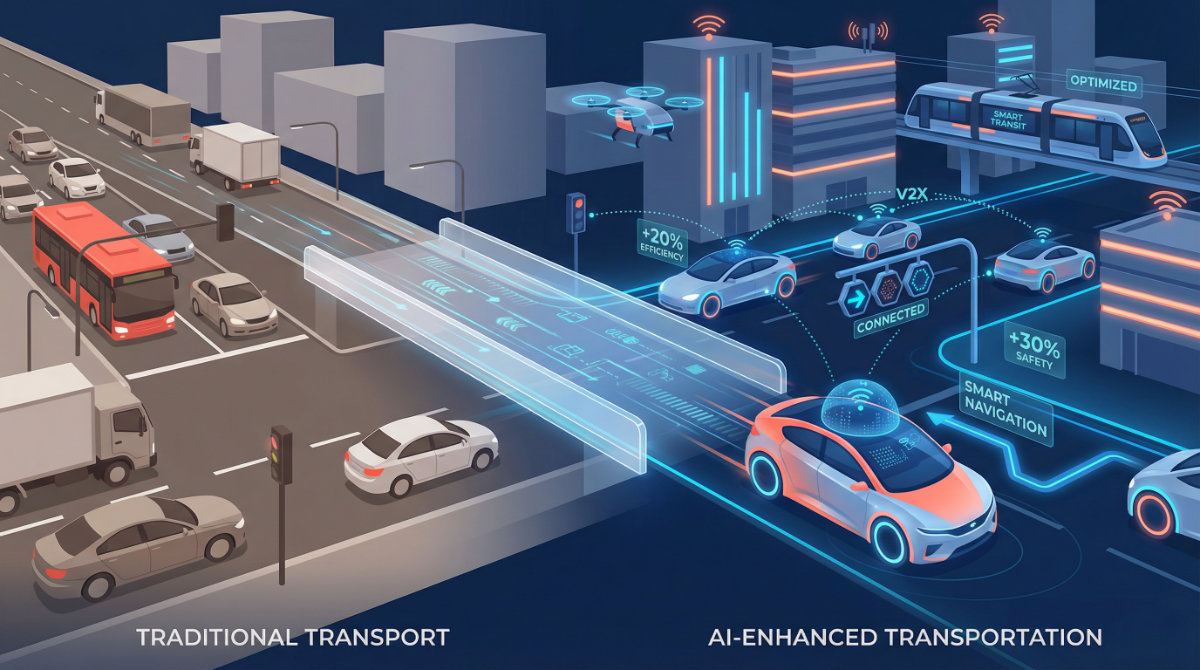
AI in Transportation and Navigation isn’t science fiction anymore—it’s happening right now on streets, in the air, and across waterways worldwide. Whether you’re using GPS to avoid traffic jams, ordering food delivered by an optimized route, or reading about self-driving cars, artificial intelligence is quietly revolutionizing how we move from place to place.
I’ve been tracking transportation technology for years, and the pace of change is remarkable. What once seemed like futuristic fantasy—cars that drive themselves, traffic lights that adapt in real-time, delivery drones navigating cities—is becoming everyday reality. But here’s what matters most: these aren’t just cool gadgets. AI-powered transportation systems are making travel safer, faster, more efficient, and more accessible for everyone.
In this guide, we’ll explore how AI is transforming every aspect of transportation and navigation. Whether you’re a commuter tired of traffic, a business owner managing deliveries, or simply curious about where technology is taking us, you’ll discover practical insights into the AI systems already changing your daily travel—and what’s coming next. This guide will provide clear explanations of how these technologies work and their implications for you, without any technical jargon or complicated theories.
What Is AI in Transportation and Navigation?
At its core, AI in Transportation and Navigation refers to computer systems that can learn, adapt, and make decisions to improve how people and goods move around. Unlike traditional transportation technology that follows fixed rules, AI systems analyze vast amounts of data—traffic patterns, weather conditions, accident reports, vehicle sensors—and continuously improve their performance.
Think of it this way: A regular GPS gives you turn-by-turn directions based on mapped roads. An AI-powered navigation system learns from millions of drivers’ experiences, predicts where traffic will build up before it happens, suggests alternative routes based on your preferences, and adapts recommendations in real-time as conditions change. That’s the difference AI makes.
These intelligent systems operate at every level of transportation: individual vehicles learning to drive themselves, traffic management systems optimizing entire city networks, logistics platforms coordinating thousands of deliveries, and navigation apps personalizing routes for millions of users simultaneously.
The Rise of AI-Powered Autonomous Vehicles: A Comprehensive Guide
Autonomous vehicles represent perhaps the most visible application of AI in transportation. Self-driving cars use a combination of sensors, cameras, radar, and sophisticated AI algorithms to perceive their environment, predict what other road users will do, and navigate safely without human intervention.
The technology works through several interconnected layers. First, sensors create a detailed 3D map of everything around the vehicle—other cars, pedestrians, cyclists, traffic signs, and road markings. Then, AI algorithms process this information to understand what’s happening: Is that pedestrian about to cross? Is the car ahead braking? Next, the system predicts what will happen in the next few seconds and plans the safest, most efficient path forward. Finally, it controls the vehicle’s steering, acceleration, and braking to execute that plan.
Major automakers and tech companies have invested billions in developing autonomous vehicles. Companies like Waymo (Google’s self-driving division), Tesla, Cruise, and traditional manufacturers like Mercedes-Benz and Ford are testing and deploying vehicles with varying levels of automation. Some ride-hailing services already operate autonomous taxis in select cities, with safety drivers monitoring the systems.
The progression toward full autonomy happens in stages, defined by the Society of Automotive Engineers. Level 2 systems, available in many new cars today, can control steering and speed under certain conditions but require constant driver supervision. Level 3 allows the car to handle some situations independently while the driver remains ready to intervene. Level 4 vehicles can drive themselves in specific areas without human intervention, while Level 5 represents full autonomy anywhere under any conditions—a goal still years away.
For everyday drivers, the benefits are compelling: reduced accidents (since AI doesn’t get distracted, tired, or impaired), increased mobility for elderly or disabled individuals, productive travel time instead of focusing on driving, and potentially reduced traffic congestion through coordinated vehicle movements.
AI in Air Traffic Control: Enhancing Safety and Efficiency
Air travel involves coordinating thousands of aircraft simultaneously across vast distances, making it one of transportation’s most complex challenges. AI in air traffic control is transforming this critical system by predicting conflicts, optimizing flight paths, and helping controllers manage increasing air traffic volumes safely.
Traditional air traffic control relies on human controllers monitoring radar displays and communicating with pilots via radio. AI augments this process by analyzing data from multiple sources—aircraft positions, weather conditions, flight plans, airport capacity—to predict potential conflicts before they become dangerous and suggest optimal resolutions.
Machine learning algorithms can process far more variables than human controllers, identifying subtle patterns that might indicate developing problems. For example, AI systems can predict which flights are likely to experience delays based on weather forecasts, airport congestion, and historical patterns, allowing controllers to proactively adjust flight paths and schedules.
Several aviation authorities worldwide are implementing AI-enhanced systems. These technologies help controllers manage airspace more efficiently, reduce fuel consumption by optimizing flight routes, minimize delays by predicting bottlenecks, and maintain safety margins even as air traffic grows.
The human controller remains essential—AI serves as a powerful assistant rather than a replacement. Controllers make final decisions, but AI provides them with better information and more options faster than ever.
AI-Driven Route Optimization for Delivery Services: A Case Study
The explosion of e-commerce has created unprecedented logistics challenges. AI-driven route optimization has become essential for delivery companies managing thousands of packages daily while controlling costs and meeting customer expectations.
Traditional route planning might optimize for shortest distance, but AI considers dozens of factors simultaneously: real-time traffic conditions, delivery time windows, vehicle capacity, driver schedules, fuel efficiency, parking availability, and even customer preferences about delivery times. The system continuously recalculates routes as new orders arrive and conditions change throughout the day.
Companies like Amazon, UPS, and FedEx have invested heavily in AI-powered logistics systems. UPS’s ORION (On-Road Integrated Optimization and Navigation) system analyzes over 200,000 route options for each driver daily, considering factors like left turns (which waste time and fuel), delivery time commitments, and package-loading efficiency. The company reports saving millions of gallons of fuel and reducing delivery times significantly.
For smaller businesses, AI-powered delivery management platforms now make sophisticated route optimization accessible without requiring massive IT investments. These systems integrate with existing operations, learning from each delivery to improve future performance.
The benefits extend beyond cost savings. Optimized routes mean faster deliveries, reduced emissions from shorter distances and less idling, improved customer satisfaction through accurate delivery windows, and better working conditions for drivers who spend less time navigating traffic and searching for addresses.
AI-Powered Navigation Apps: Features, Benefits, and Privacy Concerns
Your smartphone’s navigation app represents one of the most widely adopted AI applications in transportation. AI-powered navigation apps like Google Maps, Waze, and Apple Maps use machine learning to provide personalized, real-time routing that goes far beyond simple map directions.
These apps collect data from millions of users to create constantly updated models of traffic conditions. When your phone’s navigation app is active, it anonymously shares your speed and location with the service. AI algorithms aggregate this data to detect traffic jams, accidents, road closures, and typical travel times for different routes at various times and days. The system learns normal patterns and quickly identifies anomalies.
Advanced features include smart route suggestions that tell you when to leave based on your usual routine and expected traffic, options for different routes that save time while considering how complicated they are, planning trips that mix driving, public transport, walking, and ride-sharing, and even forecasts for parking spots at your destination.
The personalization goes deeper than you might realize. Over time, these apps learn your preferences: Do you prefer highways or local roads? Are you willing to take a longer but more predictable route? Do you typically drive faster or slower than average? The AI adjusts recommendations accordingly.
However, this convenience comes with legitimate privacy considerations. These apps collect detailed location history, movement patterns, frequently visited places, and travel timing. While companies claim to anonymize and aggregate data, the comprehensive picture of your movements raises important questions about data security, potential misuse, and user control over personal information.
Being a mindful user means understanding what you’re sharing. Most navigation apps offer privacy controls—you can limit location tracking to when you’re actively using the app, periodically delete location history, and review what data is being collected. The trade-off between personalized service and privacy is personal, but making that choice requires understanding what’s happening behind the scenes.
AI in Public Transportation: Smart Buses, Trains, and Subways
AI in public transportation is making buses, trains, and subways more reliable, efficient, and responsive to rider needs. Unlike personal vehicles, public transit must balance the needs of many passengers, making optimization particularly challenging—and valuable.
Smart transit systems use AI to predict passenger demand based on historical patterns, events, weather, and real-time conditions. This allows transit agencies to dynamically adjust service frequency, allocate vehicles where they’re most needed, and reduce overcrowding while minimizing empty runs on underused routes.
Predictive maintenance represents another crucial application. AI systems monitor vehicle sensors to detect developing mechanical problems before they cause breakdowns. This prevents service disruptions, reduces maintenance expenses by addressing issues early, and improves safety by identifying potential problems proactively.
Real-time information systems powered by AI provide passengers with accurate arrival predictions, crowding levels, alternative route suggestions during disruptions, and personalized journey planning. Some cities are experimenting with demand-responsive transit that uses AI to create flexible routes based on actual rider requests, combining the efficiency of fixed routes with the convenience of ride-sharing.
Transit agencies in cities worldwide are implementing these technologies. The results include improved on-time performance, reduced operating costs, better passenger experiences, and increased ridership as services become more reliable and convenient.
AI and the Future of Urban Mobility: Solving Congestion and Pollution
Cities face a transportation crisis: growing populations, increasing congestion, deteriorating air quality, and outdated infrastructure. AI and the future of urban mobility offer tools to create more sustainable, efficient, and livable cities.
The concept of “mobility as a service” (MaaS) envisions AI-powered platforms that seamlessly integrate all transportation options—public transit, ride-sharing, bike-sharing, scooters, and walking routes—into a single, personalized service. Rather than owning a car, users would access whatever transportation mode makes sense for each trip, with AI handling planning, booking, and payment.
This approach could dramatically reduce the number of vehicles needed in cities. Studies suggest shared autonomous vehicles could replace 10 or more privately owned cars, freeing up valuable urban space currently dedicated to parking. AI optimization guarantees the precise location of these shared vehicles, thereby reducing empty runs and enhancing their utilization.
Electric autonomous vehicles combined with AI optimization could significantly reduce urban emissions. The system could prioritize walking, cycling, and public transit for short trips while using shared vehicles for longer journeys, creating healthier, more pleasant urban environments.
Several cities are piloting integrated mobility platforms. Early results show increased public transit usage, reduced personal vehicle trips, and improved accessibility for residents without cars. The transition will take years and requires coordinating multiple stakeholders, but AI provides the technological foundation for reimagining urban transportation.
AI-Enabled Traffic Management Systems: Reducing Gridlock in Cities
Traffic congestion costs billions in lost productivity, wasted fuel, and pollution. AI-enabled traffic management systems are helping cities fight back by optimizing traffic flow across entire networks rather than just individual intersections.
Traditional traffic lights follow fixed timing patterns, perhaps adjusting for rush hour but otherwise operating on predetermined schedules. AI-powered systems continuously monitor traffic conditions through cameras, sensors, and connected vehicle data, then adjust signal timing in real-time to minimize congestion.
These adaptive systems can coordinate signals across multiple intersections to create “green waves” where vehicles moving at the speed limit encounter mostly green lights. They prioritize emergency vehicles, adjust for special events or accidents, and respond to unusual conditions faster than human operators could manage.
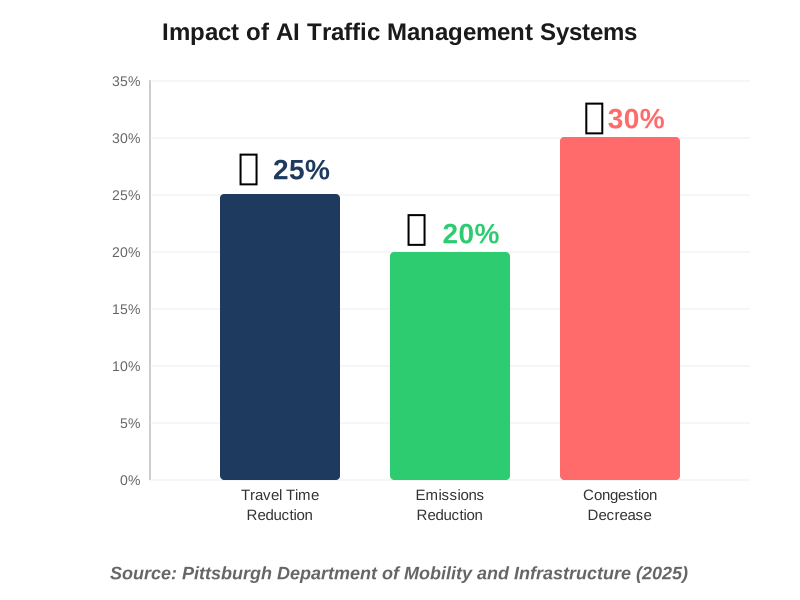
Some cities have achieved remarkable results. Pittsburgh implemented an AI traffic management system that reduced travel times by 25% and vehicle emissions by 20%. Singapore uses AI to manage its entire traffic network, dynamically adjusting speed limits, lane assignments, and traffic signal timing based on real-time conditions.
The benefits extend beyond time savings. Smoother traffic flow reduces fuel consumption and emissions, decreased congestion improves air quality and quality of life, fewer stops and starts reduce vehicle wear and tear, and emergency responders reach incidents faster.
Optimization will become even more effective as more vehicles connect and share data with traffic management systems. The vision is a transportation network that operates as a coordinated system rather than millions of independent actors competing for road space.
AI in Maritime Navigation: Enhancing Safety and Efficiency at Sea
While less visible than road transportation, maritime shipping moves 90% of global trade. AI in maritime navigation is making ocean travel safer and more efficient through autonomous systems, collision avoidance, route optimization, and predictive maintenance.
Ships at sea face unique challenges: unpredictable weather, complex navigation in busy ports, fuel efficiency over thousands of miles, and limited communication with shore. AI systems help address these challenges by analyzing weather patterns, ocean currents, and ship performance data to recommend optimal routes that balance speed, fuel consumption, and safety.
Collision avoidance systems use AI to monitor surrounding vessels, predict their movements, and alert crew to potential conflicts. Given the vast distances involved, even small course corrections made early can prevent dangerous situations. Some experimental vessels now operate with varying levels of autonomy, though fully autonomous cargo ships remain years away from widespread adoption.
Predictive maintenance is particularly valuable in maritime settings where mechanical failures far from port can be extremely costly and dangerous. AI systems monitor engine performance, hull integrity, and onboard systems to predict maintenance needs before failures occur.
Port operations are also being transformed by AI. Automated container handling, intelligent scheduling of ship arrivals and departures, and optimized cargo loading all contribute to reducing the time ships spend in port—a major cost factor in shipping.
The Ethical Implications of AI in Transportation: Safety, Bias, and Accountability
As AI systems take on greater responsibility for transportation decisions, important ethical questions emerge. Who’s responsible when an autonomous vehicle causes an accident? How should the system make split-second decisions in unavoidable crash scenarios? Can we trust AI with human lives?
The safety question is central but complex. Autonomous vehicles will eventually prevent most accidents caused by human error—distraction, impairment, and fatigue—which account for over 90% of crashes today. However, they’ll also cause some accidents that humans might have avoided. The ethical challenge isn’t whether AI will be perfect (it won’t) but whether it will be significantly safer overall than human drivers.
Decision-making in unavoidable crashes presents philosophical dilemmas. Should an autonomous vehicle prioritize passenger safety above all else, or should it consider the safety of pedestrians and other road users? Should it factor in the number of people at risk? These “trolley problem” scenarios are debated extensively, though they’re vanishingly rare in real-world driving.
Algorithmic bias represents another concern. If AI systems are trained primarily on data from certain regions, demographics, or conditions, they might perform poorly in others. For example, pedestrian detection systems have shown lower accuracy for people with darker skin tones—a serious safety issue that requires careful attention to training data diversity and testing across all user populations.
Accountability and liability questions remain largely unresolved. Current legal frameworks assign responsibility to human drivers, but who’s liable when an AI makes the driving decisions—the vehicle owner, the manufacturer, or the software company? Clear legal frameworks are essential for widespread autonomous vehicle deployment.
Privacy concerns arise as vehicles collect detailed data about travel patterns, behaviors, and activities. Who owns this data? How can it be used? What protections prevent misuse? These questions apply to navigation apps and connected vehicles today, becoming even more critical as transportation systems become more integrated and data-rich.
Addressing these ethical challenges requires collaboration among technologists, policymakers, ethicists, and the public. The decisions we make now will shape transportation for generations, and getting them right matters far more than moving fast.
AI-Based Predictive Maintenance for Transportation Infrastructure
Roads, bridges, railways, and airports represent massive public investments that require constant maintenance. AI-based predictive maintenance is transforming infrastructure management by identifying problems before they cause failures, optimizing maintenance schedules, and extending infrastructure lifespan.
Traditional maintenance follows fixed schedules or reactive responses to failures. AI systems continuously monitor infrastructure conditions through sensors, cameras, and inspection data, detecting subtle changes that indicate developing problems. This allows maintenance crews to address issues proactively when they’re small and less expensive to fix.
For roads and bridges, AI analyzes images from vehicles or inspection cameras to identify cracks, potholes, surface degradation, and structural problems. Machine learning algorithms can assess severity, predict how quickly problems will worsen, and prioritize maintenance work based on safety risk and budget constraints.
Railway systems use AI to monitor track conditions, detect irregularities in wheel-track interaction, and predict when components like switches or signals will fail. This prevents service disruptions and improves safety by addressing problems before they cause derailments or breakdowns.
Airport runways and taxiways undergo similar AI-powered monitoring. Given the safety-critical nature of aviation, even minor pavement problems must be addressed quickly. AI systems can scan runway surfaces, detect foreign objects (a major safety hazard), and schedule maintenance during off-peak hours to minimize disruption.
The cost savings are substantial—predictive maintenance typically costs 30-50% less than reactive repairs while extending infrastructure life and improving safety. Budget-constrained transportation agencies can get more value from limited maintenance funds by focusing resources where they’re most needed.
AI and the Last-Mile Delivery Challenge: Innovative Solutions
The “last mile”—getting packages from distribution centers to customers’ doorsteps—is the most expensive and challenging part of delivery. AI and the last-mile delivery challenge have sparked innovations from delivery robots to drones to optimized human courier networks.
Autonomous delivery robots are appearing on sidewalks in numerous cities. These small, wheeled robots navigate pedestrian spaces using AI systems similar to self-driving cars but operating at walking speed. They can deliver packages within a few miles of a distribution point, handling multiple deliveries per trip while avoiding obstacles, crossing streets safely, and notifying customers of arrivals.
Delivery drones represent another AI-powered solution for last-mile logistics. While regulatory challenges limit widespread deployment, several companies are conducting trials of autonomous drone delivery for packages, medical supplies, and food. AI systems enable drones to navigate complex urban environments, land safely in constrained spaces, and operate in various weather conditions.
For traditional courier delivery, AI optimization is making human drivers more efficient. Systems analyze package characteristics, customer preferences, traffic conditions, and historical data to create optimal delivery sequences, predict which customers will be home when, suggest the best parking spots, and even recommend which packages to deliver together to minimize trips.
Crowdsourced delivery platforms use AI to match independent couriers with delivery requests, optimizing for efficiency while giving workers flexibility. The system learns which couriers perform best for different types of deliveries and continuously improves matching algorithms.
These innovations aim to reduce delivery costs, speed up service, and lower environmental impact—all while meeting consumers’ growing expectations for fast, convenient delivery. The combination of AI optimization with autonomous systems and human flexibility is reshaping how goods reach customers.
AI-Powered Parking Solutions: Finding Spots and Reducing Congestion
Searching for parking wastes time and fuel and causes significant urban congestion. Studies estimate that up to 30% of urban traffic consists of drivers looking for parking. AI-powered parking solutions help drivers find spaces quickly while helping cities manage parking resources more efficiently.
Smart parking systems use sensors in parking spaces or AI-powered cameras to detect whether spots are occupied. This real-time data feeds into apps that show drivers exactly where available parking is located, often with pricing information and the ability to reserve spots in advance.
The AI component goes beyond simple availability tracking. Systems predict parking demand based on time of day, events, weather, and historical patterns, helping drivers plan ahead. They can recommend optimal parking locations considering walk time to destinations, typical turnover rates, and price, learning individual preferences over time.
Dynamic pricing represents another AI application. Some cities adjust parking prices based on demand—higher rates in high-demand areas or times, lower rates elsewhere—using AI to optimize prices that encourage parking distribution while maximizing revenue for cities and availability for drivers.
For parking facility operators, AI optimizes space utilization, predicts maintenance needs, detects security issues through video analysis, and improves traffic flow within garages through guided routing systems that direct drivers to available spots via digital signs.
The benefits extend beyond convenience. Reducing parking search time decreases congestion and emissions, improves urban air quality, reduces driver frustration, and helps cities better manage valuable land resources. As parking becomes more efficient, cities can convert some parking spaces to other uses—parks, bike lanes, outdoor dining—improving urban livability.
AI in Ride-Sharing Services: Matching Riders and Optimizing Routes
Ride-sharing services like Uber and Lyft depend fundamentally on AI systems that match millions of riders with drivers, predict demand, optimize pricing, and route vehicles efficiently. These platforms represent some of the largest-scale AI deployments in transportation.
The core matching problem is complex: given riders requesting trips and drivers available to provide them, how should they be paired to minimize wait times, maximize driver earnings, reduce total vehicle miles traveled, and balance system-wide efficiency? AI algorithms solve this optimization problem thousands of times per second in real time.
The system considers numerous factors: rider and driver locations, traffic conditions, driver ratings and preferences, rider payment methods and ratings, trip destinations (to position drivers well for next rides), and predicted demand in different areas. Machine learning continuously improves these matching decisions based on outcomes.
Demand prediction enables ride-sharing platforms to position drivers where they’ll be needed before requests arrive. AI models analyze historical data, events, weather, time of day, and real-time signals to forecast where demand will be highest, sending notifications to drivers to move toward these areas.
Dynamic pricing (often called “surge pricing”) uses AI to balance supply and demand. When demand exceeds available drivers, prices increase to both incentivize more drivers to start working and encourage some riders to wait or use alternative transportation. While controversial, this AI-managed pricing helps ensure cars are available when needed most.
Route optimization happens continuously during trips. The AI system monitors traffic, suggests optimal routes, and may even adjust destinations (with rider approval) if it identifies opportunities for efficient shared rides. All of this happens in real time across entire cities with thousands of simultaneous trips.
AI-Driven Logistics: Optimizing Supply Chains and Transportation
Global supply chains move trillions of dollars’ worth of goods annually through incredibly complex networks. AI-driven logistics is transforming how companies manage inventory, plan shipments, choose transportation modes, and respond to disruptions.
Modern supply chains involve thousands of decisions: Which warehouse should stock which products? When should goods be shipped? What transportation mode—truck, train, ship, or plane—makes sense for each shipment given cost, speed, and reliability requirements? How should companies respond to delays, weather events, or demand changes?
AI systems optimize these decisions by analyzing vast datasets that humans couldn’t process effectively. Machine learning models predict demand for products across locations and times, allowing companies to position inventory optimally. This reduces both stockouts (lost sales) and excess inventory (tied-up capital and storage costs).
Transportation planning AI considers all available options and constraints to recommend optimal shipping methods and routes. The system balances cost against speed and reliability, factors in carrier performance data, and adapts to real-time conditions like weather delays or capacity constraints.
Warehouse operations benefit from AI-powered robotics and intelligent management systems. AI determines optimal product placement within warehouses (frequently ordered items near packing stations), routes picking robots efficiently, and coordinates thousands of simultaneous operations in large fulfillment centers.
Supply chain resilience—the ability to handle disruptions—has become critical. AI systems detect potential problems early by monitoring supplier performance, weather forecasts, geopolitical events, and market conditions, then recommend proactive adjustments before disruptions impact operations.
The impact on efficiency is dramatic. Companies using AI-driven logistics report inventory reductions of 20-30%, transportation cost savings of 10-15%, and improved service levels through more reliable deliveries—all while handling growing volumes and complexity.
AI and the Future of Trucking: Autonomous Trucks and Platooning
Trucking moves the majority of goods in most countries, but the industry faces challenges: driver shortages, safety concerns from fatigue and accidents, efficiency pressures, and environmental impacts. AI and the future of trucking offer solutions through autonomous trucks and platooning technologies.
Autonomous trucks are being developed primarily for long-haul highway driving, where conditions are more predictable than urban environments. The technology uses similar AI systems to autonomous cars but scaled for much larger vehicles. Several companies are testing autonomous trucks on public roads with safety drivers, with limited commercial deployments beginning in specific corridors.
The business case for autonomous trucks is compelling: they can operate continuously without driver rest requirements, reduce labor costs (the largest expense for trucking companies), improve safety by eliminating driver fatigue and distraction, and optimize fuel efficiency through AI-controlled driving that’s smoother and more efficient than human drivers.
Truck platooning represents a near-term application of AI. Multiple trucks travel closely together in a coordinated convoy, with only the lead truck having a human driver. The following trucks use AI systems to maintain safe following distances, brake and accelerate in coordination, and reduce aerodynamic drag. This improves fuel efficiency significantly—following trucks can see 10-15% fuel savings from reduced wind resistance.
The transition won’t happen overnight. Autonomous trucks will likely first handle highway segments, with human drivers taking over for complex urban delivery. The technology needs further refinement, regulations must be developed, and infrastructure investments may be required. Employment impacts are significant and must be addressed thoughtfully—current truck drivers need retraining opportunities and transition support.
Despite challenges, the trajectory is clear. AI-powered trucks will become increasingly common over the next decade, transforming freight transportation with benefits for efficiency, safety, and sustainability—while requiring society to adapt to these changes thoughtfully.
AI in Aviation: Improving Flight Safety and Fuel Efficiency
Beyond air traffic control, AI in aviation is enhancing virtually every aspect of flight operations. Airlines and aircraft manufacturers are implementing machine learning systems to improve safety, reduce costs, and enhance passenger experiences.
Flight planning represents a major AI application. For each flight, AI systems analyze weather forecasts, winds at various altitudes, aircraft weight and performance characteristics, fuel costs, and airspace restrictions to recommend optimal routes and altitudes. These recommendations balance fuel efficiency, flight time, passenger comfort, and safety.
Modern aircraft generate enormous amounts of data from thousands of sensors monitoring engines, systems, and flight conditions. AI analyzes this data to predict maintenance needs before failures occur. By identifying subtle patterns that indicate developing problems, airlines can schedule maintenance proactively, reducing costly unscheduled repairs and flight cancellations.
Fuel efficiency optimization extends beyond route planning. AI systems help pilots make real-time decisions about speed, altitude changes, and approach procedures to minimize fuel consumption while maintaining safety and schedule. Given that fuel represents airlines’ second-largest expense after labor, even small percentage improvements yield significant savings.
Safety analysis benefits from AI systems that examine incident reports, flight data, maintenance records, and other sources to identify risk factors that humans might miss. This proactive approach helps prevent accidents by addressing issues before they become dangerous.
Passenger experience improvements powered by AI include personalized service recommendations, optimized boarding processes, predictive rebooking during disruptions, and baggage tracking systems that reduce lost luggage. While less critical than safety, these enhancements improve satisfaction and airline operational efficiency.
AI-Based Traffic Forecasting: Predicting Congestion and Accidents
Knowing where traffic will be heavy or where accidents are likely helps both individual drivers and transportation authorities. AI-based traffic forecasting uses machine learning to predict conditions hours or days in advance, enabling proactive responses.
These forecasting systems analyze historical traffic patterns, weather forecasts, event schedules, school calendars, and real-time data from numerous sources. Machine learning models identify complex patterns—for example, how rain affects traffic differently on various roads and times—that simple rule-based systems would miss.
For individual users, forecasting enables better travel planning. Navigation apps can suggest optimal departure times to avoid predicted congestion, recommend alternative routes before problems develop, or help users decide whether to work from home on days forecast to have particularly bad traffic.
Transportation authorities use forecasts to deploy traffic management resources proactively. If heavy congestion is predicted in a specific area, they can adjust traffic signal timing preemptively, dispatch traffic control personnel to manage bottlenecks, alert the public about expected conditions, and coordinate with emergency services to ensure response capability.
Accident prediction represents a more complex challenge. AI systems analyze factors associated with crashes—weather conditions, traffic volume, road characteristics, time of day, historical accident data—to identify high-risk situations. While these predictions aren’t perfectly accurate, they help target safety interventions like increased enforcement, variable speed limits, or warning messages to drivers.
The value lies in prevention and preparation rather than perfect prediction. Even probabilistic forecasts help authorities allocate resources more effectively and help individuals make better-informed travel decisions.
AI and Personalized Navigation: Tailoring Routes to Individual Preferences
Everyone has different navigation preferences—some people prioritize shortest time, others prefer fewer turns or avoiding highways. AI and personalized navigation systems learn your preferences and adapt recommendations accordingly without requiring you to specify detailed settings.
The personalization happens through machine learning that observes your behavior. If you consistently reject suggested routes that use highways, the system learns you prefer local roads and adjusts future recommendations. If you typically drive faster than average traffic, it factors your speed into time estimates. If you always take breaks at certain points during long trips, it might suggest routes with convenient stopping points.
Advanced personalization considers context. Your preferences might differ between commute trips and leisure travel, or between weekday and weekend driving. AI systems can detect these patterns and adjust recommendations for different situations.
Some navigation apps are experimenting with deeper personalization: suggesting departure times based on your calendar and typical schedule, recommending parking based on how far you typically walk, adjusting route complexity based on your familiarity with an area, or even selecting music that matches your driving style and trip duration.
Privacy is an important consideration with personalized navigation. The detailed behavioral data required for effective personalization is also extremely revealing about your life patterns. Users should understand what data is collected, how it’s used, and what controls they have over sharing and retention.
The balance between helpful personalization and privacy protection is personal. Some users value highly customized experiences and willingly share data to get them. Others prefer more private, less personalized services. Good navigation systems offer clear choices and controls so users can decide for themselves.
The Role of AI in Smart Infrastructure for Transportation
Smart infrastructure connects physical transportation systems with digital intelligence, creating networks that can sense, communicate, and adapt. AI in smart infrastructure processes data from these connected systems to optimize performance across entire transportation networks.
Connected vehicles communicate with infrastructure through Vehicle-to-Infrastructure (V2I) systems. Traffic lights share signal timing with approaching vehicles. Road sensors detect congestion, weather conditions, and accidents, transmitting this information to traffic management systems and navigation apps. Bridges and tunnels monitor structural conditions continuously.
AI serves as the brain coordinating all these connected elements. It processes streams of data from thousands of sensors, identifies patterns and anomalies, predicts developing problems, and sends commands back to infrastructure systems to optimize performance.
For example, an AI system might detect from vehicle data that traffic is building up at a particular location. It checks weather sensors and cameras to understand why, predicts how the congestion will spread, adjusts traffic signals across multiple intersections to minimize impacts, and sends route suggestions to navigation apps to divert traffic. All this happens automatically in real time.
Smart infrastructure enables entirely new capabilities: dynamic lane management where lane directions change based on traffic flow, vehicle-to-vehicle communication allowing cars to coordinate movements at intersections, predictive maintenance of roads and bridges, and adaptive public transit systems that adjust service based on real-time demand.
The investment requirements are substantial—sensors, communication networks, and computing infrastructure aren’t cheap. However, the efficiency gains, safety improvements, and reduced environmental impact make smart infrastructure increasingly attractive as cities seek to manage growing transportation demand with limited ability to build new roads.
AI-Powered Driver Monitoring Systems: Enhancing Safety and Preventing Accidents
Even with advanced assistance features, human drivers cause most accidents through distraction, fatigue, or impairment. AI-powered driver monitoring systems use cameras and sensors inside vehicles to detect when drivers aren’t paying adequate attention and intervene before accidents occur.
These systems use computer vision and machine learning to monitor driver behavior continuously. Cameras track eye gaze to ensure drivers are watching the road. They detect head position, facial expressions, and blink patterns that indicate drowsiness. Some systems even monitor steering patterns and vehicle position within lanes for signs of inattention.
When the system detects concerning behavior, it intervenes with escalating warnings: first visual or audible alerts, then more aggressive warnings if the driver doesn’t respond, and potentially emergency braking or pulling the vehicle to the roadside if the driver becomes completely unresponsive.
These technologies are becoming required safety equipment in many jurisdictions. Commercial vehicles, including trucks and buses, increasingly use driver monitoring to reduce accidents and associated costs. The systems have proven effective—studies show significant reductions in fatigue-related and distraction-related crashes.
Privacy concerns arise with cameras continuously monitoring drivers. However, most systems process data locally within the vehicle without storing images or transmitting them externally unless specifically configured to do so for fleet management purposes. Understanding how your vehicle’s system works and what data it collects is important for making informed decisions.
AI in Railway Systems: Enhancing Efficiency and Safety
Rail transportation—from urban metros to high-speed intercity trains to freight railways—benefits significantly from AI in railway systems. These technologies enhance safety, improve punctuality, optimize energy consumption, and reduce maintenance costs.
Train operation optimization uses AI to determine optimal speeds and acceleration patterns considering schedule requirements, energy efficiency, track conditions, and passenger comfort. In some advanced systems, AI can control train movements automatically, though human operators remain onboard for safety and to handle exceptions.
Signaling and traffic management systems use AI to optimize train spacing and scheduling across rail networks. These systems balance conflicting goals: running trains as frequently as possible for passenger convenience, maintaining safety margins between trains, minimizing energy consumption, and coordinating multiple train routes sharing the same tracks.
Predictive maintenance is particularly valuable for railways, where mechanical failures can cause major service disruptions affecting thousands of passengers. AI systems monitor train components, track conditions, switches, signals, and power systems to predict failures before they occur, and schedule maintenance during off-peak hours to minimize service impacts.
Safety systems use AI to detect obstacles on tracks, monitor train performance for anomalies indicating problems, analyze past incidents to identify risk factors, and even detect maintenance issues by analyzing the sound of passing trains. These technologies contribute to railways’ excellent safety record while reducing costs.
Passenger information systems powered by AI provide accurate arrival predictions, suggest alternative routes during disruptions, offer personalized journey planning, and help manage crowding by predicting which train cars will be least full.
AI and the Development of Smart Ports: Optimizing Logistics and Operations
Modern ports handle millions of containers annually in incredibly complex operations. AI and the development of smart ports is transforming these critical logistics hubs through automation, optimization, and predictive analytics.
Autonomous container handling represents a major AI application. Cranes equipped with computer vision and machine learning can identify containers, position them precisely, and stack them efficiently without human operators. Automated guided vehicles transport containers within the port, optimized by AI to minimize congestion and waiting times.
Berth and yard planning uses AI to optimize complex scheduling decisions: which ships should dock at which berths when, where should containers be stored in the yard for efficient later retrieval, and how should equipment and labor be allocated across operations? These systems consider numerous constraints while optimizing for overall throughput and cost efficiency.
Predictive analytics help ports anticipate congestion, predict ship arrival times more accurately than simple schedules allow, forecast maintenance needs for equipment, and optimize resource allocation. This proactive approach reduces delays and improves reliability throughout the supply chain.
Security systems use AI-powered video analytics to continuously monitor vast port areas, detecting unusual activities, unauthorized access, safety violations, and potential security threats. These systems can alert security personnel to investigate specific incidents rather than requiring constant human monitoring of hundreds of cameras.
Environmental optimization is becoming increasingly important. AI systems help ports reduce emissions by optimizing equipment usage, reducing truck waiting times, and coordinating with ships to minimize time spent idling in port.
AI-Driven Solutions for Fleet Management: Tracking, Optimization, and Safety
Companies operating vehicle fleets—delivery companies, taxi services, public transit, service vehicles—use AI-driven solutions for fleet management to reduce costs, improve service, and enhance safety.
Vehicle tracking and telematics systems continuously monitor location, speed, fuel consumption, engine performance, and driver behavior. AI analyzes this data to optimize routes, identify inefficient driving behaviors, predict maintenance needs, and ensure regulatory compliance.
Driver behavior monitoring uses AI to detect risky behaviors like harsh braking, rapid acceleration, excessive speeding, or distracted driving. Fleet managers can use this information for coaching, reducing both accident rates and fuel consumption. Some systems provide real-time feedback to drivers, helping them improve immediately.
Maintenance optimization represents a major cost-saving opportunity. AI systems predict when vehicles will need service based on actual usage and condition rather than fixed mileage intervals. This prevents unnecessary maintenance while avoiding breakdowns from delayed service.
Route optimization for fleets considers multiple vehicles and destinations simultaneously, creating efficient routes that minimize total distance, balance workload across drivers, meet delivery time commitments, and account for traffic conditions. As conditions change throughout the day, the system can dynamically reassign tasks to maintain efficiency.
Fuel management AI tracks consumption patterns, identifies inefficient vehicles or drivers, and suggests operational changes to reduce fuel costs. For electric vehicle fleets, AI optimizes charging schedules to minimize electricity costs while ensuring vehicles are ready when needed.
AI and the Future of Micromobility: Scooters, Bikes, and Autonomous Pods
Shared electric scooters and bikes have proliferated in cities worldwide, while autonomous personal pods represent an emerging option. AI and the future of micromobility enable these systems to operate efficiently, safely, and sustainably.
For shared micromobility services, AI optimization determines where vehicles should be deployed based on predicted demand, manages rebalancing operations to ensure availability where users need them, optimizes pricing to balance demand with supply, and predicts battery depletion requiring vehicle retrieval for charging.
Safety represents a major concern with scooters and bikes. AI-powered systems use sensors to detect riders not wearing helmets, identify dangerous riding behaviors, detect when vehicles are being ridden on sidewalks where prohibited, and even limit speed in high-risk areas. Some cities require these features as conditions for operating permits.
Autonomous personal pods—small, slow-speed vehicles that operate on sidewalks or dedicated paths—represent an emerging category. These AI-driven vehicles could serve as mobility options for elderly or disabled individuals, last-mile solutions complementing public transit, or campus transportation. The technology resembles self-driving cars but operates in more constrained environments at lower speeds.
Micromobility integration with larger transportation systems requires AI coordination. Users should be able to seamlessly combine bike sharing, scooters, public transit, and ride-sharing into convenient door-to-door journeys planned and paid through a single app. AI systems optimize these multimodal trips considering all available options and user preferences.
Environmental benefits of micromobility depend on displacing car trips rather than walking or transit use. AI systems help cities understand usage patterns to assess actual impacts and adjust policies to maximize benefits.
AI-Based Risk Assessment in Transportation: Identifying and Mitigating Hazards
Transportation involves inherent risks. AI-based risk assessment helps identify hazards, predict incidents, and guide interventions to improve safety across all transportation modes.
For road transportation, AI systems analyze crash data, road conditions, traffic patterns, and environmental factors to identify high-risk locations and situations. This enables targeted safety improvements: adding signals or signs at dangerous intersections, improving lighting in areas with frequent night accidents, or adjusting speed limits where crash risk is elevated.
Insurance companies use AI for risk assessment and pricing. Telematics systems monitor how vehicles are driven, with AI calculating risk based on behaviors like speed, braking patterns, and when and where driving occurs. This allows personalized pricing that rewards safe driving while charging higher rates for risky behavior.
Public transit systems employ AI to assess operational risks: identifying drivers who may need additional training, predicting which routes or times have higher incident rates, and analyzing near-miss events to identify systemic issues before accidents occur.
Aviation uses sophisticated AI-based risk assessment to analyze countless data sources—flight data recorders, maintenance records, incident reports, weather patterns—identifying risk factors that might not be apparent from individual events. This proactive approach has contributed significantly to aviation’s exceptional safety record.
Maritime risk assessment AI predicts weather-related hazards, identifies vessel mechanical issues before they cause failures at sea, and analyzes shipping routes for piracy or other security risks.
The key insight from AI risk assessment is that most accidents result from combinations of factors rather than single causes. Machine learning excels at identifying these complex patterns, enabling preventive interventions that wouldn’t be obvious from human analysis alone.
AI in Vehicle-to-Everything (V2X) Communication: Enhancing Safety and Efficiency
Vehicle-to-Everything (V2X) communication allows vehicles to exchange information with other vehicles, infrastructure, pedestrians, and cloud services. AI in V2X communication processes this data to enhance safety, efficiency, and traffic flow.
V2X encompasses several types of communication:
- Vehicle-to-Vehicle (V2V): Cars share information about position, speed, direction, and intentions with nearby vehicles
- Vehicle-to-Infrastructure (V2I): Vehicles communicate with traffic signals, road sensors, and traffic management systems
- Vehicle-to-Pedestrian (V2P): Vehicles detect and communicate with smartphones carried by pedestrians
- Vehicle-to-Cloud (V2C): Vehicles send and receive data from cloud services for navigation, updates, and services
AI processes the streams of information from these sources to make intelligent decisions. For example, if one vehicle suddenly brakes hard, it immediately transmits a warning to vehicles behind it. AI in those vehicles assesses whether they’re at risk and can activate automatic braking faster than human reaction time allows.
Traffic signals can communicate optimal speeds for vehicles to reach the intersection on a green light, with AI adjusting vehicle speed automatically for fuel efficiency and traffic flow. Vehicles approaching intersections share intentions—turning left, going straight—allowing AI to coordinate movements and reduce conflicts.
The safety benefits are substantial. V2X combined with AI can prevent many accident types: rear-end collisions through advanced warnings, intersection crashes through coordination and visibility beyond line of sight, and pedestrian accidents through detection of people in blind spots or unexpected locations.
Efficiency improvements come from coordinated vehicle movements that reduce unnecessary stopping and accelerating, optimized traffic signal timing based on actual vehicle flows, and routing vehicles around congestion before it develops.
Deployment requires widespread adoption—the benefits increase as more vehicles and infrastructure are equipped with V2X capabilities. Standardization is progressing, with several countries mandating V2X equipment in new vehicles within coming years.
AI and the Development of Flying Cars: Challenges and Opportunities
Flying cars—more accurately termed personal aerial vehicles or urban air mobility (UAM)—have long been science fiction staples. Recent advances in electric propulsion, battery technology, and AI are making them increasingly viable, with numerous companies developing prototype vehicles.
The AI challenges for flying cars exceed those for ground autonomous vehicles. These vehicles must navigate three-dimensional airspace, handle diverse weather conditions, maintain stability in wind and turbulence, plan energy-efficient routes considering battery limitations, and coordinate with other aircraft and air traffic control.
AI systems for UAM must handle vehicle control (maintaining stability and executing maneuvers), navigation (planning routes and avoiding obstacles), situational awareness (detecting other aircraft, structures, and weather hazards), and autonomous landing in potentially crowded urban environments.
Safety requirements for flying vehicles are even more stringent than for cars—there’s no equivalent to pulling over if something goes wrong. AI systems must be extremely reliable with extensive redundancy. Regulators are developing new frameworks for certifying autonomous flying vehicles, balancing innovation with public safety.
Infrastructure requirements are significant: vertiports for takeoff and landing, charging facilities, navigation systems, and integration with existing air traffic management. AI will coordinate vehicle movements through urban airspace, potentially handling hundreds of simultaneous flights in busy areas.
The business case centers on time-sensitive travel where flying cars could dramatically reduce trip times compared to ground traffic: airport transfers, business travel within metropolitan areas, and medical emergency transport. Initial services will likely be expensive, targeting users who value time savings highly.
Environmental considerations are mixed. Electric UAM vehicles produce no local emissions and less noise than helicopters, but battery production and electricity generation have environmental costs. AI optimization helps by planning energy-efficient routes and operations.
While widespread adoption remains years away, several companies plan to begin commercial services in limited markets within the next few years. Whether flying cars become commonplace or remain niche transportation depends on solving technological, regulatory, and economic challenges—all of which involve AI significantly.
AI-Powered Simulation for Transportation Planning: Modeling and Optimization
Transportation planning traditionally relied on limited real-world testing and analysis. AI-powered simulation enables planners to model complex transportation systems comprehensively, test interventions virtually, and optimize designs before expensive real-world implementation.
Modern transportation simulation systems create detailed digital twins of entire cities or regions. These models include road networks, traffic signals, public transit routes, typical travel patterns, and how drivers, pedestrians, and cyclists behave. AI makes these simulations far more accurate and useful than traditional approaches.
Machine learning trains simulation models on real-world data so they accurately reproduce actual behaviors and patterns. Rather than assuming drivers behave according to simplified rules, AI-powered simulations learn how people actually drive, when they travel, and how they respond to different conditions.
Planners can use these simulations to test “what if” scenarios: What happens if we add a new transit line? How would closing a bridge for repairs affect traffic? Would a new road reduce congestion or just induce more driving? Which traffic signal timing patterns work best? The simulation runs these scenarios thousands of times with variations to understand likely outcomes.
Optimization algorithms work within simulations to find the best solutions for complex planning problems. For example, determining optimal locations for electric vehicle charging stations considering current and future demand, grid capacity, user convenience, and cost—a problem with countless possible solutions that AI can solve more effectively than human planners working manually.
Autonomous vehicle testing uses AI-powered simulation extensively. Companies can expose self-driving systems to millions of miles of virtual driving, including rare, dangerous situations that would take years to encounter in real-world testing. This accelerates development while improving safety.
The key advantage is failing safely and cheaply. Negative ideas can be identified and discarded virtually rather than after expensive real-world implementation. Good ideas can be refined and optimized before implementation, increasing success likelihood and benefits.
The Impact of AI on Transportation Jobs: Automation and the Future of Work
AI and automation in transportation will significantly affect employment across multiple sectors. While some jobs will be displaced, others will be created, and many will be transformed. Understanding these changes is important for workers, employers, and policymakers.
Professional drivers represent the largest affected group. With millions of truck drivers, taxi and ride-share drivers, bus drivers, and delivery drivers, even partial automation will impact many workers. However, the transition will likely be gradual rather than sudden. Autonomous technology will first handle specific situations—highway driving, simple routes, controlled environments—with humans managing more complex scenarios. Over time, the human role may shift from active driving to monitoring and intervention.
New jobs will emerge around AI transportation systems: operators who monitor multiple autonomous vehicles remotely, technicians who maintain sophisticated sensors and systems, trainers who develop and refine AI models, safety specialists who ensure systems work properly, and countless other roles we haven’t fully envisioned yet.
Existing jobs will transform rather than disappear entirely. Truck drivers might focus more on customer interactions, loading and unloading, and handling exceptions while vehicles drive autonomously on highways. Delivery personnel might concentrate on the final customer interface while AI handles navigation and routing.
Traffic management and transportation planning will likely see employment increases as more sophisticated AI tools make professionals more effective and enable more ambitious projects. Rather than replacing planners, AI tools amplify their capabilities.
The equity implications are significant. Many transportation jobs provide middle-class incomes for workers without college degrees. Displacement without adequate retraining and transition support could worsen economic inequality. Proactive policies are essential: retraining programs for affected workers, portable benefits not tied to specific jobs, and social support systems for transition periods.
The timeline remains uncertain. Pessimistic estimates suggest major disruption within a decade, while more conservative projections expect 20+ years for widespread automation. The actual pace depends on technology development, regulatory decisions, economic factors, and social acceptance.
Historical technology transitions show that while automation displaces some workers, it generally creates more total employment while making society more productive and prosperous. Managing the transition thoughtfully—supporting affected workers, developing new opportunities, and ensuring benefits are widely shared—determines whether AI in transportation improves quality of life broadly or concentrates gains narrowly.
AI-Driven Solutions for Accessibility in Transportation: Assisting People with Disabilities
Transportation accessibility affects millions of people with disabilities. AI-driven solutions are creating new possibilities for independence and mobility, though significant challenges remain.
Autonomous vehicles could dramatically improve mobility for people unable to drive due to vision impairments, physical disabilities, or cognitive conditions. Unlike public transit or human drivers, autonomous vehicles could provide door-to-door service on demand without requiring users to navigate complex systems or depend on others’ availability.
Navigation apps increasingly incorporate accessibility features powered by AI: routing that avoids stairs and prioritizes elevators, predictions of crowding levels on transit vehicles, information about accessible parking, and real-time updates about elevator or ramp outages. Some apps use computer vision to detect and warn about obstacles in walking paths.
Public transit systems use AI to improve accessibility: apps that provide audio descriptions for visual information, real-time announcements about stops for riders with vision impairments, systems that detect when accessible ramps fail and alert maintenance teams, and scheduling that accounts for longer boarding times needed by some passengers.
Voice control powered by AI allows people with limited mobility to control vehicles, access navigation, and request assistance without physical interaction. These systems continue improving through machine learning, becoming more accurate and capable over time.
Computer vision systems can detect wheelchairs, service animals, and mobility aids, enabling transportation services to automatically accommodate needs—dispatching accessible vehicles, alerting drivers, or adjusting pickup locations for easier access.
However, significant gaps remain. Autonomous vehicle developers must ensure systems detect and respond appropriately to people using mobility aids. Navigation systems need more complete data about accessibility features and barriers. Public transit still has significant physical accessibility limitations despite legal requirements. And affordability remains a major concern—many accessible solutions cost more than standard options.
The disability community emphasizes that people with disabilities must be involved in designing these AI systems from the beginning. Systems designed without input from actual users often miss important needs or create new barriers despite excellent intentions. Inclusive design processes ensure AI transportation solutions actually serve everyone effectively.
Frequently Asked Questions
Getting Started with AI Transportation Technologies
You don’t need to wait for self-driving cars to benefit from AI in transportation. Here are practical steps you can take today:
Start with navigation apps: If you’re still using basic directions, upgrade to AI-powered navigation apps like Google Maps or Waze. Enable traffic updates, accept alternative route suggestions, and let the system learn your preferences. You’ll save time and reduce stress immediately.
Explore your vehicle’s AI features: Many newer cars include AI-powered assistance features—adaptive cruise control, lane-keeping assistance, automatic emergency braking, and driver monitoring systems. Read your manual and learn to use these features properly. They enhance safety when used correctly but require understanding their limitations.
Try multimodal trip planning: Apps like Citymapper or Transit combine public transportation, ride-sharing, bike-sharing, and walking into comprehensive journey plans. This integrated approach often beats driving, especially in dense urban areas, while reducing costs and environmental impact.
Consider your next vehicle carefully: If purchasing a vehicle soon, research AI features and assistance systems. Advanced driver assistance systems (ADAS) are becoming standard even in moderately priced vehicles. Prioritize safety features that prevent accidents—automatic emergency braking, blind spot monitoring, and rear cross-traffic alert—over convenience features.
Support smart transportation policies: As your city considers investments in smart infrastructure, connected transit, or autonomous vehicle regulations, engage with these discussions. Good policy decisions require public input to balance innovation with safety, equity, and community values.
Stay informed about developments: AI in transportation is evolving rapidly. Follow reputable sources for updates about new technologies, regulatory changes, and deployment of autonomous services in your area. Being informed helps you take advantage of new options and make better decisions.
Think about the bigger picture: Individual choices about transportation—where you live relative to work, whether to own a vehicle, and which transportation modes you use—affect your exposure to and benefit from AI transportation systems. Consider how emerging technologies might influence your long-term decisions about housing, work, and lifestyle.
Conclusion: Embracing the AI Transportation Revolution
We’re living through a fundamental transformation in how people and goods move around the world. AI in Transportation and Navigation isn’t just making existing systems incrementally better—it’s enabling entirely new possibilities that seemed impossible just years ago.
The benefits are compelling: dramatically safer travel through vehicles that don’t get distracted, tired, or impaired; more efficient transportation that reduces congestion, saves time, and cuts emissions; increased accessibility for people currently limited by transportation barriers; and more productive use of travel time when vehicles handle the driving.
Yet challenges remain. We must address employment impacts thoughtfully, ensuring workers aren’t left behind as automation progresses. Privacy protections are essential as transportation systems collect increasingly detailed data about our movements and behaviors. Equity concerns must be central—ensuring these technologies serve everyone, not just wealthy early adopters. And ethical frameworks need development for AI systems making split-second decisions that affect human safety.
The future won’t arrive overnight. Widespread deployment of fully autonomous vehicles remains years away. Smart infrastructure requires massive investments. Regulatory frameworks need development. Social acceptance takes time. But the direction is clear: AI will play an increasingly central role in how we move through the world.
What’s exciting is that you don’t need to wait for some distant future. AI transportation technologies are available today, making your commute easier, your trips more efficient, and your travel safer. As systems continue improving, those benefits will only increase.
The transportation revolution is happening now. Whether you’re using AI-powered navigation to avoid traffic, benefiting from optimized public transit schedules, or simply interested in where technology is taking us, you’re part of this transformation. Understanding how these systems work, what they can do, and what limitations they have empowers you to use them effectively while participating thoughtfully in discussions about their future.
The road ahead is exciting. AI promises to make transportation safer, more efficient, more accessible, and more sustainable. The journey has begun, and we’re all along for the ride.
References
Pittsburgh Department of Mobility and Infrastructure. (2025). “Smart Corridor Traffic Signal Optimization Project Results.” City of Pittsburgh Annual Transportation Report.
Waymo LLC. (2025). “Fifth Generation Autonomous Driving System: Technical Overview.” Waymo Safety Report. https://waymo.com/safety/
About the Authors
This article was written through collaboration between Abir Benali and James Carter, bringing together complementary perspectives on AI in transportation.
Main Author: Abir Benali is a friendly technology writer who specializes in making complex AI systems accessible to non-technical readers. With a focus on clear, practical explanations and real-world applications, Abir helps everyday users understand how emerging technologies affect their daily lives. Abir’s approach emphasizes actionable insights and beginner-friendly guidance that empowers readers to confidently engage with new technologies.
Co-Author: James Carter is a productivity coach who helps people leverage AI tools to save time and work more efficiently. James brings expertise in practical implementation strategies, time-saving techniques, and integrating AI solutions into daily routines. His contributions focus on how transportation technologies can be used immediately to improve everyday travel experiences.
Together, we’ve created this comprehensive guide to help you understand and benefit from the AI revolution in transportation and navigation—whether you’re navigating daily commutes, planning trips, or simply curious about the future of mobility.