AI Tutors vs. Human Tutors: Which Is Best for You?

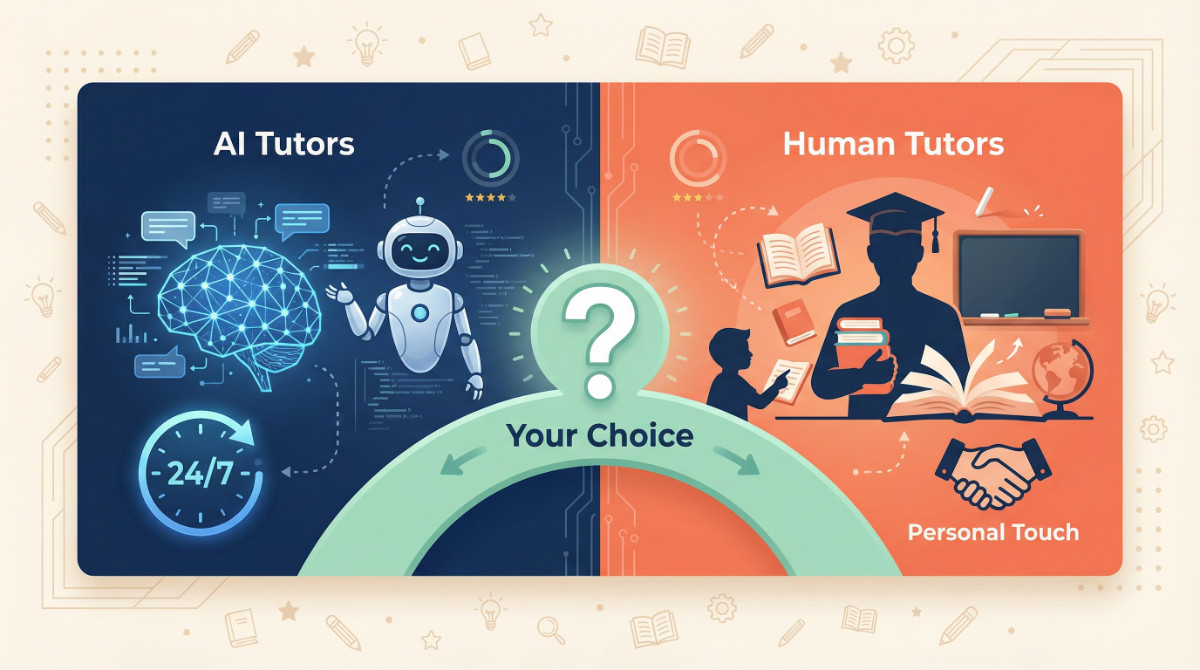
AI Tutors vs. Human Tutors represent two fundamentally different approaches to personalized education. As someone who prioritizes digital safety and responsible technology use, I’ve spent considerable time evaluating both options—not just for effectiveness, but for privacy, data security, and ethical considerations. The choice between artificial intelligence-powered learning platforms and traditional one-on-one instruction impacts more than just grades. It affects how student data is collected, who has access to learning patterns, and whether educational relationships remain truly human-centered.
The tutoring landscape has shifted dramatically. Where families once relied exclusively on local teachers for extra help, they now face decisions about algorithm-driven instruction, adaptive learning platforms, and AI chatbots that promise instant homework assistance. But this convenience raises important questions about data privacy, academic integrity, and the irreplaceable value of human mentorship.
This comparison examines AI tutors and human tutors across critical dimensions: cost structures, availability patterns, personalization capabilities, privacy implications, and long-term educational outcomes. I’ll share practical guidance for choosing responsibly, protecting student information, and ensuring that whichever path you select serves genuine learning—not just convenience.
Understanding AI Tutors: Capabilities and Limitations
AI tutors are software applications powered by machine learning algorithms and natural language processing. They range from simple flashcard apps to sophisticated platforms like Khan Academy’s Khanmigo, Duolingo’s conversation features, and ChatGPT-based study assistants. These systems analyze student responses, identify knowledge gaps, and adjust content difficulty in real time.
The technology works through pattern recognition. When you answer questions incorrectly, the AI notes which concepts you struggle with and serves additional practice in those areas. Advanced systems use large language models to generate explanations, answer follow-up questions, and even simulate conversations in foreign languages.
However, AI tutors cannot truly understand context the way humans do. They lack genuine empathy, cannot read body language, and sometimes provide confident-sounding answers that are factually incorrect—a phenomenon called “hallucination.” They also collect extensive data about learning patterns, which raises important privacy concerns I’ll address later.
The Human Tutor Experience: Strengths and Constraints
Human tutors bring irreplaceable qualities to education: intuition, emotional intelligence, and the ability to adapt teaching methods based on subtle cues. A skilled tutor notices when a student feels discouraged, recognizes when confidence is building, and adjusts pacing accordingly. They build relationships that motivate students beyond just academic performance.
Traditional tutoring encompasses various formats: one-on-one sessions, small group instruction, subject specialists, and test preparation coaches. Human tutors draw from years of teaching experience, can share personal learning strategies, and often serve as mentors beyond just academic content.
The constraints are equally significant. Quality human tutors are expensive, geographically limited, and schedule-dependent. Finding someone who matches a student’s learning style, personality, and specific needs requires time and often trial-and-error. Availability becomes especially challenging for specialized subjects or non-standard schedules.
Cost Comparison: Investment and Value Analysis
AI Tutors: Pricing Models
AI tutors typically offer tiered pricing that makes them financially accessible:
- Free tiers: Basic versions of Duolingo, Khan Academy, and Quizlet provide substantial functionality without payment
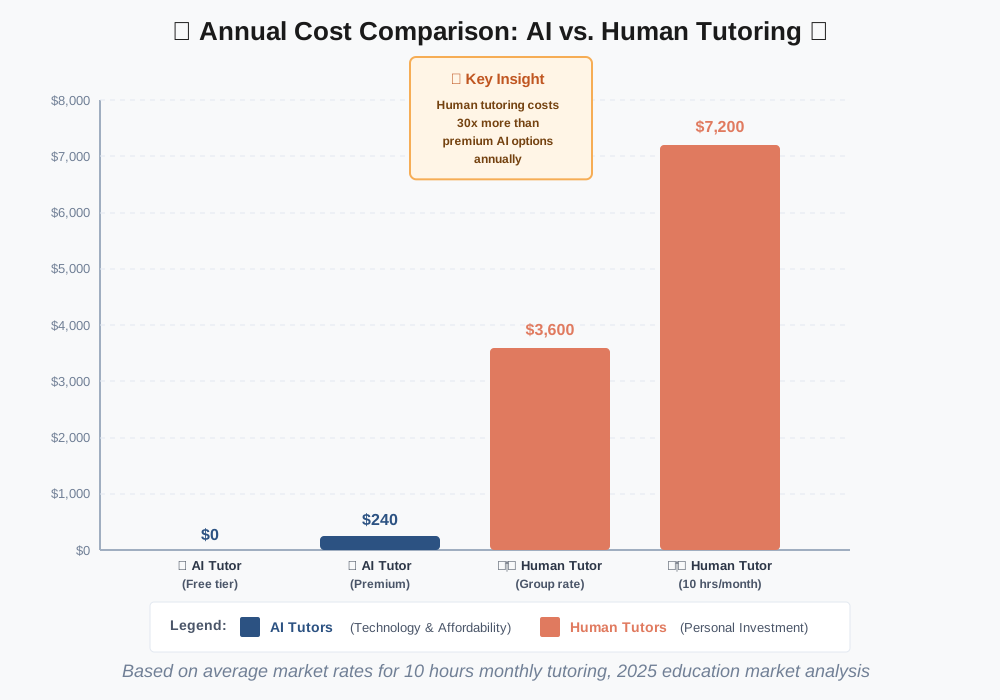
- Subscription models: Premium AI tutoring platforms range from $10 to $50 monthly for unlimited access
- Pay-per-use: Some services charge per session or question, typically $1-5 per interaction
- School licenses: Institutional pricing often reduces per-student costs to $5-15 annually
The economic advantage is clear. A family can access AI tutoring across multiple subjects and unlimited hours for less than the cost of a single hour with a human tutor. However, this affordability comes with hidden costs: subscription fatigue as families juggle multiple platforms, potential data monetization by free services, and the investment of parental time to supervise and ensure productive use.
Human Tutors: Financial Considerations
Human tutors command rates that reflect their expertise and local market conditions:
- High school students: $15-30 per hour for peer tutoring
- College students: $25-50 per hour for undergraduate tutors
- Certified teachers: $50-100 per hour for experienced educators
- Specialized experts: $100-300+ per hour for test prep specialists or subject matter experts
These figures represent substantial financial commitments. A student receiving three hours of weekly tutoring at $60 per hour spends $720 monthly—often more than annual AI subscription costs. Yet families consistently invest in human tutoring because of perceived quality differences and the value of personal accountability.
Financial aid programs, school-based tutoring, and community resources sometimes reduce these costs. Some families arrange tutoring exchanges or group sessions to share expenses. But the economic barrier remains significant for many households.
Availability and Accessibility: When Learning Happens
AI Tutors: 24/7 On-Demand Access
The most compelling advantage of AI tutors is unrestricted availability. Students can access help at midnight before an exam, during weekend study sessions, or while traveling. This eliminates scheduling coordination, wait times, and geographic barriers.
For families with non-traditional schedules—parents working night shifts, student athletes with irregular practice times, or children managing health conditions—this flexibility proves invaluable. International students or those in remote areas gain access to resources previously unavailable in their communities.
However, unlimited availability can become problematic. Without structure, students may procrastinate and then cram with AI assistance, developing poor study habits. The absence of scheduled commitments reduces accountability. Some students become overly dependent, using AI for every homework question rather than building independent problem-solving skills.
Human Tutors: Scheduled Structure and Accountability
Human tutors operate within defined schedules, typically offering sessions during after-school hours, weekends, or by appointment. This structure creates accountability—students prepare for sessions, complete assigned work between meetings, and develop time management skills.
The scheduling constraint forces prioritization. Students must identify which subjects or topics need attention, rather than passively consuming unlimited AI assistance. Regular appointments with the same tutor build rapport and allow for longitudinal progress tracking.
Yet these same constraints create barriers. Finding compatible schedules between tutor and student grows increasingly difficult as students age and commitments multiply. Cancellations due to illness, weather, or conflicts waste time and money. Geographic limitations mean rural students have fewer options, and specialized subject tutors may be unavailable locally at any price.
Personalization: Adapting to Individual Learning Needs
How AI Tutors Personalize Learning
AI tutors excel at adaptive content delivery based on performance data. Algorithms track which problems you solve correctly, how long you spend on each question, and where you repeatedly struggle. The system automatically adjusts difficulty levels, offers additional practice on weak areas, and skips content you’ve mastered.
This data-driven approach provides consistency. The AI never has a bad day, never shows favoritism, and applies the same analytical rigor to every student. For subjects with clear right-or-wrong answers—mathematics, grammar rules, vocabulary—this works reasonably well.
The personalization has significant limitations. AI cannot understand why you’re struggling. Is it conceptual confusion, test anxiety, lack of prerequisite knowledge, or distraction at home? The algorithm sees only answer patterns, not the human context behind them. It cannot adjust teaching methods based on whether you’re a visual, auditory, or kinesthetic learner—it simply serves more of the same content in slightly different formats.
AI also struggles with open-ended learning. For creative writing, complex problem-solving, or subjects requiring critical thinking, algorithmic feedback often feels generic and unhelpful. The system might identify that your essay lacks strong transitions but cannot teach you how to develop your unique voice.
Human Tutors: Holistic Understanding
Human tutors personalize through relationship and intuition. Over time, they learn your learning style, recognize your triggers for frustration or excitement, and adapt their teaching approach accordingly. They read your facial expressions, notice when you’re truly stuck versus when you just need a moment to think, and adjust pacing in real time.
This personalization extends beyond academics. A good tutor recognizes when life circumstances—stress at home, social challenges, physical fatigue—affect learning capacity. They provide encouragement during setbacks, celebrate progress, and sometimes serve as mentors for navigating school challenges beyond just subject mastery.
Human tutors also bring creativity to instruction. They use analogies, real-world examples, and hands-on demonstrations tailored to student interests. A tutor helping a sports-enthusiast student understand physics might explain momentum through basketball plays, while using cooking analogies for a culinary-interested student.
The challenge is finding that right match. Not every tutor possesses these qualities, and personality mismatches can make sessions unproductive. Students may feel uncomfortable admitting confusion to a human, whereas they freely make mistakes with an algorithm.
Privacy and Data Security: Understanding the Risks
AI Tutors: Data Collection and Protection Concerns
Every interaction with AI tutors generates data: questions asked, answers provided, time spent on topics, performance patterns, and often chat logs. This information creates detailed profiles of student knowledge, learning behaviors, and potentially sensitive details shared during tutoring conversations.
Responsible parents must investigate:
- What data is collected? Review privacy policies carefully. Some apps collect device information, location data, and even keystroke patterns beyond just academic responses.
- Who owns the data? Many free platforms retain ownership of user data and may use it to train AI models or share it with third parties for marketing purposes.
- How long is data retained? Some services store information indefinitely, meaning childhood learning struggles remain in corporate databases throughout a student’s life.
- Is data encrypted? Check whether information is protected during transmission and storage using industry-standard encryption.
- Can you delete data? GDPR and similar regulations grant deletion rights, but enforcement varies. Verify whether platforms actually honor deletion requests.
- Is data sold or shared? Free AI tutoring platforms often monetize through data sales to educational publishers, testing companies, or advertising networks.
I recommend treating AI tutoring data with the same caution as medical records. Before using any platform, read the privacy policy (not just the marketing materials), use a dedicated email address rather than your primary account, and avoid platforms that require unnecessary permissions like microphone access for text-based math tutoring.
For maximum privacy, prefer platforms that:
- Process data locally on your device when possible
- Offer anonymous or pseudonymous accounts
- Provide granular privacy controls
- Are COPPA-compliant for children under 13
- Publish transparency reports about data requests
Human Tutors: Privacy Through Discretion
Human tutors collect less systematic data but still know intimate details about student struggles, family circumstances, and academic performance. Privacy depends on professional discretion and, in some cases, contractual agreements.
When hiring a tutor, establish clear privacy expectations:
- Confidentiality agreements: For tutors working independently, consider a simple written agreement that information about your child’s learning challenges, family situation, and academic performance remains confidential.
- School record access: If tutors coordinate with teachers, understand what information is shared and whether you can limit that access.
- Session notes: Ask whether tutors keep records, how they’re stored, and who can access them.
- Online platform risks: Tutors using video platforms (Zoom, Google Meet) create data on those corporate servers. Use end-to-end encrypted services when possible.
The interpersonal nature of human tutoring means privacy violations feel more personal—a tutor gossiping about a student’s struggles causes direct harm. Yet the data isn’t systematically collected, analyzed, or commercialized the way AI tutor data can be.
Educational Effectiveness: What Research Shows
Measuring tutoring effectiveness proves challenging because student outcomes depend on numerous variables: motivation, prior knowledge, subject matter, and learning environment. However, emerging research provides insights into how AI tutors and human tutors compare.
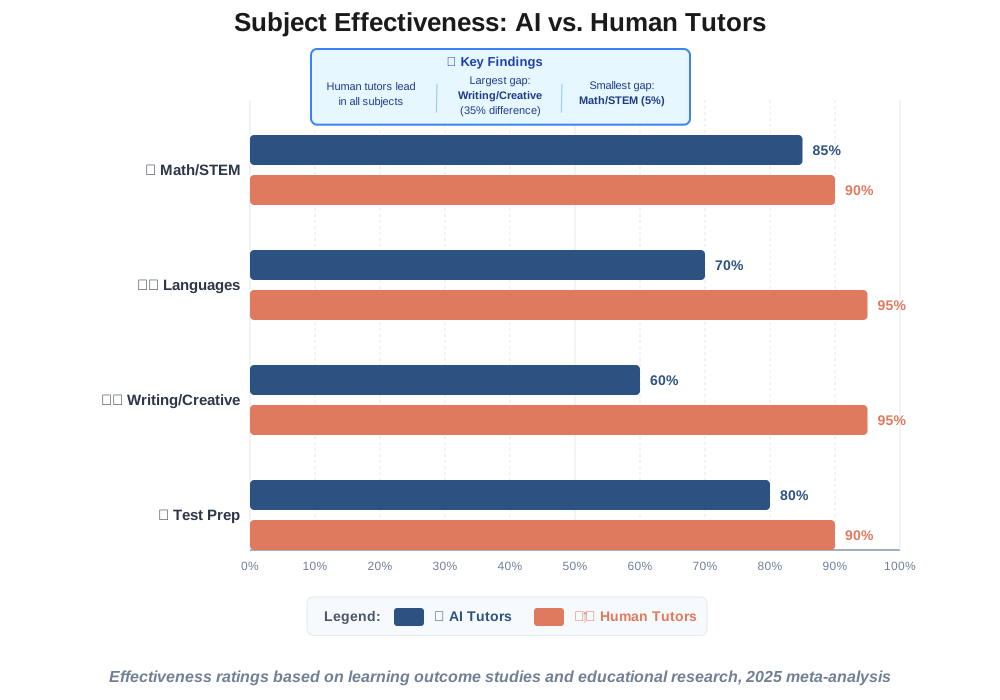
For basic skill practice and knowledge retention, AI tutoring demonstrates effectiveness comparable to human tutoring in specific contexts. Studies on adaptive learning platforms show that students using AI tutors for mathematics drill-and-practice achieve similar test score improvements as those receiving human tutoring for procedural skills.
However, for complex learning objectives—critical thinking, creative problem-solving, and metacognitive skills—human instruction maintains significant advantages. The ability to ask probing questions, model thinking processes, and provide nuanced feedback remains difficult for AI to replicate.
The most promising finding suggests that combining both approaches yields optimal results. Students who use AI tutors for practice and reinforcement while meeting periodically with human tutors for deeper understanding, motivation, and strategic guidance often outperform those using either method exclusively.
Consider this: AI tutors excel at what computers do well—tireless repetition, immediate feedback, and pattern recognition across thousands of practice problems. Human tutors excel at what humans do well—understanding context, building relationships, teaching how to learn, and inspiring genuine curiosity.
Subject-Specific Considerations: Where Each Excels
Mathematics and STEM Subjects
AI tutors perform strongly in mathematics, particularly for procedural skills like algebra manipulation, equation solving, and geometry proofs. The clear right-or-wrong nature of math problems suits algorithmic evaluation. Platforms like Khan Academy, Photomath, and IXL provide extensive practice with immediate feedback.
Human tutors add value by explaining why mathematical concepts matter, connecting abstract formulas to real-world applications, and teaching problem-solving strategies that transfer across contexts. For advanced mathematics requiring conceptual understanding—calculus, linear algebra, mathematical proofs—human guidance becomes increasingly important.
Best approach: Use AI tutors for practice problems and immediate homework help. Schedule human tutoring when introducing new concepts, preparing for major exams, or when students plateau despite AI practice.
Languages and Communication Skills
AI tutors offer conversational practice without judgment, particularly valuable for language learners self-conscious about speaking. Apps like Duolingo, Babbel, and ChatGPT-based conversation partners provide low-pressure practice at any proficiency level.
Human tutors teach cultural nuances, idiomatic expressions, and the pragmatics of communication that AI cannot fully capture. They correct pronunciation more accurately, understand regional dialects, and explain when grammatically correct phrases sound unnatural to native speakers.
Best approach: Use AI for daily vocabulary practice and conversation simulation. Meet with human tutors weekly or biweekly for pronunciation correction, cultural context, and authentic dialogue practice.
Writing and Creative Subjects
AI tutors can identify grammar errors, suggest vocabulary improvements, and analyze essay structure. However, they struggle to provide meaningful feedback on voice, originality, and persuasive argumentation. AI-generated writing suggestions often lead to formulaic, generic prose.
Human tutors help students develop unique voices, teach revision strategies, and provide the kind of substantive feedback that improves writing over time. They recognize when a “grammatically incorrect” sentence serves a stylistic purpose and teach the judgment required for creative decision-making.
Best approach: Use AI for grammar checking and basic editing only after completing your own revision. Work with human tutors on brainstorming, structural planning, and developing your authentic voice.
Test Preparation
Both AI tutors and human tutors offer test prep, but with different strengths. AI excels at providing vast question banks and timed practice tests and identifying weak areas through diagnostic testing. Human tutors teach test-taking strategies, manage test anxiety, and help students understand scoring algorithms to maximize performance.
Best approach: Use AI for practice questions and diagnostic testing. Invest in human tutoring for strategy sessions before major exams (SAT, ACT, AP tests) where test-taking techniques significantly impact scores.
Academic Integrity: Navigating the Ethics of AI Assistance
The availability of AI tutors raises important questions about academic honesty. When does legitimate tutoring assistance become unauthorized help on assignments? This boundary remains contested and evolving.
Establishing Ethical Guidelines
Students and parents should establish clear principles:
Legitimate AI tutor use includes:
- Getting explanations of concepts you don’t understand
- Reviewing worked examples to learn problem-solving methods
- Practicing skills through AI-generated problems
- Checking your own work for errors after completion
- Learning general strategies and approaches
Academic integrity violations include:
- Having AI complete homework assignments you submit as your own
- Using AI to generate essays you don’t substantially revise
- Bypassing learning by asking AI for direct answers without understanding
- Violating explicit teacher policies about AI assistance
The test I recommend: if using an AI tutor, could you still solve similar problems independently during an exam? If not, you’re using it as a crutch rather than a learning tool.
School Policies and Communication
Many schools are still developing AI use policies. Proactively discuss with teachers:
- What AI assistance is permitted for homework?
- Should students disclose when AI helped with assignments?
- Are there subjects or assignment types where AI use is prohibited?
Some teachers encourage AI tutor use while requiring students to document their learning process. Others prohibit it entirely. Following these guidelines protects students from unintentional policy violations.
Human tutors face similar ethical questions. A tutor who completes student work crosses an obvious line, but what about one who heavily guides every step? Quality tutors teach students to solve problems independently rather than creating dependency.
Practical Decision Framework: Choosing Your Path
After examining costs, capabilities, and considerations, how do you actually decide between AI tutors and human tutors? Use this framework to evaluate your specific situation:
Start with Your Primary Goals
Choose AI tutors when:
- Budget is constrained (under $50 monthly for tutoring)
- You need assistance across multiple subjects simultaneously
- Schedule flexibility is essential (travel, irregular commitments, late-night study)
- Students need practice and reinforcement more than conceptual instruction
- Subject is procedural or skill-based (basic math, vocabulary, grammar)
- Student is self-motivated and learns well from written explanations
Choose human tutors when:
- You can invest $200+ monthly per subject
- Students need motivation, accountability, and relationship-based learning
- The subject requires deep conceptual understanding or creativity
- Student has learning differences requiring specialized instructional approaches
- Building study skills and learning strategies is a priority
- Test-taking anxiety or performance pressure needs addressing
Combination Approaches That Work
Many families find success with hybrid models:
The Foundation Model: Use AI tutors as the primary learning tool, supplemented by monthly human tutor check-ins to assess progress, address persistent confusion, and adjust strategies.
The Reinforcement Model: Work with a human tutor weekly for instruction, using AI tutors between sessions for practice and homework support.
The Subject-Split Model: Use AI tutors for subjects where the student is performing adequately, reserving human tutoring for subjects where they struggle most.
The Seasonal Model: Employ human tutors during critical periods (exam preparation, difficult units, summer catch-up) while using AI tutors during maintenance phases.
Questions to Ask Before Committing
Regardless of which path you choose, evaluate options systematically:
For AI tutors:
- What data does this platform collect about my child?
- Can I review the interactions and learning content?
- Does it align with the school curriculum and teaching methods?
- What happens if the student gets stuck—is human support available?
- Does it teach concepts or just provide answers?
- Can I set time limits and monitor usage?
For human tutors:
- What are their qualifications and experience with this subject and age group?
- Can they provide references from other families?
- What is their teaching philosophy and approach to student mistakes?
- How do they communicate progress and areas of concern?
- What is their cancellation policy and session flexibility?
- Do they collaborate with schoolteachers or work independently?
Protecting Student Privacy: Practical Steps
Whichever tutoring approach you select, implement these privacy protections:
For AI Tutoring Platforms
Before signup:
- Read the complete privacy policy, not just the summary
- Research the company’s data practices through independent privacy reviews
- Check whether the service has experienced data breaches (search “[Platform Name] data breach”)
- Verify COPPA compliance for children under 13
During setup:
- Use a dedicated email address (not your primary account)
- Create usernames that don’t include your child’s full name
- Avoid providing optional information (phone numbers, detailed demographics)
- Disable location services unless absolutely required
- Opt out of data sharing and marketing communications
Ongoing monitoring:
- Review your child’s chat history periodically
- Check account settings quarterly for changed privacy defaults
- Teach children never to share personal identifying information in tutor chats
- Delete accounts for services no longer in use rather than leaving them dormant
For Human Tutors
Initial conversations:
- Discuss confidentiality expectations explicitly
- Clarify what information, if any, will be shared with schools
- Establish communication protocols that respect privacy
- Confirm whether tutors keep notes and how they’re secured
For online tutoring:
- Use video platforms with end-to-end encryption when possible
- Ensure tutors don’t record sessions without consent
- Verify that shared documents are deleted after sessions
- Consider virtual backgrounds to avoid showing home details
Real-World Success Stories and Cautionary Tales
Understanding how others navigate these choices provides valuable perspective:
Success with AI Tutors
Maria, a high school junior, struggled with Algebra II while managing a demanding dance schedule. Her family couldn’t afford weekly tutoring at $75 per hour, and her practice schedule made consistent appointments impossible. She began using Khan Academy’s AI-powered practice system, spending 30 minutes daily on targeted exercises. Within two months, her grade improved from D to B+, and she felt confident tackling homework independently. The 24/7 availability meant she could practice after late rehearsals, and the patient, nonjudgmental feedback reduced her math anxiety.
Key factors in her success: Self-motivation, consistent daily use, a clear goal (grade improvement), and supplementary help from her classroom teacher during office hours.
Success with Human Tutors
James, a middle school student with ADHD, struggled with organization and reading comprehension despite being intellectually capable. His parents hired a special education tutor who met with him twice weekly. She taught him annotation strategies, helped him break down assignments into manageable steps, and most importantly, provided accountability and encouragement. His grades improved, but more significantly, he developed executive function skills that served him across all subjects. The relationship-based learning addressed his underlying challenges in ways that algorithmic instruction couldn’t.
Key factors in his success: Tutor specialized in learning differences, consistent scheduling provided structure, and focus extended beyond just content to learning strategies.
Cautionary Tale: Over-Reliance on AI
Sophia, a college freshman, began using ChatGPT to “help” with writing assignments. What started as asking for outlines evolved into having the AI draft complete essays she’d lightly edit. Her grades were excellent, but during in-class essay exams, she struggled to produce coherent writing under time pressure. Her professor noticed the dramatic quality difference and questioned whether her take-home work was authentically hers. The investigation resulted in academic probation. Beyond the disciplinary consequences, Sophia hadn’t actually developed her writing skills despite a semester of coursework.
Lessons learned: AI tutors require honest self-assessment about whether you’re learning or just completing assignments. Shortcuts create skill gaps that emerge during high-stakes independent work.
Cautionary Tale: Poor Tutor Match
The Chen family invested in expensive SAT prep tutoring for their daughter Amy, paying $150 per hour for a tutor with impressive credentials. However, the tutor’s teaching style emphasized speed and shortcuts without building conceptual understanding. Amy felt anxious during sessions, afraid to admit confusion, and her practice test scores stagnated. After three months and over $3,000 spent, they switched to a different tutor whose patient, encouraging approach better matched Amy’s needs. Her scores improved, but they’d wasted significant resources on the poor initial match.
Lessons learned: Credentials matter less than teaching style compatibility. Trial sessions, clear communication, and willingness to switch if the match isn’t working protect your investment.
The Future of Tutoring: Emerging Trends
The distinction between AI tutors and human tutors will likely blur as technology evolves. Current trends suggest:
AI Enhancement of Human Tutoring: Platforms are emerging that provide human tutors with AI-powered dashboards showing student knowledge gaps, learning patterns, and suggested teaching strategies. This amplifies tutor effectiveness while maintaining human judgment and relationships.
More Sophisticated AI Capabilities: Next-generation AI tutors will better understand context, provide more nuanced feedback, and potentially simulate emotional intelligence more convincingly. However, these advances raise intensified privacy concerns as systems collect even more detailed behavioral data.
Hybrid Learning Models: Schools are experimenting with flipped classroom models where AI handles basic instruction and practice while teachers focus on application, creativity, and mentorship. This model may extend to private tutoring as well.
Regulation and Standards: As AI tutoring becomes mainstream, expect increased regulation around data privacy, particularly for minors. Educational standards may emerge defining appropriate AI use versus academic dishonesty.
Regardless of technological advances, certain human elements—genuine care, intuitive understanding, mentorship, and inspiration—will remain irreplaceable. The question isn’t whether AI will replace human tutors, but rather how we thoughtfully integrate both to serve students best.
Frequently Asked Questions
Final Recommendations: Making Your Choice
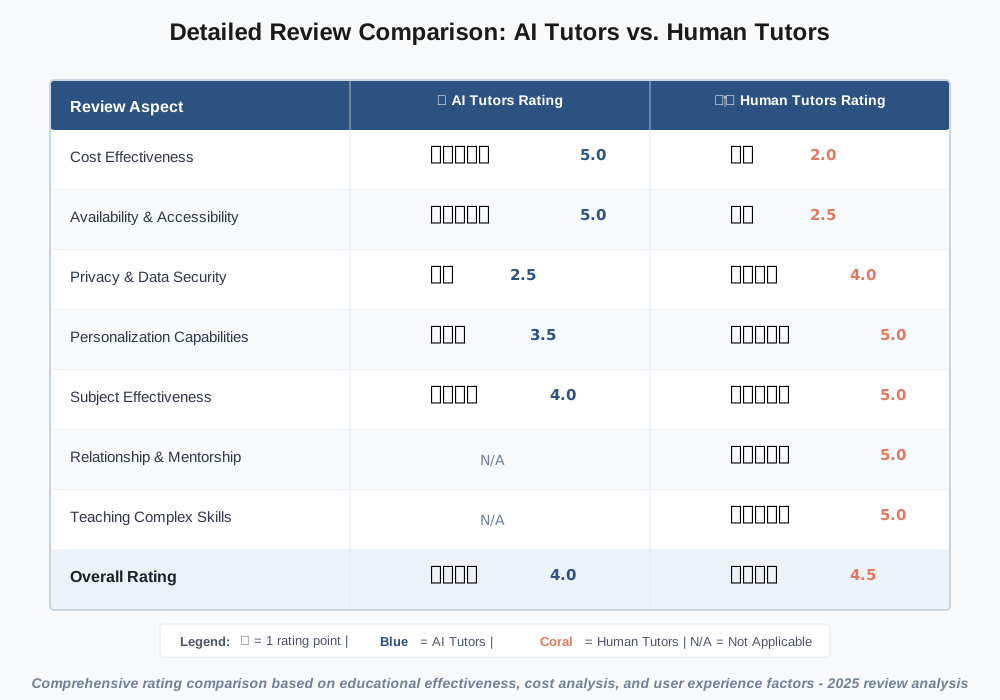
The comparison between AI tutors and human tutors reveals no universal “better” option. Instead, the optimal choice depends on your student’s learning style, subject needs, budget, and educational goals.
Choose AI tutors as your primary approach if: You’re working with limited budgets, need flexibility across multiple subjects, have a self-motivated student who learns well from written explanations, and primarily need practice rather than conceptual instruction. Implement strong privacy protections and monitor for appropriate use.
Choose human tutors as your primary approach if: You can invest financially in education, your student needs relationship-based motivation and accountability, learning differences require specialized instruction, or the subject demands creativity and critical thinking. Verify qualifications, ensure good personality matches, and establish clear communication about progress.
Choose a hybrid approach if: You want to maximize both cost-effectiveness and learning outcomes. Use AI for daily practice and homework support while scheduling regular human tutor sessions for deeper instruction, strategy development, and motivation. This combination often delivers optimal results while remaining budget-conscious.
Whatever path you choose, remember that technology serves learning—not the reverse. The goal isn’t finding the most advanced AI or the most credentialed tutor. The goal is supporting your student’s genuine understanding, curiosity, and long-term educational success. Stay engaged with their learning process, maintain open communication about challenges, and remain willing to adjust approaches as needs evolve.
Most importantly, model the kind of learning mindset you want your student to develop: viewing challenges as opportunities, asking questions without shame, and understanding that genuine learning requires effort, time, and sometimes struggle. Whether supported by algorithms or humans, these foundational attitudes determine educational success far more than any tutoring platform or service.
References
AI Tutoring Effectiveness Research
- Nature – npj Science of Learning (2025)
- “A systematic review of AI-driven intelligent tutoring systems (ITS) in K-12 education”
- Published: May 14, 2025
- URL: https://www.nature.com/articles/s41539-025-00320-7
- Key finding: Systematic review of 28 studies with 4,597 students showing AI tutors have generally positive effects on learning
- Nature – Scientific Reports (2025)
- “AI tutoring outperforms in-class active learning: an RCT introducing a novel research-based design in an authentic educational setting”
- Published: June 3, 2025
- URL: https://www.nature.com/articles/s41598-025-97652-6
- Key finding: Randomized controlled trial at Harvard showing AI tutors can be effective when properly designed
- arXiv Preprint (2025)
- “A Comprehensive Review of AI-based Intelligent Tutoring Systems: Applications and Challenges”
- Published: July 25, 2025
- URL: https://arxiv.org/html/2507.18882v1
- Key finding: Studies show ITS can improve student performance by 20%
- MDPI Education Sciences (2025)
- “The Impact of Artificial Intelligence (AI) on Students’ Academic Development”
- Published: March 11, 2025
- URL: https://www.mdpi.com/2227-7102/15/3/343
- Key finding: Research on AI effectiveness with 85 university students
Privacy and Data Security Sources
- Axios Education (2025)
- “How students’ privacy could be a casualty of schools’ rush to AI”
- Published: August 15, 2025
- URL: https://www.axios.com/2025/08/14/ai-education-privacy
- Key finding: FERPA hasn’t been significantly updated since 1974; enforcement is zero
- arXiv Security Research (2025)
- “Analyzing Security and Privacy Challenges in Generative AI Usage Guidelines for Higher Education”
- Published: June 25, 2025
- URL: https://arxiv.org/html/2506.20463v1
- Key finding: Comprehensive analysis of data privacy risks in educational AI
- Future of Privacy Forum
- AI vetting checklist for schools
- URL: Referenced in K-12 Dive article
- Key finding: Over 128 state student privacy laws schools must monitor
- MIT Sloan Teaching & Learning Technologies (2023)
- “Navigating Data Privacy”
- Published: August 31, 2023
- URL: https://mitsloanedtech.mit.edu/ai/policy/navigating-data-privacy/
- Key finding: Guidelines on protecting student data with AI tools
Tutoring Cost Data
- Kapdec Education Blog (2025)
- “Private Tutoring Rates in the U.S. (2025): What You Need to Know”
- Published: December 2025
- URL: https://kapdec.com/blog/?p=31905
- Key finding: US tutoring market projected to grow by $28 billion 2025-2029
- Care.com Cost Survey (2025)
- “How Much Does a Tutor Cost? Average Tutoring Rates by Grade”
- Published: September 22, 2025
- URL: https://www.care.com/c/how-much-does-a-tutor-cost/
- Key finding: Tutoring rates range from $18 to $18-$100+ per hour depending on factors
- Technavio Market Research
- US Private Tutoring Market forecast
- Key finding: $28.85 billion growth projection 2025-2029 at 11% CAGR
About the Author
Nadia Chen is an expert in AI ethics and digital safety who helps non-technical users navigate technology responsibly. With a background in education technology and data privacy advocacy, Nadia focuses on empowering families to make informed decisions about AI tools while protecting personal information. She specializes in making complex technical concepts accessible, emphasizing safe experimentation and responsible use. Nadia writes extensively about AI in education, privacy protection, and helping students leverage technology without compromising their digital security or academic integrity.