
AI Writing Assistants: Your Creative Partner in Content
AI Writing Assistants are transforming how we create content, and here’s the exciting part—you don’t need to be a tech wizard to use them. Whether you’re drafting your first blog post, crafting emails, or overcoming that dreaded blank page, these intelligent tools act as your creative sidekick, helping you write better, faster, and with more confidence. I’ve watched countless writers discover that AI writing assistants aren’t about replacing the human touch; they’re about amplifying it. Think of them as having a brilliant editor, idea generator, and grammar expert available 24/7, ready to help you shine.
AI Writing Assistants: A Comprehensive Guide for Beginners
Starting your journey with AI writing assistants might feel overwhelming, but let me walk you through the basics. At their core, these tools use artificial intelligence to understand language patterns and help you create, edit, and refine text. You type a prompt or a rough draft, and the AI suggests improvements, generates ideas, or even writes entire sections based on your input.
For beginners, the key is understanding that you’re always in control. The AI provides suggestions—you make the final decisions. Start with simple tasks: ask it to help you outline an article, suggest synonyms for overused words, or check your grammar. Most modern AI writing assistants have intuitive interfaces where you simply type what you need, and they respond conversationally.
What makes this technology accessible is that it learns from your preferences. The more you use it, the better it understands your style. You don’t need coding skills or technical knowledge—just a willingness to experiment and see what works for your writing process.
The Best AI Writing Assistants for Bloggers in 2025
The best AI writing assistants for bloggers have evolved into incredibly sophisticated tools that understand content strategy, SEO, and audience engagement. From my experience testing these platforms, a few stand out for their unique strengths.
Tools like Jasper excel at long-form content and maintaining brand voice across multiple pieces. Copy.ai shines for quick social media posts and ad copy. Grammarly has expanded beyond grammar checking to offer style improvements and tone adjustments. For bloggers specifically, platforms like Writesonic and Rytr provide an excellent balance between affordability and features.
What matters most is finding a tool that matches your workflow. Some bloggers love all-in-one platforms that handle research, writing, and optimization. Others prefer specialized tools for different tasks. The beauty of 2025’s ecosystem is that most offer free trials—take advantage of them. Spend a week with each tool, create actual blog posts, and see which one feels like a natural extension of your creative process.
AI Writing Assistants vs. Human Writers: A Detailed Comparison
The debate around AI writing assistants vs. human writers often misses the point—it’s not about replacement, it’s about collaboration. Let me share what I’ve learned from using both approaches extensively.
AI writing assistants process information at incredible speeds, generate multiple variations instantly, and never tire. They’re exceptional at pattern recognition, ensuring consistency, and handling repetitive tasks like product descriptions or metadata. However, they lack genuine emotional intelligence, lived experiences, and the ability to understand nuanced cultural contexts.
Human writers bring irreplaceable qualities: authentic storytelling, emotional resonance, ethical judgment, and creative intuition. We understand subtext, can read between the lines of what an audience truly needs, and craft narratives that connect on deeply personal levels.
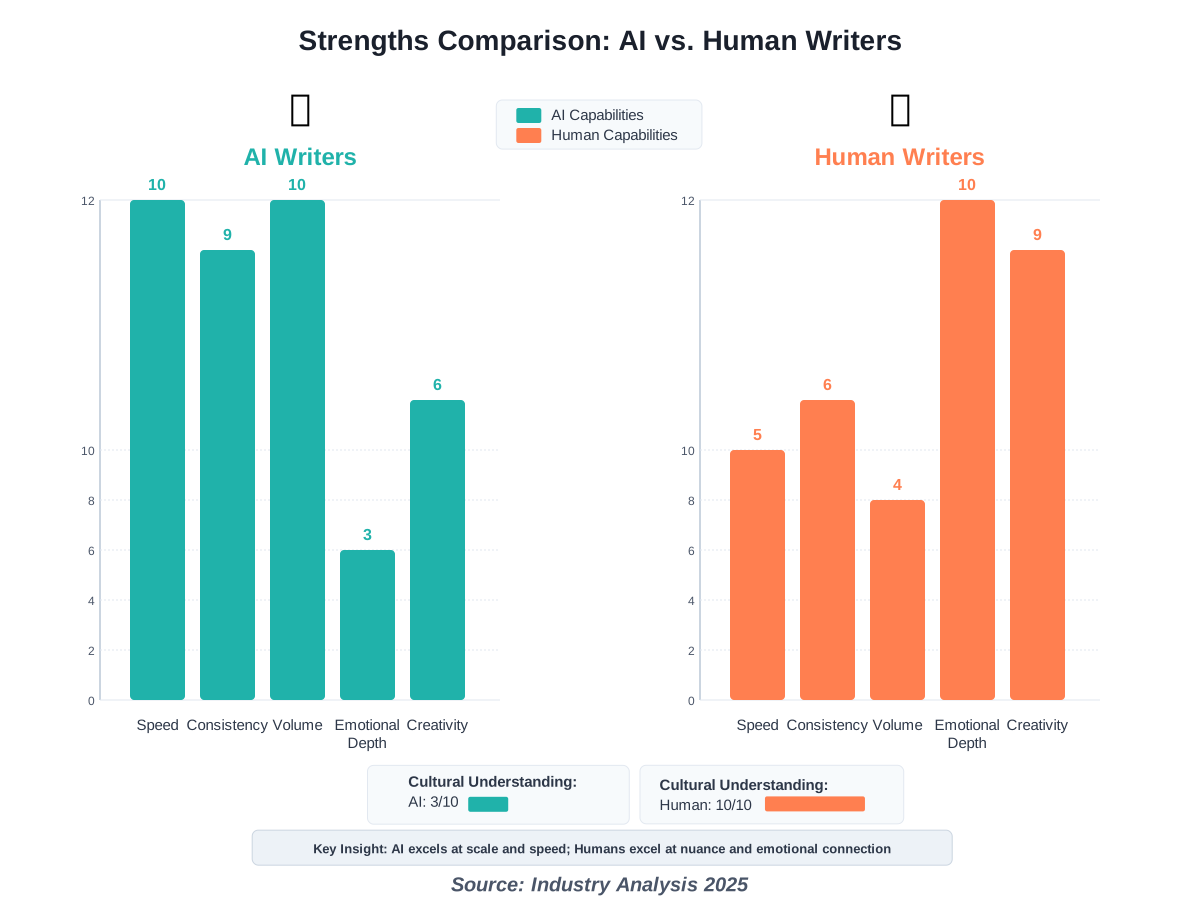
The smartest approach? Use both. Let AI handle the heavy lifting—research, first drafts, optimization—while you focus on what makes content truly memorable: your unique perspective, voice, and insights.
How to Use AI Writing Assistants for Effective Content Marketing
How to use AI writing assistants for effective content marketing starts with understanding that these tools excel at scaling your content production without sacrificing quality. Here’s my proven workflow that transforms content marketing efforts.
First, use your AI writing assistant for audience research and trend analysis. Most advanced tools can analyze competitor content, identify content gaps, and suggest topics your audience is actively searching for. This intelligence-gathering phase is where AI truly shines.
Next, create detailed content briefs. Rather than asking the AI to write blindly, give it context: your target audience, key messages, tone requirements, and SEO keywords. The more specific your brief, the better the output. I’ve found that spending five minutes on a solid brief saves thirty minutes of editing later.
Use the AI to generate multiple angles on the same topic. Ask it for ten different introductions, five headline variations, or three approaches to your conclusion. This variety sparks creativity and helps you see possibilities you might have missed.
For content calendars, AI writing assistants can suggest optimal posting times, content themes by season, and even predict which topics might trend. They’re particularly valuable for generating social media variants of your long-form content—turning one blog post into fifteen social posts with different hooks and CTAs.
The Future of AI Writing Assistants: Trends and Predictions
The future of AI writing assistants is heading toward hyper-personalization and seamless integration with our entire content ecosystem. Based on current trajectories and conversations with developers, we’re moving toward tools that understand not just language but intent, context, and brand DNA at profound levels.
Expect AI writing assistants to become multimodal—seamlessly working with text, images, video, and audio. You’ll describe a concept verbally, and the AI will generate a complete content package: a written article, accompanying visuals, a video script, and social media snippets, all cohesively branded.
Real-time collaboration features will blur the line between human and AI contributions. Imagine drafting content where the AI suggests edits mid-sentence, offers alternative phrasings as you type, and pulls relevant data from your entire content library—all without breaking your creative flow.
Privacy and ethical AI will become major differentiators. Tools that transparently show their training data sources, offer granular control over data usage, and provide clear authorship tracking will lead the market. We’ll see “ethical AI” badges becoming as important as organic food labels.
AI Writing Assistants for Copywriting: Boost Your Conversion Rates
AI writing assistants for copywriting have revolutionized how we create persuasive content that converts. The secret lies in their ability to analyze thousands of high-performing copy examples and distill proven patterns into your work.
Start by training your AI on your best-converting copy. Most advanced tools allow you to input successful past campaigns, teaching them your unique voice and what resonates with your audience. This creates a powerful foundation for generating new variations that maintain proven elements while exploring fresh angles.
For landing pages, use your AI writing assistant to A/B test copy variations at scale. Generate five different headline approaches, three value proposition statements, and multiple CTA variations. The AI can even suggest which combinations might perform best based on conversion data from similar campaigns.
One technique I love: ask the AI to rewrite your copy for different audience segments. The same product might need entirely different positioning for C-suite executives versus frontline managers. AI writing assistants can help you rapidly create these variations while maintaining core benefits.
Don’t just use AI for writing—leverage it for analysis. Tools like Jasper and Copy.ai can evaluate your copy’s emotional tone, reading level, and persuasive elements, suggesting improvements that align with conversion best practices.
Ethical Considerations When Using AI Writing Assistants
Ethical considerations when using AI writing assistants deserve serious attention as these tools become ubiquitous. We need to navigate issues of transparency, authenticity, and intellectual property thoughtfully.
First, disclosure matters. When AI has significantly contributed to content, many industries now expect transparency about this. Not because AI-assisted content is inferior, but because readers deserve to understand how information is created. I recommend a simple approach: if AI generated more than 30% of the final content, acknowledge it.
Plagiarism remains a concern. While AI writing assistants generate original text, they’re trained on existing content. Always run AI-generated content through plagiarism checkers and verify that facts and statistics come from legitimate sources. The AI can hallucinate data—your responsibility is ensuring accuracy.
Bias is another critical issue. AI models reflect biases present in their training data. Be vigilant about stereotyping, cultural insensitivity, or skewed perspectives in generated content. Read with a critical eye, especially when writing about diverse communities, sensitive topics, or marginalized groups.
Consider the impact on human writers. Using AI writing assistants ethically means viewing them as productivity tools, not cost-cutting replacements for human creativity. Support policies that protect writers’ livelihoods while embracing technology that enhances rather than eliminates human roles.
AI Writing Assistants for Academic Writing: A Guide for Students
AI writing assistants for academic writing can be powerful learning tools when used appropriately. Here’s how students can leverage these technologies while maintaining academic integrity and developing genuine skills.
Start by understanding your institution’s AI policy. Academic guidelines vary widely—some schools embrace AI for brainstorming and editing, while others prohibit it entirely. Always clarify expectations with your professors before using these tools for coursework.
Use AI writing assistants for the research phase. They excel at helping you understand complex topics, suggesting relevant sources, and identifying knowledge gaps in your understanding. Ask the AI to explain concepts in simpler terms, generate study questions, or create outlines for essays. This preparatory work enhances learning without compromising the authenticity of your final submission.
For writing itself, limit AI to editing support. After writing your first draft independently, use tools like Grammarly or ProWritingAid to catch grammatical errors, improve sentence structure, and enhance clarity. This approach develops your writing skills while benefiting from AI’s technical precision.
Never submit AI-generated text as your own work. Not only is this academically dishonest, but you’re also robbing yourself of the learning opportunity. Academic writing teaches critical thinking, argumentation, and intellectual discipline—skills that develop through struggle, not shortcuts.
AI Writing Assistants for Technical Writing: Streamlining Documentation
AI writing assistants for technical writing excel at creating clear, consistent documentation that helps users understand complex systems. Technical writing demands precision, and that’s exactly where these tools add tremendous value.
For software documentation, AI writing assistants can analyze codebases and generate API documentation, user guides, and release notes. They ensure terminology remains consistent across hundreds of pages—a crucial but tedious task that’s perfect for automation. Tools like GitHub Copilot now extend beyond code to help document functions, methods, and entire systems.
Standard operating procedures and training manuals benefit enormously from AI assistance. Feed the AI your existing documentation style guide, then ask it to draft new procedures following those exact formatting and language standards. This maintains the consistency that technical documents require while dramatically reducing creation time.
Version control documentation becomes manageable with AI. When software updates, the AI can identify which documentation sections need updating, suggest specific revisions based on changes, and even maintain change logs. This keeps documentation synchronized with product evolution without requiring manual tracking.
However, always have technical experts review AI-generated documentation. While AI writing assistants excel at structure and language, they can misunderstand technical nuances. Use AI as your first draft generator, then refine with human expertise.
The Cost of AI Writing Assistants: Pricing Models and ROI
Understanding the cost of AI writing assistants and their return on investment helps you make smart tool selections. Pricing varies dramatically, but patterns are emerging that clarify when premium tools justify their cost.
Free tiers exist across most platforms—Grammarly, ChatGPT, and others offer basic functionality at no cost. These work well for occasional users or those experimenting with AI writing. However, limitations on generation volume, feature access, and output quality often push serious users toward paid plans.
Subscription models dominate, typically ranging from $10 to $100 monthly. Mid-tier plans ($20-50/month) suit most bloggers and small business owners, offering unlimited basic generation, multiple user seats, and priority support. Enterprise plans ($100+) add advanced features like team collaboration, custom training, and API access.
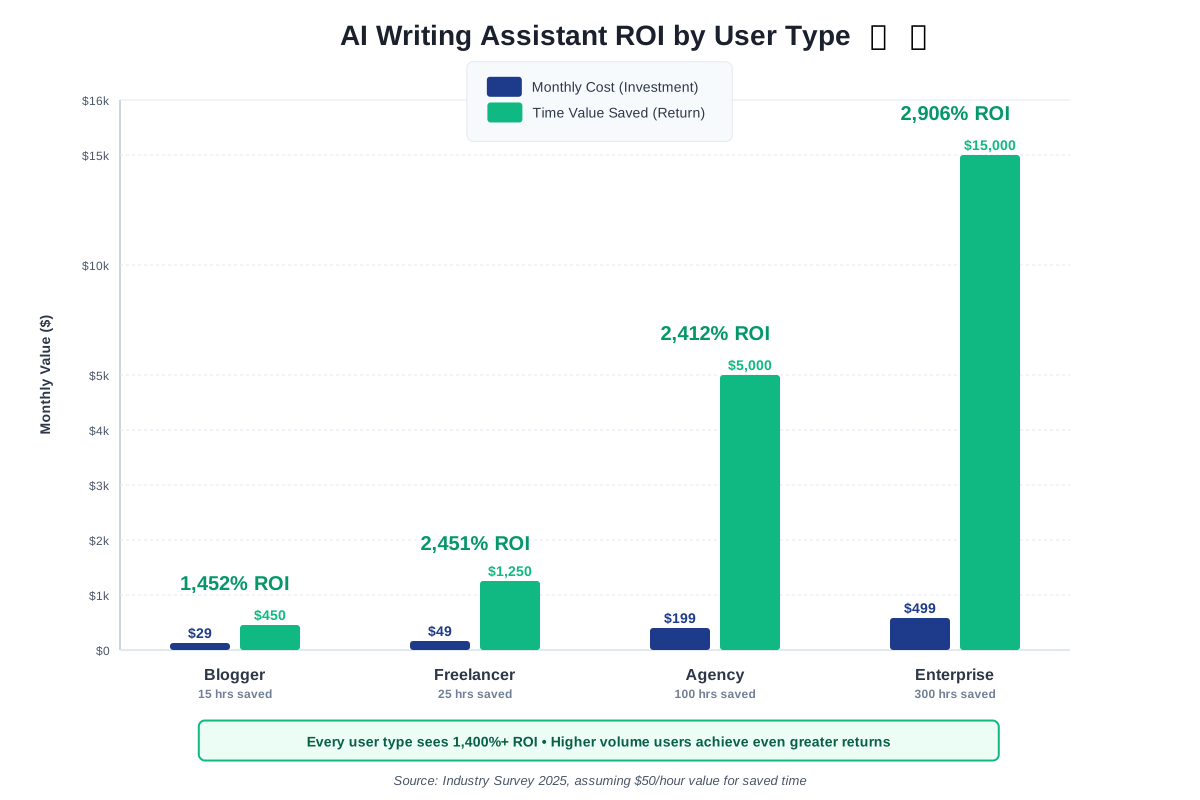
Calculate ROI by tracking time saved. If an AI writing assistant saves you ten hours monthly, and your time is worth $50/hour, that’s $500 in value. A $30 subscription delivers 1,567% ROI. Even conservative estimates show that most users recoup costs within the first week of use.
Don’t overlook hidden costs: learning curves, workflow integration, and potential quality issues requiring additional editing time. Choose tools with strong onboarding and support to minimize these expenses.
AI Writing Assistants for Social Media: Generating Engaging Content
AI writing assistants for social media have become indispensable for maintaining a consistent, engaging presence across platforms. The challenge with social media isn’t just writing—it’s writing something compelling every single day, multiple times per day, across different channels.
These tools understand platform-specific best practices. They know that LinkedIn favors professional storytelling, Twitter demands punchy brevity, Instagram needs visual-first captions, and TikTok requires conversational immediacy. Rather than you manually adjusting content for each platform, AI writing assistants can adapt a single message into platform-optimized variations.
Trend integration is where AI really shines. The best tools monitor trending topics, hashtags, and conversations, suggesting timely content angles that increase visibility. You can ask your AI, “What’s trending in digital marketing today?” and receive content ideas that tap into active conversations.
For content calendars, use AI to batch-create weeks of posts in one session. Provide your monthly themes and key messages, and the AI generates daily content variations. This consistency is crucial for social media success but can feel overwhelming when you’re staring at thirty blank content slots.
User engagement improves when you use AI writing assistants to craft multiple response templates for common comments and messages. This speeds up community management without sacrificing the personal touch—you choose which AI-suggested response fits best, then personalize it.
Overcoming Writer’s Block with AI Writing Assistants
Overcoming writer’s block with AI writing assistants has transformed how I approach those frustrating moments when words simply won’t flow. Instead of staring at a blank page, you now have a creative partner who can jumpstart your thinking.
The freewriting technique works brilliantly with AI. Write a messy, imperfect paragraph about your topic—it doesn’t matter if it’s coherent—then ask your AI writing assistant to refine it or suggest three different directions to develop the idea. This removes the pressure of creating perfect first drafts.
Prompt engineering specifically for writer’s block helps. Instead of asking, “Write about productivity,” try, “I’m writing about productivity but feeling stuck. Give me five unusual angles on this topic that most people haven’t explored.” Specificity about your stuck point helps the AI provide genuinely useful suggestions.
Use AI for dialogue with your ideas. Type your half-formed thoughts, then ask the AI questions like “What’s missing from this argument?” or “What objections might readers have?” This conversational approach often reveals the missing piece that was blocking your progress.
Sometimes writer’s block stems from overthinking. Ask your AI writing assistant to generate a bad first draft intentionally. Seeing imperfect AI output often makes you think, “I can do better than this,” which breaks the perfectionism paralysis. The AI draft becomes a reaction target rather than a threatening blank page.
AI Writing Assistants for Email Marketing: Crafting Effective Campaigns
AI writing assistants for email marketing optimize the entire campaign creation process, from subject lines to conversion-focused body copy. Email marketing demands personalization at scale—exactly what AI handles beautifully.
Subject line generation showcases AI’s power. Ask your AI writing assistant for twenty subject line variations, then A/B test the most promising options. The AI understands psychological triggers like urgency, curiosity, and exclusivity, incorporating them naturally while maintaining your brand voice.
Personalization extends beyond just inserting names. Advanced AI tools analyze subscriber behavior, segment characteristics, and engagement history to customize content for different audience groups. Your “new subscriber” email differs from your “long-time customer” email, all generated from a single master template.
Email sequences benefit enormously from AI assistance. Create a seven-email welcome series by providing the AI with your overall goal and key messages. It structures the sequence logically, gradually building toward your conversion goal while maintaining reader engagement through varied approaches.
For newsletters, AI writing assistants can summarize your blog posts, highlight key statistics, and format content specifically for email readers. They understand that email content needs to be scannable, with clear hierarchy and strong calls to action.
Always maintain human oversight for tone and branding. While AI generates effective email copy structurally, your unique voice and understanding of your audience’s emotional landscape ensure messages truly resonate.
The Impact of AI Writing Assistants on the Job Market for Writers
The impact of AI writing assistants on the job market for writers is complex and evolving. Rather than the apocalyptic predictions of mass unemployment, we’re seeing transformation and specialization within writing professions.
Entry-level, commodity writing work has definitely shifted. Simple product descriptions, basic blog posts, and formulaic content increasingly get handled by AI writing assistants with minimal human oversight. This challenges writers who compete primarily on speed and volume rather than specialized expertise.
However, demand for skilled writers who can direct, edit, and refine AI output has surged. New roles like “AI content strategist” and “prompt engineer for content” are emerging. These positions require understanding both writing craft and how to maximize AI tools—a combination that commands premium rates.
Specialized writing continues thriving. Technical writers with domain expertise, creative storytellers who craft compelling narratives, and thought leaders who provide unique perspectives remain highly valued. AI writing assistants complement rather than replace these skills.
Writers who embrace these tools as productivity amplifiers position themselves advantageously. You can handle larger projects, serve more clients, and focus on high-value creative work while delegating routine tasks to AI. This hybrid approach often increases earning potential rather than diminishing it.
The writers most vulnerable are those resisting adaptation. Skills in prompt engineering, AI output evaluation, and strategic content direction will define success in the evolving landscape.
AI Writing Assistants: Improving Grammar and Style
AI writing assistants improving grammar and style function as tireless editors who catch errors and suggest refinements you might miss. These tools have evolved far beyond basic spell-checking into sophisticated language enhancement systems.
Grammar correction now handles complex issues like subject-verb agreement in long sentences, proper comma placement with dependent clauses, and consistent tense usage throughout documents. Tools like Grammarly and ProWritingAid analyze context, understanding that “their,” “there,” and “they’re” are spelled correctly but might be used incorrectly.
Style improvements focus on readability and impact. AI writing assistants identify passive voice, suggest stronger verb choices, flag overly complex sentences, and recommend simplification when appropriate. They measure readability scores and suggest adjustments for your target audience—writing for academics differs from writing for general consumers.
Tone detection helps ensure your message lands correctly. Writing an apology email? The AI flags language that might seem defensive or insincere. Crafting a marketing message? It highlights sections that feel too aggressive or not compelling enough.
Consistency checking across long documents prevents those embarrassing moments where you spell “ecommerce” three different ways or switch between “client” and “customer” randomly. AI writing assistants create style guides from your existing content, then enforce consistency automatically.
Remember that AI suggestions are just that—suggestions. You’re the final arbiter of what sounds right for your voice and purpose. Use these tools to spot issues, but trust your ear for which corrections to accept.
AI Writing Assistants and SEO: Optimizing Content for Search Engines
AI writing assistants and SEO work synergistically when you understand how to leverage AI for both user value and search visibility. The best approach balances keyword optimization with genuinely helpful content that readers want to engage with.
Keyword research becomes streamlined with AI assistance. Tools can analyze search intent, suggest related keywords, identify content gaps in your niche, and even predict which topics might trend. Rather than manually researching every keyword variation, AI writing assistants provide comprehensive keyword maps in minutes.
Content structure optimization benefits from AI analysis of top-ranking content. The AI examines what’s working for competitors—typical word counts, heading structures, topics covered—then helps you create comprehensive content that answers user questions more thoroughly.
Natural keyword integration is where AI truly shines. Instead of awkwardly stuffing keywords, AI writing assistants suggest synonyms, related phrases, and semantic variations that satisfy search algorithms while reading naturally. They understand that “AI writing tools,” “artificial intelligence content generators,” and “automated writing assistants” all contribute to your topical authority.
Meta descriptions, title tags, and headers all benefit from AI optimization. These elements require specific character limits and keyword placement—technical constraints that AI handles effortlessly while you focus on crafting compelling messages.
However, avoid over-optimizing. Search engines increasingly prioritize user experience over keyword density. Use AI writing assistants to ensure SEO basics are covered, then focus on creating genuinely useful content that earns engagement and backlinks—the ultimate SEO signals.
AI Writing Assistants for Different Languages: Breaking Down Barriers
AI writing assistants for different languages are democratizing global content creation, enabling businesses and creators to communicate effectively across linguistic boundaries. This technology is particularly transformative for multilingual content strategies.
Translation capabilities have evolved beyond word-for-word conversion into culturally aware adaptation. Modern AI writing assistants understand idioms, cultural references, and contextual appropriateness. They know that direct translation often fails and instead localize content for different markets.
Content creation in non-English languages now rivals English-language capabilities. Spanish, French, German, Chinese, and dozens of other languages have robust AI support. You can create original content directly in these languages or adapt English content with nuanced understanding of linguistic differences.
For businesses expanding internationally, AI writing assistants enable rapid market entry. Create your core marketing messages in your primary language, then use AI to generate localized versions that maintain brand consistency while respecting cultural norms and preferences.
Challenges remain with less common languages and dialects. AI training data concentrations in major languages mean that Swahili, Tagalog, or regional language variations may receive less sophisticated support. However, this gap narrows monthly as models expand their language capabilities.
Multilingual content management becomes practical for small teams. One person fluent in English can now oversee content production in five languages, using AI writing assistants for generation and native speakers for final review and approval.
AI Writing Assistants: Generating Creative Fiction and Poetry
AI writing assistants generating creative fiction and poetry spark fascinating debates about art, creativity, and the role of technology in storytelling. These tools can be valuable creative partners when used thoughtfully.
Story ideation benefits tremendously from AI. Stuck on your plot? Ask your AI writing assistant to suggest ten possible complications for your protagonist. Need character development? Request backstory ideas or personality trait combinations. This brainstorming accelerates the creative process without dictating your artistic direction.
For poetry, AI can generate forms, suggest rhyme schemes, and offer word choices that fit meter requirements. Experimenting with different styles becomes quick—write a sonnet, then ask the AI to reimagine it as free verse, haiku, or spoken word. These variations often spark insights into your original idea.
Dialogue writing sees significant AI support. The tools excel at generating realistic conversation flow, character-specific speech patterns, and natural-sounding exchanges. They can even write dialogue in historical periods or with specific regional dialects, though human editing remains essential for authenticity.
However, the heart of creative writing—your unique vision, emotional truth, and artistic voice—cannot be outsourced. AI writing assistants provide scaffolding, not soul. Use them to overcome practical obstacles like finding the right word or plotting act structure, but the creative choices that make writing meaningful must come from you.
Many successful authors now openly use AI in their process, seeing it as one tool among many—like grammar checkers, thesauruses, and beta readers—that support but don’t replace human creativity.
Integrating AI Writing Assistants into Your Workflow: Best Practices
Integrating AI writing assistants into your workflow requires intentional strategy to maximize benefits while avoiding common pitfalls. Here’s the framework I’ve developed through years of experimentation.
Start with an audit of your writing process. Which tasks consume the most time? Where do you get stuck? Which activities drain energy versus energize you? Map these carefully before introducing AI. Target AI assistance at pain points—if research exhausts you but drafting excites you, use AI for research heavy lifting.
Create clear separation between AI-assisted and AI-free phases. Some writers find value in using AI writing assistants for outlines and first drafts, then editing without AI to maintain voice authenticity. Others prefer writing initial drafts independently, then using AI for enhancement and optimization. Find your rhythm.
Develop a prompt library. As you discover effective prompts for different content types, save them. “Generate five headline variations for a how-to article” or “Suggest three persuasive CTAs for a B2B landing page” become reusable templates that speed future work.
Set quality standards upfront. Define what “good enough for publishing” means for AI-generated content. This might include accuracy checks, voice consistency evaluation, and engagement metrics. AI writing assistants should meet these standards with minimal editing, or you’re not using them optimally.
Schedule regular workflow reviews. AI tools evolve rapidly. Features you tried six months ago might work differently now. Allocate monthly time to explore new capabilities and reassess whether your current approach remains optimal.
AI Writing Assistants for Creating Product Descriptions That Sell
AI writing assistants for creating product descriptions that sell excel at combining persuasive copywriting with the volume demands of e-commerce. Whether you have ten products or ten thousand, these tools maintain quality while scaling production.
Feature-benefit translation is where AI adds immediate value. Upload product specifications, and your AI writing assistant converts technical features into customer-focused benefits. “2000mAh battery” becomes “All-day power that keeps you connected from morning commute to evening workout.”
Tone variation for different platforms matters. The product description on your website differs from your Amazon listing, which differs from your social media posts. AI can generate these variations simultaneously, each optimized for its platform’s best practices and character limits.
SEO optimization happens naturally when you provide relevant keywords. AI writing assistants incorporate search terms organically while maintaining persuasive flow. They understand that product descriptions serve dual purposes—converting browsers into buyers while ranking for purchase-intent searches.
A/B testing becomes practical at scale. Generate five description variations for each product, then test which converts best. The AI learns from winning patterns, improving future generations. This continuous improvement cycle significantly impacts revenue over time.
For product launches, AI writing assistants can create complete content packages: main description, short description, bullet points, meta description, and social announcements—all maintaining consistent messaging while adapted to each format’s requirements.
AI Writing Assistants: Avoiding Plagiarism and Ensuring Originality
AI writing assistants avoiding plagiarism and ensuring originality requires understanding both the technology’s capabilities and your responsibilities as a content creator. This is where ethical AI use becomes critically important.
First, understand that modern AI writing assistants generate original text rather than copying from sources. They learn patterns from training data but create new combinations. However, “original” doesn’t automatically mean “unique” or “valuable.” AI can produce original text that’s generic, derivative, or uninteresting.
Always run AI-generated content through plagiarism checkers. While rare, AI can occasionally produce text that closely resembles existing content, especially with common phrases or well-established explanations. Turnitin, Copyscape, or Grammarly’s plagiarism checker should be part of your workflow.
Fact-checking remains your responsibility. AI writing assistants can confidently present false information or outdated statistics. Every claim, number, or attribution needs verification against authoritative sources. The AI generates content; you ensure accuracy.
Add your unique perspective and experience. Even original AI-generated text feels generic without human insights. Inject personal anecdotes, professional expertise, and original analysis. This combination creates content that’s not just original but valuable—something AI alone cannot produce.
Citation practices matter. If you use AI to summarize research or explain concepts, and those explanations closely follow specific sources, cite those sources. Treat AI-assisted research writing the same as human-assisted research writing.
AI Writing Assistants for Generating Ideas: Sparking Creativity
AI writing assistants for generating ideas serve as the antidote to creative stagnation, offering fresh perspectives when your mental well runs dry. The key is learning to use AI as a thinking partner rather than an answer machine.
Divergent thinking exercises work beautifully with AI. Provide a topic and ask for twenty completely different angles. Don’t evaluate immediately—just collect ideas. This forced volume pushes past obvious approaches into genuinely interesting territory. Your AI writing assistant doesn’t judge ideas as “too weird” or “too basic,” which paradoxically generates more innovative options.
Question generation reveals content opportunities. Ask the AI, “What questions do beginners have about [topic]?” or “What misconceptions exist around [subject]?” These questions become article ideas, FAQ content, or video concepts. Understanding what people need to know is half the creative battle.
Analogies and metaphors flow easily from AI. Struggling to explain a complex concept? Ask your AI writing assistant for five analogies that make it relatable. These suggestions often spark creative directions for entire pieces.
Trend combination creates unique angles. Ask the AI to connect your core topic with current events, emerging technologies, or pop culture. “How does [your topic] relate to [trending subject]?” This intersection thinking generates timely, shareable content.
Use constraints creatively. Challenge your AI writing assistant with unusual requirements: “Give me article ideas about productivity using only sports metaphors” or “Suggest content angles for budgeting that avoid all common personal finance advice.” Constraints force creative problem-solving.
AI Writing Assistants for Summarization: Condensing Information Effectively
AI writing assistants for summarization transform how we process information overload, distilling lengthy content into digestible essentials without losing critical meaning. This capability has become indispensable in our content-saturated world.
Document summarization saves incredible time. Upload a fifty-page report, and your AI writing assistant generates a two-paragraph executive summary, a one-page overview, or bullet-pointed key findings—whatever format serves your needs. This works for articles, research papers, transcripts, and even book chapters.
Meeting notes benefit from AI summarization. After lengthy discussions, the AI identifies action items, decisions made, and topics requiring follow-up. This ensures nothing falls through the cracks while saving the administrative burden of manual note-taking.
Content repurposing becomes efficient. Take your long-form blog post and ask your AI writing assistant to create a 200-word summary for newsletters, a 50-word social media teaser, and a 500-word mid-length version for Medium. Each maintains core messages while optimized for its platform.
Research synthesis across multiple sources is where AI truly excels. Provide five articles on the same topic, and the AI identifies common themes, contradictions, and unique perspectives. This meta-analysis helps you understand the conversation landscape quickly.
However, critically evaluate AI summaries before using them. The AI might miss nuance, misinterpret context, or emphasize less important points. Read the original if decisions depend on the content, using AI writing assistants for initial processing rather than final understanding.
The Limitations of AI Writing Assistants: What They Can’t Do
Understanding the limitations of AI writing assistants prevents disappointment and helps you deploy these tools effectively. Despite impressive capabilities, significant gaps remain where human expertise is irreplaceable.
Genuine expertise cannot be faked. AI writing assistants can write about quantum physics or brain surgery, but they lack deep understanding. They pattern-match from training data without truly grasping concepts. For complex technical topics, AI-generated content requires expert review and often substantial revision.
Emotional authenticity remains elusive. AI can mimic empathy and deploy emotionally appropriate language, but it hasn’t experienced loss, joy, love, or frustration. When writing about deeply human experiences, AI-generated content often feels hollow or generic. Your lived experience creates a connection that AI cannot replicate.
Cultural and contextual nuance proves challenging. While AI writing assistants improve constantly, they still miss subtle cultural references, interpret sarcasm incorrectly, or fail to understand why certain phrasings might offend specific communities. Human cultural competency remains essential.
Strategic thinking represents a significant gap. AI can execute strategy (“write this following these rules”) but struggles with formulating strategy (“what content approach will best achieve our three-year brand objectives?”). The AI assists tactics; humans provide strategic direction.
Fact verification is unreliable. AI writing assistants confidently present false information, outdated statistics, and imaginary sources. They cannot assess source credibility or distinguish between fringe theories and mainstream consensus. All factual claims require independent verification.
AI Writing Assistants for Creating Scripts and Screenplays
AI writing assistants for creating scripts and screenplays are revolutionizing entertainment writing, though they work best as collaborators rather than autonomous creators. The unique demands of visual storytelling require careful AI integration.
Structure and formatting benefit tremendously from AI. Screenplays demand precise formatting—scene headers, action lines, dialogue, and transitions. AI writing assistants handle these technical requirements automatically, letting you focus on the story rather than formatting rules.
Dialogue generation helps develop character voices. Describe your character’s personality, background, and motivations, then ask the AI to generate dialogue in their voice. This exploration often reveals character dimensions you hadn’t considered. However, always revise for authenticity—your understanding of the character should guide final dialogue choices.
Scene development moves faster with AI assistance. Stuck on a particular scene? Provide context and ask your AI writing assistant for three different approaches to the scene. These variations become springboards for your own creativity, showing possibilities that spark better solutions.
Plot troubleshooting benefits from AI’s pattern recognition. Experiencing a second-act slump? The AI can suggest complications, character reversals, or subplot developments based on your established story elements. This helps overcome the structural challenges that plague many screenwriters.
However, the soul of great screenwriting—unique vision, thematic depth, and distinctive voice—remains firmly human territory. AI writing assistants provide scaffolding and solve technical problems, but compelling storytelling emerges from your creativity and life experience.
AI Writing Assistants and Brand Voice: Maintaining Consistency
AI writing assistants and brand voice must work in harmony for effective content marketing. Teaching AI your brand’s unique voice and ensuring consistency across content requires intentional setup and ongoing refinement.
Voice training starts with documentation. Create a detailed brand voice guide: tone descriptors (professional but approachable, witty but not sarcastic), preferred vocabulary, phrases to avoid, and sentence structure preferences. Feed this to your AI writing assistant as context for every project. Many tools allow saving custom instructions that apply automatically.
Example-based training works powerfully. Provide the AI with your best-performing content—articles, emails, and social posts that perfectly embody your brand voice. Ask it to analyze these pieces and identify patterns. The AI learns through examples better than abstract rules.
Consistency checks prevent voice drift over time. As you create content, periodically ask your AI writing assistant to evaluate whether new pieces match your brand voice. This self-audit catches when you’ve unconsciously shifted tone or style.
Multiple brand voices require segmentation. If you write for different brands or audience segments, maintain separate AI instances or clear prompt prefixes for each voice. This prevents voice contamination—accidentally using your professional B2B tone for playful B2C content.
Human oversight remains essential. AI writing assistants approximate brand voice effectively but cannot replace your intuitive understanding of what feels “on brand.” Regular reviews and adjustments keep AI-generated content aligned with your evolving brand identity.
AI Writing Assistants for Creating Compelling Case Studies
AI writing assistants for creating compelling case studies streamline the process of showcasing client success while maintaining the authentic storytelling that makes case studies persuasive. These narratives require balancing data with human interest—a combination AI handles increasingly well.
Structure development benefits from AI’s understanding of effective case study formats. Provide basic project details, and your AI writing assistant can generate a framework following proven patterns: challenge, solution, implementation, and results. This structure ensures you cover essential elements while maintaining narrative flow.
Data visualization suggestions help communicate impact. When presenting metrics and results, ask the AI how to present numbers most compellingly. Should you lead with percentage improvement or absolute numbers? How can you contextualize ROI to make it relatable? AI writing assistants offer perspective on data storytelling.
Client interview transcription and synthesis saves tremendous time. Upload interview recordings or notes, and the AI extracts key quotes, identifies main themes, and suggests which client statements most powerfully illustrate your value proposition. This initial processing lets you focus on crafting narrative rather than organizing raw material.
Industry-specific customization improves relevance. Brief your AI writing assistant on industry context, challenges, and terminology for each case study. This background helps generate content that resonates with similar prospects, using language that demonstrates understanding of their world.
However, authenticity in client stories requires human judgment. You understand nuances in client relationships, which details to emphasize, and how to position success without overpromising to prospects. Use AI for efficiency, but apply your expertise to ensure case studies feel genuine and credible.
AI Writing Assistants for Newsletters: Keeping Subscribers Engaged
AI writing assistants for newsletters help maintain the consistency and quality that subscriber relationships demand. Regular newsletters require fresh content, and AI tools provide sustainable solutions for this ongoing commitment.
Content curation becomes manageable with AI assistance. Ask your AI writing assistant to summarize recent industry news, identify trending topics, or suggest relevant content your subscribers would value. This research phase—typically time-consuming—happens in minutes, leaving more energy for analysis and commentary.
Personalization at scale differentiates great newsletters. Use AI to create segment-specific variations of your newsletter. Your “new subscriber” version emphasizes foundational content, while your “long-time reader” version dives deeper into advanced topics. AI writing assistants handle these variations without multiplying your workload proportionally.
Subject line optimization directly impacts open rates. Generate multiple options using AI, then test which performs best. Over time, you’ll identify patterns in what resonates with your specific audience. The AI learns from these patterns, improving future suggestions.
Consistency in voice and quality matters enormously for subscriber retention. AI writing assistants maintain your newsletter’s tone across editions even when you’re rushed, tired, or dealing with other pressures. This reliability builds subscriber trust and anticipation.
Engagement analysis helps refine content strategy. Some AI tools analyze which newsletter sections get the highest engagement, which topics generate replies, and where readers drop off. Use these insights to continuously improve content decisions.
Choosing the Right AI Writing Assistant: Factors to Consider
Choosing the right AI writing assistant from dozens of options requires evaluating several critical factors against your specific needs and workflow. Not all tools are created equal, and the best choice depends entirely on how you’ll use it.
Content type specialization matters significantly. Some AI writing assistants excel at long-form blog content, others at short-form social media, and still others at technical documentation or creative writing. Match tool strengths to your primary content needs. If you primarily write blog articles, prioritize tools with strong SEO features and long-form capabilities.
Integration with existing tools streamlines workflow. Consider what software you already use daily. Does the AI integrate with WordPress, Google Docs, Notion, or your email platform? Native integrations save time and reduce context-switching. Some AI writing assistants offer browser extensions that work anywhere you write.
Language and tone flexibility affects content quality. Test how well potential tools adapt to different voices—professional vs. casual, technical vs. accessible, and formal vs. conversational. The best tool for you captures your unique voice with minimal editing.
Learning curves and support resources impact adoption speed. Some tools require significant prompt engineering expertise; others work intuitively from day one. Consider available tutorials, documentation quality, and customer support responsiveness, especially if you’re new to AI writing.
Cost and subscription flexibility matter for long-term viability. Evaluate pricing tiers, usage limits, and cancellation policies. Many AI writing assistants offer free trials—use them extensively before committing. Consider whether you need individual access or team features.
Advanced Techniques for Using AI Writing Assistants: Level Up Your Content
Advanced techniques for using AI writing assistants separate power users who maximize these tools from casual users who barely scratch the surface. These strategies transform AI from a simple text generator into a sophisticated creative partner.
Prompt chaining creates complex outputs through sequential refinement. Instead of one large prompt, break tasks into steps: first generate an outline, then expand each section, then add examples, and finally optimize for SEO. Each step builds on previous outputs, resulting in more sophisticated final content than single-prompt generation.
Context stacking improves output relevance dramatically. Provide your AI writing assistant with layered context: your audience profile, brand voice guide, content objectives, competitive positioning, and topic brief. This comprehensive context helps AI generate content that’s not just technically correct but strategically aligned.
Negative prompting guides away from unwanted patterns. Tell the AI what not to do: “Avoid clichés like ‘game-changer’ and ‘synergy'” or “Don’t use passive voice or overly complex sentences.” This negative instruction often produces better results than only positive direction.
Iteration frameworks maximize quality. Generate multiple variations of key sections—introductions, headlines, and calls to action. Compare them, identify what works in each, and then ask the AI to combine the best elements into an optimized version. This iterative refinement produces exceptional results.
Custom temperature and parameter adjustments control creativity versus consistency. AI writing assistants often allow adjusting these settings. Lower temperature for factual, consistent content; higher temperature for creative, varied outputs. Experiment with these controls for different content types.
Role-playing scenarios improve specialized content. Instruct the AI to adopt a specific perspective: “You’re a CFO evaluating this product” or “You’re a skeptical consumer reading this ad.” These different viewpoints reveal weaknesses in arguments and opportunities for stronger persuasion.
Your Journey with AI Writing Assistants Starts Now
We’ve explored the vast landscape of AI writing assistants—from basic grammar checking to sophisticated content strategy support. These tools represent one of the most accessible entries into AI technology, requiring no coding knowledge yet offering professional-grade capabilities.
Remember that AI writing assistants are partners, not replacements. Your creativity, expertise, and unique perspective remain irreplaceable. These tools handle the heavy mechanical lifting—grammar, structure, research, and optimization—freeing you to focus on what only you can provide: authentic voice, strategic thinking, and genuine human connection.
Start small. Choose one AI tool, explore its free tier, and experiment with a single content type. As you build confidence and discover what works for your workflow, expand your usage and sophistication. The learning curve is gentle, and the productivity gains become apparent quickly.
The future of writing isn’t human versus AI—it’s human plus AI. Writers who embrace these tools while maintaining their craft’s human essence will thrive in the evolving content landscape. Your ability to direct AI, evaluate its output critically, and infuse content with authentic humanity becomes your competitive advantage.
Try one AI writing assistant this week. Write something you’ve been postponing. Let the AI help you start, then add your unique voice and expertise. Experience firsthand how these tools transform writing from a sometimes-intimidating task into a collaborative, energizing process.
The blank page is no longer quite so blank. Your AI writing partner awaits—ready to help you create content that informs, engages, and inspires. Welcome to the future of writing, where human creativity and artificial intelligence combine to produce something neither could achieve alone.
About the Authors
This article was written through a collaboration between Alex Rivera and Abir Benali, combining our complementary expertise in AI-assisted content creation.
Alex Rivera (Main Author) is a creative technologist passionate about helping non-technical users harness AI for content generation. With a background in digital storytelling and emerging technologies, Alex specializes in making AI tools accessible and inspiring for everyday creators. Alex approaches AI as a creative partner rather than a replacement, emphasizing how technology can amplify human creativity rather than diminish it.
Abir Benali (Co-Author) is a friendly technology writer dedicated to explaining AI tools to non-technical audiences. With years of experience translating complex technologies into clear, actionable guidance, Abir focuses on practical implementation and real-world application. Abir’s approach emphasizes simplicity, avoiding jargon while maintaining depth and accuracy that readers can immediately apply.
Together, we bring both creative inspiration and practical implementation guidance to help you navigate the world of AI writing assistants with confidence and success.