
AI Writing and Content Creation Tools: Your Complete Guide

AI Writing and Content Creation Tools have fundamentally changed how we approach content creation in 2025. As a productivity coach, I’ve watched thousands of professionals transform their workflows using these powerful platforms, and the results speak for themselves.
According to Siege Media in their “2025 Content Marketing Trends” report (2025), 90% of content marketers plan to use AI to support content marketing efforts in 2025 — up from 83.2% in 2024 and 64.7% in 2023. ℹ️Source
This isn’t just another trend that’ll fade away. We’re witnessing a genuine revolution in how content gets created, refined, and distributed. The best part? You don’t need a technical background to harness this power.
What makes this moment different is that AI Writing and Content Creation Tools have matured beyond simple text generators. Today’s platforms understand context, maintain brand voice, optimize for SEO, and integrate seamlessly into existing workflows. They’re productivity multipliers that free you to focus on strategy and creativity while handling the heavy lifting of drafting, editing, and optimization.
Throughout this comprehensive guide, I’ll walk you through everything you need to know about AI Writing and Content Creation Tools. Whether you’re managing a marketing team, running a solo business, or creating content for clients, you’ll discover practical strategies that save time without sacrificing quality.
Understanding the AI Writing Revolution
The market tells a compelling story. According to Market Research Future in their “AI Writing Assistant Software Market” report (2025), the AI Writing Assistant Software Market is projected to grow from USD 88.99 Billion in 2025 to USD 1478.73 Billion by 2034, exhibiting a compound annual growth rate (CAGR) of 36.65% during the forecast period. ℹ️Source
What drives this explosive growth? Simple: results. Content marketers using AI tools report measurably better outcomes. According to Siege Media in their “2025 Content Marketing Trends” report (2025), only 21.5% of content marketers who use AI to support their content marketing efforts claim their strategy is underperforming, whereas 36.2% of those who don’t use AI say the same. ℹ️Source
Let me break down what AI Writing and Content Creation Tools actually do:
Core Capabilities:
- Generate first drafts from brief outlines in minutes instead of hours
- Maintain consistent brand voice across all content pieces
- Optimize content for search engines with integrated SEO workflows
- Rewrite and refine existing content to improve clarity and engagement
- Research topics and compile information from multiple sources
- Create content in multiple formats (blog posts, social media, emails, scripts)
- Translate and localize content for global audiences
Time-Saving Benefits:
The productivity gains are real and measurable. When I work with clients to implement AI Writing and Content Creation Tools, they typically see immediate improvements.
According to Siege Media in their “2025 Content Marketing Trends” report (2025), in 2025, 71.7% of content marketers use AI for outlining, 68% for content ideation, and 57.4% for drafting content, making these the top use cases for AI in content creation. ℹ️Source
This means you can cut your content production time by 50-70% while maintaining or even improving quality. That’s not hype—that’s what happens when you implement these tools correctly.
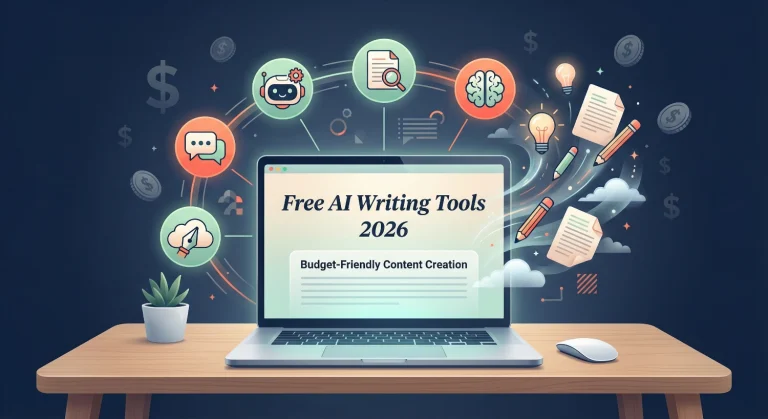
The 10 Best Free AI Writing Tools for Budget Content Creators in 2026
Budget constraints shouldn’t stop you from accessing powerful AI Writing and Content Creation Tools. Several excellent free options deliver professional results without subscription fees.
The free tier landscape has expanded significantly. ChatGPT offers robust free access with GPT-3.5, while Claude provides a generous free plan suitable for most individual creators. Google’s Gemini integrates seamlessly with Google Workspace on the free tier.
Key considerations for free tools: output limits, feature restrictions, and data privacy policies. Most free platforms limit daily usage or conversation length, but smart workflow planning helps you maximize these allocations.
Ready to explore free AI writing tools?
Head-to-Head: Jasper vs. Copy.ai – Which AI Content Creation Tool Wins for Marketing Teams?
Marketing teams face a specific challenge: maintaining brand consistency while scaling content production. Both Jasper and Copy.ai target this need, but they take different approaches.
Jasper positions itself as an enterprise-grade solution with sophisticated brand voice training and template libraries. According to testing by multiple reviewers in 2025, Jasper excels at marketing-specific writing styles, particularly persuasive and conversion-focused copy. The platform’s Brand Voice feature helps maintain stylistic consistency, though it requires initial setup and examples.
Copy.ai takes a more accessible approach with competitive pricing and workflow automation. It’s particularly strong for small businesses needing marketing copy without enterprise-level investment.
Choosing between Jasper and Copy.ai for your team?
Using AI Content Tools to Generate High-Converting Email Sequences and Subject Lines
Email marketing remains one of the highest-ROI channels, and AI Writing and Content Creation Tools excel at this specific format. The structured nature of email sequences plays to AI’s strengths.
Effective email generation requires understanding your audience, defining clear conversion goals, and testing multiple variations. AI tools can generate dozens of subject line options in seconds, each optimized for different psychological triggers.
For sequences, the key is maintaining narrative flow across multiple touchpoints while personalizing for different segments. Modern AI platforms handle this complexity effortlessly once you’ve established the parameters.
Want to master AI-powered email marketing?
The Rise of Multimodal AI Content Creation Tools: Combining Text, Image, and Video Generation
Content creation no longer stops at text. The most powerful AI Writing and Content Creation Tools now handle multiple formats simultaneously, creating cohesive campaigns across channels.
Multimodal capabilities mean you can generate a blog post, accompanying social media images, video scripts, and promotional graphics from a single brief. This integration dramatically streamlines campaign creation.
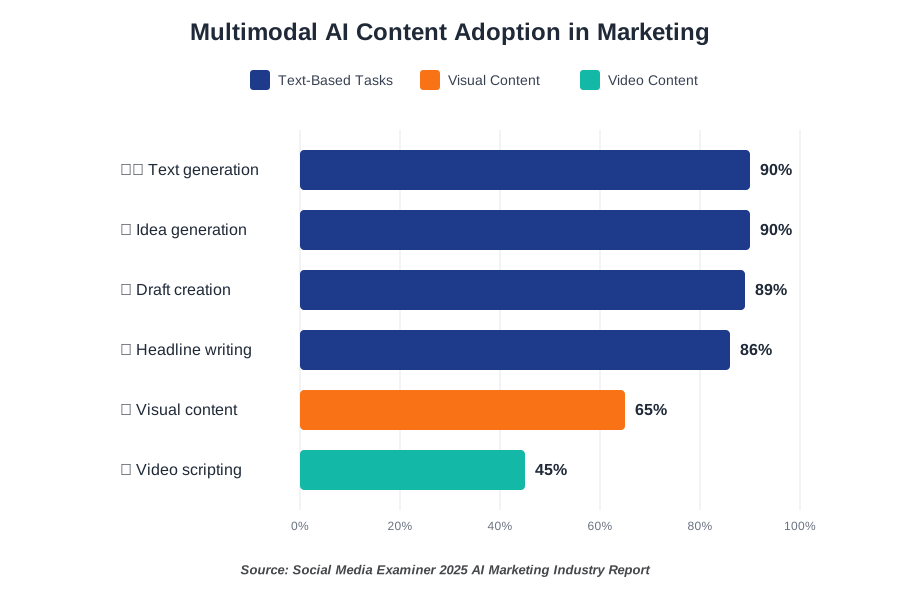
Platforms like ChatGPT with DALL-E integration, Canva with AI features, and specialized tools like Runway demonstrate where the industry is heading. According to Social Media Examiner in their “2025 AI Marketing Industry Report” (2025), 90% of marketers use AI for text-based tasks, with the most common applications being idea generation (90%), draft creation (89%), and headline writing (86%). ℹ️Source
Ready to explore multimodal content creation?
SEO Optimization with AI Writing Tools: A Complete Keyword-to-Draft Workflow
Search visibility determines content success, and modern AI Writing and Content Creation Tools integrate SEO directly into the writing process. This eliminates the traditional disconnect between content creation and optimization.
The workflow starts with keyword research, moves through competitive analysis, continues with optimized drafting, and concludes with performance tracking. AI tools now handle each step, though human oversight remains essential for strategy.
Platforms like Jasper integrated with Surfer SEO, Writesonic’s built-in SEO features, and Frase’s comprehensive workflows demonstrate varying approaches. Each offers keyword optimization, content scoring, and competitor analysis at different price points.
Want to master AI-powered SEO content creation?
The Best AI Writing Tools for Academic Research, Summarization, and Literature Reviews
Academic writing demands accuracy, proper citation, and sophisticated reasoning. Specialized AI Writing and Content Creation Tools address these requirements better than general platforms.
Claude stands out for research-based work, according to multiple 2025 reviews. Its large context window (up to 1 million tokens in Claude Sonnet 4) allows processing entire research papers, dissertations, or comprehensive literature reviews in single conversations.
ChatGPT with web search capabilities helps verify current research and locate recent studies. The key is understanding each tool’s strengths and limitations around factual accuracy and citation generation.
Conducting academic research with AI?
AI Content Creation Tools for Social Media: Comparing Short-Form Strategy Across Platforms
Social media content operates under different constraints than long-form writing. Character limits, platform algorithms, and audience expectations require specialized approaches from AI Writing and Content Creation Tools.
Each platform has unique requirements: Twitter’s brevity, LinkedIn’s professional tone, Instagram’s visual-first approach, and TikTok’s conversational style. The best AI tools understand these distinctions and adapt accordingly.
Successful social media workflows combine AI generation with human editing for authentic voice. According to industry data, marketers report strong distribution results, with 89% using LinkedIn, Instagram, TikTok, and YouTube as primary organic social media platforms.
Optimizing social media with AI?
Specialized AI Content Creation Tools for Scriptwriting (Video, Podcast, and Dialogue)
Script formats require specific structure, pacing, and dialogue flow that distinguish them from traditional writing. Specialized AI Writing and Content Creation Tools excel at these unique requirements.
Video scripts demand visual thinking, clear scene descriptions, and concise dialogue. Podcast scripts balance conversational flow with structured segments and clear calls to action. AI tools trained on these formats produce better results than general writing assistants.
Tools like Descript for podcast workflows, Runway for video scripting, and dedicated dialogue generators demonstrate the specialization occurring in this space.
Creating scripts with AI assistance?
AI Writing Tools for Non-Native English Speakers: Essential Features That Matter
Language barriers shouldn’t limit content creation opportunities. Modern AI Writing and Content Creation Tools provide sophisticated support for non-native English speakers, leveling the playing field.
Essential features include grammar correction that goes beyond simple spell-check, style suggestions that improve natural flow, idiomatic expression recommendations, and tone adjustment for different contexts.
DeepL Write expanded to support Spanish and French in July 2024, strengthening its service for global business communications. This type of multilingual support helps teams maintain brand consistency across markets while respecting linguistic nuances.
Writing in English as a second language?
Measuring ROI: Tracking Performance of Content Created with AI Writing Tools
Investment in AI Writing and Content Creation Tools requires measurable returns. Smart tracking systems help you quantify time savings, content performance, and business impact.
Key metrics include content production velocity (pieces per week), time-to-publish reduction, SEO performance of AI-assisted content, engagement rates, and conversion tracking. Compare these against your pre-AI baseline to demonstrate clear ROI.
According to CoSchedule in their “State Of AI In Marketing Report 2025” (2025), 25.6% of marketers report that AI-generated content is more successful than content created without AI, and when combined with responses of those experiencing equal success, that jumps to 64%. ℹ️Source
Need to prove AI content ROI to stakeholders?
The Top 5 Open-Source AI Writing Tools You Can Host Yourself for Data Privacy
Data privacy concerns prevent many organizations from using cloud-based AI Writing and Content Creation Tools. Open-source alternatives offer powerful capabilities while keeping sensitive data under your control.
Self-hosted solutions require technical infrastructure but provide complete data sovereignty. Models like LLaMA, GPT-J, and other open-source alternatives can be deployed on your servers with proper setup.
Consider hosting costs, technical expertise requirements, and maintenance overhead against the privacy benefits. For regulated industries or sensitive content, this trade-off often makes sense.
Exploring self-hosted AI writing solutions?
Generating Legal Disclaimers and Policy Pages Using AI Content Creation Tools
Legal content requires accuracy and compliance that makes many hesitant to use AI. However, AI Writing and Content Creation Tools can accelerate legal writing when used correctly as drafting assistance.
The key is treating AI output as first drafts requiring legal review, never as final legal documents. AI excels at structuring policy pages, identifying relevant clauses, and ensuring comprehensive coverage of required topics.
Always engage qualified legal counsel for final review and approval. AI helps legal teams work faster by handling initial drafting and research, not by replacing professional legal judgment.
Using AI for legal content?
AI Content Creation Tools Integrated with WordPress: A Feature Deep Dive Comparison
WordPress powers a massive portion of the web, making its integration a critical feature for AI Writing and Content Creation Tools. Native integrations streamline content workflows dramatically.
Jetpack AI Assistant, launched in June 2023, offers customized content, spelling and grammar correction, and creative title generation directly within WordPress. This eliminates the copy-paste workflow that slows production.
Other integrations include AI-powered SEO plugins, automated content optimization, and bulk content generation tools. Each approaches the WordPress ecosystem differently with varying strengths.
Publishing on WordPress?
Beyond Text: AI Writing Tools That Excel at Headline and Title Generation
Headlines determine whether content gets read. Specialized AI Writing and Content Creation Tools use psychological triggers, SEO optimization, and A/B testing insights to craft compelling titles.
Effective headline generation requires understanding your audience, knowing platform-specific best practices, and testing multiple variations. AI tools generate dozens of options instantly, each optimized for different outcomes.
According to Social Media Examiner data, 86% of marketers use AI for headline writing, making it one of the most popular AI content applications. This widespread adoption reflects the clear value proposition of AI-assisted headline creation.
Struggling with headlines?
AI Writing Tools for Technical Documentation and Complex API Guides
Technical documentation demands precision, consistency, and clarity that challenges even experienced writers. AI Writing and Content Creation Tools increasingly handle these requirements effectively.
API documentation, user guides, and technical specifications benefit from AI’s ability to maintain consistent terminology, generate code examples, and structure complex information logically.
Claude’s extended context window makes it particularly effective for technical writing, allowing it to process entire codebases and maintain consistency across extensive documentation projects.
Creating technical documentation?
Voice-Activated AI Writing Tools: Comparing Dictation vs. Generation Quality
Voice interfaces open AI Writing and Content Creation Tools to new workflows and accessibility needs. Modern platforms distinguish between simple dictation and intelligent voice-to-content generation.
Basic dictation transcribes speech to text with minimal processing. Advanced voice AI understands intent, structures content appropriately, and generates polished output from conversational input.
This distinction matters for different use cases. Quick note-taking benefits from accurate dictation, while content creation leverages AI’s ability to transform spoken ideas into structured, polished writing.
Interested in voice-powered writing?
AI Content Creation Tools for Financial Services and Highly Regulated Industries
Financial services, healthcare, and other regulated industries face unique constraints when adopting AI Writing and Content Creation Tools. Compliance requirements, accuracy demands, and liability concerns require specialized approaches.
Solutions like Writer.com emphasize compliance features, audit trails, and approval workflows designed for regulated environments. These platforms understand that content errors in sensitive industries carry serious consequences.
According to industry analyses, companies in regulated sectors typically choose Claude or Writer for their superior accuracy and fact-checking capabilities, prioritizing reliability over cost savings.
Working in a regulated industry?
Automating Content Calendars Using AI Writing Tools and Workflow Integrations
Content calendars organize production, but manual management consumes valuable time. AI Writing and Content Creation Tools with workflow integrations automate scheduling, topic generation, and production tracking.
Modern platforms connect with project management tools, content management systems, and collaboration platforms. This integration creates end-to-end workflows from ideation through publication.
The productivity impact is substantial. Teams report 45% faster completion of collaborative long-form projects when using integrated workflows, according to enterprise platform comparisons.
Ready to automate your content calendar?
Choosing the Right AI Writing Tool for Your Needs
With dozens of AI Writing and Content Creation Tools available, selection feels overwhelming. Let me simplify the decision with a practical framework based on what actually matters.
For Individual Creators: ChatGPT Plus ($20/month) delivers exceptional value for solo professionals. You get versatile capabilities across content types, no usage limits, and API access for automation. The free tier remains robust for testing workflows before committing.
Claude Pro ($20/month) excels at long-form content and complex reasoning. If you write extensive articles or research reports or need nuanced tone control, Claude’s extended context window justifies the investment.
For Marketing Teams: Jasper positions itself as the premium choice for teams needing brand consistency at scale. The Brand Voice training, template library, and team collaboration features serve enterprise needs, though the pricing reflects this positioning.
Copy.ai offers marketing-specific capabilities without enterprise costs. At $49/month for unlimited usage, it delivers solid value for small businesses scaling content production.
For SEO-Focused Content: Writesonic builds SEO features directly into the platform at competitive pricing ($19-20/month). You get keyword research, content optimization, and generous usage limits without requiring separate SEO tools.
Jasper + Surfer SEO provides comprehensive SEO workflows for teams prioritizing search visibility. The integrated approach streamlines optimization but requires premium investment.
For Budget-Conscious Users: Rytr ($9-29/month) makes AI writing accessible at the lowest price points. Quality suffices for light use and experimentation, though you’ll likely outgrow it as it needs scaling.
ChatGPT’s free tier with GPT-3.5 remains unbeatable for learning AI writing fundamentals before investing in paid tools.
Implementing AI Writing Tools Successfully
Purchasing a tool guarantees nothing. Successful implementation requires strategy, training, and workflow optimization. Here’s my proven framework for AI Writing and Content Creation Tools adoption.
Phase 1: Establish Baseline Metrics (Week 1)
Document your current content production before implementing AI. Track pieces per week, average time per piece, editing cycles required, and content performance metrics. This baseline proves ROI later.
Phase 2: Tool Selection and Testing (Weeks 2-3)
Select 2-3 tools matching your requirements. Use free trials to test actual workflows, not hypothetical scenarios. Generate real content you need to produce anyway.
Phase 3: Workflow Development (Weeks 4-5)
Create standard operating procedures for common content types. Document prompt frameworks, editing checklists, and quality standards. This consistency ensures reliable output quality.
Phase 4: Team Training (Week 6)
If working with a team, invest in proper training. AI writing requires skill development—learning effective prompting, recognizing AI limitations, and editing AI output efficiently.
Phase 5: Optimization and Scaling (Ongoing)
Monitor performance metrics, refine workflows based on results, and expand AI usage to additional content types. Continuous improvement delivers compounding productivity gains.
Common Mistakes to Avoid
I’ve watched countless professionals stumble with AI Writing and Content Creation Tools. These mistakes waste time and money while undermining confidence in the technology.
Mistake 1: Expecting Perfect First Drafts
AI generates drafts, not finished content. Budget time for editing, fact-checking, and voice refinement. Teams that skip this step publish generic content that underperforms.
Mistake 2: Using Generic Prompts
“Write a blog post about X” produces mediocre results. Specific prompts with context, target audience, desired tone, and structural requirements generate dramatically better output.
Mistake 3: Ignoring Brand Voice Training
AI can maintain your brand voice, but only if you teach it. Provide examples, style guidelines, and feedback. This upfront investment pays dividends in consistency.
Mistake 4: Neglecting Fact-Checking
AI occasionally generates plausible-sounding falsehoods. Always verify factual claims, statistics, and references before publishing. This responsibility never transfers to the AI.
Mistake 5: Abandoning Human Creativity
AI handles drafting and optimization brilliantly. Strategy, unique insights, and emotional resonance still require human input. The best content combines both strengths.
The Future of AI Writing and Content Creation
The trajectory is clear: AI Writing and Content Creation Tools continue advancing rapidly while becoming more accessible and specialized.
Emerging Capabilities: Agentic workflows that handle multi-step content projects autonomously are moving from experimental to mainstream. According to industry predictions, 2026 represents the year these autonomous systems mature for practical business use.
Multimodal creation capabilities expand beyond text to integrated campaigns spanning articles, images, videos, and interactive content. This consolidation streamlines creative workflows dramatically.
Personalization at Scale: AI enables content personalization that was previously impossible. Dynamic content adapts to individual reader preferences, knowledge levels, and interests while maintaining your core message.
Quality Over Quantity: As AI makes content creation easier, quality differentiates successful creators from those drowning in mediocrity. Human expertise, original research, and authentic voice command premium attention.
Frequently Asked Questions
Taking Action: Your Next Steps
You now understand the landscape of AI Writing and Content Creation Tools, from free options to enterprise platforms, to general writing to specialized applications. Knowledge means nothing without implementation.
Here’s your action plan:
This Week: Start with ChatGPT’s free tier or Claude’s free plan. Generate one piece of content you actually need using the tool. Note what works and what doesn’t.
This Month: Select the paid tool that best matches your primary use case. Implement the workflow framework I outlined above. Track baseline metrics to measure improvement.
This Quarter: Optimize your workflows based on results. Expand AI usage to additional content types. Train team members if relevant. Document what works to build institutional knowledge.
The productivity transformation is real, but it requires deliberate implementation. Don’t let analysis paralysis prevent you from capturing these time-saving benefits.
The content creation landscape has fundamentally changed. AI Writing and Content Creation Tools represent productivity multipliers that free you to focus on strategy and creativity while handling the heavy lifting. Teams that master these platforms gain competitive advantages measured in both productivity and quality.
Start small, learn fast, and scale what works. The future of content creation isn’t about choosing between human creativity and AI efficiency—it’s about combining both to achieve results neither could produce alone.
References
- Market Research Future. (2025). “AI Writing Assistant Software Market Report.” https://www.marketresearchfuture.com/reports/ai-writing-assistant-software-market-31158
- Siege Media + Wynter. (2025). “2025 Content Marketing Trends.” https://www.siegemedia.com/strategy/content-marketing-trends
- Siege Media + Wynter. (2025). “50 AI Writing Statistics To Know in 2025.” https://www.siegemedia.com/strategy/ai-writing-statistics
- Social Media Examiner. (2025). “2025 AI Marketing Industry Report.” https://www.socialmediaexaminer.com/ai-marketing-industry-report-2025/
- CoSchedule. (2025). “State Of AI In Marketing Report 2025.” https://coschedule.com/ai-marketing-statistics
About the Author
James Carter is a productivity coach who has helped thousands of professionals and organizations implement AI-powered workflows that save time and boost efficiency. With over a decade of experience in content marketing and productivity optimization, James specializes in translating complex AI capabilities into practical, actionable strategies that anyone can follow.
Through hands-on testing of dozens of AI writing platforms and direct work with marketing teams across industries, James has developed proven frameworks for AI tool adoption that deliver measurable results. His focus on time-saving processes and real-world applications makes advanced AI technology accessible to professionals without technical backgrounds.
When not coaching clients or testing the latest AI tools, James writes about productivity trends and speaks at marketing conferences about the practical integration of AI into daily workflows. His motivational and reassuring approach emphasizes that AI simplifies work without requiring technical expertise—making powerful content creation tools available to everyone.