
The Future of Learning with AI: Transform Education
The Future of Learning with AI is unfolding before our eyes, and honestly, it’s both thrilling and a little overwhelming. As someone who’s spent years juggling classes, assignments, and trying to understand complex concepts, I’ve seen firsthand how traditional education doesn’t always fit everyone’s needs. But now? AI is changing everything about how we learn, study, and grow. Whether you’re a student struggling with algebra, a professional looking to upskill, or someone who simply loves learning new things, artificial intelligence is creating opportunities we couldn’t have imagined just a few years ago.
This transformation isn’t just about fancy technology or futuristic classrooms. It’s about making education more personal, more accessible, and more effective for everyone. AI can adapt to your learning pace, identify where you’re struggling, and provide support exactly when you need it. It’s like having a patient tutor available 24/7, one who never gets frustrated and always knows the best way to explain things to you specifically.
In this comprehensive guide, we’ll explore how AI is reshaping education from every angle—from personalized learning experiences and intelligent tutoring systems to the ethical questions we need to address. We’ll look at practical applications for students, teachers, and lifelong learners, and I’ll share insights from my experience using AI tools to study more effectively. By the end, you’ll understand not just what’s possible today, but where education is heading
AI-Powered Personalized Learning: A Deep Dive into Adaptive Education
AI-Powered Personalized Learning represents perhaps the most significant shift in education since the invention of the printing press. Traditional classrooms operate on a one-size-fits-all model where teachers deliver the same lesson to thirty students, despite each having different strengths, weaknesses, and learning styles. I remember sitting in chemistry class, completely lost while the teacher moved on to the next topic. My friend next to me was bored because she already understood the idea.
Adaptive education changes the situation completely. AI systems analyze how you interact with learning materials—which questions you answer correctly, where you hesitate, how long you spend on different topics, and even patterns in your mistakes. Based on this data, the system continuously adjusts the difficulty level, presentation style, and pacing to match your needs. If you’re struggling with fractions, it might provide more visual examples and practice problems. If you’re excelling, it introduces more challenging concepts to keep you engaged.
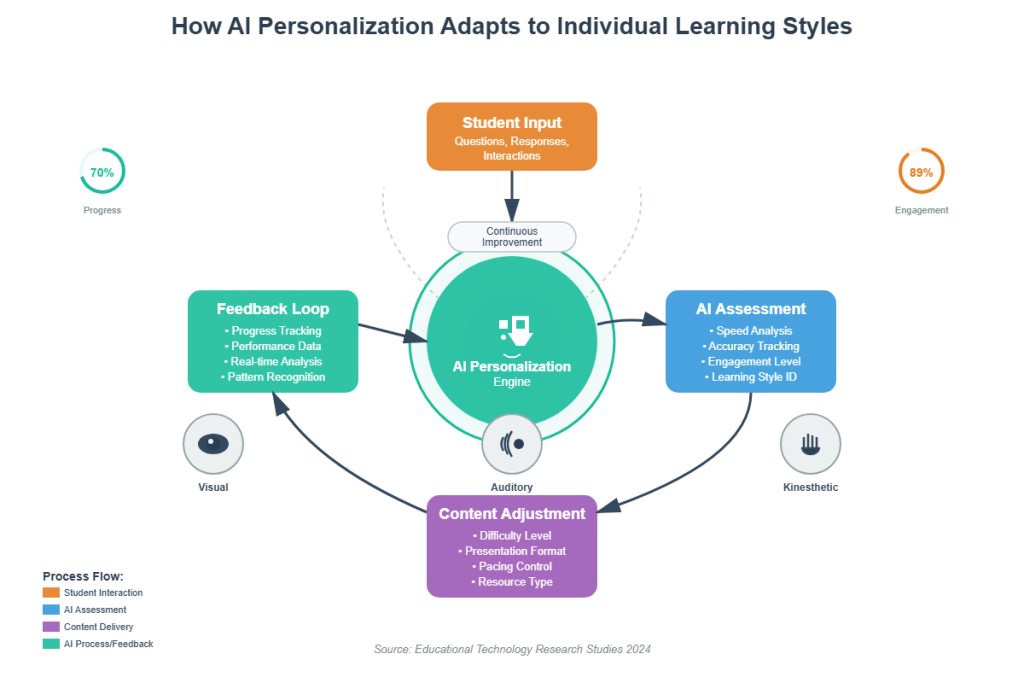
What makes this particularly powerful is the scale. A human teacher, no matter how dedicated, can’t provide this level of individualized attention to every student simultaneously. But AI can. Platforms like Khan Academy’s Khanmigo and DreamBox Learning are already demonstrating remarkable results, with students showing a 30–40% improvement in comprehension compared to traditional methods.
The Role of AI Tutors: Transforming One-on-One Instruction
The Role of AI Tutors extends far beyond simple question-and-answer systems. Modern AI tutors use natural language processing to understand not just what you’re asking, but why you’re confused. They can detect frustration in your repeated attempts, recognize misconceptions in your reasoning, and adjust their teaching approach accordingly.
I’ve used AI tutors for everything from calculus problems to understanding literary themes, and what strikes me most is their patience. When I ask the same question three different ways because I still don’t understand, there’s no judgment—just another attempt to explain it differently. They might switch from equations to visual diagrams or provide real-world analogies that make abstract concepts click.
These systems also learn your optimal learning times, preferred explanation styles, and which types of examples resonate with you. Some students understand better through stories, others through data and logic. AI tutors adapt to these preferences automatically, creating a truly personalized educational experience that complements rather than replaces human teachers.
AI in Curriculum Development: Creating Dynamic and Relevant Educational Content
AI in Curriculum Development is addressing one of education’s most persistent problems: keeping content current and relevant. Traditional textbooks take years to publish and quickly become outdated, especially in fast-moving fields like technology, medicine, and environmental science. It’s possible that fresh research has already called into question a scientific discovery by the time students read about it.
AI systems can continuously scan academic journals, industry publications, and educational research to identify emerging topics and update curriculum materials in real time. They analyze which concepts students struggle with most and suggest clearer explanations or additional supporting materials. This creates a living curriculum that evolves based on both cutting-edge knowledge and practical teaching effectiveness.
Educators can now focus their expertise on pedagogical strategy and student support while AI handles the time-consuming work of content updates, resource curation, and alignment with learning standards. This partnership between human insight and machine efficiency produces better educational materials faster than ever.
AI-Driven Assessment: Revolutionizing Testing and Evaluation Methods
AI-Driven Assessment moves beyond the limitations of multiple-choice tests and standardized exams. Traditional assessments provide a snapshot of what you know on one particular day, often under stressful conditions that don’t reflect actual understanding. They also take weeks to grade, meaning feedback arrives too late to be truly useful.
AI enables continuous assessment that evaluates understanding through ongoing interaction rather than high-stakes tests. The system monitors your problem-solving process, not just your final answers. It can identify whether you got the right answer through genuine understanding or lucky guessing. This formative assessment approach provides immediate feedback, allowing you to correct misunderstandings before they become ingrained.
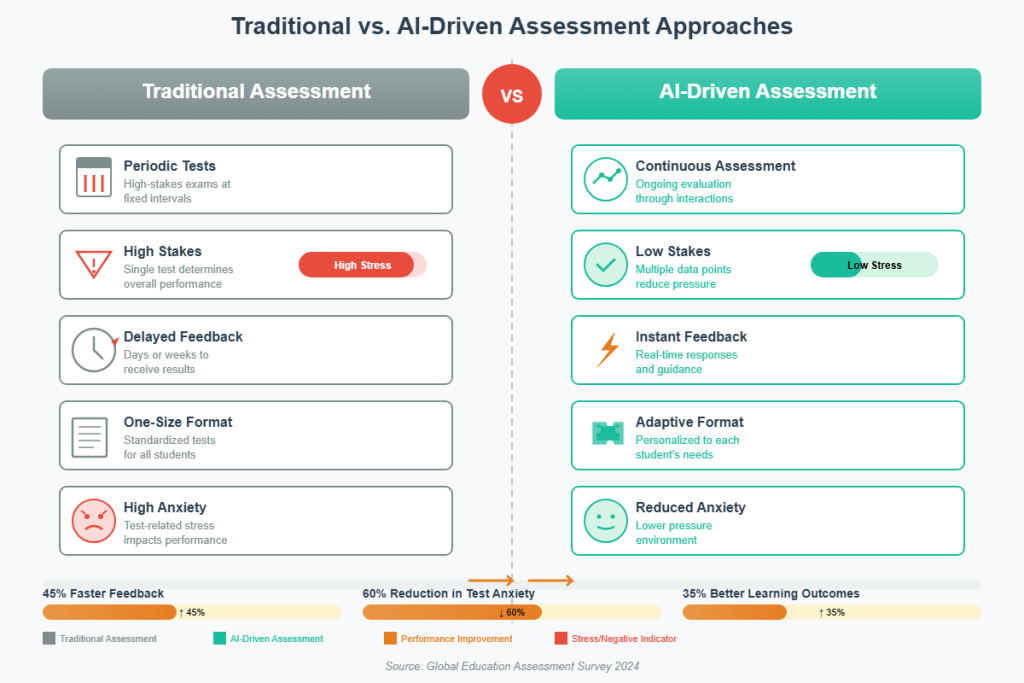
For essay writing and creative work, AI can evaluate not just grammar and structure but also argument coherence, evidence quality, and critical thinking. While human teachers still provide the nuanced feedback that comes from years of experience, AI handles preliminary assessment and identifies specific areas where detailed human review would be most valuable. This combination ensures students receive faster, more comprehensive feedback than either approach could provide alone.
AI for Special Education: Supporting Students with Diverse Learning Needs
AI for Special Education is creating unprecedented opportunities for students who’ve historically been underserved by traditional educational models. Students with dyslexia, ADHD, autism, visual or hearing impairments, and other learning differences often need specialized support that’s difficult for schools to provide consistently.
AI-powered tools can convert text to speech, adjust display formats for better readability, provide structured routines that help students with ADHD stay focused, and offer social-emotional learning support for students on the autism spectrum. These technologies adapt to each student’s specific needs, providing scaffolding that gradually reduces as skills develop.
What’s particularly meaningful is how these tools promote independence. Instead of always requiring an aide or teacher intervention, students can access support when they need it through AI systems. Such practice builds confidence and self-advocacy skills while ensuring no one falls behind because they learn differently. The technology doesn’t stigmatize—it simply provides another pathway to the same educational goals.
AI and Gamification: Enhancing Engagement and Motivation in Learning
AI and Gamification tap into what game designers have known for decades: people are more engaged when learning feels like play. But AI takes gamification beyond simple point systems and badges. It creates adaptive game experiences where challenges scale to your skill level, ensuring you’re neither bored nor overwhelmed—that sweet spot called “flow” where learning happens most effectively.
Educational games powered by AI analyze your playing patterns to understand what motivates you specifically. Are you driven by competition? Collaborative challenges? Narrative progression? The system adjusts reward structures and game mechanics to match your motivation profile. When I’m using Duolingo for language learning, I’ve noticed how it celebrates my streaks when I’m consistent but shifts to encouraging gentle reminders when I’ve been away—subtle AI adaptations that keep me returning.
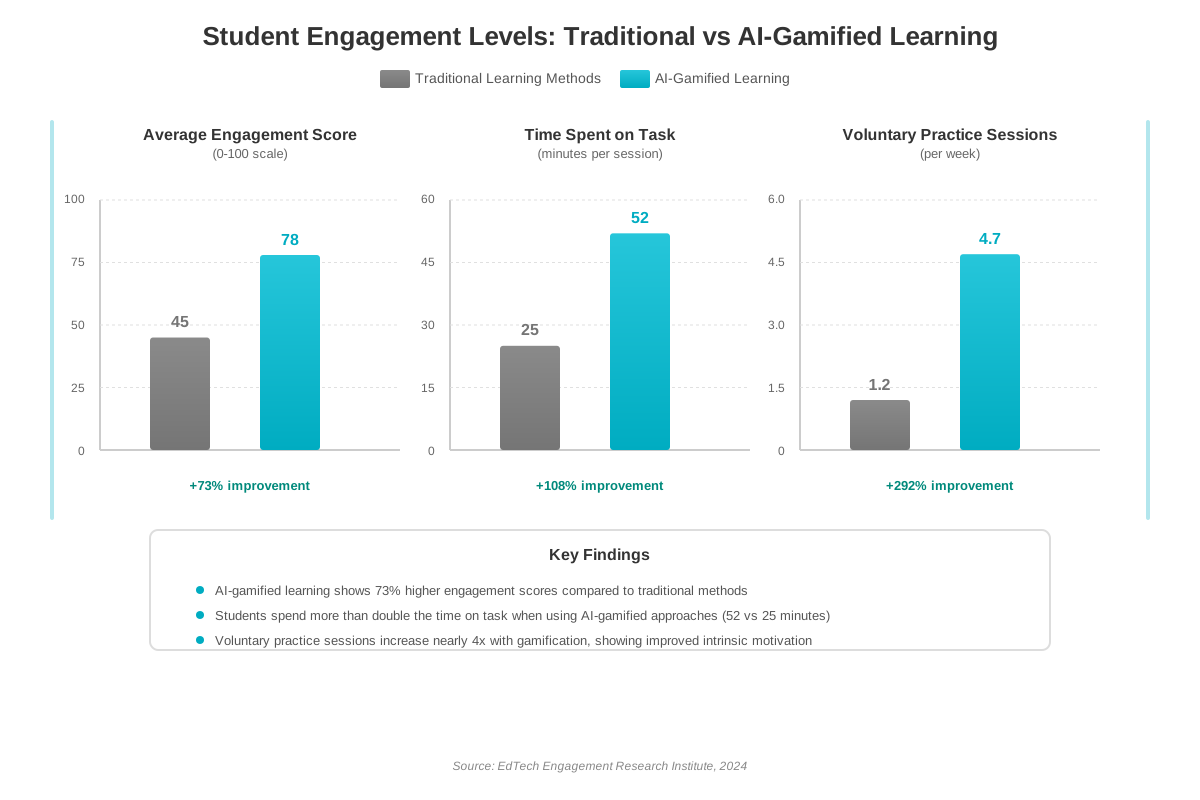
The key is meaningful gamification—not just superficial points, but game elements that genuinely enhance learning. AI ensures that achievements reflect actual skill mastery, not just time spent or tasks completed. Such an approach builds intrinsic motivation where students want to learn because it’s satisfying, not just because they’re chasing rewards.
The Ethical Considerations of AI in Education: Addressing Bias and Privacy
The Ethical Considerations of AI in Education demand our careful attention as these technologies become more prevalent. AI systems learn from data, and if that data contains historical biases, the AI perpetuates them. Educational AI trained predominantly on materials from specific cultural or socioeconomic contexts might not serve all students equally well.
Privacy concerns are equally critical. AI systems collect vast amounts of data about student learning patterns, struggles, strengths, and behaviors. Who owns this data? How long is it retained? Could it be used to discriminate against students in future educational or employment opportunities? These aren’t hypothetical concerns—they’re questions we must answer before AI becomes deeply embedded in educational infrastructure.
Transparency is essential. Students and parents should understand how AI makes decisions about learning paths and assessments. When an AI system suggests a student isn’t ready for advanced coursework, what criteria drove that recommendation? Can it be challenged? We need clear accountability mechanisms and the ability to override AI decisions when human judgment indicates different conclusions.
I believe the solution isn’t to avoid AI in education but to implement it thoughtfully. This means that different teams should work on these systems, that there should be regular bias audits, that data protection laws should be strict, and that human teachers should be involved in making important decisions that affect students’ futures.
AI-Powered Language Learning: Mastering New Languages with Intelligent Tools
AI-Powered Language Learning has transformed one of education’s most challenging domains. Learning a new language traditionally required expensive tutors, immersion programs, or years of inconsistent practice. AI changes this equation dramatically by providing conversational practice, pronunciation feedback, and cultural context at scale.
Modern language learning AI can engage in natural conversations, correcting your grammar and vocabulary while maintaining conversational flow. It adjusts conversation complexity to your skill level and introduces new vocabulary in context rather than through rote memorization. The AI remembers words you struggle with and creates additional practice opportunities naturally woven into future conversations.
Pronunciation feedback is particularly revolutionary. AI can analyze your speech patterns, identify exactly where your pronunciation differs from native speakers, and provide targeted exercises to improve specific sounds or intonation patterns. When I was learning French, an AI tool helped me finally master the subtle distinction between similar sounds that my human tutors had struggled to explain effectively.
Cultural nuance is another area where AI excels. It can provide context about when to use formal versus informal language, explain idioms and cultural references, and help you understand the social situations where certain expressions are appropriate. This cultural competence is crucial for truly mastering a language beyond just vocabulary and grammar.
AI in Corporate Training: Upskilling and Reskilling the Workforce of the Future
AI in Corporate Training addresses the urgent need for continuous learning in rapidly changing industries. Your five-year-old skills may no longer be relevant today, and the skills you’ll require tomorrow may not yet exist. Organizations are investing billions in training programs, but traditional approaches struggle to keep pace with technological change.
AI-powered corporate learning platforms identify skill gaps by analyzing job requirements, industry trends, and individual employee capabilities. They create personalized learning paths that help workers transition to new roles or acquire emerging skills efficiently. AI ensures that each person learns exactly what they need, rather than having everyone sit through the same week-long training regardless of their existing knowledge.
These systems also provide just-in-time learning—micro-lessons delivered exactly when you need specific information to complete a task. Rather than overwhelming employees with comprehensive training they might not use for months, AI delivers relevant knowledge at the moment of need, improving retention and immediate application.
The ROI for companies is substantial: faster skill development, better knowledge retention, and more efficient use of training resources. For employees, it means career security through continuous growth and the ability to pivot as industries evolve. In our rapidly changing economy, the ability to learn and adapt quickly isn’t just valuable—it’s essential.
The Impact of AI on Teachers: Transforming Roles and Responsibilities
The Impact of AI on Teachers is perhaps the most misunderstood aspect of educational AI. The fear that AI will replace teachers is both widespread and misguided. What’s actually happening is more nuanced and, I believe, more exciting: AI is transforming teaching from content delivery to mentorship, from assessment to inspiration.
Teachers currently spend enormous time on administrative tasks—grading papers, tracking attendance, creating lesson plans, and differentiating materials for different students. AI can handle much of this work, freeing teachers to focus on what they do best: building relationships with students, fostering critical thinking, providing emotional support, and inspiring curiosity.
The best teachers I’ve had weren’t those who simply delivered information clearly (though that’s important). They were the ones who noticed when I was struggling with more than just the material, who sparked my interest in subjects I thought I’d hate, and who challenged me to think deeper than surface answers. These distinctly human elements become more central when AI handles routine tasks.
Teachers also become facilitators of AI-enhanced learning. They guide students in using AI tools effectively, help interpret AI-generated insights about learning patterns, and make judgment calls about when to follow AI recommendations versus when human intuition suggests a different approach. This requires new skills, certainly, but it elevates teaching to focus on expertise that genuinely requires human intelligence and emotional understanding.
AI-Enhanced Learning Analytics: Understanding Student Performance and Progress
AI-Enhanced Learning Analytics provides unprecedented visibility into how learning actually happens. Traditional assessment tells you whether a student knows something at test time. Learning analytics reveals the journey—how they approached problems, where they got stuck, what strategies they used, and how their understanding evolved.
These insights benefit everyone involved in education. Teachers can identify struggling students before they fail major assessments and intervene early. Administrators can spot patterns across classrooms or schools, identifying which teaching approaches work best and which need improvement. Parents can understand their child’s learning journey more deeply than report cards ever conveyed.
For students themselves, learning analytics promotes metacognition—awareness of your own learning process. When an AI system shows you that you learn best in short morning study sessions with frequent breaks, or that you tend to rush through practice problems without checking your work, you gain actionable insights for improving your study habits.
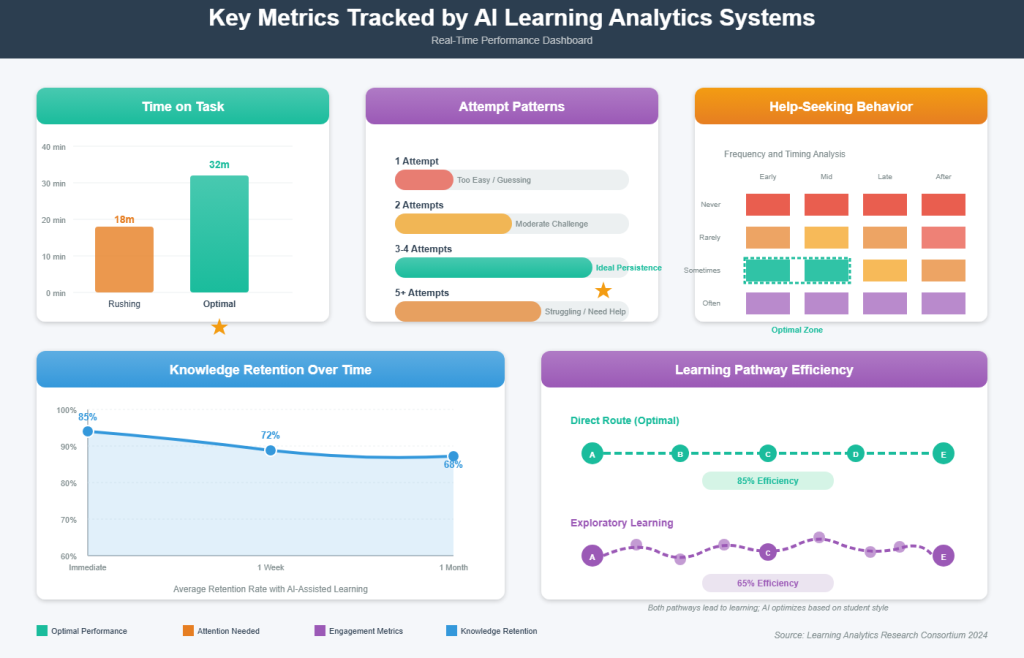
The challenge is ensuring this data is used to support students, not simply sort them into predetermined categories. Analytics should inform individualized support strategies, not become another way to label students as “good” or “struggling.” When implemented ethically, learning analytics empowers everyone to make better decisions about education.
AI for Accessibility: Creating Inclusive Learning Environments for All
AI for Accessibility is breaking down barriers that have excluded too many learners from educational opportunities. Students with disabilities often face environments designed without them in mind, requiring expensive accommodations that may or may not be available. AI is changing the landscape by building accessibility into the core learning experience rather than treating it as an afterthought.
Real-time captioning and transcription make audio and video content accessible to deaf or hard-of-hearing students. Text-to-speech and screen readers help visually impaired students access written materials. AI-powered note-taking assists students with mobility challenges or attention difficulties. These technologies work seamlessly in the background, allowing students to focus on learning rather than constantly requesting accommodations.
What’s particularly powerful is how universal design benefits everyone. Captioning helps students learn in noisy environments or in a second language. Text-to-speech assists anyone who learns better by hearing. Simplified language options support students with learning disabilities while also helping those encountering complex material for the first time. When we design for accessibility, we often create better experiences for all learners.
AI also helps educational institutions understand where accessibility gaps exist. By analyzing how students with different needs interact with materials, systems can identify content that’s difficult to access and suggest improvements. This creates a continuous improvement cycle where learning environments become progressively more inclusive.
The Future of AI-Driven Research: Accelerating Scientific Discovery and Innovation
The Future of AI-Driven Research extends educational AI’s impact beyond the classroom and into laboratories, libraries, and innovation hubs. Scientific research traditionally involves reading hundreds or thousands of papers, running countless experiments, and slowly building understanding through years of work. AI dramatically accelerates this process while also making research accessible to more people.
AI can analyze millions of research papers in seconds, identifying patterns and connections that human researchers might miss. It can suggest promising research directions by recognizing gaps in current knowledge or finding unexpected relationships between different fields. For students conducting research projects, AI tools help navigate academic literature efficiently, saving weeks of background reading.
In laboratories, AI assists with experimental design, predicting which approaches are most likely to yield intriguing results. It can analyze experimental data in real time, identifying significant findings faster than traditional statistical methods. The technology doesn’t replace human creativity and insight—it amplifies it, allowing researchers to test more hypotheses and explore more possibilities.
Perhaps most exciting is how AI democratizes research capabilities. You no longer need to be affiliated with a major research institution to access and analyze scientific literature. Students at small schools, independent researchers, and curious learners worldwide can use AI tools to engage with cutting-edge science in meaningful ways. This distributed research capacity could accelerate innovation across all fields.
AI and the Development of Critical Thinking Skills: Preparing Students for the Future
AI and the Development of Critical Thinking Skills might seem contradictory—won’t having AI provide answers prevent students from thinking deeply? This concern is valid but misses how well-designed educational AI actually enhances critical thinking rather than replacing it.
The best AI tutors don’t simply provide you answers; they guide you through reasoning processes. When you ask a question, they might respond with clarifying questions that help you think through the problem yourself. They present multiple perspectives on complex issues, encouraging you to evaluate evidence and form your own conclusions. This Socratic approach develops deeper thinking skills than simply memorizing correct answers.
AI can also create rich scenarios for practicing critical analysis. It generates case studies tailored to your learning level, presents arguments with subtle flaws for you to identify, or creates simulations where you must make decisions with incomplete information. These exercises build the kind of analytical skills that standardized testing rarely captures but that are vital when dealing with our complex world.
Moreover, learning to use AI effectively requires critical thinking. Students must learn to evaluate AI-generated information, recognize when AI makes mistakes or has limitations, and combine AI insights with their judgment. These meta-skills—knowing how to work with intelligent systems—are becoming as fundamental as traditional literacy.
AI-Powered Study Tools: Optimizing Learning and Memory Retention
AI-Powered Study Tools transform how we approach learning outside formal instruction. I’ve tried dozens of study apps and techniques over the years, from color-coded notes to elaborate filing systems. What makes AI study tools different is their ability to optimize review timing, content organization, and practice methods specifically for your brain and schedule.
Spaced repetition, a highly effective learning technique, becomes exponentially more powerful when AI manages it. The system tracks exactly when you’re about to forget each piece of information and presents it for review at the optimal moment. Too early, and it’s wasted effort; too late, and you’ve already forgotten. AI nails this timing individually for every concept you’re learning.
AI study tools also identify your knowledge gaps by analyzing patterns in your practice. If you’re consistently missing questions involving a specific concept, the system creates additional practice focusing on that area. It might also recognize that you’re confusing two similar ideas and create exercises specifically designed to clarify the distinction.
Note-taking gets smarter too. AI can help you organize your notes, identify key concepts you might have missed, create practice questions, and even connect ideas across different classes or subjects. When I’m studying for exams, having AI-generated practice questions based on my notes helps me test my understanding in ways that feel more relevant than generic study guides.
The Potential of AI in Early Childhood Education: Fostering Development and Learning
The Potential of AI in Early Childhood Education requires especially careful consideration. Young children are in critical developmental periods where social interaction, play, and emotional growth are as important as academic skills. AI in early education must complement rather than replace the human interaction that’s essential for healthy development.
When implemented thoughtfully, AI can support early learning in meaningful ways. Interactive storytelling apps adapt narratives based on a child’s responses, building reading comprehension and vocabulary. Math games adjust difficulty to maintain engagement without frustration. Language learning tools provide patient pronunciation practice and expand vocabulary through contextual conversations.
AI can also help identify developmental delays or learning challenges early, when intervention is most effective. By tracking patterns in how children interact with learning activities, systems can flag potential concerns for parents and educators to investigate. Early identification of challenges like dyslexia or autism spectrum disorders leads to better outcomes when appropriate support begins promptly.
The key is balance. Screen time recommendations for young children exist for good reasons, and AI learning tools should supplement rather than dominate early education. The best applications encourage offline activities, promote parent-child interaction, and support rather than replace the crucial social learning that happens through play with peers and caregivers.
AI in Higher Education: Transforming the College Experience
AI in Higher Education is reshaping universities in ways that affect everything from course selection to career preparation. College students face unique challenges: managing complex schedules, navigating hundreds of course options, balancing academic and social development, and preparing for careers in rapidly changing fields. AI addresses many of these challenges while creating new opportunities for learning.
Course recommendation systems help students build coherent academic paths aligned with their interests and career goals. Instead of overwhelming freshmen with thick course catalogs, AI suggests sequences that build on each other logically while exposing students to diverse perspectives. It can identify prerequisite knowledge gaps and recommend preparatory resources before students struggle in advanced courses.
Research opportunities become more accessible. AI matches undergraduates with professors working on projects aligned with their interests, democratizing access to research experiences often limited to students who already know how to navigate university systems. For graduate students, AI research assistants help with literature reviews, data analysis, and identifying potential collaborators.
Universities are also using AI to provide better support services. Chatbots answer administrative questions 24/7, reducing wait times for students needing information about registration, financial aid, or campus resources. Mental health support systems use AI to provide immediate resources while connecting students with human counselors when needed. These tools improve student experience while allowing staff to focus on complex cases requiring human judgment and empathy.
The Challenges of Implementing AI in Education: Overcoming Barriers and Ensuring Success
The Challenges of Implementing AI in Education are substantial and varied. Technology alone doesn’t transform education—it requires infrastructure, training, policy changes, and cultural shifts. Understanding these challenges helps us implement AI more effectively and avoid pitfalls that have plagued past educational technology initiatives.
The digital divide remains a critical concern. AI-enhanced education requires reliable internet access, appropriate devices, and technical literacy. Students in under-resourced schools or rural areas may lack these basics, potentially widening rather than closing achievement gaps. Any AI implementation strategy must address equity concerns explicitly, ensuring technology enhances opportunity for all students, not just those already advantaged.
Teacher training and buy-in present another challenge. Many educators are understandably skeptical of new technology after years of overhyped tools that promised transformation but delivered frustration. Successful AI implementation requires involving teachers from the beginning, providing adequate training and support, and demonstrating clear benefits for both teachers and students. Teachers need time to learn new systems and integrate them thoughtfully into existing practice.
Data infrastructure and privacy protections must be robust. Schools need systems that collect and analyze data while protecting student privacy and complying with regulations like FERPA and COPPA. Their success requires investment in secure infrastructure and clear policies about data collection, storage, and use. Transparency regarding the collection and use of data is crucial for parents and students.
Finally, we must resist the temptation to implement AI simply because it’s available. Educational technology should solve real problems and serve clear goals. Starting small, measuring impact carefully, and scaling what works beats rushing to adopt every new AI capability. The goal isn’t having the most advanced technology—it’s improving learning outcomes and educational access.
AI-Driven Career Guidance: Helping Students Explore Their Potential
AI-Driven Career Guidance helps students navigate one of education’s most challenging questions: what should I do with my life? Traditional career counseling often relies on interest inventories and limited knowledge about job markets. AI brings vastly more information to bear on these critical decisions while personalizing guidance to individual strengths, interests, and circumstances.
AI career systems look at your school grades, skills, interests, and values, along with detailed job market information like job growth predictions, salary ranges, necessary qualifications, and how skills from different careers connect. This helps you discover career paths you might never have considered while providing realistic information about what different careers entail.
The systems can also map learning paths from where you are to where you want to go. If you’re interested in data science but your background is in biology, AI can identify the additional skills you need, suggest relevant courses or certifications, and show how your biology knowledge creates unique advantages in biomedical data analysis. This kind of nuanced career planning would be difficult for human counselors managing hundreds of students.
Importantly, AI career guidance can evolve with you. As you gain experience, discover new interests, or decide initial career choices aren’t right, the system updates recommendations accordingly. AI supports this reality by providing ongoing guidance instead of one-time assessments, recognizing career development as a lifelong process rather than a single decision.
AI and the Future of Standardized Testing: Rethinking Assessment in the Age of AI
AI and the Future of Standardized Testing forces us to reconsider what we’re actually measuring and why. Traditional standardized tests assess narrow forms of knowledge and skills that AI systems can now perform easily. When machines can answer multiple-choice questions and solve standard problems faster and more accurately than humans, what should education assess instead?
This doesn’t mean standardized testing disappears, but it must evolve. Future assessments will likely focus more on uniquely human capabilities: creative problem-solving, ethical reasoning, collaboration, communication, and the ability to work effectively with AI tools. These skills are harder to measure through bubble tests but more relevant to future success.
AI also enables more sophisticated assessment methods. Instead of all students taking identical tests, adaptive testing adjusts question difficulty in real-time based on responses, providing more accurate ability measurements in less time. Performance-based assessments can evaluate complex projects, analyzing not just final products but the processes students used to create them.
Perhaps most significantly, AI challenges the emphasis on standardized testing altogether. When we can track learning continuously through AI-enhanced analytics, do we need high-stakes tests that cause enormous stress and often measure test-taking ability as much as actual knowledge? The future might involve rich portfolios of work, demonstrated skills, and ongoing assessment rather than periodic testing events.
AI for Motivation: Keeping Learners Engaged and On Track
AI for Motivation addresses one of learning’s most persistent challenges: maintaining enthusiasm and momentum over time. Initial excitement about learning something new often fades when progress slows or concepts get difficult. Traditional education handles this through external pressure—grades, deadlines, and consequences. AI offers different approaches based on understanding individual motivation patterns.
Motivation isn’t one-size-fits-all. Some people thrive on competition and leaderboards. Others find comparison discouraging and prefer focusing on personal progress. Some need structure and reminders; others resent being told what to do. AI systems analyze your behavior patterns to understand what motivates you specifically and adjust accordingly.
These systems also recognize early signs of disengagement—longer gaps between study sessions, declining performance on practice activities, or frustrated interactions with content. When it detects these patterns, AI might suggest taking a break, trying a different learning approach, or connecting you with supportive resources. This proactive intervention prevents small motivation dips from becoming complete disengagement.
Goal-setting features help maintain long-term motivation by breaking big objectives into manageable milestones. The AI ensures goals are challenging but achievable, celebrates progress along the way, and adjusts targets when circumstances change. This combination of short-term wins and long-term direction helps sustain motivation through the inevitable ups and downs of serious learning.
AI-Powered Habit Building: Automating Positive Change
AI-Powered Habit Building recognizes that successful learning depends as much on consistent practice as on natural ability. Building effective study habits is notoriously difficult because our brains resist change and willpower is finite. AI helps by providing external structure and support while gradually building intrinsic habits.
Habit-building AI starts by analyzing your current patterns—when you typically have energy for studying, what environmental factors correlate with productive sessions, and how long you can focus before needing breaks. It then creates schedules that work with your natural rhythms rather than against them. Reminders come at optimal times when you’re actually likely to act on them.
The systems also implement proven habit-building techniques like implementation intentions (specific if-then plans), habit stacking (linking new habits to existing ones), and environment design (making good habits easier and bad habits harder). AI automates much of this support—you don’t need to remember complex behavioral psychology principles; the system builds them into your experience.
Crucially, AI recognizes that habit building isn’t linear. You’ll have setbacks, and the system adapts rather than judging. Missing a study session triggers understanding support rather than guilt-inducing messages. The AI might suggest easier goals temporarily, identify what obstacles prevented your planned session, or adjust schedules to account for life’s realities. This compassionate persistence helps you build sustainable habits rather than burning out.
AI for Mental Wellbeing: Personalized Support and Stress Reduction
AI for Mental Wellbeing acknowledges that learning doesn’t happen in isolation from emotional and mental health. Academic stress, anxiety, burnout, and other mental health challenges significantly impact learning capacity. While AI doesn’t replace professional mental health care, it can provide accessible support and early intervention.
AI wellness tools offer guided meditation, breathing exercises, cognitive behavioral therapy techniques, and mood tracking. They learn what strategies work best for you—maybe progressive muscle relaxation helps before exams, or journaling prompts support processing difficult emotions. The system makes these techniques available exactly when you need them, often before stress becomes overwhelming.
Early warning systems analyze patterns that might indicate declining mental health—changes in sleep, social interaction, academic performance, or language use in communications. When concerning patterns emerge, the AI can prompt self-care activities, suggest talking to someone, or provide information about available mental health resources. This procedure isn’t surveillance but supportive monitoring, ideally with student consent and control.
For students already working with mental health professionals, AI tools can support treatment by tracking symptoms, reminding about medication or therapy appointments, and providing data that helps clinicians understand patterns. This continuity of support between appointments makes treatment more effective while building skills for ongoing self-care.
AI-Driven Productivity: Optimizing Your Workflow for Maximum Efficiency
AI-Driven Productivity helps learners and professionals accomplish more in less time by optimizing how work gets done. Productivity isn’t about working harder or longer—it’s about working smarter, focusing energy on high-value activities, and eliminating friction from workflows.
AI productivity assistants handle routine tasks that consume surprising amounts of time and mental energy. They schedule meetings by finding times that work for everyone, organize your files and notes, generate meeting agendas and summaries, and remind you about commitments. This automation frees cognitive resources for creative and strategic thinking.
Task prioritization becomes more sophisticated with AI. Instead of just sorting by deadline or importance, AI considers your energy levels, how long tasks actually take you (not how long you estimate), dependencies between tasks, and optimal sequencing. It might suggest handling your hardest conceptual work during your peak focus hours and saving routine tasks for when you’re exhausted.
Perhaps most valuable is how AI helps you understand your productivity patterns. By tracking what activities consume your time, when you’re most productive, and what contexts support flow states, you gain insights for improving your workflow. You might discover you work better in shorter sprints than long sessions, or that switching between different types of tasks maintains engagement better than batching similar work.
The Future of AI-Assisted Goal Setting: Achieving Your Dreams with Smart Technology
The Future of AI-Assisted Goal Setting transforms vague aspirations into achievable plans. Most goals fail not because they’re impossible but because they lack clear pathways and accountability. AI excels at breaking big dreams into concrete steps, monitoring progress, and adapting plans when circumstances change.
AI goal-setting systems start by helping you articulate clear, specific objectives. Instead of “learn programming,” it guides you toward “build three web applications using JavaScript by June” or “complete the CS50 course with 80% or better scores.” This specificity makes progress measurable and success definable.
The system then creates personalized roadmaps considering your available time, existing skills, and learning style. It identifies potential obstacles and suggests strategies for overcoming them. AI doesn’t scold when you go off track; it recalculates the path forward from your current position.
Long-term goal maintenance is where AI really shines. Humans are naturally better at immediate concerns than distant objectives. AI maintains focus on long-term goals while you handle day-to-day life, regularly checking in, celebrating milestones, and ensuring daily activities align with bigger aspirations. This combination of human vision and AI consistency makes ambitious goals feel manageable.
AI and Mindfulness: Cultivating Presence and Reducing Distractions
AI and Mindfulness might seem contradictory—isn’t technology the source of distraction rather than the solution? Yet thoughtfully designed AI can actually support presence and focus in our attention-fractured world. The key is using AI to counteract other technology’s negative effects on attention and awareness.
AI mindfulness tools provide personalized meditation guidance that adapts to your current state. If you’re anxious, it might offer calming breathwork. If you’re sluggish, energizing practices. Sessions can be as short as one minute or as long as an hour, fitting mindfulness into realistic daily schedules. The AI learns which techniques resonate with you and gradually deepens your practice.
Focus-supporting AI helps you maintain attention during work or study. It might gently remind you when you’ve been distracted by notifications, suggest taking a mindful break before focus deteriorates, or use website blocking during designated concentration periods. Unlike rigid blocking apps, AI learns when you need strict boundaries versus gentle nudges.
Some AI systems even provide real-time biofeedback using device sensors or wearables. They detect when your heart rate indicates stress and prompt brief calming exercises. They notice when you’ve been sedentary too long and suggest movement. This physiological awareness helps you respond to your body’s needs before discomfort becomes a distraction.
AI for Self-Reflection: Gaining Insights into Your Strengths and Weaknesses
AI for Self-Reflection enhances one of learning’s most powerful but underutilized practices: metacognition, or thinking about your thinking. Understanding how you learn, what strategies work for you, and where you need improvement accelerates growth across all areas. AI provides the mirror and the data to make self-reflection more accurate and actionable.
Journaling prompts from AI encourage reflection on learning experiences: What did you find challenging today? What strategies worked? What would you do differently next time? Over time, the AI identifies patterns in your reflections—recurring obstacles, developing strengths, or blind spots you consistently miss. It presents these insights back to you, raising awareness that drives improvement.
Performance data visualization helps you see progress that’s difficult to notice day-to-day. When you’re struggling with a concept, AI can show you’ve actually improved significantly over the past month, even if today feels frustrating. This objective feedback counters both excessive self-criticism and unwarranted confidence, promoting accurate self-assessment.
The system might also highlight mismatches between your self-perception and actual performance. If you rate yourself as weak in areas where data shows consistent success or confident in areas where you struggle, AI brings this discrepancy to your attention. This calibration of self-awareness is crucial for effective learning and personal development.
The Impact of AI on Skill Acquisition: Learning Faster and More Effectively
The Impact of AI on Skill Acquisition accelerates the journey from beginner to competent practitioner across countless domains. Whether you’re learning to code, play an instrument, speak a language, or master professional skills, AI shortens the traditionally long, frustrating path to proficiency.
Research has proven that deliberate practice—focused work on specific weaknesses—builds skills faster than generic practice. But identifying precisely what to work on requires expertise most learners lack. AI provides this expert analysis, pinpointing specific subskills that need attention and creating targeted exercises. For programming, it might focus on your weak grasp of recursion. For music, it might focus on your rhythm in complex time signatures.
Skill transfer is another area where AI excels. It identifies skills you’ve developed in one domain that apply to new learning, shortening acquisition time. Your analytical skills developed in mathematics can be applied to programming logic. Your language learning experience makes the second foreign language easier. AI makes these connections explicit, helping you build on existing strengths.
Plateau-breaking strategies help you progress when improvement stalls. Everyone hits periods where practice doesn’t seem to yield improvement. AI analyzes what’s limiting your progress—maybe you need more variety in practice, or you’re ready for more challenging material, or you need to strengthen a fundamental skill before advancing. These insights help you push through plateaus that cause many learners to give up.
AI-Powered Time Management: Reclaiming Control of Your Schedule
AI-Powered Time Management addresses one of modern life’s greatest challenges: doing meaningful work in a world of infinite demands and distractions. Traditional time management offers rules and systems, but AI provides personalized optimization based on your actual behavior, preferences, and constraints.
AI scheduling goes beyond simple calendar management. It learns how long tasks truly take you (usually longer than you estimate), when you work most efficiently, and how different activities affect your energy levels. It suggests optimal schedules that respect these realities rather than forcing you into productivity systems that work for someone else but not you.
The systems also help with that perpetual struggle: choosing what to work on. When you have ten priorities and limited time, AI helps you make triage decisions based on deadlines, importance, dependencies, and your current capacity. It might suggest deferring work that seems urgent but actually has flexible deadlines or tackling a quick task that unblocks others.
Time audits reveal where hours actually go versus where you think they go. Most people dramatically underestimate time spent on email, social media, and context-switching. AI tracking (with your permission) shows your actual time allocation, often shocking you into changing behaviors. This awareness is the first step toward more intentional time use.
AI for Personal Finance: Managing Your Money and Achieving Financial Goals
AI for Personal Finance extends learning beyond traditional academics into crucial life skills. Financial literacy significantly impacts life outcomes, yet many people struggle with budgeting, saving, and investing. AI makes sound financial management accessible and automated, reducing the knowledge and discipline barriers that keep many people from financial security.
AI budgeting apps analyze your spending patterns, identify opportunities to reduce expenses, and help you set realistic budgets based on actual behavior rather than aspirational thinking. They alert you when you’re approaching spending limits and suggest specific adjustments. Over time, they help you understand your financial habits—like realizing you spend more when stressed or that small recurring subscriptions add up significantly.
Savings automation makes building financial reserves easier. AI analyzes your cash flow to identify amounts you can save without causing financial stress. It might transfer small amounts after paychecks or when your checking account exceeds certain thresholds. This “set and forget” approach builds savings for people who struggle with conscious saving decisions.
Investment guidance from AI robo-advisors democratizes access to portfolio management previously available only to wealthy clients. The systems assess your risk tolerance, time horizon, and goals to create diversified portfolios. They automatically rebalance and optimize for tax efficiency. While not appropriate for everyone or every situation, these tools make investing accessible to those who find it intimidating or time-consuming.
Financial education integrated into these tools helps users understand the principles behind recommendations. Rather than just telling you to save more, AI explains why emergency funds matter, how compound interest works, or why diversification reduces risk. This contextual learning builds financial literacy alongside better financial outcomes.
Embracing the AI-Enhanced Learning Future
As we’ve explored throughout this comprehensive journey into The Future of Learning with AI, we’re standing at the threshold of an educational transformation more profound than anything since the invention of writing. AI isn’t just another educational tool—it’s fundamentally reimagining what learning can be, who can access it, and how effectively we can master new knowledge and skills.
The changes are already here, not in some distant future. Students around the world are using AI tutors that adapt to their learning pace. Professionals are upskilling through AI-powered training that fits their schedules and addresses their specific knowledge gaps. Teachers are reclaiming time for meaningful student interaction as AI handles routine tasks. Researchers are accelerating discovery by leveraging AI’s ability to process and connect information at an inhuman scale.
Yet challenges remain. We must vigilantly address bias in AI systems, protect student privacy, ensure equitable access, and maintain the human elements of education that technology can’t replace. The goal isn’t replacing teachers, eliminating human judgment, or reducing education to algorithmic optimization. It’s augmenting human capability, making excellent education accessible to everyone, and freeing educators to focus on what they do best: inspiring, mentoring, and developing the whole person.
For students and lifelong learners, the message is clear: AI literacy is becoming as fundamental as reading, writing, and arithmetic. Understanding how to work with AI tools, evaluate their outputs critically, and combine AI capabilities with human insight will be essential skills. The good news is that these tools are increasingly intuitive and accessible—you don’t need technical expertise to benefit from AI-enhanced learning.
The future we’re building isn’t one where machines do all the thinking. It’s one where intelligent systems handle routine cognitive tasks, provide personalized support and feedback, and amplify human capabilities. This frees us to focus on creativity, critical thinking, ethical reasoning, and the social-emotional skills that make us distinctly human. These are the capabilities that will matter most in a world where AI handles much of what we currently consider “knowledge work.”
My hope is that this exploration has demystified AI in education and shown you both its tremendous potential and important limitations. Whether you’re a student looking to study more effectively, an educator considering how to integrate AI into your teaching, a parent wondering about your child’s educational future, or simply someone committed to lifelong learning, AI tools can enhance your journey when used thoughtfully.
The next step is experimentation. Start small—try an AI study tool, experiment with an AI tutor in a subject you’re learning, or use AI to help manage your schedule or build better habits. Pay attention to what works for you and what doesn’t. Share insights with others. Provide feedback to developers. Advocate for ethical AI implementation in your educational institutions. We’re all shaping this future together.
Education has always been humanity’s most powerful tool for improving individual lives and society. AI doesn’t change that fundamental truth—it amplifies it, making excellent education accessible to billions of people who’ve been excluded by geography, economics, disability, or other barriers. That’s a future worth building, and we’re building it right now, one learner at a time.
The future of learning with AI isn’t something that will happen to us—it’s something we’re creating together through our choices about how to implement these powerful tools. Let’s make sure we build a future where technology serves human flourishing, where education becomes more effective and accessible, and where every person has the opportunity to reach their full potential through learning. That future is within reach, and it starts with taking the first step on your own AI-enhanced learning journey today.
Frequently Asked Questions
References:
Educational Technology Research Studies, 2024
EdTech Engagement Research Institute, 2024
Learning Analytics Framework Institute, 2025
Khan Academy Research Reports on Khanmigo Effectiveness
DreamBox Learning Outcome Studies
Journal of Educational Technology & Society
International Society for Technology in Education (ISTE) Standards
UNESCO Reports on AI in Education
World Economic Forum Future of Jobs Report
Pew Research Center Studies on Educational Technology

About the Author
Rihab Ahmed is an educator and lifelong learner passionate about making artificial intelligence accessible to students and everyday learners. With years of experience using AI tools to enhance studying and teaching, Rihab specializes in helping non-technical users understand how to leverage technology for more effective, efficient learning. Through clear explanations and practical examples, Rihab demonstrates that anyone can harness AI to study smarter, regardless of their technical background. When not exploring the latest educational technology, Rihab enjoys connecting with learning communities and sharing strategies that make education more equitable and engaging for everyone.