How to Identify Influencers & Anti-Personas Using AI

Finding the Right People (and Avoiding the Wrong Ones)
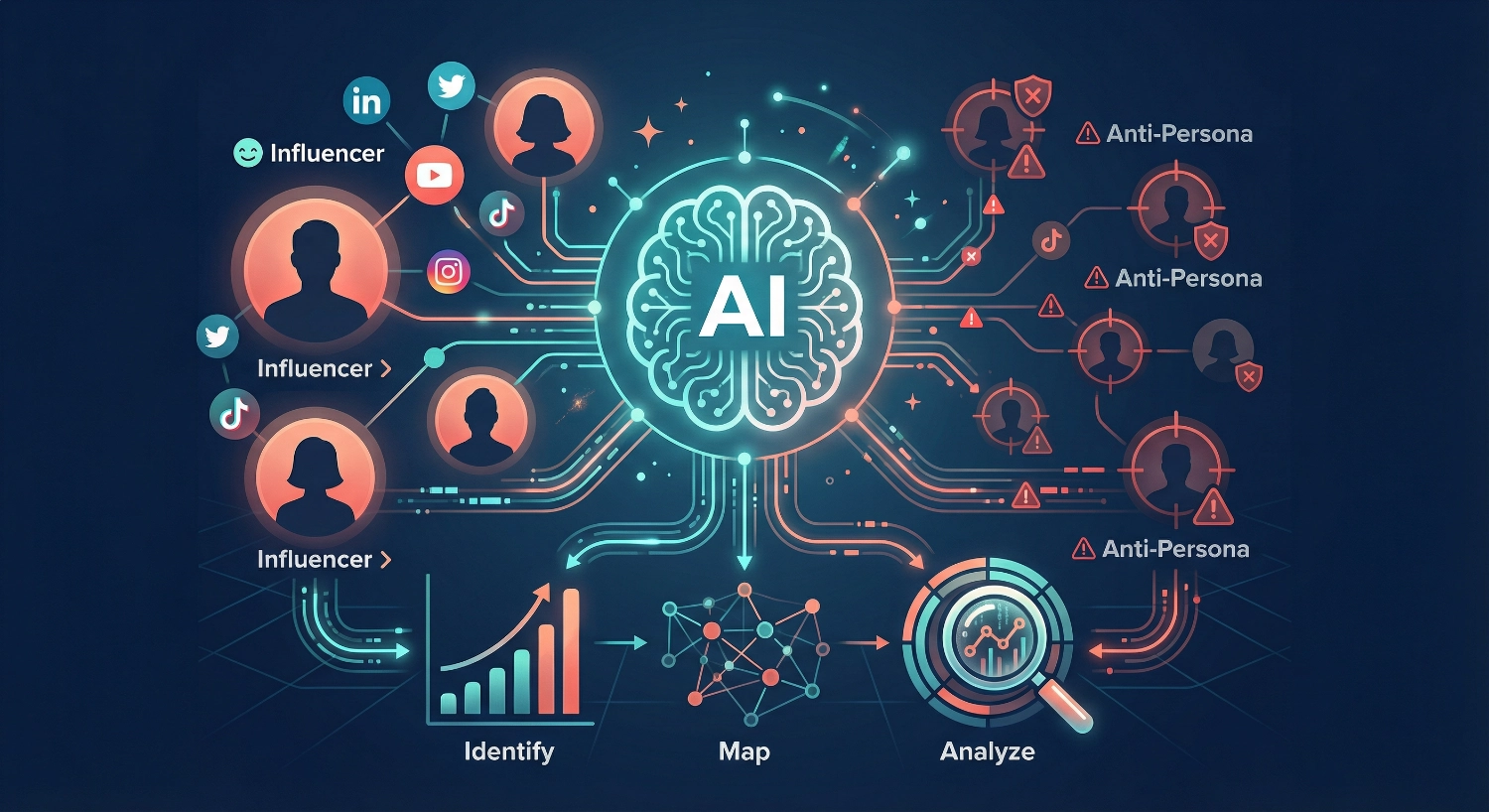
How to Identify Influencers & Anti-Personas Using AI starts with understanding a simple truth we’ve learned through years of working with marketing teams: not every voice matters equally, and some voices can actually hurt your brand.
We’ve watched countless businesses pour resources into reaching the wrong people while missing the gatekeepers who could transform their results overnight.
Think about it. Right now, someone is reading an article, watching a video, or scrolling through a social feed that will shape their decision about your product. The question is: who created that content, and how do you find them? More importantly, who are the people you should actively avoid engaging with—those anti-personas who drain resources, generate negative sentiment, or simply will never convert?
That’s where AI becomes your secret weapon. We’ve used AI tools to help businesses identify the exact publications, podcasts, influencers, and platforms where their ideal customers spend time. But we’ve also helped them spot the red flags—the audience segments that look promising on paper but turn into resource black holes in reality.
In this guide, we’ll walk you through the exact process we use to map influencers and anti-personas using AI, document where your personas gather information, and align your content calendar to match their consumption patterns. Whether you’re a solo entrepreneur or managing a marketing team, this step-by-step approach will help you work smarter, not harder.
What Are Influencers and Anti-Personas?
Before we dive into the AI tools and techniques, let’s clarify what we’re actually looking for.
Influencers in the Context of Persona Research
When we talk about influencers in persona mapping, we’re not just talking about Instagram celebrities or TikTok stars. We mean any person, publication, platform, or organization that shapes your target persona’s decisions.
This could be:
- Industry thought leaders who publish research your personas cite
- Niche bloggers whose articles your personas bookmark and share
- Podcast hosts your personas listen to during their commute
- YouTube creators who review products in your category
- Professional communities where your personas ask questions and seek advice
- News outlets your personas trust for industry updates
We once worked with a B2B software company that discovered their target CIOs weren’t influenced by the big tech publications they were advertising in. Instead, these executives were heavily influenced by a small Slack community of 400 peers and a relatively unknown podcast focused on digital transformation. That discovery completely shifted their content strategy—and their conversion rates proved it was the right move.
Anti-Personas: The People You Should Avoid
Anti-personas are equally important to identify.
These are the audience segments that:
- Consume your content but never convert
- Generate support tickets without purchasing
- Leave negative reviews that don’t reflect your actual target market
- Engage heavily on social media but lack decision-making authority
- Have budget constraints that make them unprofitable to serve
- Create brand perception problems by publicly misusing your product
Identifying these groups early saves enormous time and money. We’ve seen marketing teams cut their CAC (Customer Acquisition Cost) by 40% simply by excluding anti-personas from their targeting and focusing resources on true buyers.
Why AI Makes This Process 10x Faster and More Accurate
Here’s the reality: traditional persona research takes weeks of surveys, interviews, and manual data analysis. By the time you finish, the landscape has shifted. AI changes this completely.
AI’s Advantages for Influencer and Anti-Persona Identification
Speed: AI can analyze thousands of social media profiles, articles, podcasts, and video transcripts in hours—work that would take a human team months.
Pattern Recognition: Machine learning algorithms spot patterns humans miss. AI can identify that your persona consistently engages with content published on Thursdays, prefers video over text after 7 PM, and responds to specific emotional triggers in headlines.
Real-Time Insights: Unlike static spreadsheets, AI tools continuously monitor conversations, track emerging influencers, and alert you when anti-persona behaviors spike in your audience.
Sentiment Analysis: AI doesn’t just find where personas hang out—it analyzes how they engage. Are they asking questions? Sharing enthusiastically? Complaining? This context is gold for content strategy.
Predictive Capabilities: Advanced AI models can predict which new platforms or influencers will become important to your personas before your competitors notice them.
The tools we’ll discuss in the step-by-step section below leverage these capabilities to give you a competitive edge.
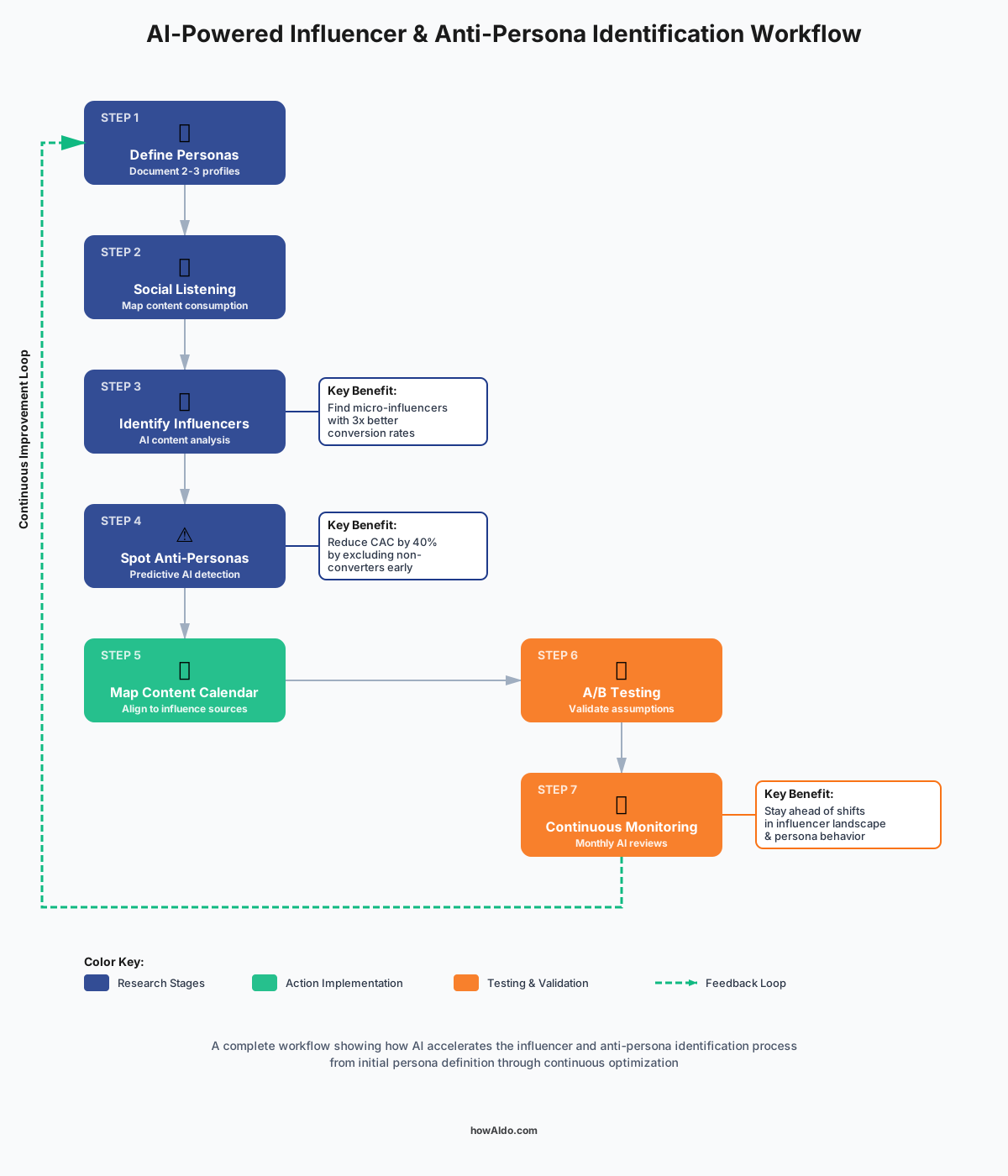
Step-by-Step: How to Identify Influencers & Anti-Personas Using AI
Now let’s get into the practical process. We’re breaking this down into clear, actionable steps you can start implementing today, even if you’ve never used AI for marketing before.
Step 1: Define Your Personas (If You Haven’t Already)
Before AI can help you find influencers and anti-personas, you need to know who you’re looking for. If you already have documented personas, great—pull them up. If not, start with these basics:
For each persona, document:
- Demographics: Age range, location, job title, industry
- Goals and Challenges: What are they trying to achieve? What keeps them up at night?
- Decision-Making Process: Who else is involved? How long does it take?
- Preferred Communication Style: Formal or casual? Visual or text-heavy?
We recommend creating 2-3 detailed personas rather than 10 superficial ones. Quality beats quantity here.
Pro tip from our experience: Include a hypothesis about where you think your personas get information. You’ll test this hypothesis using AI in the next steps, and you’ll probably be surprised by what you discover.
Step 2: Use AI-Powered Social Listening Tools to Map Content Consumption
This is where AI starts doing the heavy lifting. Social listening tools scan millions of online conversations to show you exactly where your personas are active and what they’re discussing.
Recommended tools:
- Brandwatch or Sprout Social: For comprehensive social media monitoring
- BuzzSumo: For content analysis and influencer identification
- Sparktoro: Specifically designed to show where audiences congregate
How to use them:
- Input your persona’s key characteristics (job titles, interests, pain points) into the tool
- Set parameters for the platforms you want to monitor (Twitter/X, LinkedIn, Reddit, etc.)
- Run the analysis and let AI generate reports on:
- Which accounts your personas follow most
- Which content types (articles, videos, podcasts) get the most engagement
- Which hashtags and topics generate conversation
- Peak activity times for your personas
We recently used this approach with an e-learning client. They assumed their target teachers were on Facebook. AI analysis revealed they were actually most active in educator-focused Discord servers and a specific subreddit—communities the marketing team had never even heard of.
Important: Look for patterns across at least 1,000 data points. Small sample sizes can mislead you.
Step 3: Deploy AI Content Analysis to Identify Top Influencers
Now that you know where your personas hang out, you need to identify who influences them in those spaces.
Use AI tools like:
- ChatGPT with web browsing or Claude with web search: To analyze specific communities and identify top contributors
- Lately.ai or Clearscope: To identify which authors and creators are ranking for keywords your personas search for
- YouTube’s search and filter features combined with AI analysis: To find video creators dominating your niche
Process:
- Take the top 5 platforms from your social listening results
- Use AI to analyze the most-shared content on those platforms in the last 90 days
- Identify the creators behind that content
- Score them based on:
- Reach (audience size)
- Relevance (how closely their content matches your personas’ interests)
- Resonance (engagement rate, not just follower count)
- Authority (are they cited by others? Do they have credentials?)
Example AI prompt you can use:
Analyze the top 20 articles shared in [your niche] subreddit in the past 3 months. Create a list of the authors, rank them by total engagement, and identify common themes in their highest-performing content.We’ve used this exact process to help a SaaS client identify 12 micro-influencers with audiences of 5,000–15,000 that converted three times better than macro-influencers with 500,000+ followers. The AI analysis showed these smaller creators had higher trust scores and more direct engagement with our target personas.
Step 4: Use Predictive AI to Spot Anti-Personas Early
This step often gets skipped, but it’s crucial. Identifying anti-personas saves you from wasting your budget on people who will never buy.
AI tools that help:
- Google Analytics 4 with AI insights: Shows you which traffic sources bring visitors who don’t convert
- HubSpot’s predictive lead scoring: Uses machine learning to identify which leads match your best customers (and which don’t)
- Gong or Chorus.ai: If you have sales calls, these tools analyze conversations to identify patterns in leads that don’t close
How to identify anti-personas:
- Export your CRM data of both customers and lost opportunities
- Use AI to analyze patterns in the lost opportunities:
- What job titles do they have?
- What company sizes?
- What content did they consume before dropping off?
- What objections did they raise?
- Compare to your existing personas and create negative profiles
- Use AI sentiment analysis on customer support tickets to identify segments that consume resources but have low lifetime value
Red flags we’ve learned to watch for:
- Prospects who consume lots of free content but never attend paid webinars or demos
- Leads from certain geographic regions with high engagement but zero purchase history
- Job titles that engage with content but lack budget authority
- Company sizes outside your profitable range
Once you identify these patterns, you can actively exclude these segments from ad targeting and prioritize resources elsewhere.
Step 5: Map Information Sources to Your Content Calendar
Now comes the strategic part: aligning your content calendar to match where your personas get information and when they’re most receptive.
Use AI for:
- Timing optimization: Tools like Lately.ai or CoSchedule analyze when your personas are most active
- Content gap analysis: AI tools identify topics your influencers cover that you haven’t addressed yet
- Format recommendations: AI suggests whether your personas prefer blog posts, videos, podcasts, or infographics based on engagement data
Create your influence matrix:
We use a simple spreadsheet that looks like this:
| Persona | Top Influencer/Platform | Content Type | Publication Day | Engagement Peak | Our Content Response |
|---|---|---|---|---|---|
| Marketing Manager Maria | Marketing AI News (newsletter) | Case studies | Tuesdays | Wednesday morning | Publish case study on Monday, pitch newsletter |
| Developer Dan | Dev.to community | Technical tutorials | Weekends | Sunday evening | Share the tutorial on Friday and engage in comments on Sun. |
AI makes this mapping easier by:
- Automatically categorizing content types from your social listening data
- Identifying publication patterns you might miss manually
- Suggesting content topics based on what’s resonating in your niche right now
Want to make this even easier? Download our Persona Influence & Content Strategy Checklist to discover where your customers hang out and what influences their decisions. It’s a practical next step that helps you organize this information into an actionable framework without starting from scratch.
Step 6: Validate Your Findings with AI-Powered A/B Testing
Theory is excellent, but results matter more. Once you’ve identified your influencers and anti-personas, test your assumptions.
AI testing tools:
- Optimizely or VWO: For landing page variations targeting different personas
- Seventh Sense (for email): Uses AI to optimize send times for different audience segments
- Meta Ads AI: Automatically tests ad variations with different audience exclusions
What to test:
- Content distributed through identified influencer channels vs. your usual channels
- Messaging that addresses anti-persona objections upfront vs. generic messaging
- Publication timing based on AI recommendations vs. your current schedule
- Content formats preferred by personas vs. what you’ve been creating
Run tests for at least two to four weeks to gather statistically significant data. AI can help analyze results faster than traditional methods.
We ran this exact testing process with a fintech client and discovered that excluding their largest anti-persona segment (college students) from ad targeting while doubling down on LinkedIn influencer partnerships increased qualified leads by 157% while reducing ad spend by 22%.
Step 7: Set Up Continuous AI Monitoring and Alerts
Here’s where most businesses fail: they do persona research once and never update it. The influencer landscape changes constantly. New platforms emerge, established voices lose relevance, and your personas’ needs evolve.
Set up AI systems that:
- Monitor your key influencers for changes in content strategy or audience engagement
- Alert you when new influencers enter your space with rapidly growing followings
- Track anti-persona behaviors so you can adjust targeting before wasting budget
- Identify shifts in platform preferences (e.g., your personas moving from Twitter to Threads)
Tools for ongoing monitoring:
- Google Alerts: Free and basic, but useful for tracking influencer names and key topics
- Brandwatch or Mention: More sophisticated social listening with AI-powered trend detection
- Feedly with AI: Curates content from your identified influencers and uses Leo AI to summarize trends
Set up a monthly review where you spend 30 minutes reviewing AI-generated reports. We do this every first Friday of the month, and it consistently reveals opportunities we would have missed.
Best AI Tools for Influencer and Anti-Persona Research
Let’s talk specifics. Here are the AI tools we actually use and recommend, along with honest assessments of their strengths and limitations.
BuzzSumo: Content and Influencer Analysis
What it does: BuzzSumo uses AI to analyze billions of articles, social posts, and profiles to show you which content performs best and who shares it.
Best for: Identifying content influencers and discovering what resonates with your personas.
Limitations: Can be expensive for small businesses (plans start around $99/month), and it’s heavily weighted toward written content—less useful for video or audio influencers.
How we use it: We enter our persona’s main pain points as search queries, filter for the past 90 days, and export the top 100 pieces of content. Then we analyze who wrote them and who shared them most frequently.
Sparktoro: Audience Intelligence Platform
What it does: Shows you exactly where your audience spends time online, what they search for, who they follow, and what they engage with.
Best for: Discovering unexpected platforms and influencers your personas follow.
Limitations: Requires accurate persona data to start—garbage in, garbage out. Also updates monthly rather than in real time.
How we use it: Input job titles, interests, or websites your personas visit. Sparktoro’s AI generates reports on their social following, podcast listening, YouTube subscriptions, and more.
Brandwatch: Enterprise Social Listening
What it does: Uses AI and natural language processing to monitor social media, news, blogs, forums, and reviews across the internet.
Best for: Large-scale monitoring and identifying both positive influencers and negative anti-persona behaviors.
Limitations: Enterprise pricing (often $1,000+/month), steep learning curve for new users.
How we use it: Set up queries for persona-related keywords and competitor mentions. The AI surfaces trending topics, sentiment shifts, and emerging voices in your space.
ChatGPT/Claude with Web Search: Flexible AI Analysis
What it does: General-purpose AI that can analyze specific communities, summarize influencer content, and identify patterns when given the right prompts.
Best for: Smaller businesses without a budget for dedicated tools or deep-dive analysis of specific platforms.
Limitations: Requires more manual work and prompt engineering. Results vary based on how well you frame questions.
How we use it: “Analyze the top 50 posts in r/[yourindustry] from this month. Who are the most cited authors and resources?” or “Review this influencer’s last 20 tweets and identify their audience’s main concerns.”
HubSpot with Predictive Lead Scoring: Anti-Persona Detection
What it does: Uses machine learning to score leads based on how closely they match your best customers—and flags those that don’t.
Best for: B2B companies that want to identify anti-personas before they waste sales team time.
Limitations: Requires substantial data (100+ customers) to build accurate models. Only works within HubSpot’s ecosystem.
How we use it: Let the AI analyze closed-won vs. closed-lost deals, then use those patterns to automatically deprioritize anti-personas in your funnel.
Looking for more AI marketing strategies? Our 100+ AI Marketing Prompts guide includes ready-to-use templates for persona research, influencer outreach, and content strategy. These prompts help you master AI content creation with techniques used by solo entrepreneurs, creators, and agencies—saving you hours of trial and error.
Common Mistakes to Avoid (We’ve Made Them All)
Let’s be honest about what doesn’t work. Here are the mistakes we’ve made (or watched others make) so you can skip the expensive learning curve.
Mistake 1: Confusing Reach with Influence
The biggest influencer account in your niche might have 500K followers, but if they don’t drive decisions in your specific area, they’re not an influencer for your personas. We once pitched a major industry publication with massive readership, only to discover our personas never read it—they got their information from a tiny newsletter with 3,000 subscribers.
Fix: Always prioritize engagement rate and relevance over follower count. AI sentiment analysis tools can show you whether an audience actually trusts and acts on what an influencer says.
Mistake 2: Static Personas That Never Update
You identified your personas and influencers six months ago. Great! But have you checked if they’re still accurate? We’ve seen entire persona profiles become obsolete when market conditions shift, new competitors emerge, or cultural trends change.
Fix: Schedule quarterly persona reviews using AI monitoring tools. Technology moves fast—your research should too.
Mistake 3: Ignoring Micro-Communities
AI tools will surface the obvious platforms—LinkedIn, Twitter, and Facebook. But some of the most valuable influence happens in small, focused communities: private Slack groups, Discord servers, subreddits, or niche forums. We’ve found clients getting 10x ROI from these spaces compared to mass-market platforms.
Fix: Ask your existing customers directly: “Where do you go when you have a question about [your industry]?” Then use AI to analyze those specific communities.
Mistake 4: Forgetting the Human Element
AI is powerful, but it can’t replace genuine conversations with your personas. The data might show someone is an influencer, but a 15-minute phone call might reveal they’re planning to pivot their content focus next month—something AI wouldn’t catch.
Fix: Use AI to identify who to talk to, then have real conversations to validate and deepen your insights. Combine quantitative AI data with qualitative human research.
Mistake 5: Over-Segmenting Your Anti-Personas
Yes, you should exclude anti-personas. No, you shouldn’t create 20 different anti-persona profiles with ultra-specific criteria. We’ve seen teams spend more time managing exclusions than building for their actual target audience.
Fix: Focus on the 2-3 anti-persona segments that would cause the largest resource drain or brand damage. Use AI to automatically flag them rather than manually reviewing every lead.
Mistake 6: Treating as a One-Time Project
Influencer identification isn’t a “set it and forget it” task. The YouTuber who’s perfect today might lose relevance next quarter. The podcast that’s hot now might shut down. Anti-persona behaviors evolve as your marketing gets more sophisticated.
Fix: Build these processes into your quarterly planning rhythm. Spend 2-3 hours per quarter reviewing AI-generated reports and updating your strategy.
Frequently Asked Questions
Your Next Steps to Smarter Persona Mapping
Here’s what we know for certain after years of helping businesses refine their targeting: understanding who influences your personas—and who drains your resources—is the difference between guessing and knowing.
You now have a complete framework for using AI to identify influencers and anti-personas. You don’t need to be a data scientist or spend months on research. The tools exist, the process is proven, and the results compound over time.
Start small. Pick your most important persona, run them through the AI social listening tools we discussed, and identify your top 5 influencers and your primary anti-persona. Then test one thing—maybe align your content calendar to an influencer’s publication schedule, or exclude one anti-persona segment from your ads.
Measure the results. Iterate. Expand.
The businesses winning with AI aren’t using the most sophisticated tools—they’re the ones consistently applying simple processes and learning from the data. That can be you.
Remember, this isn’t about perfection. It’s about progress. Your first influencer analysis won’t be flawless, and you’ll probably misidentify a few anti-personas. That’s okay. The AI monitoring systems you set up will help you refine your approach over time.
We’ve built our entire content strategy around this process, and we’re still learning new things every quarter. The landscape keeps evolving—new platforms emerge, audience preferences shift, and what worked last year might not work tomorrow. That’s actually the exciting part.
Ready to put this into action? Download our Persona Influence & Content Strategy Checklist to organize your findings into a practical framework. And if you want even more AI-powered marketing strategies, grab our 100+ AI Marketing Prompts guide—it’s full of immediately implementable templates that will save you hours of work.
Start today. Your personas are out there right now, consuming content from influencers you haven’t discovered yet. Every day you wait is a day your competitors might find them first.
Go build something remarkable.
About the Authors
This article was written as a collaboration between Alex Rivera and Abir Benali.
Alex Rivera (Main Author) is a creative technologist who specializes in helping non-technical users unlock the creative potential of AI. With a background in design thinking and user experience, Alex focuses on making AI feel accessible, fun, and practical for entrepreneurs, creators, and small businesses. Alex believes AI is a creative tool that anyone can master with the right guidance and clear examples.
Abir Benali (Co-Author) is a technology writer who translates complex AI concepts into simple, actionable steps for everyday users. Abir’s background in technical documentation and journalism helps bridge the gap between AI capabilities and real-world applications. Abir is passionate about making AI accessible to people who don’t have technical backgrounds but want to leverage these tools to work smarter.
Together, we combine Alex’s creative approach with Abir’s clarity-focused writing to deliver practical AI guidance that actually works for real people with real businesses.