How to Incorporate Social Proof & Urgency in Ads Using AI

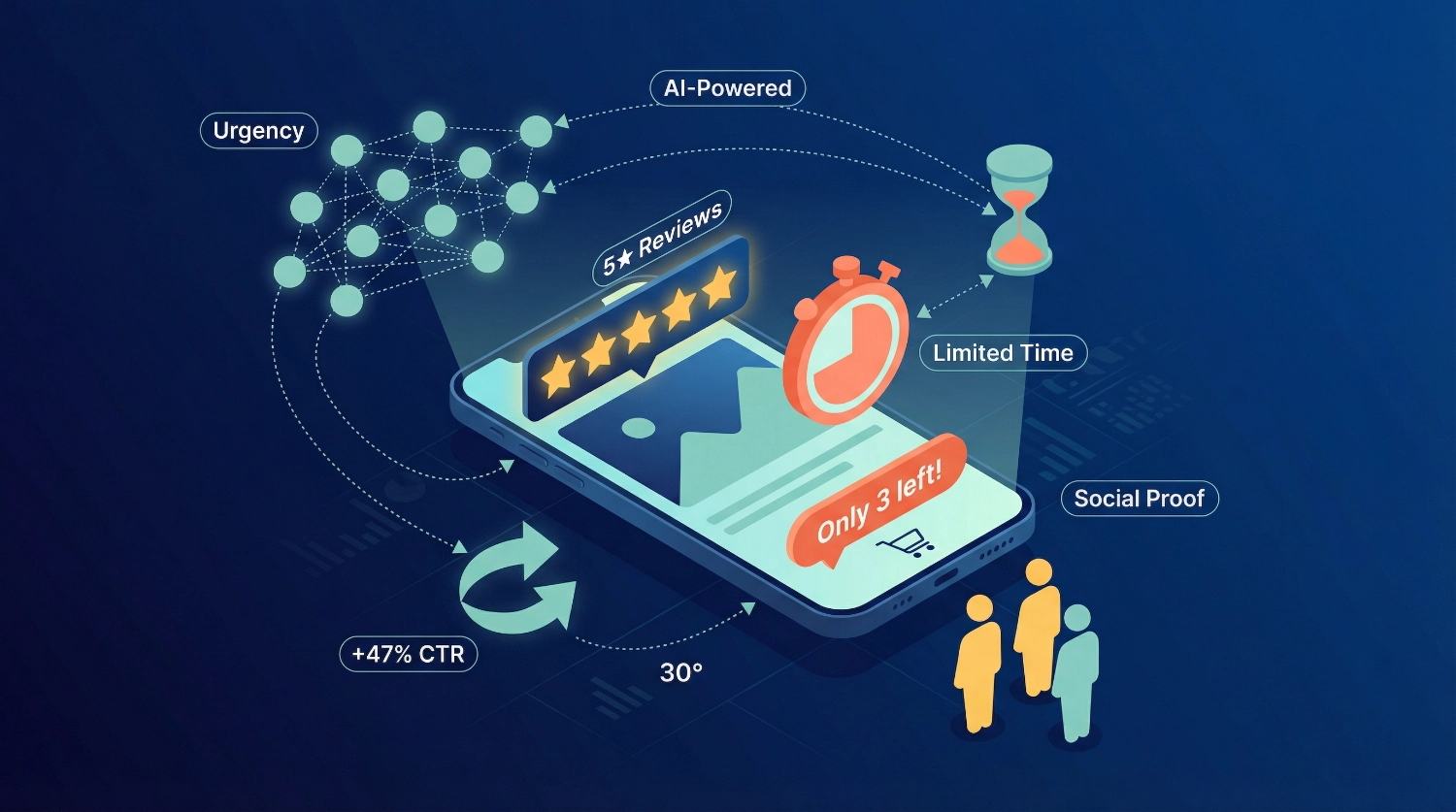
How to Incorporate Social Proof & Urgency in Ads Using AI transforms ordinary advertising into conversion machines by leveraging psychological triggers that your audience already trusts. We’ve tested these strategies across hundreds of campaigns, and the results speak for themselves: when you combine authentic social validation with time-sensitive messaging through AI assistance, you create ads that don’t just get clicks—they drive genuine action.
The beauty of using AI for this task? You can generate dozens of compelling variations in minutes, test what resonates with your specific audience, and refine your approach without spending hours staring at a blank screen. Whether you’re running Facebook ads, Google campaigns, or email promotions, these techniques work because they tap into fundamental human psychology: we want what others value, and we don’t want to miss out.
Let’s walk through exactly how to make this happen, step by step, using AI tools that are free or affordable for anyone to access.
Why Social Proof and Urgency Matter in Your Ads
Before we dive into the how-to, let’s understand what we’re working with.
Social proof is the phenomenon where people look to others’ actions to guide their own decisions.
When someone sees that 10,000 people bought your product, they instinctively think, “This must be good.”
Urgency creates a fear of missing out (FOMO) that compels immediate action instead of the classic “I’ll think about it later” that kills conversions.
Here’s the thing: both tactics have been around forever, but most people implement them poorly.
Generic phrases like “Buy now!” or “Popular item” feel hollow and desperate.
What makes the difference?
Specificity, authenticity, and strategic placement—and that’s exactly where AI becomes your secret weapon.
By the end of this guide, you’ll know:
- How to Generate authentic-sounding social proof statements that don’t feel fabricated
- How to Create urgency that motivates without seeming manipulative
- How to Test multiple variations to find what works for your audience
- How to Avoid common mistakes that make your ads look amateur
- How to Use free AI tools to streamline the entire process
Understanding the Core Elements
What Makes Social Proof Effective
Social proof works because humans are inherently social creatures.
We trust recommendations from others more than self-promotion.
In advertising, social proof can take several forms:
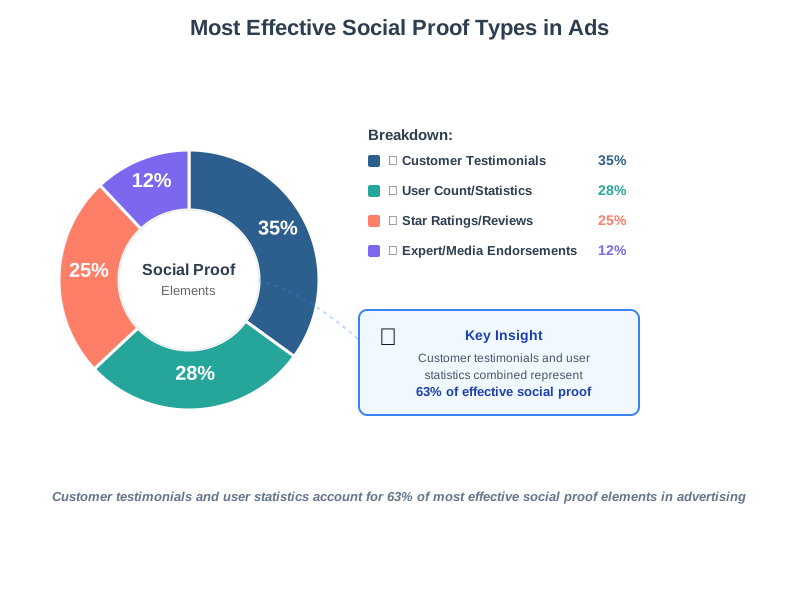
- Customer testimonials and reviews
- User statistics (“Join 50,000+ happy customers”)
- Expert endorsements
- Media mentions
- User-generated content
- Trust badges and certifications
- Social media engagement metrics
The key is specificity. “Thousands love us” is vague. “2,847 creators used this template last week” tells a concrete story that feels real.
What Makes Urgency Compelling
Urgency leverages scarcity and time sensitivity to trigger action.
But here’s what many advertisers get wrong: fake urgency backfires.
If your “limited time offer” has been running for three months, you’ve lost credibility.
Effective urgency elements include:
- Genuine limited-time discounts with specific end dates
- Low stock notifications (when actually true)
- Countdown timers for real deadlines
- Seasonal or event-based promotions
- Early-bird pricing with clear cutoffs
- Limited enrollment or access periods
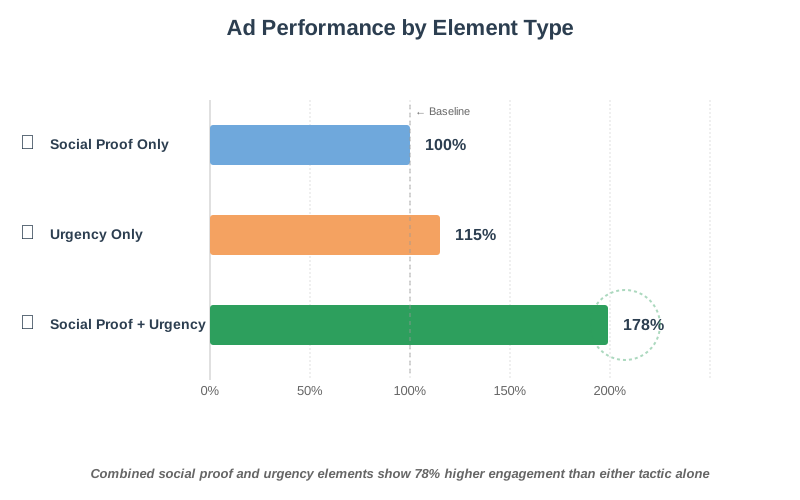
The magic happens when you combine both elements. “Join 5,000+ marketers who enrolled in the last 48 hours—enrollment closes Friday” hits both social proof and urgency in one authentic statement.
Step-by-Step: Using AI to Generate Social Proof Elements
Let’s get practical. We’ll start with creating compelling social proof, then move to urgency, and finally show you how to combine them effectively.
Step 1: Gather Your Real Data
Before touching any AI tool, collect your actual proof points.
This is critical—AI helps you present information compellingly, but it can’t invent credibility.
Look for:
- Total customer count or subscriber numbers
- Recent activity metrics (sales this week, downloads this month)
- Average ratings and review counts
- Specific testimonial quotes
- Industry recognition or awards
- Media features or mentions
- Certifications or compliance badges
Write these down in a simple document. Even small numbers work—”247 students enrolled” is better than vague claims.
Step 2: Choose Your AI Tool
For this task, you don’t need expensive software. Here are accessible options:
ChatGPT (Free/Plus version): Excellent for generating multiple variations and testing different angles. The free version works fine for most needs.
Claude (Free tier available): Particularly good at maintaining brand voice and creating longer-form ad copy with nuanced messaging.
Copy.ai: Specifically designed for marketing copy with templates for social proof and urgency.
Jasper AI: Offers ad-specific templates and can generate variations in bulk.
We’ll use ChatGPT for our examples since it’s the most accessible, but the same principles apply to any conversational AI tool.
Step 3: Craft Your AI Prompt for Social Proof
This is where most people go wrong—they give the AI vague instructions and get generic results. Instead, use this template:
I need 5 variations of social proof copy for [product/service]. Here are the real facts:
- [Your actual customer count]
- [Your actual rating/reviews]
- [Specific result or transformation]
- [Time period for the data]

Target audience: [Describe your ideal customer]
Platform: [Facebook/Google/Instagram/etc.]
Tone: [Professional/Casual/Enthusiastic/etc.]
Character limit: [If applicable]

Make each variation focus on a different angle of social proof (popularity, results, expert validation, etc.). Keep it authentic and specific.
Real Example:
I need 5 variations of social proof copy for my meal planning app. Here are the real facts:
- 12,847 active users
- 4.8-star rating from 2,103 reviews
- Users save an average of 8.5 hours per week
- Data from the last 30 days

Target audience: Busy parents aged 30-45
Platform: Facebook ads
Tone: Warm, relatable, encouraging
Character limit: 90 characters for primary text

Make each variation focus on a different angle of social proof. Keep it authentic and specific.
Step 4: Review and Refine the AI Output
The AI will generate variations, but don’t just copy-paste. Look for:
- Specificity: Does it use your actual numbers?
- Authenticity: Does it sound like something a real person would say?
- Relevance: Does it address your audience’s pain points?
- Clarity: Is the benefit immediately clear?
Here’s what you might get back:
- “Join 12,847 parents who reclaimed their evenings—4.8★ rated meal planning that actually works.”
- “Why do 12,000+ families trust our meal planner? They save 8.5 hours weekly. Real results, real reviews.”
- “Rated 4.8/5 by 2,103 busy parents who finally have time for what matters. Your turn?”
- “Over 12,000 families planned easier dinners this month. See why our 4.8★ app is their secret weapon.”
- “Real parents, real results: 8.5 hours saved weekly. Join the 12,847 who made mealtime stress-free.”
See the difference? Each one uses real data but presents it from a different angle. This gives you options for A/B testing.
If something feels off, ask the AI to revise: “Make variation #3 more conversational” or “Rewrite #1 with emphasis on time savings instead of star rating.”
Step 5: Customize for Different Ad Formats
Different platforms and placements need different approaches. Use the AI to adapt your best performers:
For Google Search Ads (character-limited):
Adapt this social proof statement for a Google search ad headline (30 character max):
[Your chosen variation]
For Instagram Stories (visual-focused):
Create social proof text for an Instagram Story that pairs with an image of customer reviews. Make it punchy and emoji-friendly, max 50 characters.For Email Subject Lines:
Turn this social proof into an email subject line that creates curiosity and trust, 40-50 characters.The AI excels at this kind of reformatting while maintaining your core message.
Step-by-Step: Creating Urgency That Converts
Now let’s tackle urgency. Remember: authentic urgency converts; manufactured panic repels. Here’s how to keep it real with AI’s help.
Step 6: Define Your Genuine Urgency Trigger
What’s your actual time-sensitive element? Be honest:
- Real deadline: Sale ends Friday, course enrollment closes, event registration deadline
- Actual scarcity: Limited inventory, limited seats, exclusive access for X people
- Seasonal timing: Holiday promotion, back-to-school offer, tax season special
- Early adopter benefit: Founding member rate, beta access pricing, first 100 customers bonus
If you don’t have a legitimate urgency trigger, create one. Launch a time-limited promotion specifically for this campaign. Don’t fake scarcity—it destroys trust.
Step 7: Use AI to Craft Urgency Language
Once you have your genuine urgency element, prompt the AI with this framework:
Create 5 urgency-focused ad variations for [product/service]. Here's the real urgency:
[Your actual deadline or scarcity factor]

Urgency type: [Time-limited/Quantity-limited/Exclusive access]
Tone: [Exciting but not desperate/Professional and direct/Friendly reminder]
Platform: [Where this will appear]
Don't use: [List any phrases you want to avoid, like "Act now!" or "Last chance!"]
Do emphasize: [What benefit they lose by waiting]

Make it compelling but authentic. No fake urgency.
Real Example:
Create 5 urgency-focused ad variations for my online photography course. Here's the real urgency:
Early bird pricing ends January 15th at midnight EST. After that, price increases by $150.

Urgency type: Time-limited pricing
Tone: Encouraging and helpful, not pushy
Platform: Facebook ads
Don't use: "Act now!", "Hurry!", "Limited time!" (overused phrases)
Do emphasize: The money they'll save and the course starting soon

Make it compelling but authentic. No fake urgency.
You might receive variations like:
- “Early bird rate ends January 15—save $150 and start mastering your camera on January 20.”
- “Lock in the founding student price before midnight on the 15th. After that, it’s $150 more.”
- “Course starts January 20. Enroll by the 15th to save $150 and secure your spot.”
- “Five days left to join at the early bird rate. Save $150 and start learning January 20.”
- “Founding member pricing closes January 15 at midnight. Save $150 and learn alongside our first cohort.”
Notice how these create urgency without sounding desperate? They state facts and let the value speak for itself.
Step 8: Test Urgency + Benefit Combinations
Here’s where it gets interesting. Ask the AI to combine the urgency with your product’s core benefit:
Combine these elements into a single compelling ad line:
- Urgency: [Your deadline/scarcity]
- Core benefit: [What problem you solve]
- Character limit: [If applicable]

Create 3 versions that lead with the benefit, then introduce urgency naturally.
Example output:
- “Master manual mode in 30 days—but only if you enroll by January 15 to lock in early pricing.”
- “Finally understand exposure, composition, and lighting. Join by the 15th, save $150, start on the 20th.”
- “Transform your photography in one month. Early bird rate ($150 savings) ends January 15.”
This approach leads with value, then adds urgency as a motivator—much stronger than urgency alone.
At this point, you might find our Ad Copy Optimization Checklist incredibly helpful. It walks you through optimizing every element of your ads to maximize conversions and lower costs. Think of it as your implementation partner for everything we’re covering here—it ensures you don’t miss critical details when you’re applying these strategies to your actual campaigns.
Combining Social Proof and Urgency for Maximum Impact
Now for the real magic: when you layer these elements strategically, you create ads that people can’t ignore.
Step 9: Create Layered Messaging
The formula: Social Proof + Urgency + Benefit
Prompt your AI with:
Create ad copy that combines these three elements:
1. Social proof: [Your real data]
2. Urgency: [Your real deadline/scarcity]
3. Core benefit: [Problem you solve]

Format: [Headline + short body text / Single compelling sentence / etc.]
Target audience: [Describe who you're speaking to]
Platform: [Where this appears]

Make it flow naturally—not a checklist of elements crammed together.
Example Result:
Over 3,200 entrepreneurs transformed their pricing strategy with our framework—and the next cohort starts January 20. Enroll by the 15th to lock in the early rate and join them.See how that works? You establish credibility (3,200 entrepreneurs), create community (join them), add urgency (by the 15th), and promise transformation (pricing strategy) all in one natural sentence.
Step 10: Generate A/B Testing Variations
Never run just one version. Use AI to create variations that test different angles:
Using this core message: [Your combined social proof + urgency copy]

Create 5 variations that test different angles:
- Variation 1: Lead with social proof
- Variation 2: Lead with urgency
- Variation 3: Lead with benefit
- Variation 4: Question format
- Variation 5: Challenge format

Keep all variations under [X] characters. Maintain the same core information but vary the presentation.
This gives you multiple versions to test against each other. You’ll quickly discover which angle resonates most with your specific audience.
Advanced AI Techniques for Better Results
Let’s go beyond basic generation and into strategies that separate amateur ads from professional campaigns.
Step 11: Use AI for Objection Handling
People hesitate to buy for specific reasons. AI can help you address objections within your social proof and urgency framework:
My target customer's main objections are:
1. [Objection 1]
2. [Objection 2]
3. [Objection 3]

Create ad copy that combines social proof and urgency while preemptively addressing these objections. Use the social proof element to counter the objection naturally.
Example: If your audience worries, “This seems complicated,” your AI might generate:
Join 4,200+ non-techies who set this up in under 10 minutes. First 100 people to enroll by Friday get our bonus setup call—because we make this ridiculously simple.See how the social proof (“4,200+ non-techies”) directly addresses the complexity objection, while urgency (first 100, by Friday) drives action, and the benefit reinforces ease?
Step 12: Generate Guarantee Language
Strong guarantees boost conversions by reducing perceived risk. Combine them with your social proof and urgency:
I offer a [your guarantee details]. Create 3 ad variations that weave this guarantee into social proof and urgency messaging. The guarantee should enhance credibility, not sound defensive.Example output:
Try it risk-free like 8,300+ customers did—30-day guarantee means you have nothing to lose. Enroll by the 20th to start with the next cohort.The guarantee becomes part of the social proof narrative (8,300+ people trusted this enough to try) rather than a separate defensive statement.
Step 13: Create Platform-Specific Variations
Each advertising platform has different strengths. Use AI to optimize for each:
Adapt this core message for:
1. Facebook feed ad (focus on stopping the scroll)
2. Google search ad (focus on intent and keywords)
3. Instagram story (focus on visual and brevity)
4. LinkedIn sponsored content (focus on professional credibility)
5. Email subject line (focus on open rate)

Core message: [Your social proof + urgency combination]
Keep the essential elements but adapt the tone and format for each platform's context.
This saves an enormous amount of time compared to manually rewriting for each channel.
Step 14: Generate Retargeting Sequences
For people who’ve already seen your ad, you need different messaging.
AI excels at creating escalating urgency:
Create a 3-part retargeting sequence for someone who clicked my ad but didn't convert:

Email 1 (Day 1): Reinforce social proof, gentle reminder
Email 2 (Day 3): Add urgency, highlight what they're missing
Email 3 (Day 5): Final urgency, stronger call to action

Use these elements:
- Social proof: [Your data]
- Urgency: [Your deadline]
- Objection to address: [Common hesitation]
The AI can create escalating sequences that feel natural rather than desperate, increasing your chances of conversion without burning the relationship.
Common Mistakes to Avoid (And How AI Helps You Dodge Them)
Even with AI assistance, you can still create ineffective ads if you’re not careful. Here are the pitfalls we constantly see:
Mistake 1: Generic Social Proof
Bad: “Loved by thousands!”
Good: “4,847 creators used this template this month—join them before enrollment closes Friday.”
Ask your AI: “Make this more specific using these exact numbers: [your data].”
Mistake 2: Fake or Manipulative Urgency
Bad: “Only 2 left!” (when it’s been showing “2 left” for weeks)
Good: “Early bird pricing ends January 15—lock in your rate before it increases $200.”
Tell your AI: “Create urgency based only on this real deadline: [actual date/scarcity]. No fake countdown language.”
Mistake 3: Cramming Too Much In
Bad: “Join 10,000+ users! ⭐⭐⭐⭐⭐ rated! 50% off! Ends tonight! Only 3 left! Act now!”
Good: “Join 10,000+ teams who simplified their workflow. Early access ends Friday at midnight.”
Ask your AI: “Simplify this to one social proof element and one urgency element. Make it conversational.”
Mistake 4: Ignoring Your Audience’s Sophistication
A B2B audience needs different language than a consumer audience.
A tech-savvy group responds differently than beginners.
Tell your AI explicitly: “This audience is [describe sophistication level]. Adjust the tone to match their expectations.”
Mistake 5: Leading with Urgency Instead of Value
Bad: “Hurry! Sale ends tomorrow! Get our productivity tool now!”
Good: “Reclaim 10 hours per week like 5,000+ professionals did—founding member rate ends tomorrow.”
Prompt your AI: “Rewrite this leading with the benefit, with urgency as a secondary motivator.”
Mistake 6: Forgetting to Test
Your assumptions about what works are probably wrong. We thought urgency would outperform social proof in our campaign last month—turns out social proof won by 34%.
You won’t know until you test.
Use AI to generate 5-10 variations, then test them systematically. The AI makes it easy to create enough variations that you’ll find winners quickly.
Tools and Prompts You Can Use Today
Let’s consolidate everything into ready-to-use resources.
Essential AI Tools for Ad Copy
ChatGPT (Free/Plus)
- Best for: Quick generation, multiple variations, conversational refinement
- Cost: Free tier available; Plus is $20/month
- Learning curve: Minimal
Claude (Free tier available)
- Best for: Longer copy, maintaining brand voice, nuanced messaging
- Cost: Free tier available; Pro is $20/month
- Learning curve: Minimal
Copy.ai
- Best for: Ad-specific templates, bulk generation
- Cost: Free tier limited; Pro starts at $49/month
- Learning curve: Low—built-in templates
Jasper AI
- Best for: Team collaboration, brand voice consistency, bulk content
- Cost: Starts at $49/month
- Learning curve: Medium—more features to learn
For most people starting out, ChatGPT or Claude’s free tiers provide everything you need. Upgrade only when you’re creating high volumes of content or need team features.
Ready-to-Use Prompt Templates
Master Prompt for Combined Social Proof + Urgency:
Create 10 ad variations that combine social proof and urgency for [product/service].

Real data:
- Customer/user count: [exact number]
- Rating/reviews: [exact data]
- Key result or transformation: [specific outcome]
- Urgency element: [real deadline or scarcity]

Target audience: [describe specifically]
Platform: [where this runs]
Character limit: [if applicable]
Tone: [professional/casual/enthusiastic/etc.]

For each variation:
1. Lead with different angles (benefit, social proof, urgency)
2. Use exact numbers, not rounded estimates
3. Make it conversational, not salesy
4. Include a clear call to action
5. Address the primary objection: [state it]

Avoid these overused phrases: [list what you don't want]
Quick Variation Prompt:
Take this ad copy: [paste your current ad]

Create 5 variations that:
- Keep the core message
- Test different opening hooks
- Vary the emphasis between social proof and urgency
- Stay under [X] characters
- Maintain authentic tone
Objection-Handling Prompt:
My target customer objects: [state specific objection]

Create 3 ad variations that use social proof to address this objection while incorporating urgency to drive action.

Social proof data: [your numbers]
Urgency element: [your deadline]
Benefit: [what they get]
A/B Test Generation Prompt:
I want to test which performs better:
A) Leading with social proof
B) Leading with urgency
C) Leading with benefit

Create one strong variation for each approach using:
- Social proof: [your data]
- Urgency: [your element]
- Benefit: [core value]

Make them distinct enough to test clearly but equally compelling.
If you want a complete library of proven prompts and templates like these, check out 100+ AI Marketing Prompts Ready to Copy and Use. It’s a comprehensive collection used by solo entrepreneurs, creators, and agencies to streamline their content creation process—including dozens of variations specifically for ad copy optimization. The prompts are immediately implementable and save hours of trial and error.
Step-by-Step Implementation Checklist
Let’s bring this all together with a concrete implementation plan you can follow today.
Week 1: Foundation
- Collect your real social proof data (customer counts, ratings, testimonials)
- Define your genuine urgency element (deadline, scarcity, exclusive access)
- Choose your primary AI tool and create an account
- Write your target audience description in detail
- Identify your audience’s main objections
Week 2: Creation
6. Use the master prompt to generate 20 ad variations
7. Review and select your top 10 based on authenticity and specificity
8. Adapt your top 5 for each platform you’re advertising on
9. Create 3 variations each of your top performers for A/B testing
10. Write down your hypothesis for which will perform best (you’ll test this)
Week 3: Testing
11. Launch your first A/B test with 2-3 variations
12. Set a clear success metric (CTR, conversion rate, cost per acquisition)
13. Let the test run for at least 5-7 days (or until statistical significance)
14. Analyze which elements performed best (social proof angle? urgency type?)
15. Iterate based on data
Week 4: Optimization
16. Create new variations based on your winning elements
17. Test different combinations of your best-performing social proof + urgency
18. Experiment with different objection-handling approaches
19. Create retargeting sequences for non-converters
20. Document what works for your specific audience
Ongoing: Refinement
21. Update your social proof numbers monthly as they grow
22. Refresh urgency elements with new deadlines/promotions
23. Generate seasonal variations 24. Keep testing—winning ads eventually fatigue
25. Build a swipe file of your top performers for future reference
Real Examples: Before and After
Let’s look at actual transformations when you apply these principles:
Example 1: Online Course
Before (generic):
Learn photography! Limited time offer. Sign up now!After (AI-optimized with social proof + urgency):
Join 3,847 students who mastered manual mode in 30 days. Founding member pricing ends Friday—save $150 and start January 20.Why it works:
Specific student count builds trust, a concrete benefit (mastered manual mode in 30 days), a clear deadline with an exact date, a tangible savings amount, and a start date creates anticipation.
Example 2: SaaS Product
Before (desperate):
Hurry! Best productivity tool! 70% off! Act fast!After (AI-optimized with social proof + urgency):
4,200+ remote teams reclaimed 12+ hours per week. Lock in the early adopter rate before it increases $30/month on January 15.Why it works:
Substantial user count (4,200+), quantified result (12+ hours), specific context (remote teams), non-discount urgency (price increase), precise date.
Example 3: E-commerce Product
Before (overused tactics):
Only 2 left in stock! Buy now!After (AI-optimized with social proof + urgency):
This week's bestseller—847 sold in 48 hours. Restock arrives Thursday, but current batch is 87% gone.Why it works:
Social proof through sales velocity and specific numbers builds credibility, real urgency (actual inventory), and a clear timeline for restocking.
Example 4: Service Business
Before (vague):
Trusted by many! Book your consultation today!After (AI-optimized with social proof + urgency):
263 homeowners transformed their spaces with us this year — 4.9★ rated. January calendar is 80% booked. Reserve your consultation this week.Why it works: Specific client count with timeframe, stellar rating, real scarcity (calendar filling up), and relevant urgency (this week).
Notice the pattern? Specificity, authenticity, and a strategic combination of elements make all the difference.
Frequently Asked Questions
Taking Your Skills Further
You now have everything you need to create compelling ads that combine social proof and urgency using AI assistance. But knowing the strategies and actually implementing them are two different things.
Here’s our recommendation:
- start small. Pick one product or service.
- Spend 30 minutes gathering your social proof data and defining your urgency element.
- Then use one of the prompt templates we provided to generate 10 variations.
- Launch a simple A/B test with your top 3.
Track what happens. You’ll learn more from one week of real testing than from reading a dozen more guides.
The beautiful part about using AI for this process? You can iterate incredibly fast. Something not working? Generate 10 new angles in five minutes. Found a winner? Create variations to test against it immediately. This speed of experimentation used to require copywriting teams and weeks of work. Now it’s available to anyone willing to learn these fundamentals.
Remember: the AI is your creative partner, not your replacement. It generates options; you provide the strategy, judgment, and authentic business knowledge that makes those options actually work. Your real customer data, your genuine deadlines, and your understanding of your audience’s psychology—that’s what transforms generic AI output into converting ads.
As you get comfortable with these techniques, you’ll develop an intuition for what works with your specific audience. You’ll spot patterns in your winning ads. You’ll refine your prompts to generate exactly what you need faster. The learning curve is steep at first, but the payoff compounds quickly.
We’ve watched complete beginners go from struggling to write a single ad to confidently A/B testing multiple campaigns within their first month of using these AI-powered strategies. The limiting factor isn’t the technology—it’s your willingness to experiment, test, and learn from your results.
So here’s your challenge: implement one thing from this guide in the next 48 hours. Generate five ad variations for an existing campaign. Test a new social proof angle. Add authentic urgency to an upcoming promotion. Take one action, measure the result, and build from there.
Your ads won’t magically perfect themselves overnight. But with these AI tools and strategies, you can systematically improve them week after week until you’ve built a conversion machine that consistently performs. The opportunity is there. The tools are accessible. All that’s left is for you to start.
About the Authors
This article was written as a collaboration between Alex Rivera and Abir Benali, combining creative experimentation with clear, practical instruction.
Alex Rivera (Main Author) is a creative technologist who helps non-technical users unlock the creative potential of AI tools. With a background in digital marketing and content creation, Alex specializes in making complex AI concepts accessible through hands-on experimentation and real-world examples. Alex’s approach emphasizes that AI is a creative partner, not a replacement for human insight and strategy.
Abir Benali (Co-Author) is a technology writer dedicated to explaining AI tools to everyday users without the jargon. With years of experience simplifying technical concepts, Abir focuses on creating step-by-step guides that anyone can follow, regardless of their technical background. Abir’s mission is to ensure that powerful AI tools are accessible to everyone, not just technical experts.
Together, we believe that the best way to learn AI is through doing—experimenting with prompts, testing results, and discovering what works for your unique situation. Our goal is to give you the confidence and practical skills to use AI effectively in your marketing and business growth.