How to Craft Persona Messaging & Stories Using AI

How to Craft Persona‑Specific Messaging & Stories Using AI starts with understanding that every customer is different—and speaking to everyone the same way means connecting with no one. We’ve discovered that AI can transform how you create messaging that actually resonates, turning generic pitches into personalized narratives that speak directly to each person’s needs, fears, and aspirations.
If you’ve ever stared at a blank document wondering how to write different versions of your message for different audiences, you’re not alone. The good news? AI tools can help you map objections, craft success stories, understand buying stages, and even identify alternatives—all tailored to specific customer personas. This guide will walk you through the exact process we use to create persona‑specific messaging that converts, without needing a marketing degree or expensive agency support.
Why Persona-Specific Messaging Matters
Before diving into the how, let’s clarify the why. When you speak to everyone, you speak to no one. Generic marketing messages get ignored because they don’t address the specific pain points, goals, or contexts of different customer types.
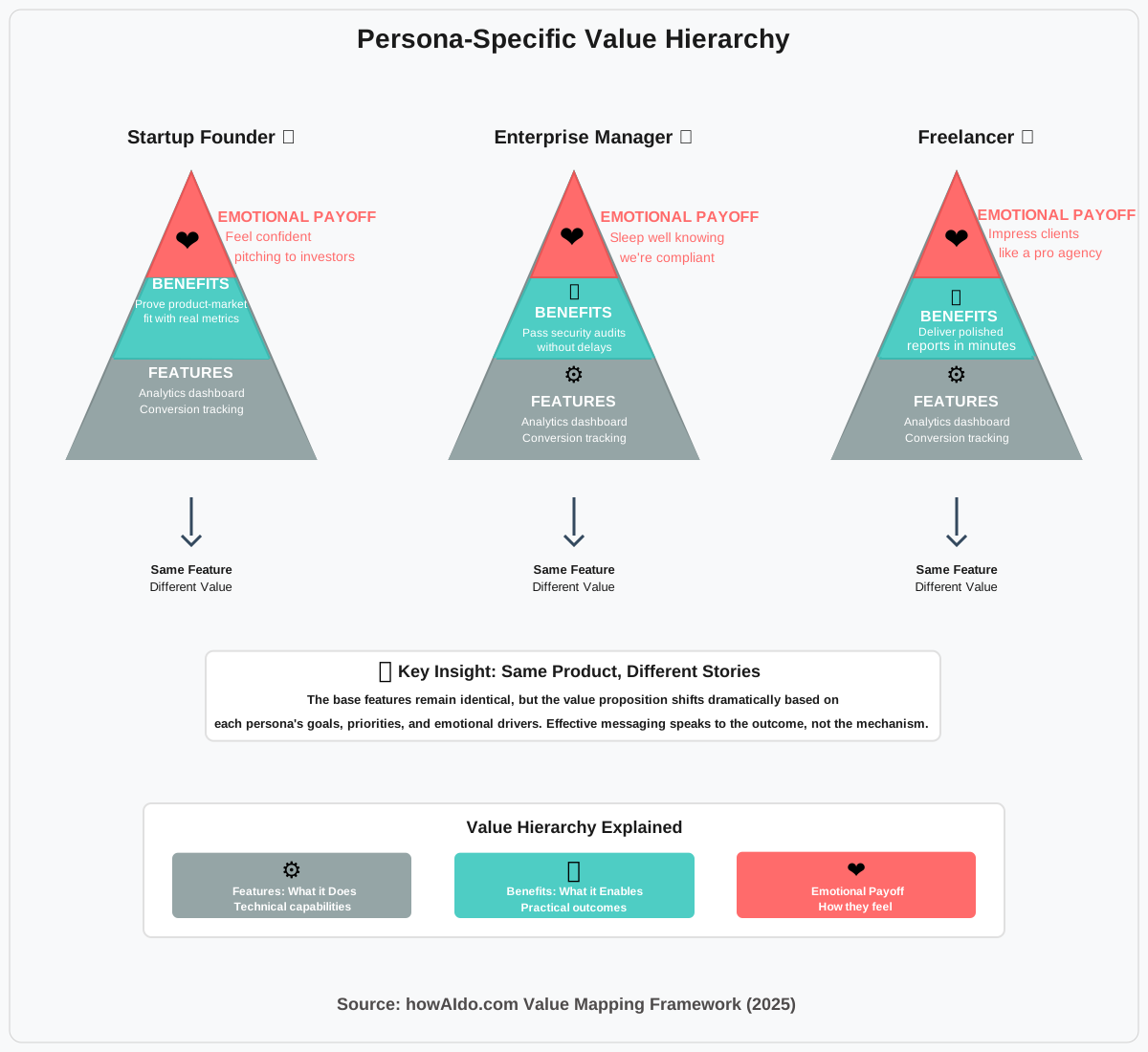
Think about it: A busy startup founder evaluating your product cares about speed and ROI. A corporate IT manager cares about security and compliance. A freelance designer cares about ease of use and creative freedom. Same product, completely different concerns.
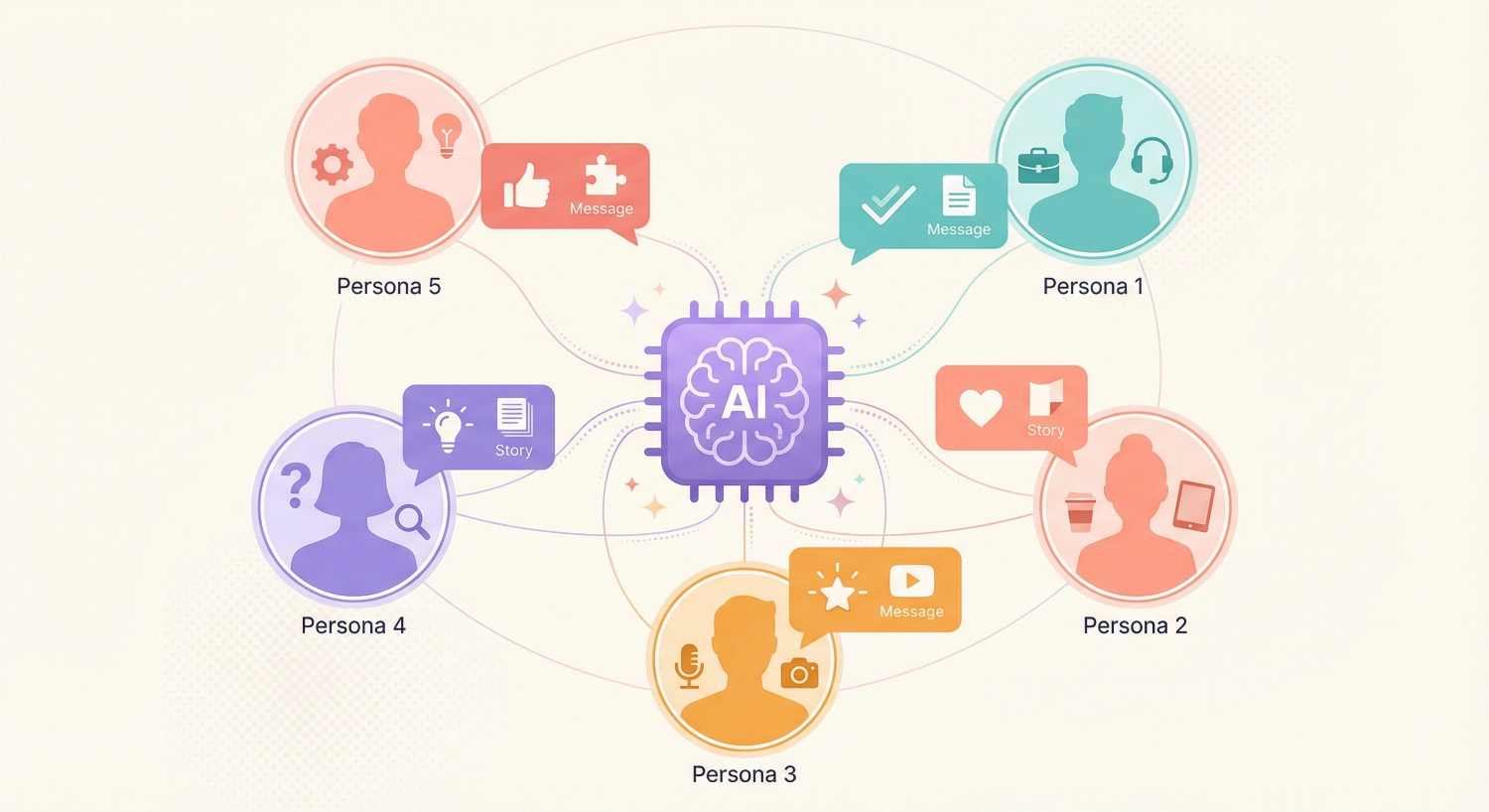
Persona‑specific messaging solves such issues by creating distinct narratives for each customer type. And AI makes this process faster, more consistent, and surprisingly creative—even if you’re not a natural writer.
Understanding Your Core Personas First
Before AI can help you craft messaging, you need to know who you’re talking to. Start by identifying your 3-5 core customer personas. These aren’t just demographics—they’re behavioral profiles.
For each persona, document:
- Role and responsibilities: What do they do all day?
- Primary goals: What are they trying to achieve?
- Biggest pain points: What keeps them up at night?
- Decision-making factors: What influences their choices?
- Objections and fears: What might stop them from buying?
- Preferred communication style: Formal? Casual? Data-driven? Story-driven?
We recommend starting with real customer data if you have it—support tickets, sales call notes, and review feedback. If you’re just starting out, create educated hypotheses based on industry research and competitor analysis.
Not sure where to start with persona documentation? We’ve created a Persona Messaging & Positioning Checklist that walks you through exactly what information to gather for each customer type. It’s a practical framework that prevents you from missing critical details and helps you organize your thinking before jumping into AI-powered content creation.
Step 1: Set Up Your AI Persona Messaging Workspace
Let’s get practical. You’ll need an AI tool that allows conversational interaction and remembers context across a session. We typically use Claude, ChatGPT, or similar LLMs for this work.
Create a dedicated workspace or chat session for each persona. This keeps your messaging focused and prevents cross-contamination between different customer types.
Start your session by giving the AI comprehensive context about the persona:
Example prompt framework:
I'm creating messaging for [PERSONA NAME], who is a [ROLE] at [COMPANY TYPE].

Key characteristics:
- Primary goal: [SPECIFIC GOAL]
- Biggest pain point: [SPECIFIC CHALLENGE]
- Decision criteria: [WHAT MATTERS MOST]
- Budget sensitivity: [HIGH/MEDIUM/LOW]
- Tech comfort level: [BEGINNER/INTERMEDIATE/ADVANCED]

Our product/service: [BRIEF DESCRIPTION]

Help me craft messaging that resonates with this specific persona.
The more specific you are in this initial prompt, the better your results will be throughout the session.
Step 2: Map Objections for Each Persona
Every persona has unique objections—reasons they might hesitate or say no. AI can help you identify these objections and then craft responses that address them directly.
Prompt to identify objections:
Based on the [PERSONA NAME] profile I shared, what are the top 5 objections they would likely have about [YOUR PRODUCT/SERVICE]? Consider their role, goals, and pain points. Format these as direct quotes they might think or say.AI will generate realistic objections. Review these and refine them based on your actual sales conversations or customer feedback.
Once you have the objections list, move to response crafting:
Prompt to address objections:
For each objection, write a 2-3 sentence response that:
1. Acknowledges the concern without being defensive
2. Reframes it as an opportunity or addresses it with specific evidence
3. Uses language that matches [PERSONA NAME]'s communication style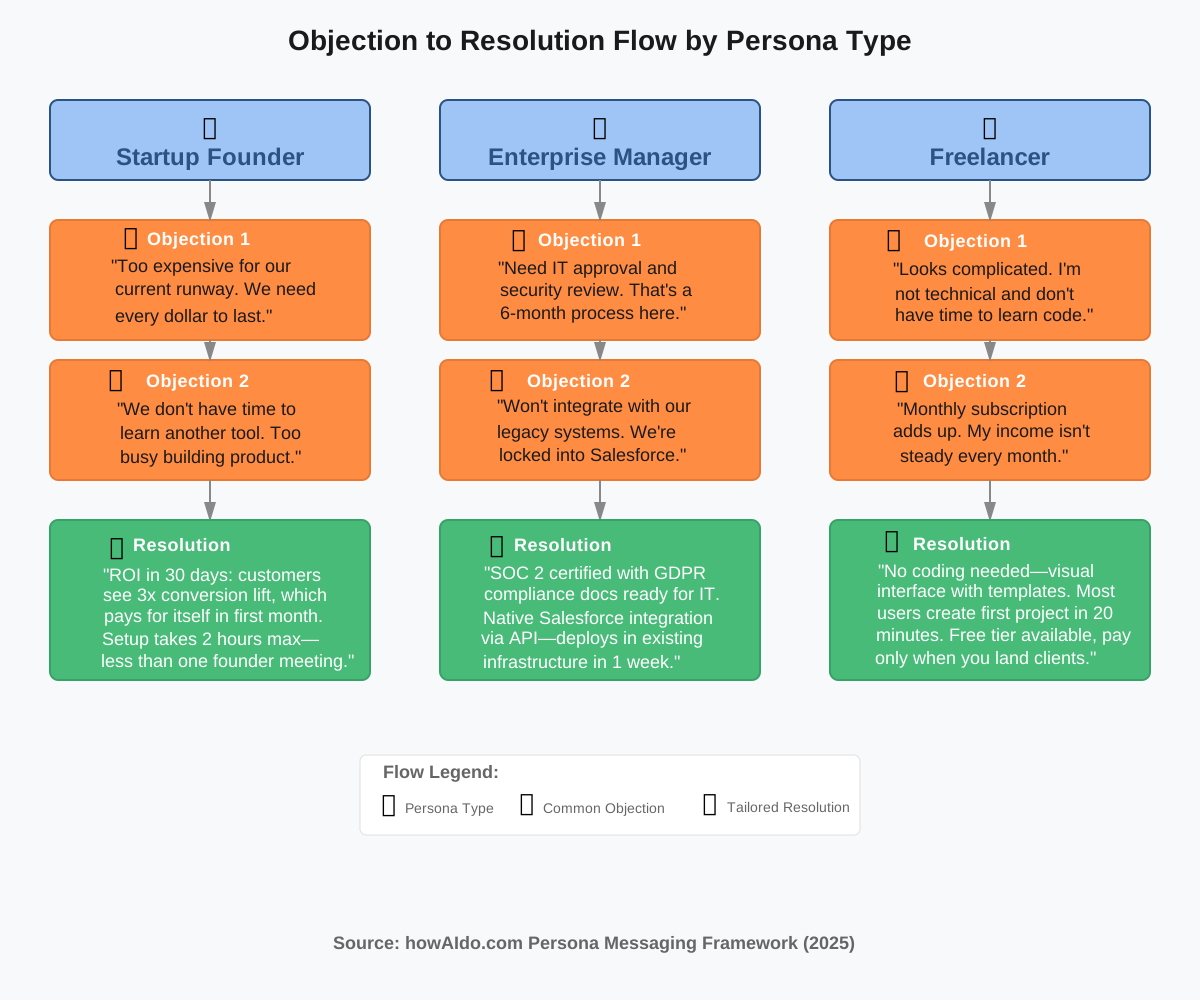
Step 3: Generate Success Stories Tailored to Each Persona
People buy based on how they imagine success feeling, not just what features you offer. AI-generated success stories make your product tangible and relatable for each persona.
Here’s how we approach this:
Prompt for success story generation:
Write a 150-200 word success story for [PERSONA NAME] that shows them 6 months after adopting [YOUR PRODUCT/SERVICE]. Focus on:
- Specific metrics that matter to this persona
- Day-to-day improvements in their work
- How they feel about the change
- What their colleagues/boss/clients notice

Write it in first person from the persona's perspective. Use their language and priorities.
The AI will create a narrative that feels authentic to that persona’s experience. You can then use this story in email campaigns, landing page copy, case study formats, or sales conversations.
Pro tip: Generate 2-3 variations for each persona. Different people respond to different story angles—some want metrics, others want emotional transformation, and some want social proof from peers.
Step 4: Map the Buying Journey for Each Persona
Not every persona moves through the buying journey at the same pace or in the same way. AI can help you map out the specific stages and create appropriate messaging for each phase.
Prompt to map buying stages:
For [PERSONA NAME], map out their typical buying journey from first awareness to final purchase. For each stage, identify:
1. What they're thinking and feeling
2. What information they need
3. What objections arise at this stage
4. What would move them to the next stage

Format as a numbered list with 4-6 stages.
Once you have the journey mapped, create stage-specific messaging:
Prompt for stage-specific content:
For the [STAGE NAME] stage of [PERSONA NAME]'s journey, write:
- A compelling email subject line
- A 3-paragraph email body
- A social media post (150 characters)
- A landing page headline

All should address their specific needs and concerns at this stage.
This gives you a complete content library, organized by persona and buying stage. When someone from that persona enters your funnel, you know exactly what message to send at each point.
Step 5: Identify and Address Alternatives from Each Persona’s Perspective
Every persona has alternatives—whether that’s competitors, DIY solutions, or simply doing nothing. Understanding these alternatives from their specific viewpoint helps you position your offering more effectively.
Prompt to identify alternatives:
From [PERSONA NAME]'s perspective, what are the 4-5 alternatives they're likely considering instead of [YOUR PRODUCT/SERVICE]? Include:
- Direct competitors
- Adjacent solutions
- DIY approaches
- Status quo (doing nothing)

For each alternative, explain why it might appeal to this persona specifically.
Now create comparison messaging:
Prompt for comparison content:
For each alternative you identified, write a brief comparison from [PERSONA NAME]'s perspective that:
1. Acknowledges why the alternative is appealing
2. Highlights a specific trade-off or limitation they should consider
3. Positions our solution as addressing what the alternative misses

Keep each comparison to 2-3 sentences. Be fair and factual, not salesy.
If you’re looking for more ready-to-use prompts like these, we’ve compiled 100+ AI Marketing Prompts that cover everything from persona research to content creation. These templates are immediately implementable and save hours of prompt engineering—you can literally copy, customize with your details, and get professional results.
Step 6: Create Emotional Hooks and Value Props by Persona
Features tell, benefits sell—but emotional connection closes deals. AI can help you identify the emotional drivers for each persona and craft messaging that resonates on that level.
Prompt for emotional drivers:
For [PERSONA NAME], identify their top 3 emotional drivers related to [YOUR PRODUCT CATEGORY]. Consider:
- What success feels like to them emotionally
- What failure or frustration feels like
- What they want to feel when colleagues/boss/clients see their work
- What personal or professional identity they're building

Format as: [EMOTION]: [WHY IT MATTERS TO THIS PERSONA]
Then translate these into value propositions:
Prompt for emotional value props:
Write 3 value proposition statements for [PERSONA NAME] that lead with the emotional benefit, then support with the practical benefit. Format:
"[EMOTIONAL OUTCOME] by [PRACTICAL MECHANISM]"

Example: "Feel confident in every client presentation by having data-backed insights at your fingertips"
These emotional hooks become your headline copy, email subject lines, and ad messaging—the elements that make someone stop scrolling and pay attention.
Step 7: Test and Refine Your Messaging with AI Feedback
Once you’ve created initial messaging for each persona, use AI to pressure-test it before you send it to real customers. This is where things get interesting—you can essentially role-play sales conversations with AI acting as your persona.
Prompt for messaging review:
You are now [PERSONA NAME] with all the characteristics we discussed. I'm going to share some messaging I've created for you. Review it and tell me:
1. Does this feel like it was written FOR me specifically?
2. What phrases or words feel off or generic?
3. What objections or questions does this raise that aren't addressed?
4. On a scale of 1-10, how likely am I to take the next step after reading this?

Here's the messaging: [PASTE YOUR CONTENT]
AI, playing the role of your persona, will give you brutally honest feedback. It’s like having a focus group on demand.
You can also have AI generate alternative phrasings:
Prompt for alternatives:
Take the key message from this content and rephrase it 5 different ways for [PERSONA NAME], ranging from very direct to more story-driven. Show me the spectrum of approaches.This helps you test different tones and angles without spending hours rewriting manually.
Step 8: Build a Persona Messaging Library
Now that you’ve created all this tailored content, organize it in a way that’s easy to reference and use repeatedly.
Create a simple document or spreadsheet with these sections for each persona:
- Core profile summary (one paragraph)
- Key objections and responses (bullet list)
- Success stories (2-3 versions)
- Buying journey messaging (organized by stage)
- Competitive alternatives messaging
- Emotional hooks and value props
- Example email templates
- Example social posts
- Example ad copy
This becomes your persona playbook—a reference guide that ensures consistency across all your marketing materials. When a new team member joins or you’re launching a campaign, you’re not starting from scratch.
AI can help maintain this library:
Prompt for new content:
Using the established messaging style and key themes for [PERSONA NAME] in our library, create [NEW CONTENT TYPE] that maintains consistency with our existing approach. Here's a sample of our current messaging: [PASTE EXAMPLE]Step 9: Adapt Messaging Across Different Channels
Your personas interact with you across multiple channels—email, social media, website, sales calls, and ads. The core message stays consistent, but the format and tone need to adapt to each channel.
AI makes this adaptation effortless:
Prompt for channel adaptation:
Take this core message for [PERSONA NAME]: [PASTE MESSAGE]

Adapt it for:
1. A LinkedIn post (1200 characters max, professional tone)
2. An Instagram caption (150 characters, more casual)
3. A cold email subject line (40 characters max)
4. A landing page headline (8-10 words)
5. A 15-second video script

Maintain the core value proposition but adjust tone and format for each channel.
The AI understands the conventions and constraints of each platform and will create appropriate variations while keeping your messaging on-brand for that persona.
Step 10: Iterate Based on Real Performance Data
This is where many people stop—they create the messaging and never revisit it. Don’t make that mistake. Your persona messaging should evolve based on actual customer responses.
Set up a simple feedback loop:
- Track which messaging variations receive the best response rates
- Note objections that come up in sales calls that you didn’t anticipate
- Pay attention to the language customers use when they DO convert
- Monitor which success stories resonate most in case studies
Feed this back into your AI sessions:
Prompt for iteration:
We've been using messaging for [PERSONA NAME] for 3 months. Here's what we've learned:
- [INSIGHT 1]
- [INSIGHT 2]
- [INSIGHT 3]

Based on these insights, suggest refinements to our messaging approach. What should we emphasize more? What should we change or remove?
AI can help you identify patterns you might miss and suggest strategic pivots based on real-world evidence.
The Persona Messaging & Positioning Checklist includes a section specifically for tracking these performance insights, helping you maintain a continuous improvement cycle rather than letting your messaging go stale.
Common Mistakes to Avoid
Through helping dozens of businesses implement AI-powered persona messaging, we’ve seen a few mistakes pop up repeatedly. Here’s what to watch for:
Mistake 1: Creating Too Many Personas Start with 3-5 core personas max. More than that becomes unmanageable, and you’ll end up with surface-level messaging for everyone rather than depth for the right people.
Mistake 2: Making Personas Too Similar If two personas could easily swap messaging without noticing a difference, they’re probably the same persona. Each should have distinct pain points, goals, and communication preferences.
Mistake 3: Confusing Personas with Demographics “25-34-year-old males in tech” is not a persona—it’s a demographic segment. Personas are about behavior, goals, and psychology, not just age and industry.
Mistake 4: Writing Messaging Once and Forgetting About It Markets change, your product evolves, and customer priorities shift. Review and update your persona messaging quarterly at minimum.
Mistake 5: Letting AI Do All the Thinking AI is a powerful tool for generation and iteration, but you still need human judgment. Always review AI outputs through the lens of “Would my actual customer say this?” and “Does this feel authentic?”
Mistake 6: Ignoring Your Customer’s Voice The best persona messaging incorporates the actual words and phrases your customers use. Don’t rely solely on AI invention—feed it real customer quotes, reviews, and testimonials to ground the messaging in reality.
Real-World Application Examples
Let’s look at how this plays out in practice across different business contexts:
SaaS Product Example
A project management tool targeting three personas:
- Agency Owner – Anna: Needs client visibility and time tracking. Messaging focuses on profitability and client retention.
- Corporate PM – Chris: Needs compliance and stakeholder reporting. Messaging emphasizes security, integration, and governance.
- Freelancer – Fiona: Needs simplicity and affordability. Messaging highlights ease of use and flexible pricing.
Same product, entirely different landing pages, email sequences, and value propositions—all created using the AI persona messaging process outlined above.
Service Business Example
A business coaching consultancy with two distinct personas:
- First-Time Founder: Overwhelmed, needs structure and confidence. Messaging is encouraging and educational.
- Second-Time Entrepreneur: Experienced but facing new scaling challenges. Messaging is strategic and peer-to-peer in tone.
The coaching service itself hasn’t changed, but how it’s positioned and described shifts dramatically between these two personas.
E-commerce Example
An online course platform serving:
- Career Switchers: Looking for quick, practical skills. Messaging focuses on time-to-employment and ROI.
- Lifelong Learners: Exploring interests for personal growth. Messaging emphasizes the joy of learning and community.
- Professional Upskilling: Staying relevant in changing fields. Messaging highlights competitive advantage and certificate value.
Each persona sees different course bundles highlighted, different success metrics emphasized, and different testimonials featured—all generated and organized using AI.
Frequently Asked Questions
Your Next Steps: Making This Actionable Today
The difference between reading about persona-specific messaging and actually implementing it comes down to taking the first concrete action. Here’s exactly what to do next:
Today: Choose your primary persona—the customer type that represents the biggest opportunity or the clearest pain point you can solve. Write down their profile using the framework we shared in Step 1.
This week: Run through Steps 2-4 with AI for that one persona. Create objection responses, a success story, and basic journey mapping. Don’t aim for perfection; aim for completion. You can refine later.
This month: Implement your persona messaging in one channel—whether that’s your email welcome sequence, your primary landing page, or your ad campaigns. Measure the results against your previous generic messaging.
Ongoing: Add one new persona per month to your messaging library. By quarter’s end, you’ll have a complete system that transforms how you communicate with every customer segment.
The beauty of using AI for this work is that you’re not locked into expensive agencies or lengthy timelines. You can experiment, iterate, and improve continuously based on real-world feedback. Every conversation teaches you something new about your personas, and every insight can be immediately incorporated into your messaging through a simple AI prompt.
Remember, the goal isn’t to create the perfect messaging system on day one. The goal is to start speaking directly to your customers’ specific needs rather than broadcasting generic marketing messages into the void. Even imperfect persona messaging dramatically outperforms one-size-fits-all content.
So grab that checklist we mentioned, open up your preferred AI tool, and start with just one persona. You’ll be surprised how quickly you can create messaging that finally feels like it was written for real people—because it was, with AI as your creative partner in understanding and articulating what matters most to each customer type.
About the Authors
This article was written as a collaboration between Alex Rivera and Abir Benali for howAIdo.com.
Alex Rivera (main author) is a creative technologist passionate about making AI accessible and fun for non-technical users. Alex specializes in helping individuals and small businesses unlock AI’s creative potential through practical, step-by-step guidance that emphasizes experimentation and customization.
Abir Benali (co-author) is a friendly technology writer who breaks down complex AI tools into clear, actionable instructions for everyday users. Abir focuses on eliminating jargon and making technology feel approachable, ensuring that anyone—regardless of technical background—can confidently use AI to solve real problems.
Together, we believe AI should empower creativity and efficiency, not intimidate or overwhelm. Our goal is to help you use these tools in ways that feel natural, practical, and genuinely useful in your daily work.