How to Structure Brand‑Customized AI Prompts Using AI

How to Structure Brand‑Customized AI Prompts Using AI starts with understanding one simple truth: the difference between generic AI outputs and content that sounds unmistakably yours isn’t the AI itself—it’s how you structure your instructions.
We’ve spent countless hours testing prompt variations, and we’ve discovered that mastering prompt anatomy transforms AI from a random content generator into a reliable brand voice extension.
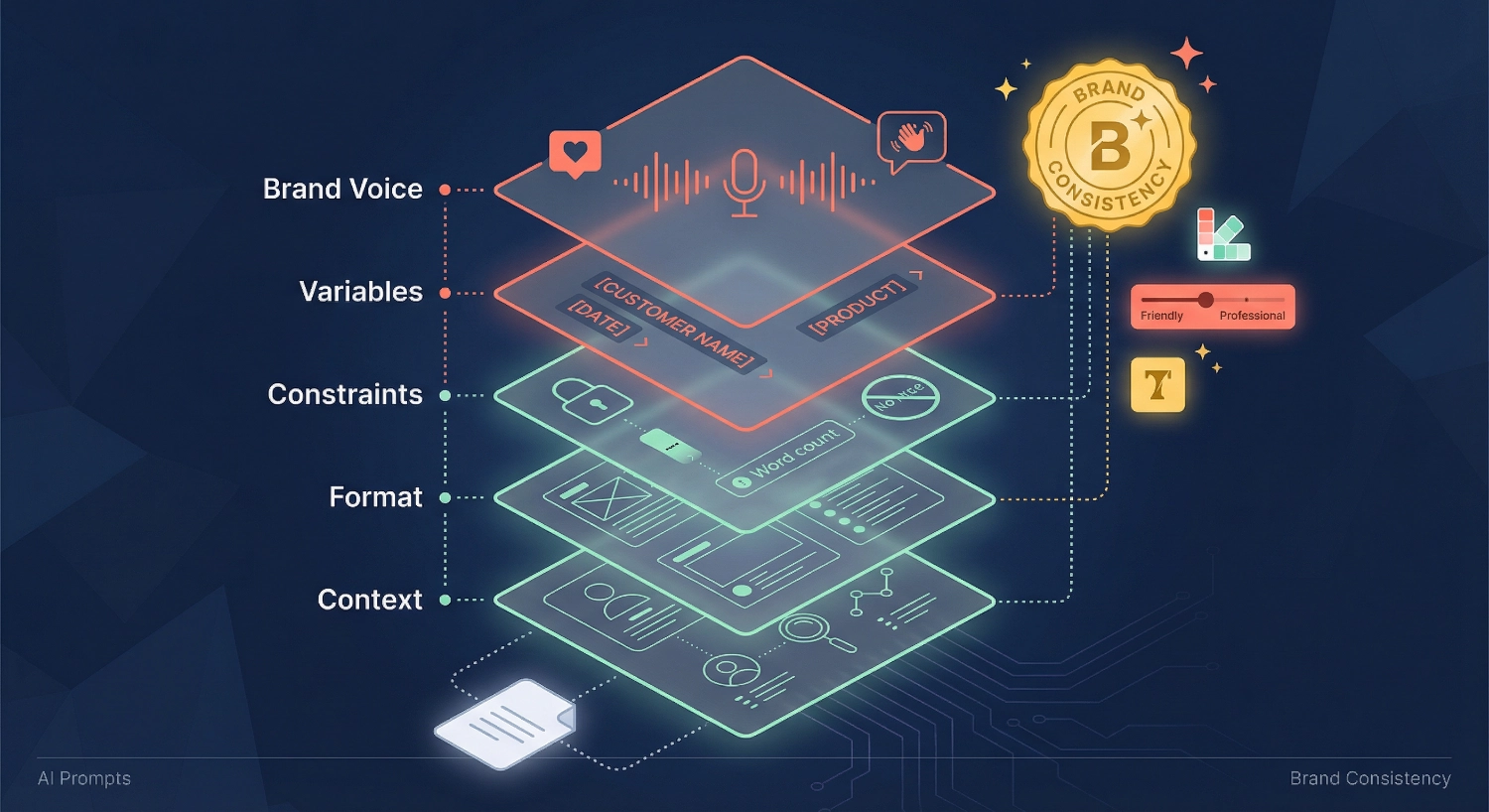
Think of AI prompts like recipes. You wouldn’t just tell a chef to “make dinner”—you’d specify ingredients, cooking methods, presentation style, and dietary restrictions. The same principle applies to AI prompts: the more precisely you structure your instructions using context, format, constraints, variables, and brand voice documentation, the more consistent and on-brand your outputs become.
Whether you’re a solo entrepreneur building your first content system or a marketer managing multiple brand voices, this guide will walk you through exactly how to structure prompts that deliver professional, branded content every single time. No technical background required—just a willingness to experiment and learn.
Why Prompt Structure Matters for Brand Consistency
Before we dive into the mechanics, let’s understand why this matters. Generic prompts like “write a blog post about productivity tips” produce generic content. They ignore your brand’s personality, your audience’s specific pain points, and the unique angle that makes your content stand out.
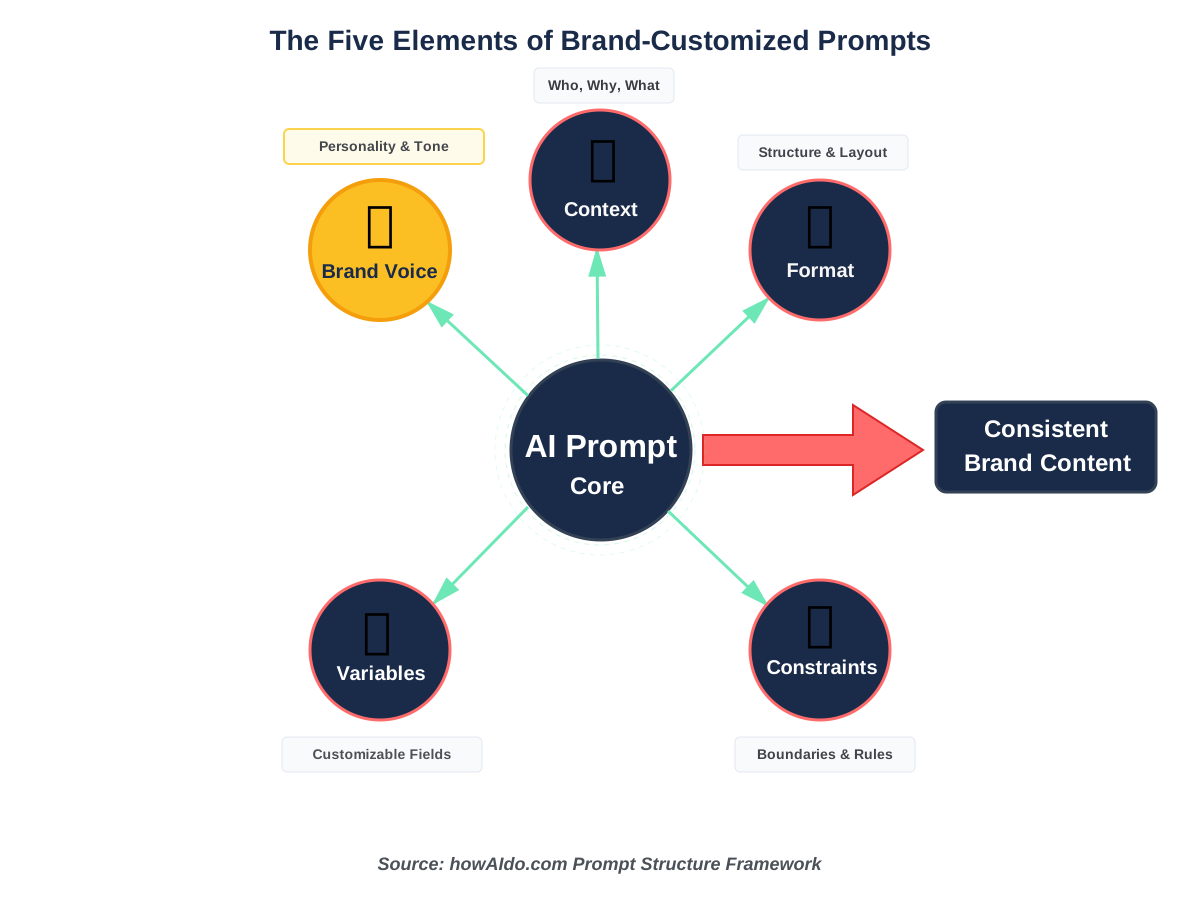
Structured prompts solve this by breaking your instructions into modular components. Each component serves a specific purpose:
- Context tells the AI who it’s writing for and why
- Format defines how the content should look
- Constraints set boundaries around length, tone, and what to avoid
- Variables allow customization without rewriting everything
- Brand voice documentation ensures consistency across all outputs
When we started systematically structuring our prompts this way, our revision time declined by roughly 60-70% because the first draft already matched our brand standards. That’s the power of proper prompt anatomy.
The Five Core Elements of Brand‑Customized Prompts
1. Context: Setting the Stage for AI Understanding
Context is where you tell the AI everything it needs to know before it starts creating. Think of it as briefing a new team member—the more background they have, the better their work.
What to include in your context section:
- Audience profile: Who’s reading this? What’s their knowledge level?
- Brand positioning: Are you the friendly expert, the bold disruptor, or the trusted authority?
- Content purpose: Is this to educate, entertain, convert, or nurture?
- Industry specifics: Any unique terminology or standards in your field?
Example context structure:
You are writing for [Brand Name], a [brand positioning] helping [target audience] with [main benefit]. Our readers are [knowledge level] who value [key values]. This piece aims to [specific goal].We’ve found that spending an extra 30 seconds on context dramatically improves output quality. The AI stops guessing and starts creating with purpose.
2. Format: Designing Your Content Blueprint
Format specifications tell the AI exactly how to structure the output. This isn’t about creativity—it’s about consistency. When every blog post, email, or social caption follows the same structural pattern, your audience develops trust and recognition.
Key format elements to specify:
For long-form content:
- Heading hierarchy (H2, H3, H4)
- Introduction length (1-2 paragraphs vs. 3-4)
- Body structure (numbered steps, themed sections, Q&A format)
- Conclusion style (summary, call-to-action, thought-provoking question)
For short-form content:
- Character limits for social platforms
- Emoji usage and placement
- Hashtag a strategy and count
- Hook patterns (question, bold statement, curiosity gap)
Example format instruction:
Structure:
- Introduction (2 paragraphs, include the main keyword)
- 5-7 H2 sections with practical examples
- Each section: 200-300 words
- Conclusion with 1 actionable next step
- Use bullet points only for lists of 3+ items
The beauty of format specifications is their reusability. Create a format template once, and use it forever.
3. Constraints: Drawing Clear Boundaries
Constraints are your quality control mechanism. They tell the AI what not to do, preventing common issues like tone-deaf content, keyword stuffing, or overly formal language when you need conversational warmth.
Essential constraints to include:
Tone boundaries:
- “Avoid corporate jargon and buzzwords”
- “Never use emojis in professional emails”
- “Keep humor light and inclusive; avoid sarcasm”
Content boundaries:
- Word count ranges (minimum and maximum)
- Forbidden phrases or overused expressions
- Topics to avoid or handle sensitively
- Keyword density limits (we recommend 1-2% for primary keywords)
Style boundaries:
- “No bullet points in narrative content”
- “Avoid passive voice except when necessary”
- “Don’t start sentences with generic phrases like ‘In today’s world'”
Example constraint section:
Constraints:
- Length: 800-1200 words
- Tone: Friendly but authoritative, never condescending
- Avoid: Marketing clichés ("game-changing," "revolutionary"), excessive exclamation points
- Keyword: Use "[primary keyword]" 2-3 times naturally
- Voice: Active voice preferred, contractions allowed
We learned this the hard way—without clear constraints, even well-structured prompts can produce content that’s technically correct but feels wrong for your brand. One constraint about avoiding corporate speak saved us hours of editing.
4. Variables: Building Flexible Templates
This is where prompt templates become powerful. Variables are placeholders you can swap out without rewriting your entire prompt structure. They’re your secret weapon for scaling content production while maintaining quality.
Common variable types:
Content variables:
[TOPIC]– The specific subject of this piece[KEYWORD]– Primary SEO keyword[TARGET_AUDIENCE]– Specific audience segment[PRODUCT_NAME]– Featured product or service
Structural variables:
[WORD_COUNT]– Adjustable length[TONE_MODIFIER]– “more technical” or “more casual”[CTA]– Specific call-to-action
Brand variables:
[BRAND_VALUE]– Which brand value to emphasize[AUTHOR_NAME]– Who’s writing this[PUBLICATION]– Where it will be published
Example variable implementation:
Write a [WORD_COUNT]-word article about [TOPIC] for [TARGET_AUDIENCE]. Use a [TONE_MODIFIER] tone and include [KEYWORD] naturally. End with a CTA to [CTA]. Emphasize our brand value of [BRAND_VALUE].When you need to create similar content for different products, audiences, or platforms, simply update the variables rather than creating entirely new prompts. We use this approach for our weekly content calendar—one master template with 8-10 variables generates 12+ unique pieces each month.
Want to streamline your process even further? Grab our Prompt Anatomy & Customization Checklist to ensure you’re including all essential elements every time you build a new prompt template.
5. Brand Voice Documentation: Your Consistency Blueprint
This is the element that transforms generic AI outputs into content that sounds unmistakably like your brand. Brand voice documentation includes everything from vocabulary preferences to sentence rhythm patterns.
What to document for brand voice:
Vocabulary and phrasing:
- Preferred terms vs. avoided terms (e.g., “customers” vs. “clients”)
- Industry-specific language use
- Formality level (contractions allowed? Slang acceptable?)
Structural patterns:
- Average sentence length
- Paragraph structure preferences
- Use of questions, exclamations, or em dashes
Personality markers:
- Humor style and frequency
- Storytelling approach
- Level of directness or diplomacy
- Use of metaphors or analogies
Example brand voice documentation:
Brand Voice: Professional friend
- Use contractions (we're, you'll, it's)
- Mix short punchy sentences (5-8 words) with longer explanatory ones (15-20 words)
- Start sections with questions to engage readers
- Use "we" when sharing our perspective, "you" when giving advice
- Include practical examples, not abstract theory
- Occasional mild humor (wordplay, relatable observations)
- Avoid: Corporate jargon, excessive formality, talking down to readers
We recommend creating a living document that you refine over time. After generating content, note phrases that feel perfectly “you” and ones that don’t. Add these observations to your brand voice documentation so each iteration improves.
Step‑by‑Step: Building Your First Structured Prompt
Now let’s put it all together. We’re going to build a complete brand-customized prompt from scratch, step by step.
Step 1: Define Your Context
Start by answering these questions:
- Who is this content for?
- What do they already know?
- What problem are we solving?
- Where will they encounter this content?
Write it out:
Context: You're writing for small business owners who have basic familiarity with AI tools but haven't systematized their content creation. They're time-strapped and looking for practical, implementable solutions. This content will appear on our blog and should demonstrate value while building trust.Step 2: Specify Your Format
Map out the exact structure you want:
Format:
- Attention-grabbing title (50-60 characters)
- Introduction: 2-3 paragraphs establishing the problem and solution
- 5 H2 sections, each with:
  - Opening paragraph (context)
  - Practical explanation
  - Example or mini case study
  - Transition to next section
- Conclusion: Summary + 1 specific action step
- Length: 1500-2000 words
Step 3: Set Your Constraints
Define your non-negotiables:
Constraints:
- Tone: Conversational expert—knowledgeable but approachable
- Avoid: "Utilize" (use "use"), "leverage" (use "use"), "game-changing," "revolutionary"
- No more than 2 bullet point lists in entire article
- Primary keyword "[KEYWORD]" appears 3-4 times naturally
- Every H2 section must include at least 1 concrete example
- No passive voice constructions
Step 4: Insert Your Variables
Identify what changes from project to project:
Variables:
- [TOPIC]: The specific subject
- [KEYWORD]: Primary SEO term
- [AUDIENCE_PAIN_POINT]: Specific problem we're addressing
- [SOLUTION_BENEFIT]: Main benefit of our approach
- [CTA]: Where to send readers next
Step 5: Add Your Brand Voice
Include your unique voice markers:
Brand Voice:
- Write like Alex Rivera and Abir Benali: creative but clear, inspiring but practical
- Use "we" when sharing our experience
- Start sections with relatable observations or questions
- Include mini-stories or specific examples (not generic scenarios)
- End sections with encouragement to experiment
- Contractions welcome, formality not
- Occasional em dashes for emphasis—like this
Step 6: Assemble and Test
Combine all elements into one complete prompt. Here’s what the full structure looks like:
[CONTEXT]
You're writing for small business owners who have basic familiarity with AI tools but haven't systematized their content creation. They're time-strapped and looking for practical, implementable solutions. This content will appear on our blog and should demonstrate value while building trust.

[FORMAT]
Structure:
- Attention-grabbing title (50-60 characters)
- Introduction: 2-3 paragraphs establishing the problem and solution
- 5 H2 sections, each with:
  - Opening paragraph (context)
  - Practical explanation
  - Example or mini case study
  - Transition to next section
- Conclusion: Summary + 1 specific action step
- Length: 1500-2000 words

[CONSTRAINTS]
- Tone: Conversational expert—knowledgeable but approachable
- Avoid: "Utilize," "leverage," "game-changing," "revolutionary"
- No more than 2 bullet point lists in entire article
- Primary keyword "[KEYWORD]" appears 3-4 times naturally
- Every H2 section must include at least 1 concrete example
- No passive voice constructions

[VARIABLES]
Topic: [TOPIC]
Primary keyword: [KEYWORD]
Audience pain point: [AUDIENCE_PAIN_POINT]
Solution benefit: [SOLUTION_BENEFIT]
Call-to-action: [CTA]

[BRAND VOICE]
Write like Alex Rivera and Abir Benali: creative but clear, inspiring but practical. Use "we" when sharing our experience. Start sections with relatable observations or questions. Include mini-stories or specific examples. End sections with encouragement to experiment. Contractions welcome, formality not. Occasional em dashes for emphasis—like this.

[TASK]
Write a blog article about [TOPIC] following all specifications above.
Step 7: Run a Test Generation
Generate content and evaluate:
- Does it match your format exactly?
- Does it sound like your brand?
- Are constraints being followed?
- Is the content actionable and valuable?
Make notes about what worked and what needs adjustment.
Step 8: Refine and Save
Based on your test, refine the prompt. Then save it as a template with clear variable indicators. We keep ours in a simple document with version numbers—”Blog Post Template v3.2″ tells us it’s been refined multiple times.
Advanced Techniques: Layering Instructions for Complex Outputs
Once you’ve mastered basic prompt structure, you can create more sophisticated templates using layered instructions. This works particularly well for multi-format content or when you need outputs that adapt based on the input.
Conditional instructions let you build flexibility:
If [TOPIC] relates to a technical feature:
- Include a simple analogy in the introduction
- Define technical terms on first use
- Add a "Quick Definitions" sidebar

If [TOPIC] is strategy-focused:
- Lead with the "why" before the "how"
- Include 2-3 mini case studies
- End with a decision framework
Sequential prompts break complex content into phases:
Phase 1: Generate outline with 5 main sections
Phase 2: For each section, write 300-400 words
Phase 3: Add transitions between sections
Phase 4: Write introduction and conclusion
We use this approach for comprehensive guides, where we want to review the structure before investing in full drafts.
Common Mistakes When Structuring AI Prompts (And How to Avoid Them)
We’ve made every mistake in the book, so you don’t have to. Here are the most common pitfalls:
Mistake 1: Vague tone descriptions ❌ “Write in a professional tone” ✅ “Write like you’re explaining something to a smart colleague—knowledgeable but not condescending, using contractions and occasional humor”
Mistake 2: Forgetting examples Prompt anatomy includes examples for a reason. Show the AI what “good” looks like by including sample sentences, phrases, or structural patterns you want mimicked.
Mistake 3: Overloading with constraints Too many rules create rigid, unnatural content. Focus on your top 5-7 non-negotiables and let the AI have creative flexibility within those boundaries.
Mistake 4: Ignoring variable organization Keep variables at the top or in a clearly marked section. Scattered throughout the prompt, they’re easy to miss when updating.
Mistake 5: Never updating your templates Your brand evolves, your audience grows, and your content standards change. Review and refine your prompt templates quarterly. We set calendar reminders because it’s simple to forget.
Mistake 6: Not testing with edge cases Test your prompts with unusual inputs—very short topics, technical subjects, and controversial themes. The boundaries of your prompt reveal weaknesses.
Real‑World Application: Different Prompts for Different Purposes
Brand-customized prompts should vary by content type. Here’s how we structure ours:
For social media posts:
- Context is brief but includes platform specifics
- Format emphasizes character counts and visual elements
- Constraints include hashtag strategy and emoji usage
- Variables for topics and product names
- Brand voice condensed to 3-4 core principles
For technical documentation:
- Context defines a reader’s technical level precisely
- Format includes code block specifications and diagram notes
- Constraints prioritize clarity over personality
- Variables for product names, version numbers, feature names
- Brand voice maintains helpfulness while allowing formality
For email sequences:
- Context includes position in the customer journey
- Format specifies subject line patterns and preview text
- Constraints address unsubscribe compliance and tone consistency across sequences
- Variables for the recipient name, product details, and timeline
- Brand voice emphasizes relationship-building and value delivery
The structure remains the same—context, format, constraints, variables, brand voice—but the specifics within each element shift based on purpose.
If you’re building a content system with multiple prompt types, you’ll save massive time with ready-made templates. Our 100+ AI Marketing Prompts guide includes dozens of structured prompts for every content type we just covered—blog posts, social media, emails, technical docs, and more. Each prompt follows the exact anatomy we’ve outlined here, so you can customize them for your brand in minutes rather than building from scratch.
How to Document and Scale Your Prompt Library
As you build multiple structured prompts, organization becomes critical. Here’s our system:
Create a prompt repository with these categories:
- Content type (blog, social, email, video script, etc.)
- Tone variation (casual, professional, technical, inspirational)
- Length variation (short-form, medium-form, long-form)
- Purpose (awareness, consideration, conversion, retention)
For each prompt, document:
- Purpose statement: When to use this prompt
- Last updated date: So you know what’s current
- Version notes: What you changed and why
- Variable list: All customizable elements with examples
- Sample outputs: 2-3 examples of successful results
Naming convention we use: [ContentType]_[Tone]_[Length]_v[Version]
Example: BlogPost_Conversational_Medium_v2.1
This system lets anyone on your team grab the right prompt instantly and know it’s been tested and refined.
Measuring Prompt Effectiveness: What to Track
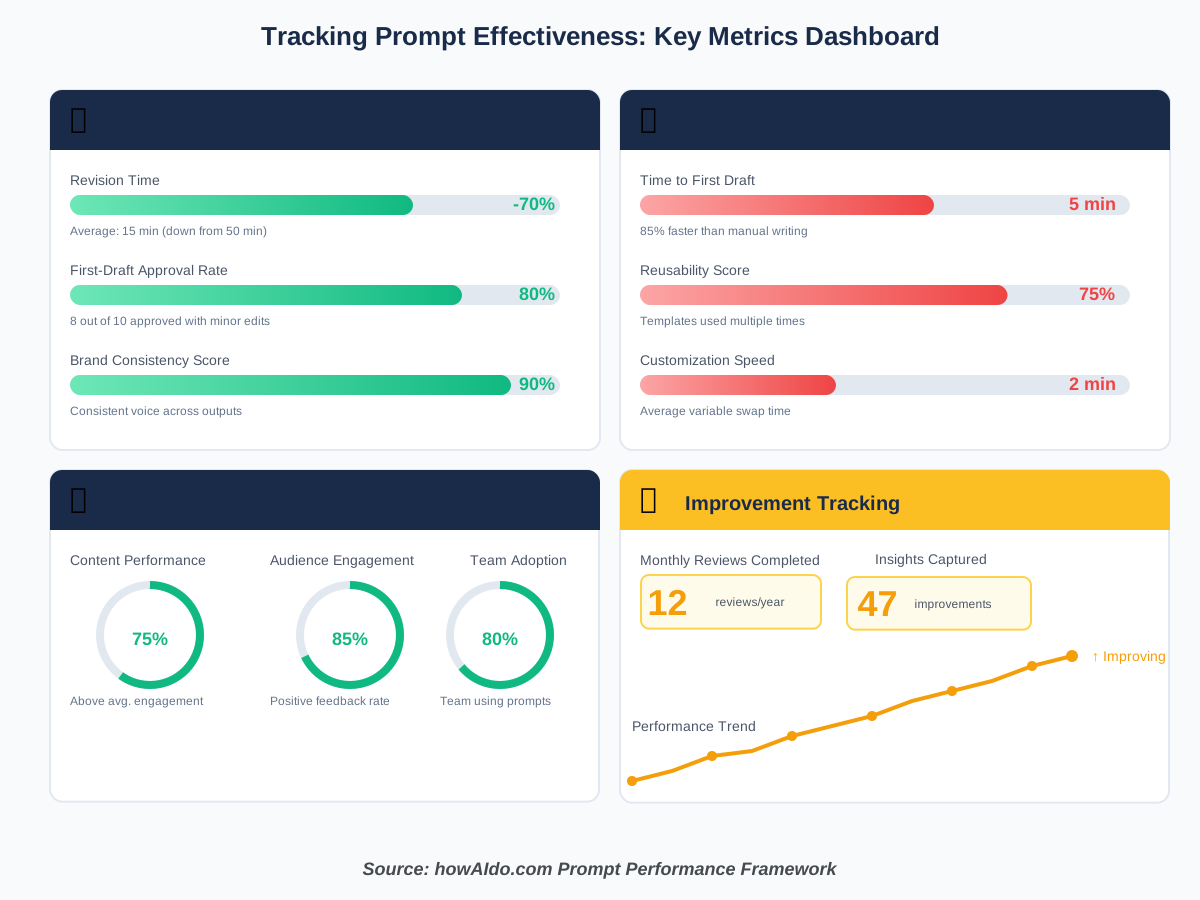
You’ve built structured prompts—now how do you know they’re working? We track these metrics:
Quality indicators:
- Revision time: How much editing was needed?
- First-draft approval rate: What percentage were approved with minor edits only?
- Brand consistency score: Does it sound like you? (subjective but important)
Efficiency indicators:
- Time to first draft: How quickly can you produce content?
- Reusability: How often do you use this exact prompt?
- Variable swap time: How quickly can you customize for new topics?
Business indicators:
- Content performance: Engagement, conversion, SEO rankings
- Audience feedback: Comments mentioning your unique voice
- Team adoption: Are others using your prompts successfully?
We review our top-performing prompts monthly and reverse-engineer what makes them work. Those insights are incorporated into new prompts.
Frequently Asked Questions
Your Next Steps: Implementing Structured Prompts Today
You now understand how to structure brand-customized AI prompts using AI—the anatomy, the process, the common pitfalls, and the scaling strategies. Here’s what to do next:
Today: Start with one content type you create frequently. Use the five-element framework to build your first structured prompt: context, format, constraints, variables, and brand voice. Generate one piece of content and evaluate the results.
This week: Refine that initial prompt based on what worked and what didn’t. Create versions for 2-3 other content types you produce regularly. Test each one multiple times with different variables.
This month: Build your prompt library with at least five to ten templates covering your most common content needs. Document each prompt with purpose statements and sample outputs. Share with your team if applicable and gather feedback.
The difference between dabbling with AI and using it strategically comes down to structure. Generic prompts create generic content that requires heavy editing. Structured prompts create on-brand content that requires minor refinement. The upfront investment in building solid templates pays dividends every single time you generate content.
Remember, every brand voice is unique, every audience has specific needs, and every business has its own content goals. The framework we’ve shared is your foundation—build on it, customize it, make it yours. Experiment with different constraint combinations, test various format patterns, and refine your brand voice documentation as you learn what resonates with your audience.
Start simple, stay consistent, and watch your AI outputs transform from “needs work” to “ready to publish.” You’ve got this.
About the Authors
Alex Rivera, the Main Author, and Abir Benali, the Co-Author, collaborated to write this article for howAIdo.com.
Alex Rivera is a creative technologist passionate about making AI accessible and inspiring for non-technical users. With a focus on creative applications and experimentation, Alex helps individuals and businesses unlock AI’s potential through clear, actionable guidance.
Abir Benali is a friendly technology writer specializing in translating complex AI concepts into simple, practical instructions. Abir’s approach emphasizes clarity, real-world applicability, and empowering readers to confidently use AI tools regardless of their technical background.
Together, we combine creative inspiration with practical implementation to help you master AI content creation—one structured prompt at a time.