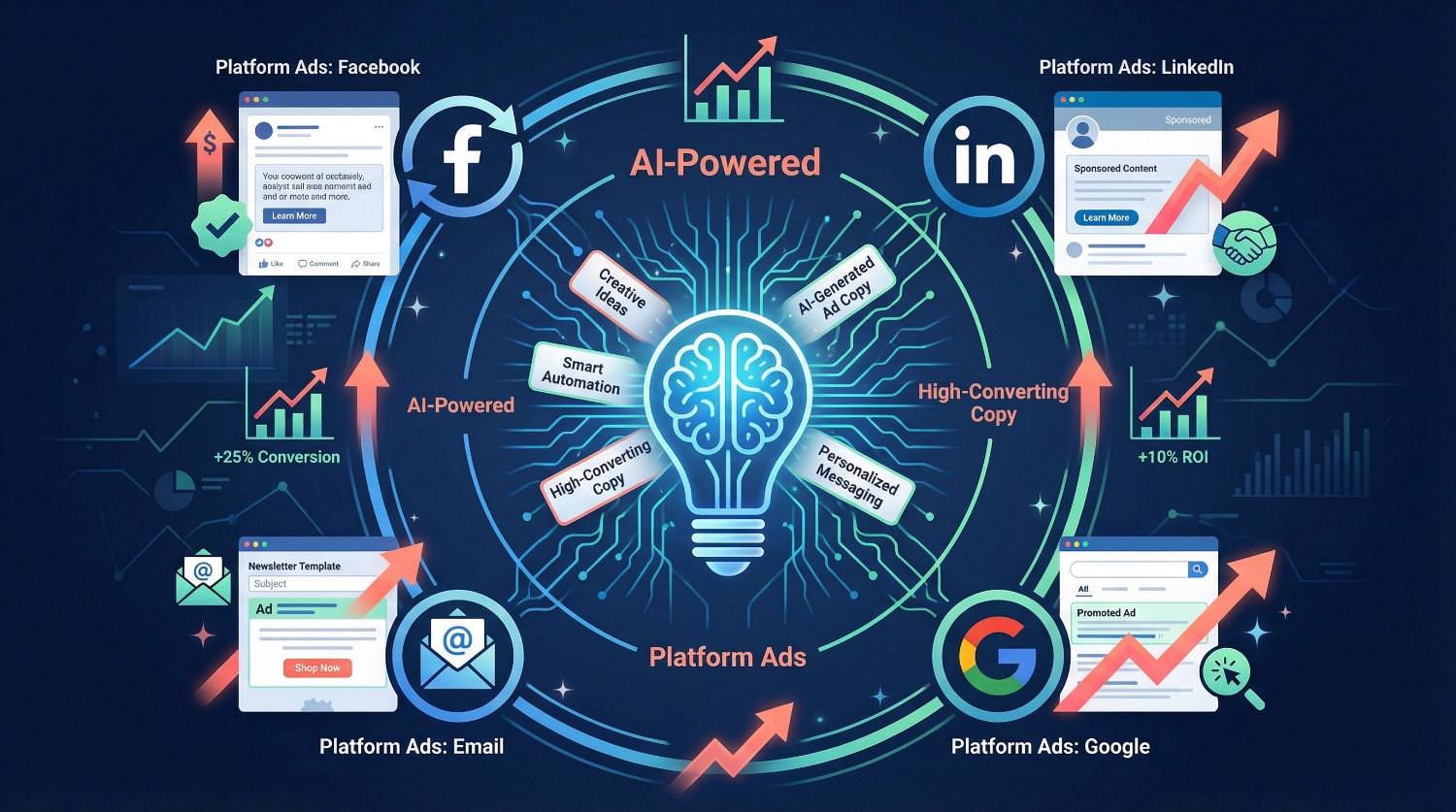
How to Write High‑Converting Platform Ad Copy Using AI

How to Write High‑Converting Platform Ad Copy Using AI is easier than you might think—and we’re here to show you exactly how. Whether you’re running Facebook campaigns, crafting LinkedIn promotions, optimizing Google Ads, or designing email subject lines, AI tools can transform your advertising workflow from overwhelming to effortless.
We’ve both spent countless hours testing AI copywriting tools across different platforms, and we’re excited to share what actually works. The beauty of using AI for ad copy isn’t just about speed—it’s about accessing proven frameworks, testing multiple variations instantly, and discovering angles you might never have considered on your own.
In this guide, we’ll walk you through the complete process of creating platform-specific ad copy that resonates with your audience and drives conversions. You’ll learn the exact steps we use, the prompts that generate the best results, and the platform-specific nuances that make the difference between ads that flop and ads that fly.
Ready to revolutionize your advertising? Let’s dive in.
Why AI-Powered Ad Copy Works Better Than Traditional Methods
Before we get into the how-to, let’s address the elephant in the room: can AI really write ads that convert?
From our experience, absolutely—but with an important caveat. AI doesn’t replace your strategic thinking; it amplifies it. Think of AI as your tireless creative partner who can generate dozens of variations, help you avoid writer’s block, and apply proven copywriting frameworks in seconds.
Here’s what makes AI ad copy generation so powerful:
Speed and volume: Generate 20 headline variations in the time it used to take to write three. This isn’t about quantity for quantity’s sake—it’s about rapid iteration and testing.
Framework application: AI tools have been trained on thousands of successful ads. They understand the AIDA model (Attention, Interest, Desire, Action), the PAS framework (Problem, Agitate, Solution), and other proven structures instinctively.
Platform optimization: Modern AI can tailor copy to each platform’s unique requirements and audience expectations, something that’s incredibly time-consuming to do manually.
Fresh perspectives: Sometimes we get stuck in our own creative patterns. AI can suggest angles and hooks you hadn’t considered, sparking new ideas even if you don’t use the exact output.
The key is learning to guide AI effectively, which is precisely what this guide will teach you.
Understanding Platform-Specific Requirements Before You Start
One of the biggest mistakes we see people make is treating all platforms the same. A LinkedIn ad that performs brilliantly will likely bomb on TikTok, and vice versa. Before you write a single word of platform ad copy, you need to understand these fundamental differences.
Facebook and Instagram Ads
These platforms thrive on visual storytelling and emotional connection. Your AI prompts should focus on creating conversational, benefit-driven copy that stops the scroll.
Facebook audiences respond to:
- Personal stories and relatable scenarios
- Clear value propositions in the first sentence
- Conversational tone that feels like a friend sharing advice
- Strong visual descriptions that complement your creative
- Calls-to-action that feel natural, not pushy.
LinkedIn Ads
Professional doesn’t mean boring. LinkedIn audiences are searching for solutions to business problems, career growth opportunities, and industry insights.
Your LinkedIn ad copy should be:
- Professional yet approachable
- Value-focused with clear ROI implications
- Credibility-driven (mentioning results, case studies, and expert status)
- Solution-oriented rather than feature-heavy
- Aligned with professional goals and pain points
Google Ads
Search intent is everything here. People on Google are actively looking for solutions, which means your copy needs to be direct, specific, and aligned with their search query.
Effective Google ad copy includes:
- Keyword-rich headlines that match search intent
- Specific benefits or outcomes in the description
- Unique selling propositions that differentiate you
- Strong, action-oriented CTAs
- Extension opportunities (site links, callouts)
Email Subject Lines
Your subject line has one job: get the email opened.
AI-generated email subject lines work best when they:
- Create curiosity without being clickbait
- Personalize when possible (recipient name, company, behavior)
- Use power words that trigger emotion or urgency
- Stay concise (40-50 characters for mobile optimization)
- A/B test constantly—what works changes regularly
Video Ad Scripts
Video ads combine visual and verbal storytelling. Your script needs to hook viewers in the first 3 seconds, maintain interest, and drive action—all while being authentic and engaging.
AI can help structure:
- Opening hooks that stop scrolling
- Story arcs that build to a clear CTA
- Emotional beats that resonate
- Platform-specific timing (6 seconds for bumper ads, 15-30 seconds for most platforms)
Step-by-Step: Setting Up Your AI Ad Copy Workflow
Now let’s get practical. We’ll walk you through our exact process for creating high-converting ad copy using AI, regardless of which platform you’re targeting.
Step 1: Define Your Campaign Objectives and Audience
Before you touch any AI tool, you need crystal-clear answers to these questions:
- What action do you want people to take? (Download, purchase, sign up, learn more, etc.)
- Who exactly are you targeting? (Demographics, pain points, desires, current situation)
- What’s the key benefit or transformation you’re offering?
- What makes your offer different from competitors?
- What objections might your audience have?
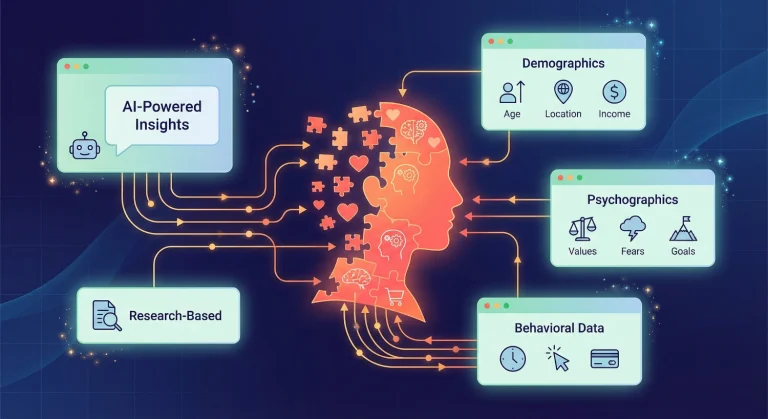
The more specific you are here, the better your AI-generated copy will be. We like to create a simple one-page brief that includes:
- Target audience persona (age, role, challenges, goals)
- Key message (the one thing they should remember)
- Supporting benefits (3-5 specific advantages)
- Desired action and conversion goal
- Brand voice guidelines (formal, casual, humorous, authoritative)
This brief becomes your reference point for creating effective AI prompts.
Step 2: Choose the Right AI Tool for Ad Copywriting
Not all AI tools are created equal for ad copy generation. We’ve tested most of them, and here are our recommendations:
Claude excels at understanding context and following complex instructions. It’s perfect for creating platform-specific variations and iterating on copy based on feedback.
ChatGPT offers excellent conversational flow and can generate multiple variations quickly. The newer models understand marketing frameworks well.
Copy.ai and Jasper are purpose-built for marketing copy and include templates specifically designed for ads, making them ideal for beginners.
Anyword uses predictive analytics to score your copy, helping you identify which variations are likely to perform best.
For this guide, we’ll use prompts that work with any of these tools, but you are welcome to experiment and find what fits your workflow best.
Step 3: Craft Your AI Prompt Using the CRISP Framework
This is where most people struggle. A vague prompt like “write a Facebook ad for my product” will give you generic, mediocre results. We use the CRISP framework to create prompts that generate exceptional copy:
C – Context: What’s the situation? What platform? What stage of the customer journey?
R – Role: What expertise should the AI adopt? (copywriter, marketer, strategist)
I – Instruction: What specific task do you want completed?
S – Specifics: Exact details about format, length, tone, requirements
P – Parameters: Constraints, what to avoid, brand voice guidelines
Here’s an example of a weak prompt versus a CRISP prompt:
Weak:
Write a LinkedIn ad for my coaching programCRISP:
Act as an expert B2B copywriter creating a LinkedIn sponsored content ad.

Target: Mid-level managers struggling with team productivity.
Goal: Drive clicks to a free workshop registration.
Tone: Professional but warm, authoritative but approachable.
Format: Headline (max 70 characters), body copy (max 150 words), CTA.

Include a compelling statistic or question in the opening.
Avoid jargon and hype.
Focus on the transformation, not just features.
See the difference? The CRISP prompt gives the AI everything it needs to create targeted, effective copy.
Step 4: Generate Multiple Variations and Test Different Angles
Never settle for the first output. One of AI’s greatest strengths is generating variations quickly, so use it. We typically ask for at least 5–10 different approaches for each ad.
Here’s how we structure this:
First generation:
Create five variations using different hooks:
– Pain point hook (identify a problem)
– Benefit hook (lead with the transformation)
– Question hook (engage with curiosity)
– Story hook (brief narrative that resonates)
– Urgency hook (time-sensitive opportunity)
Second generation:
Take the strongest 2-3 variations and ask for refinements:
– “Make this more conversational”
– “Strengthen the CTA”
– “Add more specificity to the benefits”
– “Reduce to fit [platform character limits]”
Third generation:
Create platform-specific versions of your best performer:
– Facebook version (emotional, visual)
– LinkedIn version (professional, ROI-focused)
– Google Ads version (search-intent aligned)
– Email subject line version (curiosity-driven)
This iterative approach gives you a library of tested copies to choose from, dramatically increasing your chances of finding winners.
Step 5: Optimize for Platform Character Limits and Requirements
Each platform has specific technical requirements that AI doesn’t always remember. Before finalizing your copy, verify:
Google Ads:
- Headline 1: 30 characters max
- Headline 2: 30 characters max
- Headline 3: 30 characters max
- Description 1: 90 characters max
- Description 2: 90 characters max
Facebook/Instagram:
- Primary text: 125 characters (before “See More” truncation)
- Headline: 40 characters
- Link description: 30 characters
LinkedIn:
- Intro text: 150 characters (before truncation)
- Headline: 70 characters
- Description: 100 characters
Email Subject Lines:
- 40-50 characters for mobile optimization
- 60-70 characters maximum
Pro tip: Ask your AI to count characters and flag anything over the limit. Most tools can do this if you specify it in your prompt.
Step 6: Apply Proven Copywriting Frameworks
AI works best when you give it structure. We always specify which copywriting framework to use.
Here are the ones we rely on most:
AIDA (Attention, Interest, Desire, Action): Perfect for longer-form ads and email sequences. The AI should grab attention with a hook, build interest with benefits, create desire through transformation or social proof, and close with a clear action.
PAS (Problem, Agitate, Solution): Excellent for pain-point marketing. Identify the problem, agitate it by highlighting the consequences of inaction, then present your solution as the answer.
FAB (Features, Advantages, Benefits): Great for product-focused ads. List the feature, explain the advantage it provides, and connect it to a meaningful benefit for the user.
The 4 U’s (Useful, Urgent, Unique, and ultra-specific): Essential for headline writing. Your AI-generated headlines should be useful to the audience, create urgency, highlight what’s unique, and be ultra-specific rather than vague.
Example prompt:
Using the PAS framework, write a Facebook ad for [product].

Problem: [specific pain point].
Agitation: [consequences of not solving it].
Solution: [your product/service].

Keep it under 125 characters in the primary text.
Step 7: Inject Personalization and Brand Voice
Generic AI copy sounds like… well, AI. The magic happens when you infuse personality and specificity.
Here’s how we do it:
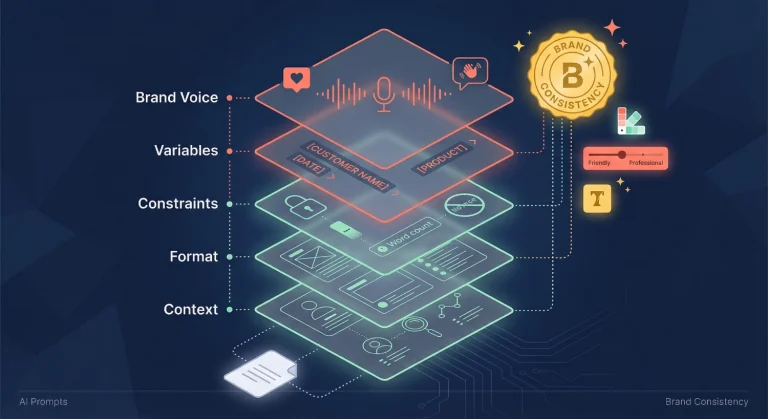
Create a voice guide for your AI prompts:
- 3-5 words that describe your brand voice (e.g., “friendly, knowledgeable, slightly irreverent”)
- Examples of phrases you’d use vs. phrases you’d never use
- Your target audience’s language patterns and terminology
- Industry-specific nuances or inside knowledge
Add personalization layers:
- Dynamic insertion fields ({FirstName}, {Company}, {Industry})
- Behavioral triggers (abandoned cart, page visit, download)
- Demographic variations (age, location, job title)
- Journey stage considerations (awareness, consideration, decision)
Include specific details:
Instead of: “Our tool helps you work faster”
Try: “Cut your reporting time from 3 hours to 15 minutes”Instead of: “Join thousands of happy customers”
Try: “Join 12,847 marketing teams who’ve eliminated manual data entry”
Specificity builds trust and makes your copy memorable. When prompting AI, include real numbers, actual customer quotes, or specific scenarios your audience faces.
Step 8: A/B Test Your AI-Generated Variations
Creating great copy is only half the battle. Testing is where you discover what actually converts. We use AI to generate test-worthy variations, then let data decide the winner.
Set up proper A/B tests:
- Test one variable at a time (headline, CTA, hook, etc.)
- Run tests to statistical significance (don’t call it early)
- Document what you tested and the results
- Build a swipe file of winning elements
What to test:
- Headlines (emotional vs. rational, question vs. statement)
- Opening hooks (pain point vs. benefit vs. curiosity)
- CTA wording (“Get Started” vs. “Try Free” vs. “See How”)
- Copy length (short vs. medium vs. long)
- Tone variations (casual vs. professional, urgent vs. informative)
Use AI to analyze results:
Once you have data, you can prompt AI to help identify patterns:
I tested these 5 headlines.
Version 3 got a 2.4% CTR, version 5 got 1.8%, and others were below 1.5%.
What patterns do you notice in the better-performing copy that I should apply to future ads?
This creates a continuous improvement loop where your AI-generated copy gets better over time based on actual performance data.
Platform-Specific AI Prompting Strategies
Now let’s get granular with platform-specific techniques. Each advertising channel requires a slightly different approach to maximize results.
Facebook and Instagram: Emotional Storytelling at Scale
Facebook and Instagram thrive on scroll-stopping content that creates emotional resonance. Your AI prompts should emphasize relatability and visual language.
Effective prompt structure:
Create a Facebook ad for [product/service] targeting [specific audience].
Open with a relatable scenario that [audience] experiences daily.
Use conversational language, like you're texting a friend.
Include a specific transformation or result.
End with a soft CTA that invites rather than demands.
Primary text should be 100-120 characters.
Avoid marketing jargon and hype.
Example variations to request:
- Problem-solution angle (identify frustration, offer relief)
- Social proof angle (highlight what others are achieving)
- Transformation angle (before/after scenario)
- Fear-of-missing-out angle (time-sensitive opportunity)
- Curiosity angle (intriguing question or statement)
Instagram-specific considerations:
- Emoji usage (request strategic placement, not overuse)
- Hashtag strategy (if needed for organic content)
- Story vs. feed optimization
- Vertical vs. square image copy requirements
If you’re creating multiple campaigns, consider using our Platform-Specific Ad Copy Checklist to ensure you’re optimizing for each channel’s unique requirements. It’s saved us countless hours of revisions and helped catch platform-specific details we might have otherwise missed.
LinkedIn: Professional Value Without the Corporate Speak
LinkedIn users are in business mode, but that doesn’t mean your copy should be boring. The sweet spot is professional value delivered in an approachable way.
Effective prompt structure:
Act as a B2B copywriter creating a LinkedIn sponsored content ad.
Target: [job title] at [company size] facing [specific challenge].
Focus on ROI and measurable outcomes.
Tone: authoritative but conversational, like a trusted peer sharing insights.
Include a specific metric or result if possible.
Avoid corporate jargon and buzzwords.
Headline: 70 chars max. Body: 150 words max.
Key elements to emphasize in prompts:
- Business impact and ROI
- Credibility markers (without being boastful)
- Industry-specific pain points
- Professional growth or efficiency gains
- Peer success stories or case study snippets
Common mistakes to avoid: When prompting for LinkedIn copy, explicitly tell the AI to avoid:
- Generic business buzzwords (“synergy,” “leverage,” “disrupt”)
- Overly casual language that doesn’t fit the platform
- Hype without substance
- Claims without proof points
- Feature dumps instead of benefit focus
Google Ads: Match Intent, Win Clicks
Google Ads are different because users are actively searching. Your copy needs to match their search intent precisely and stand out from competitors bidding on the same keywords.
Effective prompt structure:
Create Google Search ad copy for the keyword '[exact keyword]'.

User intent: [informational/transactional/navigational].

Headline 1: Include the exact keyword and a key benefit (30 chars).
Headline 2: Address the user's main concern or question (30 chars).
Headline 3: Include CTA or unique differentiator (30 chars).

Description 1: Expand on benefits and what makes you different (90 chars).
Description 2: Address objections and include CTA (90 chars).
Search intent categories:
- Informational: User wants to learn (use “discover,” “learn,” “guide”)
- Navigational: User looking for specific brand/site (use brand name, “official”)
- Transactional: User ready to buy/act (use “buy,” “get,” “start,” pricing)
- Commercial investigation: User comparing options (use “best,” “vs,” “review,” “top”)
Quality Score optimization: Prompt your AI to align copy with landing page content.
Specify:
The landing page focuses on [specific benefits/features].
Ensure the ad copy directly mirrors this messaging to improve quality score and ad relevance.
Email Subject Lines: Open Rates Start Here
Email subject lines are their own art form. You need to balance curiosity, value, and urgency without triggering spam filters or sounding clickbait-y.
Effective prompt structure:
Generate 10 email subject line variations for [campaign type].

Target audience: [specific description].
Goal: [open email/click through].
Tone: [curious/urgent/helpful/exclusive].
Length: 40-50 characters for mobile. Include personalization opportunities where appropriate.

Avoid spam trigger words like 'free,' 'guarantee,' excessive punctuation.

Test these angles: curiosity gap, benefit-driven, question format, exclusivity, time sensitivity, social proof.
Subject line formulas that work:
- The Curiosity Gap: “We discovered something unexpected about [topic]”
- The Direct Benefit: “Save 4 hours/week on [specific task]”
- The Question Hook: “Still struggling with [pain point]?”
- The Insider Angle: “[Name], this is just for [segment]”
- The Urgency Play: “48 hours left: [specific offer]”
A/B testing variables:
- Emoji vs. no emoji
- Question vs. statement
- Personalization (name, company, behavior) vs. generic
- Length variations (short -punch vs. descriptive)
- Tone shifts (casual vs. professional, urgent vs. informative)
Retargeting Ads: Acknowledge the Journey
Retargeting copy should acknowledge that users have already interacted with your brand. Generic messaging falls flat here—personalization is crucial.
Effective prompt structure:
Create a retargeting ad for users who [specific action: visited product page/abandoned cart/downloaded lead magnet].
Reference their previous interaction subtly without being creepy.
Address the likely objection preventing conversion: [price/timing/uncertainty].
Offer: [specific incentive or value].
Platform: [Facebook/Google Display].
Tone: helpful reminder, not pushy sales pitch. Include social proof element if possible.
Retargeting segments and messaging:
- Cart abandoners: “Still thinking about [product]? Here’s what others love about it…”
- Content consumers: “Loved the [resource name]? Here’s the next step…”
- Product viewers: “See something you like? [Specific benefit] is waiting…”
- Previous customers: “Welcome back! Based on [previous purchase], you might love…”
Video Ad Scripts: Hook, Story, Call
Video ads require a different structure entirely. You’re working with time constraints and the challenge of hooking viewers who can scroll past in a second.
Effective prompt structure:
Write a 30-second video ad script for [product/service].

Target: [audience].
Hook (first 3 seconds): [type of hook - question/bold statement/visual surprise].
Story arc: [problem → agitation → solution].
CTA: [specific action].
Tone: [energetic/calm/authoritative/friendly].
Include visual suggestions and timing cues.
Format as: [Seconds 0-3: Hook], [Seconds 4-15: Build], [Seconds 16-25: Payoff], [Seconds 26-30: CTA].
Video-specific considerations:
- Captions required: Most users watch without sound
- Visual-first: The script should complement visuals, not replace them
- Front-load value: First 3 seconds determine if they keep watching
- Platform-specific timing: 6 seconds (YouTube bumper), 15 seconds (Instagram Stories), 30-60 seconds (Facebook/YouTube pre-roll)
Advanced AI Techniques for Ad Copy Optimization
Once you’ve mastered the basics, these advanced techniques will take your AI-generated ad copy to the next level.
Chain Prompting for Complex Campaigns
Instead of trying to generate perfect copy in one shot, use chain prompting—a series of connected prompts that build on each other.
Example chain:
- “Analyze this target audience: [description]. What are their top 5 pain points and top 5 desires?”
- “Based on these pain points and desires, create 5 unique positioning angles for [product].”
- “Take the 3rd positioning angle and develop it into a Facebook ad using the PAS framework. Primary text: 120 chars.”
- “Now adapt that same message for LinkedIn, making it more professional and ROI-focused.”
- “Create 5 headline variations for the LinkedIn version, each under 70 characters.”
This approach mimics how you’d work through the creative process manually, resulting in more thoughtful, strategic copy.
Using AI to Analyze Competitor Ads
Turn AI into your competitive intelligence tool. This technique helps you understand what’s working in your space and find gaps you can exploit.
Effective prompt:
I'm going to share 5 competitor ads from [platform].

Analyze them for:
1) Common messaging themes,
2) Emotional triggers being used,
3) Unique value propositions,
4) Call-to-action strategies,
5) Gaps or opportunities they're missing.

Then suggest 3 positioning angles I could use that differentiate from their approach.
This gives you strategic insights without directly copying competitors.
Creating Brand-Specific Style Guides for Consistent AI Output
If you’re running ongoing campaigns, create a reusable style guide prompt that you can reference every time.
Style guide template:
Use this brand voice guide for all copy:
Tone: [3-5 descriptive words]
We say: [5 examples of phrases you use]
We never say: [5 examples of phrases to avoid]
Target audience: [specific description]
Key messages: [3 core value propositions]
Differentiation: [what makes you unique]
Vocabulary to use: [industry terms, customer language]
Vocabulary to avoid: [jargon, competitor terms]
Remember this style guide for future prompts in this conversation.
Save this as a starting prompt, then reference it: “Using the brand voice guide from earlier, create…”
Leveraging AI for Ad Copy Audits
Use AI to review and improve existing ad copy, not just create new content.
Effective audit prompt:
Audit this ad copy: [paste your ad].

Evaluate it based on:
1) Clarity (is the value proposition immediately clear?),
2) Relevance (does it speak to the target audience's needs?),
3) Persuasiveness (does it use effective emotional triggers?),
4) Action-orientation (is the CTA clear and compelling?),
5) Platform optimization (does it fit [platform] best practices?).

Provide specific improvement suggestions for each criterion.
This helps you continuously improve your ad library.
Dynamic Copy Generation Based on Audience Segments
Create master prompts that generate variations for different audience segments automatically.
Effective segmentation prompt:
Create Facebook ad variations for [product].

Generate 3 versions, each targeting a different segment:
Segment 1: [Demographics, psychographics, pain points]
Segment 2: [Different demographics, psychographics, pain points]
Segment 3: [Different demographics, psychographics, pain points]

For each version, adapt the headline, primary text, and CTA to resonate specifically with that segment's language, concerns, and motivations.
Keep formats consistent but messaging personalized.
This scales your personalization without manual effort for each segment.
Common Mistakes to Avoid When Using AI for Ad Copy
We’ve made every mistake in the book, so you don’t have to. Here are the pitfalls to watch out for:
Mistake 1: Using AI Output Verbatim Without Editing
The problem: AI-generated copy often needs human refinement to truly shine. It might be technically correct but lack the spark that makes it memorable.
The solution: Think of AI as your first draft generator, not your final copy. Always read the output out loud, check for your brand’s unique voice, and add those specific details only you would know. We typically spend 5-10 minutes editing and personalizing even the best AI output.
Mistake 2: Not Providing Enough Context
The problem: Vague prompts produce vague results. “Write a Facebook ad for my business” won’t cut it.
The solution: Use the CRISP framework we outlined earlier. The more context you provide—audience details, campaign goals, brand voice, constraints—the better your results will be.
Mistake 3: Ignoring Platform-Specific Requirements
The problem: Copy that works brilliantly on LinkedIn might completely fail on Instagram. Each platform has its culture, format requirements, and audience expectations.
The solution: Always specify the platform in your prompt and familiarize yourself with that platform’s best practices. Better yet, use our Platform-Specific Ad Copy Checklist to ensure you’re not missing crucial platform nuances.
Mistake 4: Forgetting to Test Variations
The problem: Settling for the first AI output you receive, even if it’s excellent. You might be leaving significant performance gains on the table.
The solution: Always generate multiple variations and A/B test them. The difference between your first option and your fifth option can be massive in terms of conversion rates.
Mistake 5: Neglecting the Creative-Copy Connection
The problem: Writing amazing copy but pairing it with visuals that don’t support or enhance the message.
The solution: When prompting AI for ad copy, also describe the visual you plan to use. Ask the AI to suggest how the copy and creative can work together.
For example: “The ad visual shows [description]. How should I adjust this copy to complement the image?”
Mistake 6: Over-Optimizing for AI, Under-Optimizing for Humans
The problem: Getting so focused on keywords and SEO that your copy loses its humanity and persuasiveness.
The solution: Write for humans first, optimize for algorithms second. If your copy doesn’t resonate emotionally and provide clear value to a real person, perfect keyword placement won’t save it.
Mistake 7: Not Building a Swipe File of Winners
The problem: Starting from scratch every time instead of learning from what’s worked before.
The solution: Document your winning ads in a swipe file. Note what worked and why.
Use these as reference points in future prompts: “Create copy similar in style and structure to this high-performing ad: [example]”
Creating Your AI Ad Copy Template Library
To really streamline your workflow, we recommend building a personal library of prompts and templates. Here’s what we keep in ours:
Master Prompt Templates
Create saved prompts for each platform and ad type. For example:
Facebook Ad Master Template:
Platform: Facebook
Campaign Type: [Awareness/Consideration/Conversion]
Target Audience: [Specific details]
Product/Service: [Description]
Key Benefit: [Main value proposition]
Framework: [AIDA/PAS/FAB]
Tone: [Brand voice descriptor]
Format: Primary text (120 chars), Headline (40 chars), CTA
Constraints: [Any specific requirements]
Generate: 5 variations with different hooks
Segment-Specific Variations
Keep templates for your key audience segments so you can quickly generate personalized variations:
Segment Template:
Segment Name: [e.g., "Budget-Conscious First-Time Buyers"]
Demographics: [Age, location, income, etc.]
Pain Points: [3-5 specific challenges]
Desires: [3-5 specific goals]
Language Patterns: [How they speak, terms they use]
Objections: [What holds them back from converting]
Best Hooks: [Types of angles that resonate]
Platform Optimization Checklists
Before finalizing any ad, run through these AI-assisted checks:
Pre-Launch Checklist Prompt:
Review this ad copy and check:
✓ Character count within platform limits
✓ CTA is clear and action-oriented
✓ Value proposition stated in first sentence
✓ No jargon or unclear language
✓ Addresses specific audience pain point
✓ Includes differentiator from competitors
✓ Tone matches platform and audience
✓ No spelling or grammatical errors
✓ Power words included (specific, results-oriented)
✓ Mobile-friendly (reads well on small screens)
Real-World Examples: AI Ad Copy in Action
Let’s look at how this actually works in practice. We’ll show you the prompts we used and the results we got (with our human edits applied).
Example 1: Facebook Ad for a Productivity Tool
Our Prompt:
Create a Facebook ad for a project management app targeting solopreneurs and freelancers who feel overwhelmed by client work.
Use PAS framework.
Primary text: 120 characters.
Headline: 40 chars.
Tone: Empathetic and solution-focused, like a friend who gets it.
Include specific time-saving benefit.
AI Output (edited for final use):
Juggling five client projects with zero visibility?
You're not alone.
Turn chaos into clarity—organize everything in one place and save 10+ hours weekly.
Your sanity will thank you.
Headline: Finally, project management that just works
What We Edited:
- Changed “We’ve been there” to “You’re not alone” (more personal)
- Added specific time frame: “10+ hours weekly” (AI suggested “significant time”)
- Strengthened the emotional payoff: “Your sanity will thank you”
Example 2: LinkedIn Ad for B2B SaaS
Our Prompt:
Create LinkedIn sponsored content for sales enablement software targeting VP Sales at mid-market companies (100-500 employees). Problem: Sales reps spend too much time searching for content.
Solution: Centralized content library with AI-powered recommendations.
Tone: Professional but conversational, ROI-focused.
Headline: 70 chars.
Body: 150 words.
AI Output (edited for final use):
Headline: Is your sales team losing deals while searching for content?

Your reps shouldn't spend 30% of their time hunting for the right presentation, case study, or one-pager. That's selling time you can't get back.

Our platform cuts content search time by 85%. Sales teams access the right materials instantly through AI-powered recommendations matched to each deal stage. No more outdated decks. No more version confusion. Just sales reps spending their time actually selling.

Result: 23% increase in pipeline velocity for teams using our system.

See how top B2B companies are enabling their sales teams: [CTA]
What We Edited:
- Replaced generic statistics with specific (but realistic) numbers
- Added “Result:” section for clear ROI focus
- Refined the CTA to be more specific
Example 3: Google Search Ad for Local Service
Our Prompt:
Create Google Search ad for keyword 'emergency plumber near me'.
User intent: immediate need, transactional.
Location: serving Chicago area.
Differentiation: 24/7 service, arrive within 90 minutes, licensed and insured.
Three headlines (30 chars each), two descriptions (90 chars each).
AI Output (edited for final use):
Headline 1: Emergency Plumber Chicago 24/7
Headline 2: Licensed Plumbers On-Site Fast
Headline 3: 90-Minute Response Guaranteed

Description 1: Burst pipe? No hot water? Our licensed plumbers arrive in 90 mins or less. Call now!
Description 2: No overtime charges nights or weekends. Chicago's trusted emergency plumbing service.
What We Edited:
- Added “Chicago” to Headline 1 for local relevance
- Emphasized the guaranteed response time in Headline 3
- Clarified “no overtime charges” in Description 2 (addressing common objection)
If you found these examples helpful, you might want to explore our 100+ AI Marketing Prompts Ready to Copy and Use collection. It includes prompts for every major advertising platform, audience segment, and campaign type—all based on frameworks that have driven real results for solo entrepreneurs and agencies alike. Think of it as your shortcut to mastering AI copywriting across every platform.
Measuring Success and Iterating Based on Results
Creating outstanding AI-generated ad copy is only the beginning. The real magic happens when you measure, analyze, and continuously improve based on data.
Key Metrics to Track by Platform
Different platforms require different success metrics:
Facebook/Instagram:
- Click-through rate (CTR)
- Cost per click (CPC)
- Cost per acquisition (CPA)
- Engagement rate (likes, comments, shares)
- Relevance score
LinkedIn:
- CTR (typically lower than Facebook; 0.5-1% is solid)
- Cost per lead (CPL)
- Lead quality scores
- Engagement rate
- Conversion rate to SQL
Google Ads:
- Quality Score (1-10 rating)
- CTR (varies by industry; 3-5% is average)
- Conversion rate
- Cost per conversion
- Impression share
Email:
- Open rate (varies widely; 20-30% is average)
- Click-through rate (2-5% of opens)
- Conversion rate
- Unsubscribe rate (keep below 0.5%)
Using AI to Analyze Performance Data
Once you have data, use AI to help spot patterns and opportunities:
Performance analysis prompt:
I ran an A/B test on these 5 ad variations:

- Variation 1: [copy] - CTR: 2.1%, CPC: $1.50, Conv Rate: 3.2%
- Variation 2: [copy] - CTR: 3.4%, CPC: $1.20, Conv Rate: 4.1%
- Variation 3: [copy] - CTR: 1.8%, CPC: $1.75, Conv Rate: 2.8%
- Variation 4: [copy] - CTR: 2.9%, CPC: $1.35, Conv Rate: 3.9%
- Variation 5: [copy] - CTR: 3.1%, CPC: $1.40, Conv Rate: 3.5%

Analyze what elements in the top performers (Variation 2 and 5) are driving better results.
What patterns do you see in the copy, hook, CTA, or structure?
What should I apply to future ads?
This helps you build a knowledge base of what works for your specific audience and offers.
Creating a Continuous Improvement Loop
Here’s the system we use to continuously improve our AI ad copy:
Week 1: Create and Launch
- Generate variations using AI
- Select top 3-5 to test
- Launch with proper tracking
Week 2: Monitor and Gather Data
- Track daily performance
- Note any early indicators
- Let tests run to statistical significance
Week 3: Analyze and Document
- Review winning elements
- Use AI to analyze patterns
- Update swipe file with winners
- Refine audience understanding
Week 4: Iterate and Scale
- Apply winning elements to new campaigns
- Generate new variations based on insights
- Test new angles while scaling winners
- Update master prompts with learnings
This cycle never ends—each iteration makes your AI prompts smarter and your results better.
Frequently Asked Questions About AI Ad Copywriting
Next Steps: Putting AI Ad Copy Into Practice
You now have everything you need to start creating high-converting platform ad copy using AI. The difference between knowing this information and seeing results comes down to implementation.
Here’s your action plan:
Today: Choose one platform where you’re currently running ads (or want to start). Use the platform-specific prompt templates we shared to generate 5 ad variations. Don’t overthink it—just generate and review.
This week: Launch an A/B test with your top three AI-generated variations. Set up proper tracking and commit to letting the test run for at least 7 days before making decisions.
This month: Build your personal prompt library. Start documenting what works—which prompts generate the best copy, which hooks resonate with your audience, and which CTAs drive action. This library becomes more valuable with every campaign you run.
Ongoing: Establish the continuous improvement loop we outlined. Every campaign teaches you something. Feed those lessons back into your AI prompts, refine your understanding of your audience, and watch your results compound over time.
Remember, AI ad copywriting isn’t about replacing your creativity—it’s about amplifying it. You’re not trying to find the one perfect prompt that generates winning copy every time. You’re building a system that gets smarter with each campaign, combining AI’s capabilities with your strategic thinking and audience insights.
The marketers seeing the best results from AI aren’t the ones with the most sophisticated tools—they’re the ones who understand their customers deeply, test relentlessly, and use AI to scale what works.
Before you start your first campaign, grab our Platform-Specific Ad Copy Checklist—it’ll help you catch platform-specific requirements and optimization opportunities you might otherwise miss. And if you want to accelerate your learning curve, explore our collection of 100+ AI Marketing Prompts Ready to Copy and Use. These are the exact prompts we’ve refined through hundreds of campaigns across every major platform.
The future of advertising isn’t AI versus humans—it’s AI empowering humans to create better, faster, and more effective campaigns than ever before. You have the knowledge. Now it’s time to put it into practice.
Go create something amazing.
About the Authors
This article was written through collaboration between Alex Rivera and Abir Benali.
Alex Rivera is a creative technologist passionate about making AI accessible to non-technical users. Alex specializes in helping content creators and marketers leverage AI tools for creative projects, with a focus on experimentation and innovative workflows that make technology feel less intimidating and more inspiring.
Abir Benali (Lead Author) is a technology writer dedicated to explaining AI tools in clear, practical terms. Abir creates step-by-step guides that help beginners implement AI solutions in real-world scenarios, with a focus on actionable advice, common pitfall prevention, and encouraging readers to build confidence with new technologies.
Together, we bring both creative exploration and practical implementation to help you master AI-powered advertising workflows that actually work in the real world.