
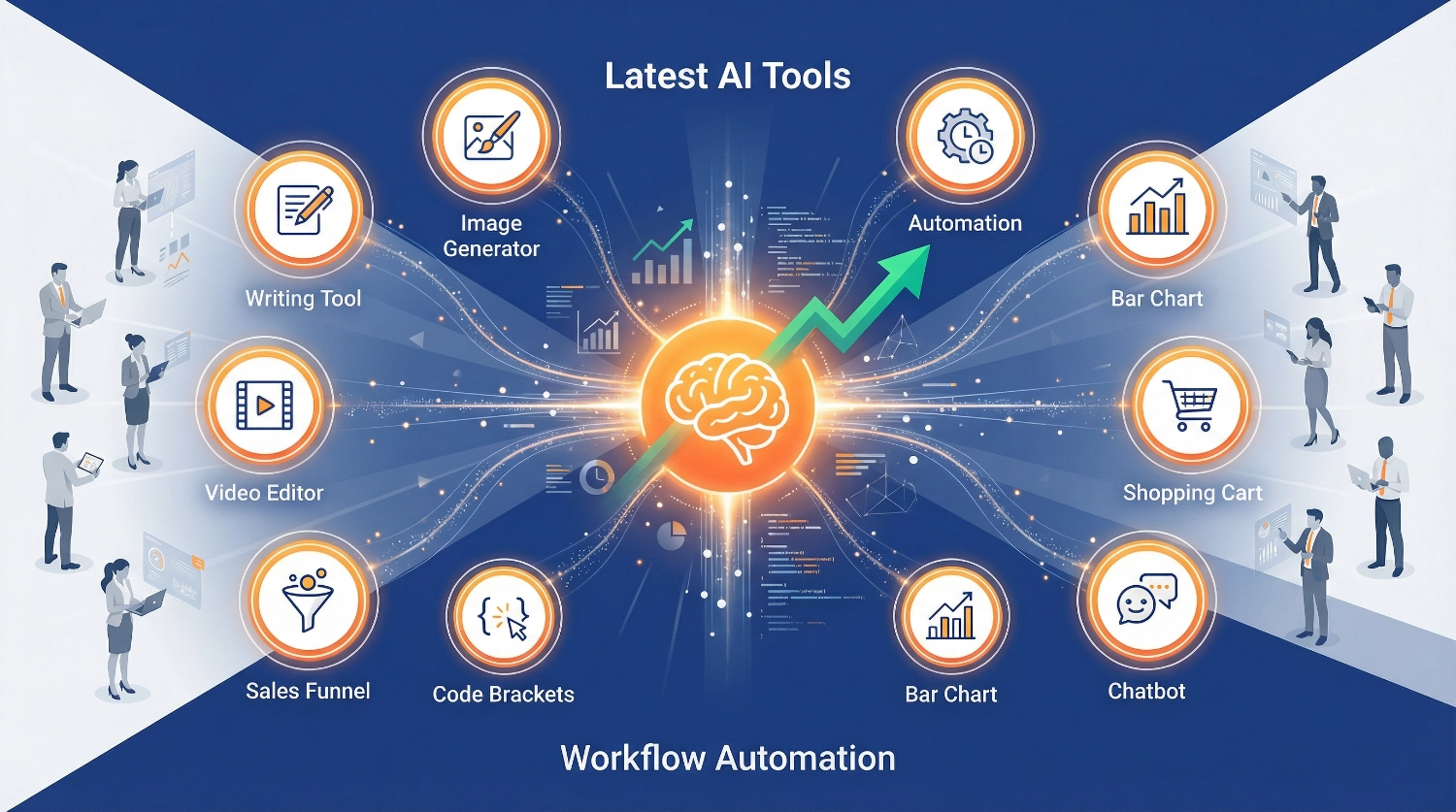
Latest AI Tools: Your Complete Workflow Optimization Guide
Welcome to Your AI-Powered Productivity Revolution
Let me be direct with you: if you’re not leveraging the latest AI tools in your workflow right now, you’re burning time and leaving money on the table.
We’re in 2025-2026, and the AI landscape has fundamentally transformed. This isn’t about curiosity anymore—it’s about survival and thriving in an increasingly competitive landscape. According to Menlo Ventures in their 2025 State of Generative AI report, departmental AI spending surged to $7.3 billion in 2025, a 4.1x increase year-over-year. That’s not hype; that’s investment capital flowing toward companies that understand how to work smarter with AI.
The challenge? With so many AI tools flooding the market, choosing the right ones for your specific workflow has become genuinely difficult. That’s where my experience comes in.
I’ve spent years helping teams implement productivity solutions, and I can tell you this: the difference between picking the right AI tool and the wrong one isn’t marginal—it’s transformational. Teams using the right AI tools report productivity gains of 40-60%, reduced operational costs by 20-37%, and revenue lifts of 6-20% depending on their function.
This comprehensive guide will walk you through the entire landscape of the latest AI tools across 10 essential categories, show you exactly how to choose the right tools for your workflow, and give you the framework to implement them without chaos.
Understanding the 2025-2026 AI Tools Landscape: What’s Changed
The AI tools market isn’t just growing—it’s accelerating at a pace most organizations can’t keep up with.
According to global market research, the AI market reached $244 billion in 2025 and is projected to hit $312 billion in 2026, growing at 27.7% annually. But here’s what matters for you: the adoption patterns tell an even more compelling story.
According to McKinsey’s 2025 State of AI research (survey conducted June 25-July 29, 2025), organizations using AI tools at the highest performance level are three times more likely than others to pursue transformative change in their operations. They’re not using AI for incremental efficiency; they’re redesigning workflows entirely.
This is critical: the latest AI tools ecosystem has matured from experimental to essential.
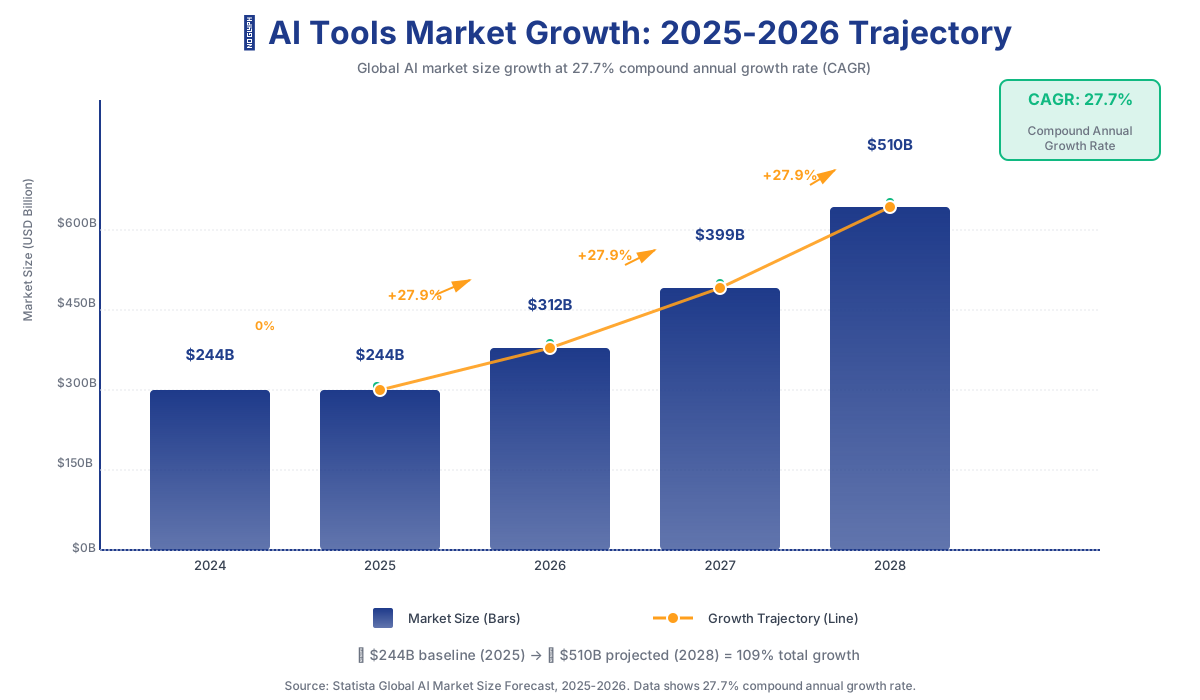
What this growth means for you isn’t just bigger numbers—it’s broader accessibility. Cloud-based AI tools will now account for 71.64% of the market share in 2025, meaning you don’t need massive infrastructure or deep technical expertise to leverage enterprise-grade AI. The barrier to entry has collapsed, and what remains is choosing wisely.
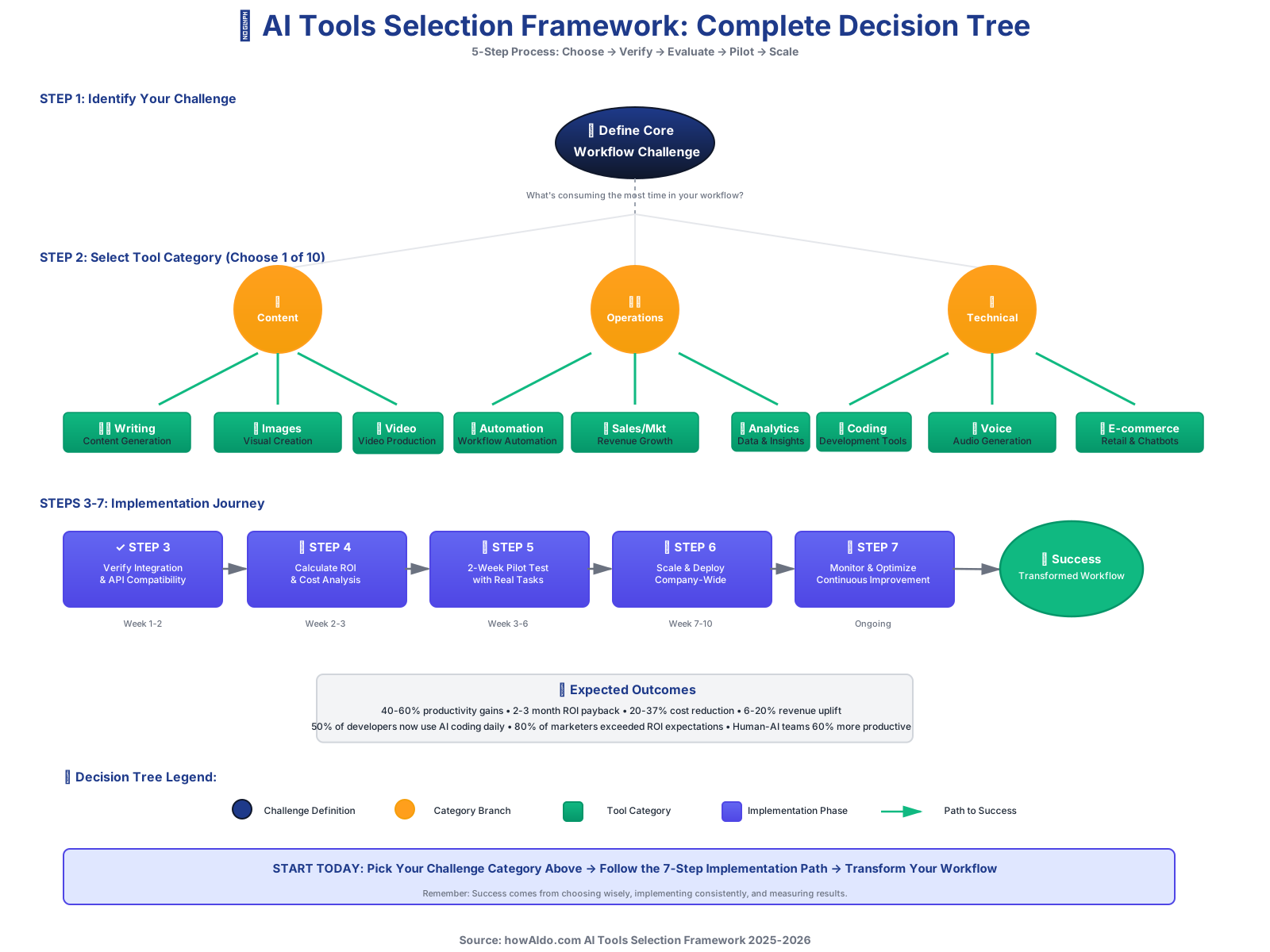
How to Choose the Right AI Tool for Your Workflow: A Practical Framework
This is where most people stumble. They see a flashy tool, get excited, implement it, and six months later it’s gathering digital dust.
I’ve helped dozens of organizations avoid this trap. Here’s the framework I use with them, adapted for your workflow:
Define Your Core Workflow Challenge First
Before considering any tools, please take a moment to thoughtfully answer this question:
- What’s the single biggest time-killer in your workflow?
- Is it repetitive content creation?
- Manual data entry?
- Decision-making bottlenecks?
- Video editing chaos?
- Lead qualification processes?
The more specific you are, the better your tool selection will be. Don’t look for a tool that can do everything—look for one that solves your primary pain point exceptionally well.
Write it down. Seriously. “We spend 15 hours weekly on content outlines” or “Our team wastes 8 hours monthly on video post-production.” Quantify it.
Assess Integration Capabilities—No Tool Works Alone
Here’s what I tell every team: a tool is only as powerful as its ability to talk to your existing systems.
The latest AI tools worth using should integrate seamlessly with your current workflow—whether that’s Slack, Google Workspace, Salesforce, HubSpot, or your custom systems. Before you commit to any tool, spend 30 minutes checking their integration library. Can it connect to the platforms you’re already using? If integration is clunky or requires technical developers, costs escalate and adoption plummets.
The best latest AI tools in 2025-2026 prioritize API-first architecture and pre-built integrations. They make data flow between systems effortlessly.
Evaluate Ease of Use vs. Power
Here’s the tension: the most powerful tools often have steep learning curves.
You want something your entire team can use on day one—not six weeks after intensive training. Look for tools that offer both accessibility for beginners and depth for power users. The interface should be intuitive enough that someone without a technical background can generate results immediately, yet flexible enough to customize as your team grows.
Test the app with a real task from your workflow. Spend 30 minutes hands-on with a trial. If you’re frustrated after that timeframe, the team will be too.
Consider Cost vs. ROI (Not Just Price)
The cheapest tool isn’t the best value. The most expensive tool isn’t either.
Calculate the ROI before you sign up. If a tool saves your team 5 hours weekly at a $25/hour average salary, that’s $125 in weekly savings or $6,500 annually. If the tool costs $500 annually, your ROI is 1,200%. That’s a no-brainer.
According to Warmly’s 2025 AI agents research, 80% of marketers reported that AI tools exceeded their return on investment expectations in 2025. However, marketers measured their ROI before making their decisions. You should too.
Compare:
- Cost per seat per month
- Hours saved per team member weekly
- Revenue impact (if applicable to your function)
- Hidden costs (integration, training, infrastructure)
Test Before You Commit at Scale
The best implementation strategy? Start small.
Pick one team member or one department. Run a 2-week pilot with the tool. Measure adoption, measure output quality, and measure time saved. Gather feedback. Then scale it if it works.
Too many organizations do a company-wide rollout and discover problems only after massive adoption. Reverse that. Pilot first, scale second.
The 10 Essential AI Tools Categories for Modern Workflows
The latest AI tools landscape divides naturally into 10 categories, each solving distinct workflow challenges. Let’s explore each one with what you need to know to make decisions.
1. The Latest AI Writing and Content Creation Tools
Primary Challenge:
Creating quality written content faster without sacrificing your voice or accuracy.
Content creation remains the most time-intensive workflow component for most organizations. Whether you’re generating blog posts, marketing copy, email campaigns, or product descriptions, the velocity demands are brutal.
What These Tools Do:
The latest AI writing tools generate drafts, outlines, and full articles with minimal input. More importantly, sophisticated platforms now understand your brand voice, maintain consistency, and handle SEO optimization natively. They’ve moved from “generates okay first drafts” to “reduces writing time by 50-70% while maintaining quality.”
Best Use Cases:
- Marketing copywriting and campaign messaging
- Blog content creation and topic development
- Email campaign sequences
- Social media content calendars
- Product descriptions at scale
- Internal documentation
Key Selection Criteria:
- Voice customization (does it learn your brand?)
- SEO optimization features
- Plagiarism detection
- Revision workflows
- Collaborative editing
Learn More: Explore The Latest AI Writing and Content Creation Tools for detailed tool reviews and implementation strategies.
2. Cutting-Edge AI Image and Art Generators
Primary Challenge:
Creating custom visuals without requiring design expertise or outsourcing to expensive designers.
Visuals drive engagement—that’s not negotiable. But commissioning custom graphics for every piece of content becomes expensive fast. The latest AI image generators have evolved to produce professional-quality visuals from text descriptions.
What These Tools Do:
These tools generate images, graphics, and art from natural language descriptions. Recent advances mean you’re not getting weird AI artifacts anymore—you’re getting genuinely usable visuals that align with your brand and message.
Best Use Cases:
- Social media graphics
- Website hero images
- Blog post featured images
- Marketing collateral
- Product mockups
- Custom illustrations
- Brand asset creation
Key Selection Criteria:
- Output quality and consistency
- Commercial use rights
- Customization and style control
- Batch generation capabilities
- Integration with design tools
Learn More: Discover Cutting-Edge AI Image and Art Generators for the best platforms and practical workflows.
3. Top AI Video Editing and Production Software
Primary Challenge:
Video production takes forever—from editing to subtitling to effects. The latest AI video tools compress this timeline dramatically.
Video is non-negotiable for engagement now. But traditional video workflows require weeks and specialized skills. AI video tools are the great equalizer.
What These Tools Do:
These platforms automate the heavy-lifting tasks in video production: trimming dead space, adding captions and subtitles automatically, applying effects, color grading, and even generating video from scripts or stills.
Best Use Cases:
- YouTube content production
- Social media video creation
- Podcast video conversion
- Product demo videos
- Training and educational content
- Customer testimonial compilation
- Live stream highlight reels
Key Selection Criteria:
- Auto-subtitling accuracy
- Trim/edit automation
- Template availability
- Export quality and formats
- Collaboration features
- Processing speed
Learn More: Check out Top AI Video Editing and Production Software for tools that actually save time.
4. AI Tools for Workflow Automation and Productivity
Primary Challenge:
Repetitive tasks consume hours every week. Automation isn’t optional anymore—it’s essential for operational efficiency.
This aspect is where the real ROI starts showing. Workflow automation tools eliminate the busywork that blocks your team from strategic thinking.
What These Tools Do:
These platforms automate multi-step workflows across your entire tech stack.
Trigger → Action → Result, without human intervention. Email received → Extract data → Create task → Notify the team. All automatic.
Best Use Cases:
- Automated data entry and processing
- Task and project management automation
- Email and calendar workflows
- Lead scoring and nurturing
- Document routing and approval
- Report generation and distribution
- Notification and alert systems
Key Selection Criteria:
- No-code vs. low-code availability
- Trigger and action library breadth
- Error handling and logging
- Workflow complexity capacity
- Pricing model (per-task vs. fixed)
Learn More: Explore AI Tools for Workflow Automation and Productivity for implementation guides and ROI calculators.
5. Specialized AI Sales and Marketing Platforms
Primary Challenge:
Sales and marketing teams are drowning in data but starving for actionable insights.
According to Menlo Ventures’ 2025 research, marketing and sales platforms reached $660 million in departmental AI spending. That investment tells you something: AI is proving ROI in revenue functions faster than anywhere else.
What These Tools Do:
These platforms use AI to analyze customer data, identify high-potential leads, optimize campaign messaging, personalize outreach, and forecast pipeline outcomes. They’re moving from reporting tools to predictive engines.
Best Use Cases:
- Lead qualification and scoring
- Pipeline forecasting and analytics
- Personalized email campaigns
- Social media optimization
- A/B testing and optimization
- Customer sentiment analysis
- Sales enablement and coaching
Key Selection Criteria:
- CRM integration depth
- Predictive accuracy
- Customization for your sales process
- Reporting granularity
- Mobile accessibility
Learn More: Deep dive into Specialized AI Sales and Marketing Platforms for tools that transform GTM teams.
6. New AI Coding Assistants and Development Tools
Primary Challenge:
Development timelines are too long, and debugging consumes disproportionate resources.
Here’s where AI adoption is advancing fastest. According to Menlo Ventures, coding captures $4 billion in departmental AI spending (55% of all departmental AI investment), and 50% of developers now use AI coding tools daily.
What These Tools Do:
These aren’t just auto-complete. Modern, latest AI coding tools understand entire codebases, generate functional code from requirements, identify security vulnerabilities, optimize performance, and handle multi-step development tasks autonomously.
Best Use Cases:
- Code generation from specifications
- Debugging and error resolution
- Security vulnerability detection
- Code refactoring and optimization
- Documentation generation
- Test case creation
- Architecture recommendations
Key Selection Criteria:
- Language and framework support
- Accuracy of generated code
- Security scanning capabilities
- Integration with IDEs
- Learning curve and adoption friction
Learn More: Check out New AI Coding Assistants and Development Tools for teams accelerating development velocity.
7. AI Voice Generation and Music Synthesis Tools
Primary Challenge:
Audio content requires expensive voice actors or specialized musicians. Latest AI voice tools democratize this entirely.
Audio content is exploding—podcasts, audiobooks, video voiceovers, and music composition. But traditional production costs prohibit most organizations from scaling audio.
What These Tools Do:
These platforms generate human-quality synthetic voices, clone voices for consistency, compose original music, and even generate sound effects from descriptions. The quality has reached the point where audiences often can’t tell it’s AI-generated.
Best Use Cases:
- Podcast and audiobook narration
- Video voiceover production
- Multilingual audio content
- Interactive voice assistant development
- Background music generation
- Personalized audio messages
- Audio brand development
Key Selection Criteria:
- Voice naturalness and variety
- Emotional inflection control
- Language support
- Commercial use rights
- Custom voice cloning
- Music composition quality
Learn More: Explore AI Voice Generation and Music Synthesis Tools for expanding into audio content efficiently.
8. AI Data Analysis and Business Intelligence Platforms
Primary Challenge:
Data exists everywhere, but insight extraction is bottlenecked by analytics expertise availability.
Most organizations have data they can’t fully leverage because the analytics pipeline is resource-constrained. Latest AI data tools change this equation.
What These Tools Do:
These platforms process massive datasets, identify patterns humans miss, create predictive models, and generate actionable recommendations automatically. They make data science accessible to non-specialists.
Best Use Cases:
- Customer behavior analysis
- Predictive analytics and forecasting
- Operational efficiency optimization
- Risk identification and mitigation
- Market trend analysis
- Anomaly detection
- Automated reporting and dashboards
Key Selection Criteria:
- Data source connectivity
- Visualization quality
- Predictive model accuracy
- Ease of use for non-data-scientists
- Real-time vs. batch processing
- Scalability
Learn More: Deep dive into AI Data Analysis and Business Intelligence Platforms for tools that turn data into decisions.
9. Emerging AI Tools for E-commerce and Retail
Primary Challenge:
E-commerce teams juggle inventory, personalization, customer service, and fraud detection simultaneously. Latest AI e-commerce tools streamline everything.
The retail AI market is heating up because the ROI is so visible—increased conversion rates and reduced fraud translate directly to bottom-line impact.
What These Tools Do:
These platforms optimize product recommendations, personalize shopping experiences, manage inventory intelligently, detect fraudulent transactions, and automate customer service workflows.
Best Use Cases:
- Product recommendation engines
- Inventory forecasting and optimization
- Personalized email marketing
- Fraud detection and prevention
- Customer service chatbots
- Price optimization
- Customer lifetime value prediction
Key Selection Criteria:
- Personalization accuracy
- Inventory forecasting precision
- Fraud detection rate
- Integration with e-commerce platforms
- Reporting and analytics depth
Learn More: Explore Emerging AI Tools for E-commerce and Retail for platforms driving conversion rate improvements.
10. The Best New AI Chatbots and Conversational Assistants
Primary Challenge:
Customer service demand never stops, but hiring enough support staff creates cost structures that don’t scale.
Chatbots powered by AI technology are transforming customer service from a cost center to a scalable service engine.
What These Tools Do:
Modern AI chatbots understand context, handle complex questions, escalate appropriately to humans, and continuously improve through interaction. They’re not the rigid decision-tree chatbots of 2015—they’re genuinely conversational.
Best Use Cases:
- 24/7 customer support automation
- Lead qualification and initial sales engagement
- FAQ automation and knowledge base
- Internal HR and IT support
- Research assistance and information retrieval
- Content recommendation
- Appointment scheduling
Key Selection Criteria:
- Natural language understanding quality
- Multi-language support
- Seamless handoff to human agents
- Customization and training
- Integration with your knowledge base
- Response accuracy
Learn More: Discover The Best New AI Chatbots and Conversational Assistants for tools improving customer satisfaction while reducing costs.
Comparative Analysis: Choosing Across Categories
Here’s what most organizations miss: you don’t choose one tool per category. You build an integrated ecosystem.
The smartest implementations integrate 3-5 AI tools working together:
- Scenario 1 – Marketing Team: AI writing tool → AI image generator → AI video editor → AI sales/marketing platform → workflow automation connecting them all
- Scenario 2 – Development Team: AI coding assistant → workflow automation for code review → AI chatbot for internal documentation → data analytics for performance monitoring
- Scenario 3 – E-commerce Team: E-commerce AI for recommendations → chatbot for customer service → data analytics for insights → workflow automation for inventory → video tools for product content
The integration multiplier effect is real. When tools work together, you get exponentially more value than summing their individual benefits.
Real-World Implementation: Building Your AI Tools Strategy
Let me give you the roadmap I use with teams implementing AI tools at scale:
Phase 1: Audit and Baseline (Week 1-2)
Document current workflow:
- What tasks consume the most time?
- Where are the bottlenecks?
- What systems do you already use?
- What’s your current output quality?
- What’s your current cost structure?
This baseline becomes your measurement stick for ROI.
Phase 2: Prioritize and Select (Week 3-4)
Using the selection framework above:
- Pick your single highest-impact opportunity
- Research the top 3-4 tools in that category
- Schedule trials with each
- Evaluate based on your criteria (integration, ease, ROI)
Phase 3: Pilot Implementation (Week 5-8)
- Assign one champion team member
- Give them dedicated time to learn the tool
- Run real workflow tasks through it
- Measure output quality, time saved, team feedback
- Document the process for scaling
Phase 4: Feedback and Optimization (Week 9-10)
- Gather team feedback
- Identify friction points
- Optimize your workflows within the tool
- Measure results against baseline
Phase 5: Scale (Week 11+)
- Train broader team
- Integrate with existing systems
- Monitor adoption and adjust
- Plan next tool integration
FAQ: Choosing and Implementing Latest AI Tools
Conclusion: Your Action Plan for 2025-2026 AI Tool Implementation
Here’s the reality: the latest AI tools landscape is moving faster than most organizations can adapt. That’s not a problem—it’s actually your advantage if you move deliberately and strategically.
You now have:
- The framework to evaluate and choose tools that actually fit your workflow
- The 10 essential categories covering virtually every business function
- The implementation roadmap to pilot and scale without chaos
- The ROI logic to justify investment to leadership and teams
The organizations winning in 2025-2026 aren’t the ones with the fanciest AI tools. They’re the ones who chose wisely, integrated thoughtfully, and empowered their teams to work smarter.
Your first step is simple: identify your single highest-impact workflow challenge and pilot a solution. Two weeks. Real tasks. Honest measurement.
Then scale what works.
The gap between organizations leveraging AI tools effectively and those struggling is widening rapidly. The time to start isn’t next year—it’s now.
Explore the 10 AI tool categories deeper by visiting their dedicated cluster pages:
- The Latest AI Writing and Content Creation Tools
- Cutting-Edge AI Image and Art Generators
- Top AI Video Editing and Production Software
- AI Tools for Workflow Automation and Productivity
- Specialized AI Sales and Marketing Platforms
- New AI Coding Assistants and Development Tools
- AI Voice Generation and Music Synthesis Tools
- AI Data Analysis and Business Intelligence Platforms
- Emerging AI Tools for E-commerce and Retail
- The Best New AI Chatbots and Conversational Assistants
Pick one. Start today. Transform tomorrow.
References
- Menlo Ventures. (2025). “2025: The State of Generative AI in the Enterprise.” Retrieved from https://menlovc.com/perspective/2025-the-state-of-generative-ai-in-the-enterprise/
- McKinsey & Company. (2025). “The state of AI in 2025: Agents, innovation, and transformation.” Survey conducted June 25-July 29, 2025. Retrieved from https://www.mckinsey.com/capabilities/quantumblack/our-insights/the-state-of-ai
- Statista. (2025). “Global AI Market Size Forecast.” Retrieved from https://www.statista.com/outlook/tmo/artificial-intelligence/worldwide
- Grand View Research. (2025). “Artificial Intelligence Market Size, 2025-2033.” Retrieved from https://www.grandviewresearch.com/industry-analysis/artificial-intelligence-ai-market
- Microsoft. (2025). “Global AI adoption in 2025 – A widening digital divide.” Published November 13, 2025. Retrieved from https://blogs.microsoft.com/on-the-issues/2026/01/08/global-ai-adoption-in-2025/
- Warmly. (2025). “35+ Powerful AI Agents Statistics: Adoption & Insights [2026].” Retrieved from https://www.warmly.ai/p/blog/ai-agents-statistics

About the Author
James Carter is a productivity coach who helps teams and organizations use artificial intelligence tools to save time, boost efficiency, and create meaningful competitive advantages. With over a decade of experience implementing workflow optimization solutions, James specializes in turning AI adoption from overwhelming to straightforward. He works with companies ranging from startups to Fortune 500 enterprises, guiding them through tool selection, implementation, and scaling. When he’s not coaching teams through their AI transformation, James writes about productivity, efficiency, and how to make technology work for humans—not the other way around. His philosophy: the best tool isn’t the fanciest one; it’s the one your team actually uses and that measurably improves your workflow.