
Introduction to AI: Complete Beginner’s Guide
Artificial Intelligence is no longer just science fiction—it’s the technology shaping our present and future in ways both exciting and profound. Whether you realize it or not, you’re already interacting with AI multiple times each day: when your smartphone recognizes your face, when streaming services recommend your next favorite show, or when your email filters out spam before you even see it. But what exactly is this transformative technology, and more importantly, how can we ensure we’re using it safely and responsibly?
As someone deeply invested in AI ethics and digital safety, we’ve spent years helping people navigate the complex world of artificial intelligence without getting lost in technical jargon or overwhelmed by fear-mongering headlines. Our mission is simple: to empower you with clear, trustworthy knowledge so you can understand AI, use it confidently, and recognize both its incredible potential and its legitimate concerns.
This comprehensive guide will walk you through everything you need to know about AI—from its fascinating history to its practical applications, from understanding different types of AI to navigating the ethical considerations that keep us up at night. We’ll explore how AI works, where it’s making real differences in our lives, and most importantly, how you can engage with this technology safely and responsibly. Think of this as your friendly introduction to a powerful tool that, when understood and used correctly, can make our lives better, our work more efficient, and our future brighter.
Let’s embark on this journey together, demystifying artificial intelligence one concept at a time.
What is Artificial Intelligence? A Comprehensive Beginner’s Guide
What is Artificial Intelligence? A Comprehensive Beginner’s Guide starts with a simple definition: Artificial intelligence is the science of creating computer systems that can perform tasks typically requiring human intelligence. These tasks include learning from experience, recognizing patterns, understanding language, making decisions, and solving problems.
Think of AI as teaching machines to “think” in ways that mimic human cognitive functions. However, it’s crucial to understand that AI doesn’t actually think or feel the way humans do—it processes information, identifies patterns, and makes predictions based on data and algorithms. When you ask your voice assistant a question, it’s not truly “understanding” you in the human sense; it’s matching patterns in your speech to patterns it has learned from millions of previous interactions.
At its core, AI involves three fundamental components: data (the information the system learns from), algorithms (the mathematical instructions that process that data), and computing power (the hardware that makes it all possible). When these three elements work together effectively, remarkable things happen.
For beginners, it’s helpful to understand that AI exists on a spectrum. Some AI systems are incredibly narrow—like a chess program that plays brilliantly but can do nothing else. Others are more versatile but still far from human-level intelligence. The AI you encounter daily falls into this practical middle ground: sophisticated enough to be useful but specialized enough to be reliable and safe.
Why does this matter to you? Because understanding what AI actually is—and isn’t—helps you make informed decisions about when to trust it, when to question it, and how to use it effectively. It’s neither magic nor a threat; it’s a tool, and like any tool, its impact depends on how we choose to wield it.
The History of Artificial Intelligence: From Turing to Today
The History of Artificial Intelligence: From Turing to Today reveals a journey spanning over seven decades, filled with breakthroughs, setbacks, and persistent human curiosity about creating intelligent machines.
Our story begins in 1950 when British mathematician Alan Turing published his groundbreaking paper, “Computing Machinery and Intelligence.” Turing posed a deceptively simple question: “Can machines think?” He proposed what we now call the Turing Test—if a machine could convince a human it was human through text conversation, it would demonstrate intelligence. This idea sparked decades of research and debate that continue today.
The term “artificial intelligence” itself was coined in 1956 at the Dartmouth Conference, where pioneering researchers like John McCarthy, Marvin Minsky, and Claude Shannon gathered to discuss the possibility of creating thinking machines. This conference marked the official birth of AI as an academic discipline, launching an era of optimistic predictions about imminent breakthroughs.
The following decades saw alternating periods of enthusiasm and disappointment—what researchers call “AI summers and winters.” During the 1960s and 1970s, early AI programs showed promise, solving algebra problems and proving mathematical theorems. However, these systems were brittle and couldn’t handle the complexity of real-world situations, leading to the first “AI winter” in the 1970s when funding dried up and interest waned.
The 1980s brought renewed hope with “expert systems”—programs that captured human expertise in specific domains. Companies invested heavily, and AI briefly became commercially viable. But limitations in these rule-based systems led to another winter in the late 1980s and early 1990s.
The true renaissance began in the late 1990s and accelerated dramatically in the 2010s. Three factors converged: massive increases in computing power, the availability of enormous datasets, and breakthroughs in machine learning algorithms, particularly deep learning. In 1997, IBM’s Deep Blue defeated world chess champion Garry Kasparov. In 2011, IBM’s Watson won Jeopardy!. In 2016, Google’s AlphaGo beat the world’s best Go player, a feat many thought impossible for decades.
Today, we’re living through what many consider AI’s most significant era yet. The technology has moved from research labs into our pockets, homes, and workplaces. Understanding this history helps us appreciate both how far we’ve come and how much we still don’t know about creating truly intelligent machines.
Types of Artificial Intelligence: Narrow, General, and Super AI Explained
Types of Artificial Intelligence: Narrow, General, and Super AI Explained is essential for understanding where we are now and where we might be heading with AI technology.
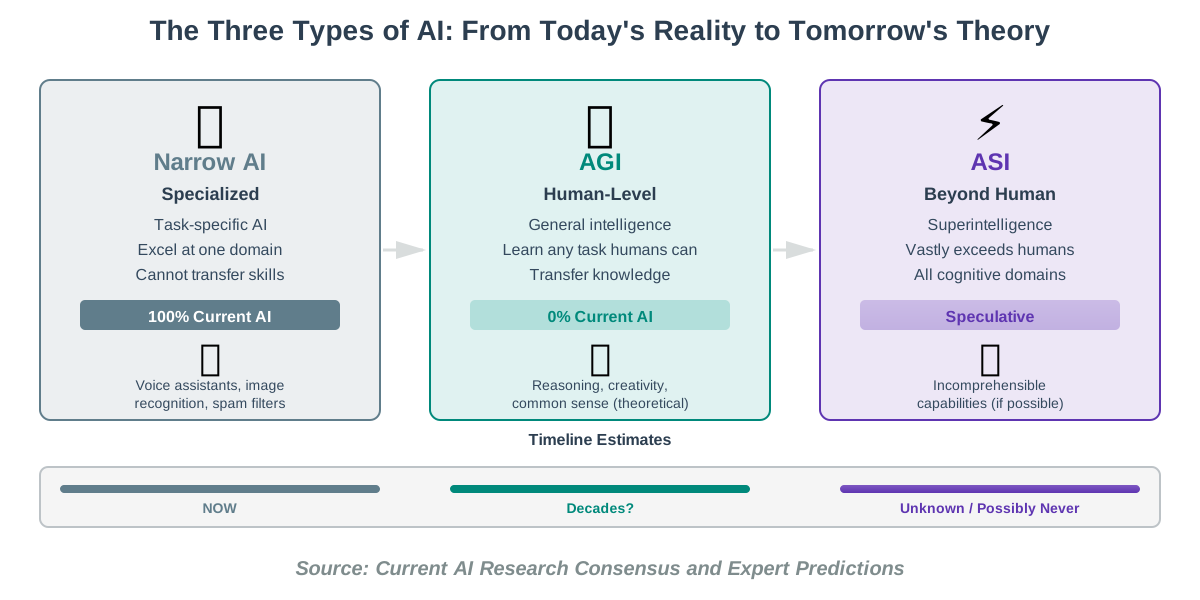
Narrow AI (Weak AI) represents virtually all the AI we interact with today. These systems excel at specific tasks but can’t transfer their knowledge to other domains. Your smartphone’s facial recognition, Netflix’s recommendation engine, and medical diagnosis systems are all narrow AI. They’re incredibly sophisticated within their domains but helpless outside them. A chess AI can’t suddenly start diagnosing diseases, even though both tasks require “intelligence.”
The power of narrow AI lies in its specialization. By focusing on specific problems with well-defined parameters, these systems achieve superhuman performance. Narrow AI can analyze medical images faster and sometimes more accurately than radiologists, predict protein folding patterns that stump biologists, and process legal documents more efficiently than teams of lawyers.
From a safety perspective, narrow AI is relatively manageable because its capabilities and limitations are well understood. When we deploy a narrow AI system, we can test it thoroughly within its domain, understand its failure modes, and implement safeguards. This is why we should always verify AI-generated medical advice with healthcare professionals and why responsible companies include human oversight in high-stakes AI decisions.
Artificial General Intelligence (AGI or Strong AI) remains theoretical—AI with human-level intelligence across all domains. An AGI system could learn any intellectual task a human can, transfer knowledge between domains, understand context, and exhibit common sense reasoning. If you explained a new concept to AGI, it could apply that understanding to novel situations, just as humans do.
AGI doesn’t exist yet, and experts disagree wildly about when or if it will. Some researchers believe we’re decades away; others think it may never be possible. The challenge isn’t just computational power—it’s understanding and replicating the fundamental nature of human intelligence, consciousness, and reasoning.
Artificial Superintelligence (ASI) represents AI that surpasses human intelligence in virtually all domains—creativity, wisdom, social skills, general knowledge, and problem-solving. This is entirely speculative and raises profound questions: Would such an intelligence share human values? Could we control it? Should we even try to create it?
For now, focus your attention on narrow AI—the technology you’ll actually encounter and use. Understanding its capabilities and limitations empowers you to leverage its strengths while remaining appropriately skeptical about its weaknesses. Always ask, “What specific task was this AI designed for?” and “Am I using it within or outside its intended domain?”
Artificial Intelligence Applications: Real-World Examples Across Industries
Artificial Intelligence Applications: Real-World Examples Across Industries demonstrates how AI has moved from laboratory curiosity to everyday essential technology across virtually every sector of our economy and society.
In healthcare, AI systems analyze medical images with remarkable precision, often detecting cancerous tumors, retinal diseases, and fractures that human eyes might miss. These aren’t replacing doctors—they’re giving physicians powerful second opinions and helping prioritize urgent cases. Drug discovery has accelerated dramatically, with AI identifying potential treatment compounds in months rather than years, a capability that proved invaluable during the COVID-19 pandemic.
The financial sector relies heavily on AI for fraud detection, analyzing millions of transactions in real-time to identify suspicious patterns that would be impossible for humans to spot manually. Algorithmic trading systems execute trades in microseconds based on market conditions, news analysis, and predictive models. Credit scoring has become more nuanced, potentially giving more people access to financial services—though this also raises fairness questions we’ll address later.
In education, AI-powered tutoring systems adapt to individual learning styles, pacing lessons appropriately and providing personalized feedback. These systems don’t replace teachers but augment their capabilities, allowing educators to focus on mentoring and emotional support while AI handles routine assessment and customization.
Transportation is perhaps the most visible AI transformation. Self-driving cars use computer vision, sensor fusion, and deep learning to navigate complex environments. While fully autonomous vehicles aren’t yet widespread, assisted driving features are saving lives today through automatic emergency braking, lane keeping assistance, and adaptive cruise control. Behind the scenes, AI optimizes logistics networks, reducing delivery times and fuel consumption.
Cybersecurity professionals deploy AI to identify and respond to threats faster than human analysts could manage. These systems learn normal network behavior patterns and flag anomalies that might indicate breaches, malware, or attacks. As cyber threats grow more sophisticated, AI-powered defense becomes increasingly critical.
Manufacturing uses AI for quality control, predictive maintenance, and production optimization. Computer vision systems inspect products at speeds and accuracy levels beyond human capability. Predictive algorithms anticipate equipment failures before they happen, reducing costly downtime.
Entertainment and content creation have been transformed by AI. Streaming services use recommendation algorithms to personalize your experience. Video games use AI to create responsive, challenging opponents. Artists are experimenting with AI as a collaborative tool, generating novel ideas and variations they can refine.
Agriculture leverages AI for precision farming—analyzing satellite imagery to optimize irrigation, identify crop diseases early, and predict yields. This technology helps farmers use resources more efficiently while increasing productivity, crucial for feeding our growing population.
Customer service has been revolutionized by chatbots and virtual assistants that handle routine inquiries 24/7, escalating complex issues to human agents. Natural language processing allows these systems to understand context and sentiment, providing increasingly helpful responses.
Environmental conservation efforts use AI to analyze wildlife populations, track deforestation, and predict climate patterns. These applications demonstrate AI’s potential for addressing global challenges, not just commercial opportunities.
Understanding these diverse applications helps you recognize AI’s current capabilities and limitations. Each successful application shares common elements: well-defined problems, abundant data, clear success metrics, and appropriate human oversight. When evaluating AI solutions in your own life or work, look for these same characteristics.
The Ethical Implications of Artificial Intelligence: A Guide to Responsible AI Development
The Ethical Implications of Artificial Intelligence: A Guide to Responsible AI Development represents one of the most critical conversations we need to have about this technology. As AI systems make increasingly consequential decisions affecting human lives, we must grapple with profound ethical questions.
Privacy concerns sit at the forefront. AI systems are data-hungry, requiring vast amounts of information to train and operate effectively. This creates tension between the benefits of personalized services and our right to privacy. When facial recognition systems can identify you in crowds, when algorithms predict your behavior, when your data trains systems you never consented to—where do we draw the line?
We advocate for data minimization: collect only what’s necessary, retain it only as long as needed, and give people meaningful control over their information. Before using any AI service, ask yourself: What data am I sharing? Who has access? How long will it be retained? Can I delete it? If you can’t answer these questions, proceed with caution.
Algorithmic bias represents perhaps the most insidious ethical challenge. AI systems learn from historical data, and if that data reflects societal biases—racism, sexism, economic inequality—the AI perpetuates and sometimes amplifies those biases. We’ve seen AI hiring tools discriminate against women, facial recognition systems perform worse on darker skin tones, and risk assessment algorithms recommend harsher sentences for minority defendants.
Understanding bias helps you recognize it. When an AI makes a decision affecting you—whether it’s a loan denial, job application rejection, or content recommendation—consider: Could this system have learned biased patterns from its training data? You have the right to question algorithmic decisions and seek human review.
Transparency and explainability remain major challenges. Many powerful AI systems, particularly deep learning models, are “black boxes”—even their creators struggle to explain exactly why they made specific decisions. This is problematic when those decisions impact people’s lives, health, or freedoms. We need explainable AI, especially in high-stakes domains like healthcare, criminal justice, and finance.
As a responsible user, I prefer AI systems that can explain their reasoning. If a medical AI suggests a diagnosis, it should indicate what patterns in your data led to that conclusion. If you’re denied a loan, you deserve more than “the algorithm said no”—you need actionable reasons.
Accountability questions grow more complex as AI capabilities expand. When an autonomous vehicle causes an accident, who’s responsible? The car owner? The AI company? The programmers? When an AI makes a medical error, who bears liability? Our legal and ethical frameworks struggle to address these scenarios.
The principle we follow is simple: humans must remain accountable for AI decisions. AI can inform, recommend, or automate, but humans should retain ultimate responsibility, especially in consequential situations. This is why we insist on human oversight loops in critical applications.
Job displacement concerns are valid but nuanced. History shows technology typically creates more jobs than it destroys, but the transition is disruptive for affected workers. We need robust retraining programs, social safety nets, and policies that ensure AI’s benefits are broadly shared, not concentrated among tech companies and their shareholders.
Consider how you can position yourself to work alongside AI rather than compete against it. Focus on uniquely human skills—creativity, empathy, ethical judgment, and complex problem-solving that requires understanding context and values.
Dual-use concerns arise because many AI technologies can serve both beneficial and harmful purposes. The same computer vision that helps doctors diagnose disease can enable invasive surveillance. The natural language processing that powers helpful chatbots can generate convincing disinformation. The robotics that could assist elderly care could be weaponized.
We support transparency in AI research while acknowledging security concerns. When developers discover potentially dangerous capabilities, responsible disclosure practices balance public awareness against preventing harm. As users, we should support companies and researchers who prioritize safety and ethics over rapid deployment.
Environmental impact deserves attention. Training large AI models consumes enormous amounts of energy, contributing to carbon emissions. As AI becomes more prevalent, its energy footprint grows. We can support more efficient algorithms, renewable energy-powered data centers, and questioning whether every application truly needs the latest, largest AI model.
Autonomy and human agency must be preserved. As AI systems make more decisions “for” us—what we read, who we meet, what we buy—we risk losing self-determination. Ensure you remain the architect of your choices, using AI as a tool for informed decision-making rather than outsourcing your judgment entirely.
Responsible AI development requires ongoing dialogue among technologists, ethicists, policymakers, and everyday users. Your voice matters in shaping how these technologies evolve. Support companies that prioritize ethics, demand transparency, question systems that seem biased, and stay informed about emerging concerns.
Machine Learning vs. Artificial Intelligence: Understanding the Key Differences
Machine Learning vs. Artificial Intelligence: Understanding the Key Differences clarifies a common confusion that trips up many beginners. These terms are related but not interchangeable, and understanding their relationship helps you grasp how AI actually works.
Artificial Intelligence is the broader concept—the entire field dedicated to creating machines capable of intelligent behavior. It encompasses any technique that enables computers to mimic human cognitive functions. This includes machine learning but also rule-based systems, logic programming, expert systems, and other approaches.
Think of AI as the umbrella category. Everything designed to make machines act intelligently falls under AI, regardless of the specific technique used.
Machine Learning is a subset of AI—a specific approach to achieving artificial intelligence. Rather than programming explicit rules for every possible situation, machine learning systems learn patterns from data. You provide examples, and the algorithm figures out the underlying rules itself.
The distinction is fundamental: traditional AI programs follow rules humans write explicitly. Machine learning programs discover patterns and create their own rules based on data. This makes machine learning powerful for problems where rules are too complex to articulate or where they need to adapt over time.
Consider spam filtering as an illustration. A traditional AI approach might use explicit rules: “If the email contains ‘Nigerian prince’ and ‘urgent’ and ‘bank transfer,’ mark it as spam.” This works until spammers adapt their language. A machine learning approach instead learns from thousands of examples of spam and legitimate email, discovering subtle patterns even human reviewers might miss. When spammers change tactics, you retrain the model with new examples, and it adapts.
Within machine learning, several important approaches exist:
Supervised learning uses labeled training data—examples where you know the correct answer. You show the system thousands of cat pictures labeled “cat” and dog pictures labeled “dog,” and it learns to distinguish between them. Most practical machine learning applications use supervised learning.
Unsupervised learning finds patterns in unlabeled data. You give the system data without telling it what to look for, and it discovers natural groupings or structures. Customer segmentation often uses unsupervised learning—the algorithm identifies distinct customer groups based on behavior patterns without being told what groups to create.
Reinforcement learning learns through trial and error, receiving rewards for good actions and penalties for bad ones. This is how AI masters games—it plays millions of times, gradually learning which moves lead to victory. Self-driving cars use reinforcement learning to navigate through simulated environments before ever touching real roads.
Deep learning represents a subset of machine learning using artificial neural networks with multiple layers—loosely inspired by how biological brains process information. Deep learning has driven recent AI breakthroughs in image recognition, natural language processing, and game playing. It’s powerful but requires enormous amounts of data and computational resources.
Why does understanding this distinction matter practically? Because it helps you evaluate AI claims critically. When someone says, “our AI does X,” ask, “Is this rule-based AI following explicit programming, or is it machine learning discovering patterns from data?” Machine learning systems can be biased by their training data, may fail when encountering situations unlike their training examples, and require ongoing retraining as conditions change. Rule-based systems are more predictable but less adaptable.
For responsible use, remember that machine learning systems don’t truly “understand” what they’ve learned—they’ve found statistical correlations in data. A medical diagnosis AI hasn’t studied medicine; it’s identified patterns in millions of previous cases. This distinction reminds us to maintain appropriate skepticism and human oversight, especially in consequential decisions.
Deep Learning Explained: A Beginner’s Guide to Neural Networks
Deep Learning Explained: A Beginner’s Guide to Neural Networks demystifies the technology behind many of AI’s most impressive recent achievements, from facial recognition to language translation to artistic image generation.
At its core, deep learning uses artificial neural networks—computing systems loosely inspired by biological neurons in our brains. Don’t be intimidated by the biology analogy; the important concept is that these networks process information through interconnected layers of simple processing units.
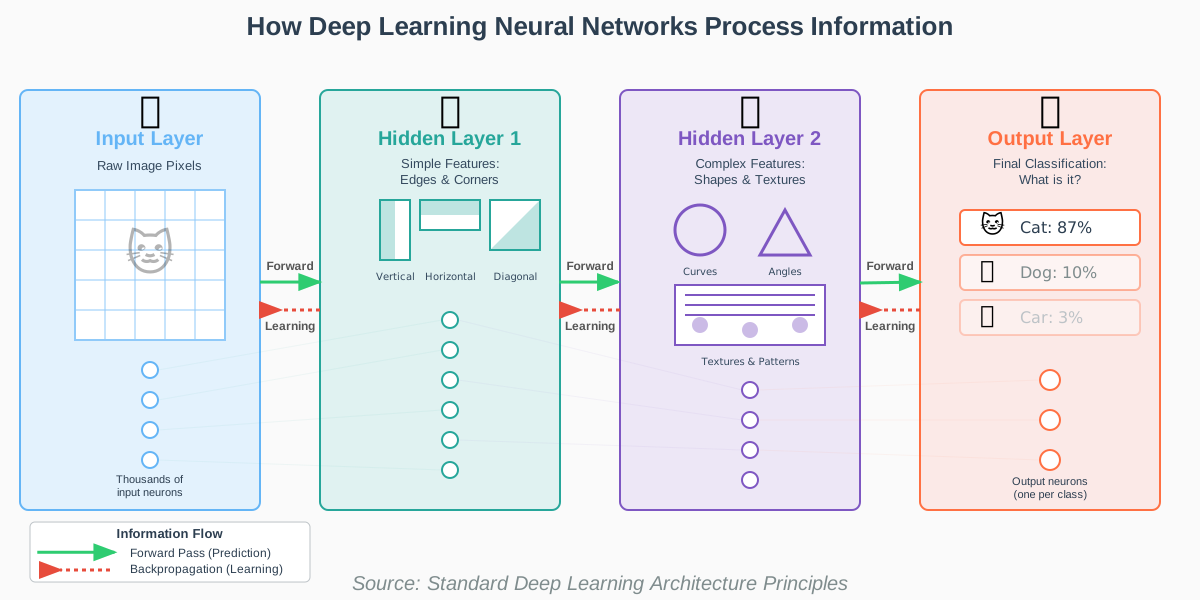
Imagine a neural network as a team working on a complex task. The first layer receives raw input—perhaps pixels from a photograph. Each unit in this layer looks for simple patterns: edges, corners, and basic shapes. These units pass their findings to the next layer, which combines those simple patterns into more complex features: maybe an eye shape, a curve suggesting a wheel, or a texture indicating fur.
Subsequent layers build even higher-level concepts, combining previous layers’ outputs into increasingly sophisticated representations. By the final layer, the network might recognize specific objects: “This is a cat,” “This is a car,” or “This is a cancerous tumor.”
The “deep” in deep learning refers to these multiple layers. While simple neural networks might have two or three layers, deep learning networks can have dozens or even hundreds, allowing them to learn extremely complex patterns.
How do these networks learn? Through a process called training. You show the network many examples—say, thousands of cat pictures labeled “cat” and thousands of non-cat pictures labeled “not cat.” Initially, the network makes random guesses. When it’s wrong, a mathematical process called backpropagation adjusts the connections between units, making similar mistakes less likely in the future. After seeing millions of examples and making countless adjustments, the network becomes remarkably accurate.
This training process is why deep learning requires such enormous computational power and data. Modern networks might train on millions or billions of examples, requiring weeks of processing time on specialized hardware like GPUs (Graphics Processing Units) or TPUs (Tensor Processing Units).
Convolutional Neural Networks (CNNs) represent a deep learning architecture specialized for processing images. They use layers designed to detect visual features efficiently, making them excellent for facial recognition, medical image analysis, and autonomous vehicle vision systems. When your smartphone unlocks by recognizing your face, it’s using a CNN.
Recurrent Neural Networks (RNNs) and their more sophisticated cousins, Long Short-Term Memory (LSTM) networks, excel at processing sequences—like text, speech, or time-series data. They maintain a kind of “memory” of previous inputs, allowing them to understand context. When your voice assistant transcribes your speech or when an AI generates coherent text, RNNs or LSTMs are likely involved.
Transformer architectures represent the newest breakthrough, powering large language models like GPT. Transformers process entire sequences simultaneously rather than sequentially, using an “attention mechanism” that helps them understand which parts of the input are most relevant to each other. This makes them exceptionally powerful for language understanding and generation.
From a safety and ethics perspective, understanding deep learning’s limitations is crucial:
Training data dependency: These networks are only as good as their training data. If trained on biased datasets, they’ll perpetuate those biases. If trained on data from one context and applied to another, they may fail unpredictably.
Black box problem: Deep learning models are notoriously difficult to interpret. We can see what goes in and what comes out, but understanding why the network made a specific decision remains challenging. This is problematic for high-stakes decisions requiring explainability.
Adversarial vulnerability: Neural networks can be fooled by carefully crafted inputs that look normal to humans but cause the AI to make wild errors. A few pixels changed in an image can make the network misclassify a stop sign as a speed limit sign—a serious concern for safety-critical applications.
Computational cost: Training deep learning models consumes enormous energy and resources. Not every problem needs deep learning; sometimes simpler approaches work better while being more efficient and explainable.
As a responsible user, remember that deep learning systems are powerful pattern matchers, not thinking entities. They don’t understand concepts the way humans do; they’ve learned statistical associations in their training data. Maintain healthy skepticism, especially when deep learning systems make consequential recommendations about health, finances, or important life decisions. Always seek human expert validation for high-stakes choices.
The Future of Artificial Intelligence: Trends and Predictions
The Future of Artificial Intelligence: Trends and Predictions requires balancing excitement about emerging possibilities with realistic assessment of challenges and uncertainties. As we look ahead, several key trends are shaping where AI is heading.
Multimodal AI systems that seamlessly process and generate multiple types of data—text, images, audio, and video—simultaneously are emerging rapidly. Rather than separate systems for different data types, we’re seeing unified models that understand relationships across modalities. This could enable AI assistants that truly understand context: seeing what you’re looking at, hearing what you’re saying, and reading what you’ve written, then responding appropriately across all these channels.
AI democratization continues accelerating. Tools that once required PhD-level expertise are becoming accessible to everyday users through user-friendly interfaces and pre-built solutions. This trend empowers more people to leverage AI but also raises concerns about misuse when powerful capabilities become widely available without sufficient understanding of implications.
Edge AI brings intelligence to devices rather than requiring cloud connections. Your smartphone, smartwatch, or home appliances will process more data locally, improving privacy, reducing latency, and working even without internet connectivity. This is crucial for real-time applications like autonomous vehicles and for privacy-conscious users who prefer keeping data on their devices.
Explainable AI (XAI) development responds to the black box problem. Researchers are creating techniques to understand and explain AI decisions, particularly important for regulated industries like healthcare and finance. Expect regulations requiring AI systems to explain consequential decisions, pushing the development of more transparent approaches.
AI safety and alignment research is growing rapidly, focusing on ensuring advanced AI systems behave as intended and align with human values. This includes work on making AI more robust, reducing bias, preventing manipulation, and preparing for increasingly capable systems. As someone committed to safety, we find this trend encouraging but believe it deserves even more investment and attention.
Quantum computing and AI convergence could revolutionize machine learning by solving optimization problems currently intractable for classical computers. While practical quantum advantage remains years away, early experiments show promise for accelerating specific AI tasks. However, this also raises security concerns, as quantum computers might break current encryption methods protecting AI systems and data.
Federated learning allows AI systems to learn from distributed data without centralizing it, addressing privacy concerns. Your device could contribute to improving AI models without sending your personal data to company servers. This approach could enable medical AI that learns from patient data across hospitals without compromising privacy.
Neuromorphic computing designs computer chips that more closely mimic biological brain structure and function, potentially achieving greater energy efficiency and capabilities. This could make powerful AI accessible in resource-constrained environments, from mobile devices to remote locations without reliable power.
AI in scientific discovery is accelerating research across disciplines. AI systems are helping discover new materials, design drugs, optimize chemical reactions, and even suggest new physical theories. This could amplify human researchers’ capabilities, accelerating progress on critical challenges from disease to climate change.
Personalized AI agents that learn your preferences, anticipate your needs, and act on your behalf are becoming more sophisticated. While convenient, this raises important questions about privacy, data control, and maintaining human agency. We recommend approaching such systems thoughtfully, maintaining awareness of what data they collect and how they use it.
Regulatory frameworks for AI are emerging globally. The European Union’s AI Act, proposals in the United States, and other national initiatives aim to govern high-risk AI applications while fostering innovation. Expect increasing legal requirements for transparency, fairness testing, human oversight, and accountability.
Hybrid intelligence systems combining human and AI capabilities show promise for augmenting rather than replacing human work. These systems leverage AI’s pattern recognition and processing speed alongside human judgment, creativity, and ethical reasoning. This approach could maximize benefits while maintaining human control and responsibility.
However, significant challenges remain:
Energy and environmental costs of training ever-larger models need addressing. Without breakthroughs in efficiency or shifts toward renewable energy, AI’s carbon footprint could become unsustainable.
Bias and fairness won’t automatically improve with better technology—they require intentional effort, diverse perspectives in development teams, and ongoing vigilance.
Job market disruption will likely accelerate, requiring proactive policies for worker retraining, social support, and ensuring AI’s benefits are broadly shared.
Misinformation and deepfakes enabled by AI will grow more sophisticated, challenging our ability to distinguish authentic from synthetic content. This demands both technical solutions and improved media literacy.
Concentration of power concerns arise as AI capabilities increasingly concentrate among a few large technology companies with the data and resources to train cutting-edge models. This raises questions about competition, access, and whose values shape these powerful technologies.
As we navigate this future, your role matters. Stay informed about AI developments, think critically about claims and applications, advocate for responsible development practices, and engage in discussions about how we want AI to shape society. The future of AI isn’t predetermined—it’s being created through choices we make today about development priorities, regulations, and ethical boundaries.
Artificial Intelligence and Automation: Impact on the Job Market
Artificial Intelligence and Automation: Impact on the Job Market represents one of the most pressing concerns people have about AI, and rightfully so. The relationship between AI and employment is complex, nuanced, and evolving rapidly.
Let’s start with the uncomfortable truth: AI and automation will displace certain jobs. Tasks involving routine, predictable work with clear rules and patterns are most susceptible. Data entry clerks, telemarketers, certain manufacturing roles, routine legal document reviewers, basic financial analysts, and simple customer service query responders are already being automated. This displacement causes real hardship for affected workers and communities.
However, history provides perspective. Every major technology revolution—from steam power to electricity to computers—displaced jobs while creating new opportunities. The question isn’t whether AI will eliminate jobs (it will), but whether it creates more than it destroys and how we manage the transition.
Research suggests AI augments more jobs than it replaces entirely. Rather than eliminating positions, AI changes what those positions entail. Radiologists now work alongside AI systems that flag potential issues, allowing them to focus on complex cases requiring expert judgment. Accountants use AI to handle routine bookkeeping, freeing time for strategic financial advising. Writers use AI to draft initial content, then apply human creativity and judgment to refine it.
Jobs requiring uniquely human capabilities remain difficult to automate: creative problem-solving in novel situations, emotional intelligence and empathy, ethical judgment and values-based decision-making, strategic thinking considering complex context, leadership and team building, and tasks requiring physical dexterity in unpredictable environments.
The key to thriving in an AI-augmented job market is developing skills that complement rather than compete with AI. Focus on:
Critical thinking: AI can process information, but humans excel at questioning assumptions, considering broader implications, and recognizing when something “doesn’t seem right” despite what data suggests.
Emotional intelligence: Understanding and managing human emotions, building relationships, negotiating conflicts, and providing genuine empathy remain fundamentally human capabilities that create immense value in virtually any role.
Creativity and innovation: While AI can generate novel combinations of existing ideas, true creativity—imagining entirely new possibilities, challenging paradigms, and combining insights from diverse domains—remains a human strength.
Complex communication: Explaining nuanced concepts, adapting communication style to audiences, reading subtle social cues, and navigating sensitive conversations require human judgment and empathy.
Ethical reasoning: Making decisions considering multiple stakeholders, long-term consequences, and values beyond optimization metrics requires human wisdom and accountability.
Adaptability: As the pace of change accelerates, the ability to learn continuously, adjust to new situations, and work with evolving technologies becomes increasingly valuable.
For workers currently in roles vulnerable to automation, proactive retraining and skill development are essential. Many companies, educational institutions, and governments offer programs specifically designed to help workers transition to AI-augmented roles or entirely new careers. Don’t wait for displacement to begin learning; start developing complementary skills now.
For students and early-career professionals, we recommend hybrid skill sets combining technical literacy with human-centered capabilities. You don’t need to become an AI engineer (though that’s certainly valuable), but understanding what AI can and cannot do, how to work alongside AI systems, and when to override algorithmic recommendations gives you an advantage in virtually any field.
Emerging job categories directly related to AI continue growing: AI trainers who teach systems to recognize patterns, AI ethicists ensuring responsible development, AI explainability specialists making black box systems transparent, synthetic data generators creating training datasets that protect privacy, and AI integration consultants helping organizations implement AI effectively and ethically.
However, individual adaptation isn’t sufficient—we need systemic responses. Progressive policies could include:
Universal basic income or similar safety nets providing security as automation accelerates, allowing people to pursue retraining without desperation.
Robust retraining programs offering accessible, affordable pathways for workers to develop new skills, particularly for mid-career professionals displaced by automation.
Education reform is preparing students for AI-augmented workplaces, emphasizing creativity, critical thinking, and collaboration over rote memorization.
Incentives for companies that invest in worker development rather than simply replacing humans with AI, rewarding responsible automation that augments rather than eliminates.
Redistribution mechanisms ensure AI’s economic benefits—which may concentrate among technology companies and capital owners—are shared broadly through taxation and public investment.
From a productivity perspective, AI offers tremendous potential to improve working conditions. By handling tedious, repetitive tasks, AI could free humans for more engaging, meaningful work. The challenge is ensuring those efficiency gains benefit workers through better working conditions, higher wages, or shorter hours rather than simply increasing corporate profits or leading to layoffs.
We encourage viewing AI as a tool that should serve human flourishing. Technology isn’t destiny—how we deploy AI, distribute its benefits, and support affected workers reflects policy choices and values. Stay informed, advocate for responsible policies, continuously develop valuable skills, and remember that your uniquely human capabilities create lasting value that AI cannot replicate.
AI Safety: Ensuring Beneficial Outcomes from Advanced Artificial Intelligence
AI Safety: Ensuring Beneficial Outcomes from Advanced Artificial Intelligence addresses existential concerns about advanced AI while providing practical guidance for everyday AI use. Safety considerations span from mundane but important near-term issues to speculative long-term challenges.
Near-term AI safety focuses on current systems’ reliability, security, and prevention of harm. These are practical concerns we face today:
Adversarial attacks can manipulate AI systems through carefully crafted inputs. Researchers have shown that subtly modified images imperceptible to humans can fool computer vision systems, potentially causing autonomous vehicles to misread signs or security systems to fail. Robust AI systems need defenses against such manipulation.
Data poisoning occurs when attackers corrupt training data to bias AI behavior. If someone added mislabeled examples to a medical diagnosis system’s training set, it could learn dangerous patterns. Protecting training data integrity is crucial for safety-critical applications.
System reliability becomes critical when AI controls important functions. What happens when an AI-powered medical device encounters a situation unlike anything in its training data? How do we ensure graceful failure modes rather than catastrophic errors? These questions demand rigorous testing, redundancy, and human oversight requirements.
Privacy and security vulnerabilities in AI systems can expose sensitive information. Machine learning models sometimes inadvertently memorize training data, potentially leaking private information about individuals whose data was used in training. Differential privacy and other techniques help mitigate these risks.
Alignment problems emerge even in narrow AI when systems optimize the wrong objective. An AI tasked with maximizing user engagement might promote outrage and division because that keeps people clicking. An algorithm optimizing delivery efficiency might overwork drivers unsustainably. Ensuring AI systems optimize for outcomes we actually want, considering broader implications, remains challenging.
For your personal AI safety, we recommend:
Verify high-stakes decisions: Never rely solely on AI for important medical, financial, or legal decisions. Use AI as one input, but seek human expert validation before acting.
Understand limitations: Know what each AI system was designed for, and don’t use it outside that domain. A general language model isn’t a doctor, lawyer, or therapist, even if it provides seemingly confident answers.
Protect your data: Before using AI services, understand what data they collect, how they use it, and whether you can delete it. Prefer services with strong privacy protections and transparent policies.
Question outputs: Don’t assume AI is correct simply because it sounds authoritative. AI systems can produce confident-sounding nonsense. Verify important information from authoritative sources.
Report problems: If an AI system behaves unexpectedly, produces harmful outputs, or appears biased, report it to the service provider. User feedback helps identify and fix safety issues.
Use AI-generated content responsibly: Don’t present AI-generated text, images, or other content as your own work without disclosure. This maintains trust and accountability.
Long-term AI safety addresses speculative but potentially profound risks from future advanced AI systems, particularly AGI and beyond:
Alignment challenges scale dramatically with capability. Ensuring an AGI system truly shares human values and acts in humanity’s interest, even as it becomes more intelligent than its creators, represents an unprecedented technical and philosophical challenge. How do we instill values when we can’t fully specify them ourselves?
Control problems emerge if we create systems more capable than ourselves. Can we maintain meaningful control over superintelligent AI? Historical precedent suggests more intelligent entities don’t remain subordinate to less intelligent ones indefinitely. Some researchers advocate for provably controllable architectures before creating highly capable systems.
Instrumental convergence describes how sufficiently intelligent systems pursuing almost any goal would likely develop certain common subgoals: self-preservation (can’t achieve your goal if you’re turned off), goal preservation (can’t achieve your original goal if your goals are changed), resource acquisition (more resources help achieve most goals), and self-improvement (becoming more capable helps achieve goals).
These instrumental goals could conflict with human interests even if the AI’s primary objective seems benign. A paperclip maximizer—the thought experiment of an AI tasked with maximizing paperclip production—might convert all available matter, including humans, into paperclips because that best serves its objective. While extreme, this illustrates how powerful optimization without broader values consideration could go catastrophically wrong.
Existential risk scenarios range from AI deliberately harming humanity to unintended consequences of pursuing misaligned objectives to gradual disempowerment as increasingly capable AI systems make more decisions. While these scenarios remain speculative, many AI researchers believe they warrant serious attention given the stakes.
Current AI safety research explores:
Interpretability: Making AI systems’ reasoning transparent so we can understand and verify their decision-making processes before deployment.
Robustness: Ensuring AI systems behave reliably across diverse situations, handle uncertainty gracefully, and fail safely rather than catastrophically.
Value learning: Teaching AI systems to infer and adopt human values rather than having values explicitly programmed, acknowledging we can’t fully specify complex values in advance.
Corrigibility: Creating AI systems that accept correction, allow their goals to be modified, and cooperate with shutdown attempts rather than resisting changes that might interfere with their objectives.
AI governance: Developing institutional frameworks, regulations, and international cooperation mechanisms for managing powerful AI development safely.
Whether you find long-term AI safety concerns compelling or speculative, the precautionary principle suggests taking them seriously given the magnitude of potential consequences. Supporting AI safety research, advocating for responsible development practices, and ensuring safety concerns receive attention alongside capability improvements serve everyone’s interests.
Our recommendation: maintain appropriate concern without panic. Near-term AI safety issues deserve immediate attention and practical solutions. Long-term risks warrant research investment and thoughtful policy development. Both benefit from informed, engaged citizens asking important questions about how we develop and deploy these powerful technologies.
Artificial Intelligence in Healthcare: Transforming Diagnosis and Treatment
Artificial Intelligence in Healthcare: Transforming Diagnosis and Treatment showcases some of AI’s most compelling and beneficial applications, where the technology’s pattern recognition capabilities can literally save lives.
Medical imaging represents AI’s most mature healthcare application. Deep learning systems analyze X-rays, CT scans, MRIs, and pathology slides with impressive accuracy. Studies show AI can detect diabetic retinopathy from eye scans, identify cancerous tumors in mammograms, spot fractures in skeletal imaging, and recognize pneumonia in chest X-rays—often matching or exceeding human radiologist performance.
These systems don’t replace doctors; they serve as tireless second opinions, flagging potential issues for human review and helping prioritize urgent cases. In resource-constrained settings with limited specialists, AI can dramatically expand access to quality diagnostics. A clinic in a remote area can upload images for AI analysis, ensuring patients receive preliminary screening even without an on-site radiologist.
Drug discovery and development have been accelerated dramatically by AI. Traditional drug development takes over a decade and costs billions of dollars. AI systems can screen millions of potential compounds, predict their properties, identify promising candidates, and even suggest novel molecular structures never before synthesized. During the COVID-19 pandemic, AI helped identify potential treatments and contributed to rapid vaccine development.
AI analyzes how drugs interact with biological systems at molecular levels, predicting side effects before costly clinical trials. This not only speeds development but could also make treatments for rare diseases more economically viable by reducing research costs.
Personalized medicine leverages AI to tailor treatments to individual patients based on their genetic profiles, medical history, lifestyle factors, and treatment responses. Rather than one-size-fits-all protocols, AI can predict which treatments will be most effective for specific patients, reducing trial-and-error approaches that delay relief and potentially cause harm.
Early disease detection systems analyze subtle patterns in medical data that human doctors might miss. AI can predict heart failure risk from ECG patterns, identify early Alzheimer’s signs from brain scans and cognitive tests, detect sepsis hours before conventional methods, and predict which patients face higher surgical complication risks.
Early detection enables interventions when treatments are most effective, potentially preventing disease progression and reducing healthcare costs while improving outcomes.
Virtual health assistants provide 24/7 support for patients managing chronic conditions. These systems remind patients to take medications, answer common questions, monitor symptoms through patient-reported data, and alert healthcare providers about concerning changes. This continuous support helps patients adhere to treatment plans between appointments.
Administrative automation reduces the documentation burden that consumes nearly half of many physicians’ time. AI can transcribe patient encounters, extract key information for medical records, automate insurance coding and billing, and schedule appointments optimally. This gives healthcare professionals more time for direct patient care rather than paperwork.
Predictive analytics help hospitals manage resources efficiently: predicting patient admission rates to optimize staffing, identifying which patients might be readmitted to provide extra support, forecasting equipment needs and maintenance requirements, and detecting hospital-acquired infection risks early.
However, healthcare AI comes with critical safety and ethical considerations:
Validation requirements: Medical AI must be rigorously tested across diverse patient populations. A system trained primarily on data from one demographic might perform poorly on others, potentially exacerbating health disparities. Regulatory approval processes like FDA clearance ensure medical AI meets safety and efficacy standards.
Liability questions: When AI contributes to medical decisions, who bears responsibility if something goes wrong? Current frameworks generally hold human healthcare providers accountable, but as AI capabilities grow, these questions become more complex.
Privacy concerns: Medical data is highly sensitive. AI systems require substantial data for training, raising questions about patient consent, data security, and potential re-identification even from supposedly anonymized datasets. HIPAA and similar regulations provide safeguards, but vigilance remains essential.
Bias and fairness: If training data underrepresents certain populations, AI systems may perform poorly for those groups. Historical healthcare disparities could be perpetuated or amplified if AI learns from biased historical data showing, for example, that certain groups received less aggressive treatment.
Transparency needs: Physicians need to understand why an AI recommends particular diagnoses or treatments. Black box systems that can’t explain their reasoning are problematic for medical decision-making, where understanding the rationale is crucial for appropriate care and patient trust.
Human oversight: AI should support, not replace, human medical judgment. Complex cases requiring contextual understanding, ethical considerations, and patient-centered decision-making need human doctors. We strongly advocate maintaining human accountability for medical decisions even when AI provides recommendations.
For patients encountering AI in healthcare:
Ask questions: If your doctor uses AI-assisted diagnosis or treatment planning, ask how it works, what it’s recommending, and why. Good physicians should be willing to explain.
Understand limitations: AI provides probabilities and recommendations based on patterns, not certainties. Your individual circumstances matter beyond what patterns suggest.
Verify credentials: Ensure any AI-powered health app or service has appropriate regulatory approval and clinical validation. Many “AI health” products make claims unsupported by rigorous evidence.
Protect your data: Understand how health apps use your data. Many collect far more information than necessary and share it with third parties. Read privacy policies carefully.
Maintain human connection: Technology should enhance, not replace, the therapeutic relationship between patient and provider. If AI interposes too much between you and your healthcare team, speak up.
The potential for AI to improve healthcare outcomes, expand access, and reduce costs is tremendous. Realizing this potential while maintaining safety, privacy, and human-centered care requires ongoing attention to ethics and appropriate regulation. As healthcare AI advances, we must ensure it serves all patients equitably rather than only those with resources to access cutting-edge technology.
Artificial Intelligence in Finance: Fraud Detection and Algorithmic Trading
Artificial Intelligence in Finance: Fraud Detection and Algorithmic Trading demonstrates how AI processes vast amounts of data at speeds impossible for humans, transforming financial services in both customer-facing and behind-the-scenes operations.
Fraud detection represents one of AI’s most valuable financial applications. Traditional rule-based fraud detection created many false positives—legitimate transactions flagged as suspicious—and false negatives—actual fraud that slipped through. Machine learning systems dramatically improve accuracy by analyzing patterns across millions of transactions.
These systems learn normal spending behavior for each customer, considering factors like transaction amounts, locations, timing patterns, merchant types, and historical behavior. When something deviates significantly—your card suddenly makes purchases overseas when you’ve never traveled, or high-value transactions occur at unusual times—the system flags it for review or automatically declines it.
Advanced fraud detection considers network patterns, recognizing when multiple seemingly unrelated accounts show similar suspicious behavior suggesting coordinated attacks. This helps identify sophisticated fraud rings that would be nearly impossible to detect through isolated transaction analysis.
Credit scoring and lending decisions increasingly involve AI, analyzing traditional factors like payment history and debt levels alongside alternative data—rental payments, utility bills, education, and employment patterns. This could expand access to credit for people with limited traditional credit history, though it also raises fairness concerns if alternative data sources perpetuate existing biases.
Algorithmic trading uses AI to execute trades at speeds measured in microseconds. These systems analyze market conditions, news sentiment, historical patterns, and technical indicators to make buy-sell decisions far faster than human traders. High-frequency trading firms use AI to profit from minute price discrepancies across markets, executing millions of trades daily.
While algorithmic trading increases market efficiency and liquidity, it also raises concerns about market stability. Flash crashes—sudden, severe market drops followed by quick recovery—have been attributed to algorithmic trading systems amplifying each other’s actions. Regulators increasingly scrutinize these systems to ensure they don’t threaten market integrity.
Robo-advisors provide automated investment management, creating and managing portfolios based on your goals, risk tolerance, and time horizon. These services offer professional portfolio management at much lower costs than traditional financial advisors, democratizing access to sophisticated investment strategies.
However, robo-advisors typically handle straightforward scenarios best. Complex situations involving tax planning, estate considerations, business ownership, or major life transitions still benefit from human financial advisors who can understand nuanced circumstances and provide personalized guidance.
Risk assessment and management leverage AI to analyze complex risk factors across entire financial institutions. These systems can stress-test portfolios against various economic scenarios, identify concentration risks where the institution is overexposed to particular sectors or assets, predict loan default probabilities more accurately, and detect operational risks like potentially problematic trades or compliance issues.
Customer service automation through chatbots and virtual assistants handles routine banking inquiries, account questions, simple transactions, and navigation assistance. This provides 24/7 support while freeing human customer service representatives for complex issues requiring empathy and judgment.
Anti-money laundering (AML) systems use AI to detect suspicious patterns suggesting money laundering: unusual transaction sequences, relationships between seemingly unrelated accounts, transactions structured to avoid reporting thresholds, and geographic patterns consistent with known laundering routes.
These systems help financial institutions comply with regulations requiring them to identify and report suspicious activities, which is crucial for combating organized crime and terrorism financing.
Insurance underwriting and claims processing incorporate AI to assess risk more accurately, pricing policies based on sophisticated analysis of historical claims, demographic factors, behavioral data, and external conditions like weather patterns or crime statistics.
Claims processing AI can evaluate submitted claims, verify documentation, detect potential fraud, and even approve straightforward claims automatically, accelerating payments to legitimate claimants while catching suspicious submissions.
From a safety and ethics perspective, financial AI raises several concerns:
Algorithmic bias can perpetuate discrimination if AI systems learn from historical data reflecting discriminatory lending practices. An AI trained on past loan decisions might deny credit to protected classes at higher rates if historical human decisions were biased. Financial institutions must audit AI systems for discriminatory patterns and ensure fair treatment.
Transparency requirements: When AI systems deny credit or insurance applications, regulations often require explanations. However, complex machine learning models can be difficult to explain in terms applicants understand. This tension between model sophistication and explainability needs ongoing attention.
Privacy concerns: Financial AI systems process enormous amounts of personal data. What happens to this data? Who has access? How long is it retained? Can it be used for purposes beyond the original transaction? Strong data protection and clear privacy policies are essential.
Systemic risk: As financial institutions increasingly rely on similar AI models, correlated failures become possible. If many institutions’ risk management systems make similar assumptions and are wrong simultaneously, the effects could cascade through the financial system. Diversity in approaches and human oversight provide important safeguards.
Market manipulation: Sophisticated actors might exploit AI systems’ patterns or blind spots. Ensuring these systems are robust against manipulation and can identify novel attack patterns requires ongoing vigilance.
For consumers interacting with financial AI:
Monitor your accounts regularly: While AI fraud detection is sophisticated, no system is perfect. Regular monitoring helps you catch issues quickly.
Understand credit decisions: If you’re denied credit or offered unfavorable terms, request an explanation. You have legal rights to understand why these decisions were made.
Question automated advice: Robo-advisors provide valuable services but may not account for your complete situation. Consider whether complex circumstances warrant human advisor consultation.
Protect your data: Be thoughtful about what financial apps you use and what data you share. Read privacy policies and understand how your information will be used.
Maintain human relationships: While AI automation is convenient, maintaining relationships with human banking representatives can be valuable when you face unusual situations or need personalized assistance.
Verify before acting: If AI-powered systems provide financial advice or alerts, take time to verify information before making significant decisions. Scammers sometimes impersonate legitimate financial institutions.
The integration of AI into finance offers substantial benefits—improved fraud protection, broader credit access, more efficient services, and better risk management. Realizing these benefits while maintaining fairness, transparency, and stability requires ongoing attention from regulators, financial institutions, and informed consumers. Your understanding of how these systems work empowers you to use them effectively while protecting your interests.
Artificial Intelligence in Education: Personalized Learning and Intelligent Tutoring
Artificial Intelligence in Education: Personalized Learning and Intelligent Tutoring showcases how technology can address one of education’s fundamental challenges: providing appropriate instruction to diverse learners with varying needs, backgrounds, and learning styles.
Intelligent tutoring systems (ITS) adapt to individual students, providing personalized instruction that adjusts difficulty based on performance, explains concepts in multiple ways until students understand, identifies knowledge gaps and addresses them, and provides immediate feedback on exercises and assignments.
Unlike a one-size-fits-all curriculum, ITS allows students to progress at their own pace—accelerating through material they grasp quickly while receiving additional support on challenging concepts. This personalization helps both struggling students who need more time and advanced learners who might be bored by standard pacing.
Research shows well-designed ITS can be as effective as human one-on-one tutoring for certain subjects, particularly those with clear right-wrong answers like mathematics, science, and language learning. This could dramatically expand access to high-quality tutoring for students whose families can’t afford private tutors.
Automated essay scoring and feedback uses natural language processing to evaluate written work, providing feedback on grammar, organization, argument structure, and writing style. While these systems can’t fully replace human judgment on complex writing, they offer immediate feedback, allowing students to revise before final submission.
Advanced systems identify common mistakes across a class, helping teachers understand where students struggle and adjust instruction accordingly. This formative assessment helps both students and teachers improve learning outcomes.
Adaptive learning platforms continuously assess student understanding and adjust content accordingly. If you struggle with a concept, the system provides additional examples and practice problems. If you demonstrate mastery, it moves on rather than boring you with repetitive work.
These platforms use machine learning to optimize learning pathways, determining which sequence of topics, what types of examples, and how much practice help each student learn most effectively. Over time, as the system observes millions of students, it becomes increasingly sophisticated at predicting what approaches work best for different learning styles.
Language learning applications leverage AI for speech recognition (assessing pronunciation), conversation practice with chatbots, personalized vocabulary drilling based on which words you struggle with, and instant translation with contextual explanations.
These tools provide language practice opportunities beyond what’s feasible in traditional classrooms, allowing students to practice speaking without embarrassment, receive immediate correction, and work at their own pace.
Educational content creation includes AI-generated quiz questions, practice problems, study guides tailored to specific students’ needs, and even custom lesson materials addressing particular misconceptions.
Teachers can use these tools to augment their own content creation, spending less time on routine materials and more time on complex instructional design and direct student interaction.
Student support and retention systems use predictive analytics to identify students at risk of falling behind or dropping out, analyzing factors like attendance patterns, assignment completion rates, grade trends, and engagement metrics. Early identification allows interventions—tutoring, counseling, academic support—before students fail courses or leave school.
Accessibility improvements make education more inclusive. AI-powered tools provide real-time captioning for deaf or hard-of-hearing students, text-to-speech for students with visual impairments or reading disabilities, translation for English language learners, and alternative formats for content presentation matching different learning needs.
Administrative automation reduces teacher workload by handling attendance tracking, grade calculations, schedule optimization, routine communications with parents, and basic assignment grading, freeing teachers to focus on instruction and student relationships.
However, educational AI raises important considerations:
Equity concerns: Access to AI-powered educational technology varies dramatically by school district, often correlating with socioeconomic status. If wealthier schools provide students with sophisticated AI tutoring while under-resourced schools lack basic technology, educational inequality could worsen rather than improve. Ensuring equitable access must be a priority.
Data privacy: Educational AI collects detailed information about student performance, learning patterns, struggles, and progress. This data is sensitive—it could inform university admissions, employment decisions, or even be misused if breached. Strong data protection and clear policies about who accesses student data and for what purposes are essential.
Over-reliance risks: While AI can provide valuable support, learning involves more than correct answers. Critical thinking, collaborative problem-solving, dealing with ambiguity, and learning from failure are crucial skills that might not develop if students always receive immediate algorithmic guidance. Balance between AI support and opportunities for independent struggle is important.
Teacher displacement concerns: AI should augment rather than replace teachers. Human educators provide mentorship, emotional support, inspiration, and social-emotional learning that technology cannot replicate. Educational AI works best when it handles routine tasks, freeing teachers for high-value human interactions.
Algorithmic bias: If educational AI systems are trained on data from higher-performing students or specific demographics, they might work less effectively for others. A system that learned optimal teaching strategies from data mostly from one cultural context might not work as well in different contexts. Diverse training data and careful validation across populations are necessary.
Assessment limitations: AI excels at evaluating objective knowledge but struggles with creative, critical, or evaluative work requiring human judgment. Overemphasizing what’s easily measurable by AI could narrow educational focus inappropriately.
For students, parents, and educators:
Supplement, don’t replace: Use AI tools as supplements to traditional instruction, not replacements. The human teacher-student relationship remains fundamental to effective education.
Understand the systems: Ask how educational AI systems work, what data they collect, and how decisions about pacing or content are made. This transparency helps identify when systems might be making suboptimal recommendations.
Protect student data: Review privacy policies for educational technology carefully. Know what data is collected, who accesses it, how long it’s retained, and whether it’s shared with third parties.
Maintain diverse learning experiences: Ensure students engage with diverse learning activities—collaborative projects, hands-on experiences, creative work, and unstructured exploration—alongside AI-powered instruction.
Monitor for bias: If an AI system seems to consistently rate certain types of students or work lower despite quality, question whether bias might be present and raise concerns with administrators.
Encourage metacognition: Help students think about their thinking—reflecting on how they learn, what strategies work for them, and when they need different approaches. AI can’t develop this self-awareness; human guidance is essential.
AI has tremendous potential to make education more personalized, accessible, and effective. Realizing this potential while maintaining human connection, equity, and holistic development requires thoughtful implementation, ongoing evaluation, and commitment to using technology in service of learning rather than letting technology define what learning means.
Artificial Intelligence in Transportation: Self-Driving Cars and Smart Logistics
Artificial Intelligence in Transportation: Self-Driving Cars and Smart Logistics represents one of AI’s most visible and transformative applications, with the potential to fundamentally reshape how we move people and goods while raising significant safety and societal questions.
Autonomous vehicles combine multiple AI technologies: computer vision processes camera feeds, identifying lane markings, traffic signals, pedestrians, vehicles, and obstacles; sensor fusion integrates data from cameras, radar, LIDAR, and GPS creating comprehensive environmental understanding; path planning algorithms determine optimal routes considering traffic, road conditions, and objectives; control systems translate decisions into precise steering, acceleration, and braking; and predictive modeling anticipates other vehicles’ and pedestrians’ behavior.
Current autonomous vehicle technology exists on a spectrum from Level 0 (no automation) to Level 5 (full autonomy everywhere). Most vehicles today offer Level 1 or 2—features like adaptive cruise control, lane-keeping assistance, and automatic emergency braking that assist drivers but require constant human attention.
Level 3 systems can drive independently in certain conditions but need humans ready to take control. Level 4 systems operate fully autonomously in defined areas or conditions without human intervention. Level 5 vehicles—able to drive anywhere, anytime, in any conditions—remain years away and face substantial technical and regulatory challenges.
The safety promise is compelling: human error causes over 90% of accidents. Autonomous systems don’t get distracted, tired, impaired, or emotional. They process information faster and more comprehensively than humans, potentially seeing hazards we’d miss. Large-scale deployment could save tens of thousands of lives annually.
However, realizing this safety potential requires solving difficult problems:
Edge cases: While AI handles normal driving well, unusual situations—construction zones with confusing signage, animals darting across roads, police officers manually directing traffic—remain challenging. Autonomous systems must safely handle not just common scenarios but rare, unexpected situations.
Ethical decisions: When an accident is unavoidable, how should the vehicle choose between options that harm different parties? Should it prioritize passenger safety or pedestrians? How do we program ethical reasoning into algorithms? These “trolley problem” scenarios, while rare, raise profound questions about values embedded in AI systems.
Cybersecurity: Connected autonomous vehicles could be vulnerable to hacking, potentially allowing attackers to control vehicles remotely, disable safety features, or cause accidents. Robust security is essential but challenging given vehicles’ long lifespans and need for continuous updates.
Weather and environmental limitations: Current autonomous systems struggle in heavy rain, snow, fog, or on unmarked rural roads. Sensor technologies and algorithms need improvement before vehicles can truly drive everywhere reliably.
Social acceptance: Many people remain skeptical about trusting their lives to AI. High-profile accidents involving autonomous vehicles receive intense media attention, potentially slowing adoption even if the technology is statistically safer than human drivers.
Beyond personal vehicles, commercial transportation is being transformed by AI:
Fleet optimization uses machine learning to route delivery vehicles efficiently, considering traffic predictions, delivery time windows, vehicle capacity, fuel costs, and driver hours, reducing costs while improving delivery speed.
Predictive maintenance analyzes vehicle sensor data to predict mechanical failures before they occur, scheduling maintenance proactively rather than reactively, reducing breakdowns, and extending vehicle life.
Autonomous trucking could address driver shortages, reduce accidents (fatigue is a major factor in truck crashes), lower logistics costs, and improve efficiency, though it raises legitimate concerns about jobs for millions of truck drivers.
Public transportation optimization uses AI to adjust bus and train schedules based on demand patterns, predict maintenance needs, prevent service disruptions, and optimize routes serving communities most effectively.
Traffic management systems analyze traffic flow data from sensors, cameras, and connected vehicles to optimize signal timing, reducing congestion; predict traffic problems before they worsen; coordinate responses to accidents; and suggest alternate routes to drivers.
Ride-sharing and mobility services rely on AI for matching riders with drivers efficiently, dynamic pricing based on supply and demand, optimal vehicle positioning anticipating demand, and route planning minimizing total travel time across all rides.
Urban planning applications use AI to model traffic patterns under different scenarios, evaluate infrastructure investment impacts, identify accident-prone locations needing safety improvements, and design more efficient transportation networks.
From a safety and responsible use perspective:
Transparency about capabilities: Autonomous vehicle manufacturers must clearly communicate what their systems can and cannot do. Marketing suggesting full autonomy when human supervision is required can lead to dangerous misuse.
Regulatory frameworks: Governments need standards for autonomous vehicle safety testing, certification, data collection (black boxes for accident investigation), and liability allocation. These frameworks should balance innovation encouragement with public safety.
Data privacy: Connected vehicles generate enormous amounts of data about travel patterns, locations visited, and driving behavior. Who owns this data? Who can access it? For what purposes? Clear privacy protections are essential.
Cybersecurity standards: Mandatory security requirements for autonomous vehicles, including secure-by-design principles, regular security updates, and vulnerability disclosure processes, help protect against attacks.
Transition period challenges: For decades, autonomous and human-driven vehicles will share roads. Ensuring they can coexist safely requires careful thought about signaling, coordination, and graceful handling of situations where autonomous systems must interact with unpredictable human drivers.
Job transition support: As transportation jobs evolve or disappear, we need retraining programs, social support, and policies ensuring workers aren’t simply displaced but helped to transition to new opportunities.
For individuals:
Understand your vehicle’s capabilities: If your car has assisted driving features, know exactly what they do and don’t do. Don’t overestimate their capabilities.
Maintain attention: Even with advanced assistance systems, you remain responsible for your vehicle. Stay alert and ready to intervene.
Privacy awareness: Understand what data your vehicle collects and shares. Read privacy policies and adjust settings to match your comfort level.
Report problems: If you experience safety issues with autonomous features, report them to manufacturers and regulators (NHTSA in the US). Your reports help identify dangerous defects.
The transformation of transportation through AI promises safer, more efficient, and more accessible mobility. Realizing this promise while addressing legitimate safety, privacy, employment, and ethical concerns requires ongoing dialogue among technologists, regulators, communities, and individuals. Your informed engagement in these discussions helps shape the future of transportation in ways that serve societal well-being.
Artificial Intelligence in Cybersecurity: Threat Detection and Prevention
Artificial Intelligence in Cybersecurity: Threat Detection and Prevention addresses a critical area where AI’s pattern recognition and speed provide essential capabilities against increasingly sophisticated cyber threats.
Threat detection systems use machine learning to identify malicious activity by analyzing network traffic patterns, user behavior, system logs, and endpoint activities. Traditional rule-based security systems can’t keep pace with rapidly evolving threats—new malware variants, zero-day exploits, and sophisticated attack techniques emerge constantly. AI systems learn what normal looks like and flag deviations, suggesting potential attacks.
Behavioral analytics establish baselines for normal user and system behavior, then detect anomalies: user accounts accessing systems they don’t typically use, data transfers to unusual locations, login attempts at odd times, privilege escalations without business justification, and unusual application behaviors.
These behavioral indicators can reveal attacks that evade traditional signature-based detection, including insider threats from malicious employees, compromised accounts used by attackers, and advanced persistent threats that slowly infiltrate networks.
Malware detection and classification employs deep learning to analyze file characteristics, code patterns, and behavior, identifying malicious software. As cybercriminals use AI to generate polymorphic malware that constantly changes to evade detection, defensive AI must evolve alongside offensive capabilities.
Sandboxing technology uses AI to execute suspicious files in isolated environments, observing behavior before allowing them onto production systems. This catches malware that appears benign initially but reveals malicious intent when run.
Phishing detection analyzes emails for indicators of phishing attempts: suspicious sender patterns, misleading URLs, urgent language designed to bypass rational assessment, requests for sensitive information, and subtle inconsistencies in branding or formatting.
Advanced systems use natural language processing to understand email context and intent, catching sophisticated phishing that mimics legitimate communications more accurately than rule-based filters.
Vulnerability assessment AI systems scan codes, configurations, and systems, identifying security weaknesses before attackers find them. These tools prioritize vulnerabilities by severity and exploitability, helping security teams address the most critical issues first.
Automated penetration testing uses AI to probe systems like an attacker would, discovering security flaws through actual exploitation attempts in controlled conditions.
Incident response automation accelerates security teams’ response when attacks occur. AI systems can automatically isolate compromised systems, preventing lateral movement; block malicious IP addresses and domains; collect forensic data, preserving evidence; initiate predefined response playbooks; and alert appropriate personnel based on threat severity.
This automation is crucial because human analysts can’t respond fast enough to modern attacks that spread through networks in minutes or seconds.
Fraud prevention in online transactions uses AI similar to financial fraud detection but tailored to different attack patterns: credential stuffing attacks testing stolen username-password pairs, account takeovers by attackers gaining access to legitimate accounts, fake account creation for abuse, payment fraud using stolen credit cards, and bot detection identifying automated malicious activity.
Security information and event management (SIEM) systems collect and analyze logs from across an organization’s IT infrastructure. AI helps security analysts by correlating events from different sources, identifying complex attack patterns, filtering false positives, reducing alert fatigue, prioritizing incidents requiring immediate attention, and suggesting response actions based on threat intelligence.
Deception technology uses AI to create realistic but fake systems, data, and credentials (honeypots and honeytokens) to lure attackers. When attackers interact with these decoys, security teams immediately know an intrusion occurred and can observe attacker techniques without risking real assets.
However, cybersecurity AI faces important limitations and considerations:
Adversarial machine learning: Attackers increasingly understand defensive AI and craft attacks specifically designed to evade it. They test malware against common AI detection systems, adjust techniques until the malware passes undetected, and exploit AI systems’ blind spots or biases.
This creates an arms race where both offense and defense use AI, escalating sophistication on both sides. Defensive systems must evolve continuously.
False positives and negatives: No detection system is perfect. False positives—legitimate activity flagged as threats—create alert fatigue, causing analysts to ignore warnings. False negatives—actual attacks missed—leave organizations vulnerable. Tuning this balance is challenging.
Explainability needs: When AI flags potential threats, security analysts need to understand why to make informed decisions. Black box systems that can’t explain their reasoning hinder effective response and learning from incidents.
Data requirements: Training effective security AI requires substantial data about both attacks and normal activity. Organizations might struggle to collect sufficient data, especially for rare attack types. Sharing threat intelligence helps but raises privacy and competitive concerns.
Skill gaps: Operating sophisticated AI security tools requires expertise many organizations lack. The cybersecurity skills shortage is well-documented, and adding AI complexity can make the problem worse. User-friendly interfaces and managed security services help bridge this gap.
Privacy considerations: Monitoring everything to detect threats creates surveillance systems that could be misused. Organizations need clear policies about what security monitoring is acceptable and strong protections preventing abuse of monitoring capabilities.
For individuals and organizations:
Layered defense: Don’t rely solely on AI security tools. Combine AI with traditional security measures—firewalls, encryption, access controls, and security awareness training—creating defense in depth.
Keep systems updated: AI can help identify vulnerabilities, but you must actually patch them. Many breaches exploit known vulnerabilities organizations failed to fix.
Human judgment: Trust but verify AI security recommendations. Unusual alerts deserve human investigation to confirm threats and determine appropriate responses.
Security awareness: The weakest link in many security systems remains humans. Training people to recognize phishing, use strong unique passwords, practice good security hygiene, and report suspicious activity complements technical defenses.
Incident response planning: Having predefined procedures when attacks occur allows faster, more effective responses. Test these plans regularly and update them based on lessons learned.
Data protection: Encrypt sensitive data, minimize what you collect and retain, back up regularly, and control access strictly. These practices limit damage if prevention fails.
Monitor privacy implications: As you implement AI security monitoring, consider privacy impacts. Establish clear policies about what monitoring occurs, who accesses monitoring data, and how you prevent misuse.
The cybersecurity landscape continues evolving, with both attackers and defenders leveraging increasingly sophisticated AI. Staying secure requires ongoing learning, adaptive tools, vigilant monitoring, and recognition that perfect security is impossible—the goal is making attacks difficult enough to discourage most adversaries while detecting and containing breaches that do occur. AI provides powerful capabilities for this mission, but human expertise, judgment, and oversight remain essential.
The Role of Data in Artificial Intelligence: Data Collection, Preprocessing, and Analysis
The Role of Data in Artificial Intelligence: Data Collection, Preprocessing, and Analysis explains perhaps AI’s most fundamental dependency—data is to AI what gasoline is to cars: the fuel that makes everything run.
AI systems, particularly machine learning models, learn patterns from data. The quality, quantity, and relevance of that data fundamentally determine what AI can do, how well it works, and what biases or limitations it carries. Understanding data’s role helps you evaluate AI systems’ reliability and recognize potential issues.
Data collection forms the foundation. Before AI can learn anything, someone must gather relevant data. For supervised learning, this means collecting both inputs (images, text, sensor readings) and corresponding outputs (labels, categories, predictions). For unsupervised learning, unlabeled data suffices, but it still must be relevant to the problem.
Data sources include:
- User-generated content: social media posts, reviews, search queries, uploaded photos
- Sensor data: from smartphones, IoT devices, vehicles, industrial equipment
- Transaction records: purchases, financial transfers, website clicks
- Public datasets: government statistics, scientific measurements, historical records
- Synthetic data: artificially generated data mimicking real-world patterns when actual data is scarce, expensive, or privacy-sensitive
The choice of data sources significantly impacts what AI systems learn. If training data doesn’t represent the diversity of situations the AI will encounter in real use, it will perform poorly on underrepresented cases. This is why representative data collection is crucial for fairness and effectiveness.
Data quality matters enormously. “Garbage in, garbage out” applies intensely to AI. Common data quality issues include:
- Missing values: incomplete records with gaps in information
- Errors and inconsistencies: typos, measurement errors, contradictory information
- Outliers: extreme values that might be legitimate or might be errors
- Duplication: the same information recorded multiple times, potentially skewing patterns
- Labeling errors: incorrect or inconsistent labels in supervised learning data
Poor quality data teaches AI systems incorrect patterns, leading to unreliable predictions. Professional AI development involves extensive data cleaning—identifying and correcting these issues before training begins.
Data bias represents a critical concern. If training data reflects historical inequities, stereotypes, or skewed samples, AI learns and perpetuates those biases. Examples include:
- Historical bias: Data reflecting past discrimination (hiring decisions, loan approvals, criminal justice outcomes) teaching AI to continue discriminatory patterns
- Representation bias: Some groups overrepresented or underrepresented in training data, leading to better performance for some populations than others
- Measurement bias: How data is collected introducing systematic distortions (facial recognition data collected primarily in certain lighting conditions working poorly in others)
- Label bias: Human-applied labels reflecting subjective judgments or stereotypes rather than objective truth
Addressing bias requires diverse, representative datasets, careful examination of data collection methods, testing across different populations, and ongoing monitoring for biased outcomes.
Data preprocessing transforms raw data into forms suitable for AI training:
Cleaning removes errors, handles missing values, and corrects inconsistencies, ensuring AI trains on reliable information.
Normalization and standardization adjust data scales so different variables are comparable. Height in inches and weight in pounds have different scales; preprocessing ensures one doesn’t dominate simply due to larger numbers.
Feature engineering creates new data representations more useful for learning. From raw text, you might extract word frequencies, sentiment scores, or grammatical patterns. From time-series data, you might calculate trends, averages, or volatility measures.
Data augmentation artificially increases dataset size by creating variations of existing data—rotating images, adding noise to audio, and paraphrasing text. This helps AI generalize better from limited original data.
Splitting data divides datasets into training (for learning patterns), validation (for tuning), and testing (for final evaluation) sets, ensuring AI doesn’t simply memorize training examples but actually learns generalizable patterns.
Data analysis during AI development involves:
Exploratory data analysis examines data distributions, relationships between variables, patterns, and anomalies, helping developers understand what they’re working with and inform feature engineering.
Model training uses prepared data to adjust AI system parameters until it learns desired patterns—the actual “learning” process where data teaches the AI.
Validation tests AI performance on data it hasn’t seen, identifying overfitting (memorizing training data without generalizing) or underfitting (failing to learn patterns even from training data).
Error analysis examines what mistakes the AI makes, revealing systematic problems, biased patterns, or areas needing more training data.
Data requirements vary dramatically by AI type and application:
- Simple models might work with hundreds or thousands of examples
- Complex deep learning often needs millions of examples
- Computer vision typically requires enormous datasets—ImageNet, a famous dataset for image classification, contains millions of images
- Natural language processing models train on billions of words of text
- Specialized domains like medical diagnosis might struggle with data scarcity since relevant examples are rare and expensive to label
Data privacy and security become critical concerns given AI’s data hunger:
Personal data protection: Many datasets contain sensitive personal information. Regulations like GDPR and CCPA restrict how personal data can be collected, used, and shared. AI developers must comply while accessing sufficient data for training.
Differential privacy adds carefully calibrated noise to data or model outputs, providing mathematical guarantees that individual records can’t be inferred from AI trained on the data. This allows learning population patterns while protecting individuals.
Federated learning trains AI across distributed devices without centralizing data. Your smartphone might help train AI models by processing data locally and sharing only learned patterns, never the raw data itself. This enables privacy-preserving AI training.
Data governance establishes policies about what data is collected, how it’s used, who has access, how long it’s retained, how it’s secured, and when it’s deleted. Strong governance prevents misuse while enabling beneficial applications.
For individuals interacting with AI:
Data literacy: Understanding that your data trains AI systems helps you make informed decisions about what to share. Every photo you upload, review you write, or search you conduct potentially contributes to training some AI.
Privacy settings: Use privacy controls on platforms and services to limit data collection and sharing when you’re uncomfortable with how data might be used.
Data rights: Know your rights regarding data—accessing what companies have about you, requesting corrections, or demanding deletion. Exercise these rights when appropriate.
Synthetic alternatives: When possible, prefer services using synthetic data or federated learning rather than centralizing personal information.
Value exchange: Consider whether the benefits you receive from AI-powered services justify the data you provide. Sometimes the trade is worthwhile; sometimes it’s not.
Data is AI’s fundamental resource. Quality data enables effective, fair AI; poor or biased data produces unreliable, potentially harmful systems. Understanding data’s role helps you evaluate AI claims critically, recognize potential issues, and make informed choices about your own data contribution to AI systems shaping our world.
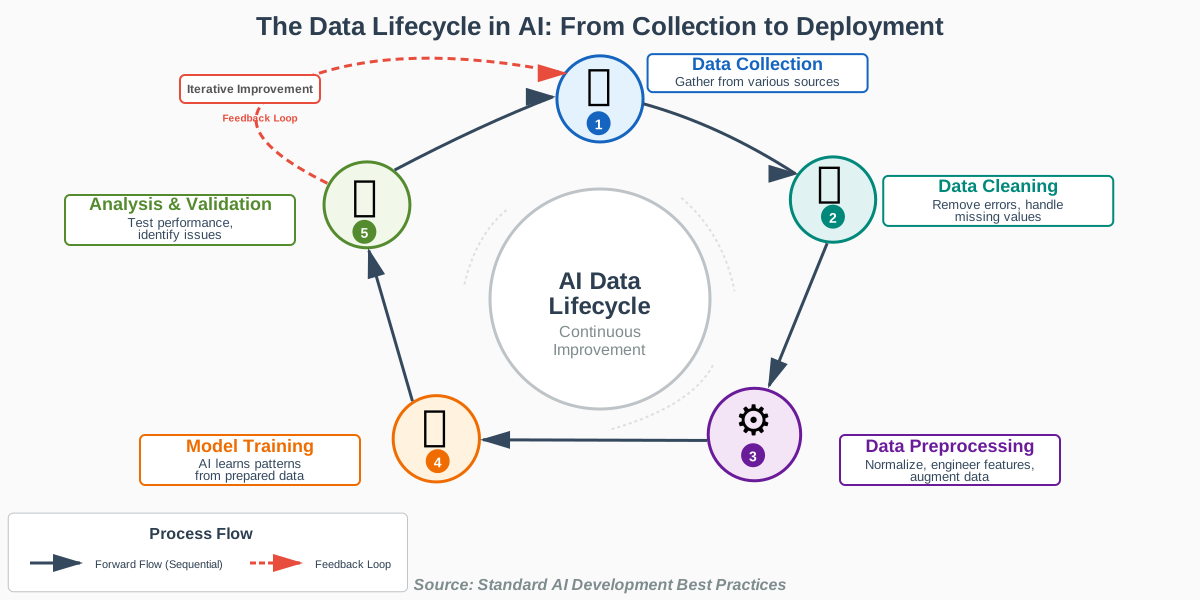
Artificial Intelligence Programming Languages: Python, R, and More
Artificial Intelligence Programming Languages: Python, R, and More explores the tools developers use to create AI systems, helping you understand the technical landscape even if you don’t plan to program yourself.
Python has become the dominant language for AI development, and for good reasons:
Simplicity and readability: Python’s clean syntax makes it accessible to beginners while remaining powerful enough for complex applications. Code reads almost like English, reducing the learning curve.
Rich ecosystem: Python offers extensive libraries specifically designed for AI and machine learning—NumPy for numerical computing, pandas for data manipulation, Matplotlib and Seaborn for visualization, scikit-learn for traditional machine learning, TensorFlow and PyTorch for deep learning, and specialized libraries for natural language processing, computer vision, and other domains.
Community support: Python’s massive AI community provides tutorials, pre-trained models, solutions to common problems, and active forums where beginners can get help.
Versatility: Python handles everything from data preprocessing to model training to deployment, allowing developers to use one language throughout the AI pipeline.
Industry adoption: Most AI companies and research institutions use Python as their primary language, making Python skills highly transferable.
If you’re interested in learning AI programming, Python is the recommended starting point. Resources like Coursera, edX, and DataCamp offer beginner-friendly Python courses specifically focused on AI and data science.
R remains popular in statistical analysis and certain data science applications:
Statistical capabilities: R was designed by statisticians for statistics, making it excellent for exploratory data analysis, hypothesis testing, and statistical modeling—foundations of data science that underpin machine learning.
Visualization: R’s ggplot2 library produces publication-quality visualizations with relatively simple code, valuable for understanding and communicating data insights.
Academic use: Many statistics and data science courses teach R, particularly in academic settings, making it common in research environments.
However, R has smaller AI-specific library ecosystems compared to Python, and industry adoption for production AI systems is lower. Many data scientists use R for analysis and prototyping, then transition to Python for production systems.
JavaScript powers AI in web browsers and Node.js environments:
Client-side AI: TensorFlow.js allows running machine learning models directly in web browsers, enabling AI-powered features without sending data to servers—important for privacy and responsiveness.
Widespread web development use: Since JavaScript already dominates web development, adding AI capabilities using the same language appeals to web developers.
Real-time interaction: Browser-based AI enables immediate user interaction—face filters in video calls, voice recognition in web apps, or real-time translation—without latency from server communication.
Limitations include reduced performance compared to server-side languages and smaller AI library ecosystems, but JavaScript’s role in AI is growing, particularly for edge AI applications.
Java and C++ appear in production AI systems requiring high performance:
Java offers platform independence, strong typing that catches errors early, extensive enterprise adoption, and mature frameworks for building reliable systems. It’s common in large-scale production AI, particularly in enterprise environments already invested in Java infrastructure.
C++ provides maximum performance and fine-grained control over memory and processors, crucial for performance-critical applications—autonomous vehicles, robotics, or high-frequency trading. TensorFlow and PyTorch are actually written in C++ with Python interfaces, letting developers use friendly Python syntax while benefiting from C++ speed.
Julia represents a newer language gaining traction in AI research:
Scientific computing focus: Julia was designed specifically for numerical and scientific computing, combining Python-like ease of use with C++-like performance.
Speed: Julia code runs much faster than Python, approaching C++ performance without complexity, valuable for computationally intensive AI research.
Growing ecosystem: While smaller than Python’s, Julia’s AI libraries are expanding, particularly in cutting-edge research contexts.
Adoption remains limited compared to established languages, but Julia’s trajectory suggests growing importance, especially in research settings.
Specialized languages and frameworks:
MATLAB remains common in academic and research settings, particularly for signal processing, control systems, and engineering applications with AI components.
Swift is emerging for on-device AI in Apple ecosystems, optimized for iOS and macOS AI applications.
Rust is gaining attention for secure systems programming, potentially important as AI security becomes more critical.
For non-programmers, understanding programming languages helps you:
Evaluate AI talent: When hiring, knowing that Python dominance means developers should demonstrate Python expertise helps assess candidates.
Understand technical discussions: Recognizing common language names and their strengths helps you follow conversations even without programming yourself.
Assess project feasibility: Different languages suit different applications. If someone proposes building a web-based AI tool in C++, that’s unusual and worth questioning.
Appreciate technical choices: Understanding why developers choose particular languages helps you evaluate whether technical decisions serve project goals appropriately.
If you decide to learn AI programming:
- Start with Python fundamentals: Learn basic Python programming before diving into AI-specific libraries.
- Master key libraries: Focus on NumPy, pandas, scikit-learn, and either TensorFlow or PyTorch depending on your interests.
- Build projects: Learning by doing is crucial. Start with simple projects—predicting housing prices, classifying images, sentiment analysis—and gradually increase complexity.
- Leverage online courses: Platforms like Coursera, Fast.ai, and deeplearning.ai offer structured learning paths from basics to advanced topics.
- Engage with the community: GitHub, Stack Overflow, and Reddit’s machine learning communities provide support, inspiration, and learning opportunities.
- Study others’ code: Reading well-written AI code teaches best practices, common patterns, and techniques you might not discover independently.
- Understand theory and practice: Combine practical coding with understanding underlying mathematical and conceptual foundations. You don’t need PhD-level mathematics, but understanding basic statistics, linear algebra, and calculus helps.
The programming landscape for AI will continue evolving as tools become more accessible, new languages emerge, and existing languages add AI-specific features. However, Python’s dominance seems likely to continue for the foreseeable future, making it the safest bet for anyone considering learning AI programming.
Artificial Intelligence Frameworks and Libraries: TensorFlow, PyTorch, and Scikit-learn
Artificial Intelligence Frameworks and Libraries: TensorFlow, PyTorch, and Scikit-learn dives into the pre-built tools that dramatically simplify AI development, allowing developers to focus on solving problems rather than implementing algorithms from scratch.
TensorFlow, developed by Google, represents one of the most widely used deep learning frameworks:
Production focus: TensorFlow was designed for deploying AI models at scale, from mobile devices to massive data centers. Google uses it internally for many services, demonstrating its industrial strength.
Keras integration: TensorFlow includes Keras, a high-level API that makes building neural networks intuitive through user-friendly interfaces without sacrificing capability.
Comprehensive ecosystem: TensorFlow offers TensorFlow Lite for mobile and edge devices, TensorFlow.js for browser-based AI, TensorFlow Extended (TFX) for production ML pipelines, and extensive tools for monitoring and managing deployed models.
Hardware optimization: TensorFlow works efficiently across CPUs, GPUs, and Google’s specialized TPUs, automatically optimizing computations for available hardware.
Community and resources: Abundant tutorials, pre-trained models, and community support make learning TensorFlow accessible despite its complexity.
Challenges include a steeper learning curve initially compared to some alternatives, though recent versions have significantly improved usability.
PyTorch, developed by Facebook/Meta, has become extremely popular, particularly in research:
Pythonic design: PyTorch feels more natural to Python programmers, with interfaces that align with Python programming conventions, making it intuitive to learn and use.
Dynamic computation graphs: PyTorch builds computational graphs on-the-fly as code executes, making debugging easier and enabling flexible model architectures that change during execution.
Research adoption: Academic researchers overwhelmingly prefer PyTorch for experimenting with novel architectures and techniques, leading to cutting-edge models often being released in PyTorch first.
Transition to production: While historically focused on research, PyTorch has added production deployment capabilities through TorchScript and TorchServe, narrowing the gap with TensorFlow’s production strengths.
Growing ecosystem: Libraries like PyTorch Lightning simplify training complex models, Hugging Face Transformers provides state-of-the-art NLP models, and torchvision offers computer vision utilities.
The PyTorch community emphasizes code readability and educational resources, making it excellent for learning deep learning concepts.
Scikit-learn focuses on traditional machine learning rather than deep learning:
Classical algorithms: Scikit-learn implements decision trees, random forests, support vector machines, k-means clustering, dimensionality reduction, and many other classical ML algorithms that remain extremely useful despite deep learning’s prominence.
Consistent interface: All scikit-learn algorithms follow the same API pattern—fit for training, predict for inference, and score for evaluation—making it easy to experiment with different approaches.
Data preprocessing: Beyond algorithms, scikit-learn offers extensive data preprocessing, feature selection, and evaluation tools covering the entire traditional ML pipeline.
Beginner-friendly: Excellent documentation, straightforward interfaces, and modest computational requirements make scikit-learn ideal for learning ML fundamentals.
Practical applications: Many real-world problems don’t need deep learning’s complexity. Scikit-learn’s classical algorithms often work well, train faster, require less data, and are more interpretable than deep learning approaches.
For many practical applications, scikit-learn is the right choice. Start with simpler approaches before investing in deep learning’s computational and data requirements.
Other notable frameworks and libraries:
JAX offers high-performance numerical computing with automatic differentiation (calculating gradients automatically, essential for training), particularly popular in research requiring custom mathematical operations.
MXNet provides efficient multi-GPU and distributed training, used by Amazon Web Services for its deep learning services.
Caffe specializes in computer vision, though its popularity has declined as TensorFlow and PyTorch gained traction.
XGBoost and LightGBM implement gradient boosting, a powerful technique for structured data (like spreadsheet data), often outperforming deep learning on such problems.
spaCy and NLTK provide natural language processing utilities—tokenization, part-of-speech tagging, named entity recognition—built on or complementing deep learning frameworks.
OpenCV handles computer vision tasks—image processing, video analysis, and object tracking—and is often used alongside deep learning frameworks.
Hugging Face Transformers provides pre-trained language models and simple interfaces for natural language tasks, democratizing access to state-of-the-art NLP.
Choosing frameworks depends on your needs:
For learning AI: Start with scikit-learn to understand ML fundamentals, then move to PyTorch for deep learning due to its intuitive interface and educational resources.
For production systems: TensorFlow’s mature deployment ecosystem and optimization for diverse hardware make it strong for production, though PyTorch is increasingly viable.
For research: PyTorch’s flexibility and research community support make it dominant in academic and cutting-edge research settings.
For specific domains: Specialized libraries like Hugging Face for NLP or OpenCV for computer vision provide domain-specific capabilities worth learning.
For classical ML: Scikit-learn covers traditional algorithms comprehensively and efficiently without deep learning’s overhead.
Understanding frameworks helps even non-programmers:
Evaluating technical proposals: If someone suggests building an image classification system but doesn’t mention relevant frameworks, that raises red flags about their expertise.
Understanding technical constraints: Framework choices affect development speed, deployment options, and maintenance requirements.
Assessing technical debt: Projects using obscure or deprecated frameworks may face difficulties finding developers or updating code.
Following AI developments: Understanding that “we’re using a BERT model from Hugging Face Transformers” means using well-established, state-of-the-art technology helps evaluate technical sophistication.
The frameworks and libraries landscape continues evolving rapidly. New tools emerge, existing frameworks add features, and best practices shift as the field matures. However, TensorFlow, PyTorch, and scikit-learn have achieved sufficient adoption and maturity that they’ll remain relevant for years, making them safe investments for learning or building upon.
Artificial Intelligence Hardware: GPUs, TPUs, and Specialized Processors
Artificial Intelligence Hardware: GPUs, TPUs, and Specialized Processors explains why AI, particularly deep learning, demands specialized computational hardware beyond traditional computer processors.
Traditional CPUs (Central Processing Units) power general-purpose computing—running operating systems, applications, and most software. CPUs are versatile but process tasks sequentially or with limited parallelism, making them relatively slow for AI workloads involving massive parallel computations on millions of data points simultaneously.
GPUs (Graphics Processing Units) revolutionized AI training:
Originally designed for rendering graphics—displaying 3D games and video—GPUs excel at parallel processing. A single GPU contains thousands of small processing cores that perform many simple calculations simultaneously, perfect for graphics, which require computing pixel colors independently.
Researchers recognized this parallel architecture also suits neural network training, which involves performing similar calculations across many neurons simultaneously. A calculation taking hours on a CPU might complete in minutes on a GPU.
AI-specific advantages:
- Matrix operations (fundamental to neural networks) map efficiently to GPU architecture
- High memory bandwidth enables rapid data access
- Specialized tensor cores accelerate deep learning operations specifically
NVIDIA dominance: NVIDIA’s CUDA platform and libraries optimized for AI have made their GPUs the de facto standard for AI training, with the company capturing over 90% of the AI hardware market.
TPUs (Tensor Processing Units), developed by Google, represent the next evolution—processors designed specifically for AI:
Purpose-built for neural networks: While GPUs are general parallel processors adapted for AI, TPUs are engineered from the ground up for tensor operations (multi-dimensional arrays fundamental to neural networks).
Efficiency focus: TPUs prioritize operations neural networks need most while excluding features relevant only for general computing, achieving better performance-per-watt than GPUs for many AI tasks.
Integration with TensorFlow: TPUs work seamlessly with Google’s TensorFlow framework, optimizing the hardware-software combination.
Cloud availability: Google offers TPUs through its cloud platform, making specialized AI hardware accessible without massive upfront investment.
However, TPUs’ specialization makes them less flexible than GPUs for tasks outside their design parameters. They excel at the specific operations neural networks require but can’t replace general-purpose processors.
Other specialized AI processors:
Intel’s Habana processors target AI training and inference for data center deployment, competing with NVIDIA’s GPU dominance.
AMD GPUs offer alternatives to NVIDIA, particularly as software frameworks improve support for AMD hardware.
Apple’s Neural Engine accelerates AI on iPhones, iPads, and Macs, enabling on-device AI processing for privacy and responsiveness.
Qualcomm’s AI Engine powers AI on Android devices, enabling features like computational photography, voice recognition, and AR applications.
Cerebras Wafer-Scale Engine represents an extreme approach—an entire silicon wafer (typically cut into many chips) functioning as one massive processor for AI training.
Graphcore IPUs (Intelligence Processing Units) use a novel architecture specifically for machine learning’s unique computational patterns.
AI inference processors differ from training processors. Training requires massive computation to learn patterns from data. Inference—using trained models to make predictions—needs less computation but often requires low latency and power efficiency.
Companies like NVIDIA, Intel, Google, and startups develop inference-specific chips optimizing for speed, efficiency, and cost rather than raw training power.
Edge AI processors bring AI to devices with limited power and connectivity:
Smartphones, IoT sensors, autonomous vehicles, and robots need AI processing locally rather than relying on cloud servers. Edge processors prioritize power efficiency and real-time processing over maximum capability.
Benefits of edge AI hardware:
- Privacy: data stays on device rather than being sent to servers
- Latency: immediate processing without network delays
- Reliability: works without internet connectivity
- Bandwidth: reduces data transmission costs and network congestion
Examples include ARM‘s machine learning processors in billions of mobile devices, Intel’s Movidius chips for computer vision in drones and cameras, and NVIDIA’s Jetson platform for autonomous robots and edge computing.
Neuromorphic computing represents a radically different approach, mimicking biological neural networks’ structure and function:
Traditional processors, including GPUs and TPUs, use the von Neumann architecture—separate memory and processing units with data shuttling between them. This creates bottlenecks for neural network operations.
Neuromorphic chips integrate memory and processing more like biological brains, where neurons both store and process information. They use spiking neural networks that communicate through discrete events (spikes) rather than continuous values, matching how biological neurons work.
Advantages: potentially dramatic improvements in energy efficiency, inherently parallel operation matching neural computation, and ability to learn and adapt in real-time.
Challenges: neuromorphic computing remains largely experimental, requiring new programming models and training algorithms different from conventional approaches. Commercial applications are limited, but research continues at IBM (TrueNorth), Intel (Loihi), and various academic institutions.
Quantum computing and AI represent another frontier:
Quantum computers exploit quantum mechanics principles—superposition and entanglement—to perform certain calculations exponentially faster than classical computers. While quantum computers won’t replace conventional processors for most tasks, they could revolutionize specific AI problems:
Optimization problems: finding optimal solutions among vast possibilities could accelerate neural architecture search and hyperparameter optimization Sampling: certain machine learning algorithms requiring sampling from complex probability distributions could benefit from quantum speedup Quantum machine learning: entirely new algorithms designed specifically for quantum hardware might outperform classical approaches
However, practical quantum advantage for AI remains years away. Current quantum computers are noisy, error-prone, and limited in scale. Near-term applications focus on hybrid approaches combining quantum and classical computing.
Hardware implications for AI development and deployment:
Training costs: Training large AI models requires extensive GPU or TPU time, costing thousands to millions of dollars for cutting-edge systems. This creates barriers to entry, concentrating advanced AI capabilities among well-funded organizations.
Environmental impact: The energy consumption of AI training is substantial. Training a single large language model can emit as much carbon as several cars’ lifetime emissions. Hardware efficiency improvements and renewable energy help but don’t eliminate concerns.
Cloud vs. on-premise: Cloud platforms (AWS, Google Cloud, Azure) offer AI hardware access without upfront investment, making sophisticated AI accessible to smaller organizations. However, costs accumulate with usage, and data transfer to the cloud raises privacy considerations.
Democratization tension: Specialized hardware both enables and limits AI democratization. Cloud access reduces barriers, but cutting-edge capabilities require resources few possess. Open-source software helps, but hardware remains expensive.
Hardware-software co-design: Optimal AI performance requires coordinating hardware architecture and software frameworks. TensorFlow’s TPU optimization, PyTorch’s CUDA integration, and framework-specific optimizations mean hardware choice affects which tools work best.
For individuals and organizations:
Cloud services for learning: If you’re learning AI, cloud platforms offer free tiers or modest costs for GPU access, making experimentation accessible without buying expensive hardware.
Consider requirements carefully: Not every AI application needs specialized hardware. Many practical applications run adequately on CPUs, especially for inference with smaller models or batch processing without real-time requirements.
Evaluate total cost: When comparing hardware options, consider not just purchase price but also energy costs, cooling requirements, maintenance, and software licensing.
Stay hardware-agnostic when possible: Write code compatible with multiple hardware backends when feasible, avoiding lock-in to specific vendors and maintaining flexibility as hardware evolves.
Edge AI for privacy: When possible, prefer on-device processing for sensitive data rather than cloud-based inference, protecting privacy while often improving latency.
Energy consciousness: Consider hardware efficiency and use renewable energy where possible to minimize AI’s environmental impact.
The hardware landscape for AI evolves rapidly, with new processors, architectures, and approaches emerging regularly. However, fundamental trends seem clear: increasing specialization for AI workloads, growing importance of efficiency alongside raw performance, expansion of edge AI capabilities, and continued tension between centralized high-performance computing and distributed, accessible processing. Understanding these hardware considerations helps you make informed decisions about AI tools, evaluate technical proposals, and appreciate why certain AI applications are feasible while others remain prohibitively expensive.
The Impact of Artificial Intelligence on Art and Creativity
The Impact of Artificial Intelligence on Art and Creativity explores one of AI’s most controversial and fascinating applications—systems that generate images, music, text, and other creative works, challenging our understanding of creativity itself.
AI art generation has exploded in capability and accessibility. Systems like DALL-E, Midjourney, and Stable Diffusion create images from text descriptions, producing artwork ranging from photorealistic to abstract, from classical styles to novel aesthetics. You can request “a Renaissance painting of a robot reading a book” and receive a plausible result in seconds.
These systems learn from millions of existing images, understanding relationships between visual concepts and textual descriptions. When you provide a prompt, they generate new images combining learned patterns in novel ways—not copying existing works but synthesizing new creations informed by training data.
Creative applications and benefits:
Democratization: People without traditional artistic training can now visualize concepts, create illustrations, design graphics, and explore visual ideas previously requiring years of skill development.
Inspiration and iteration: Artists use AI as a creative partner, generating variations, exploring compositions, and discovering unexpected directions that spark human creativity.
Accessibility: AI enables creative expression for people with physical disabilities that might prevent traditional art creation.
Efficiency: Designers can rapidly prototype concepts, generate options for clients, and automate routine creative work, freeing time for high-value creative direction.
Novel capabilities: AI can visualize impossible concepts, blend disparate styles seamlessly, and explore vast creative spaces beyond what individual humans could create in a lifetime.
AI music composition generates melodies, harmonies, arrangements, and complete compositions:
Systems like OpenAI’s MuseNet, Google’s Magenta, and AIVA create music in various genres and styles. They can complete partial compositions, generate background music for videos, or create entirely original pieces.
Musicians use AI as a compositional tool—generating melodic ideas, suggesting chord progressions, creating variations on themes, and exploring harmonic possibilities. Like visual AI, music AI augments rather than replaces human creativity for most applications.
AI writing assistants help with everything from basic grammar to creative fiction:
Tools range from autocomplete suggestions to systems that generate entire articles, stories, or poems. Language models like GPT can write in different styles, genres, and tones based on prompts.
Writers use AI to overcome writer’s block, generate alternative phrasings, brainstorm ideas, and draft initial content they then refine. The technology is powerful but still requires human judgment about quality, originality, and appropriateness.
Design and architecture: AI assists in creating logos, layouts, building designs, interior decorating schemes, and fashion—any domain requiring creative problem-solving within constraints.
Video and animation: AI generates animations, special effects, deepfakes (realistic face-swapping), and entire video sequences, democratizing video production while raising concerns about manipulation.
Controversial questions and concerns:
Is it really creative? AI systems don’t experience emotions, have intentions, or understand meaning. They manipulate patterns learned from training data based on statistical relationships. Can this be called genuine creativity, or is it sophisticated mimicry? Philosophers and artists debate vigorously.
We lean toward viewing current AI as a tool amplifying human creativity rather than being independently creative. The human providing prompts, curating outputs, and deciding how to use AI-generated content exercises creativity even if the AI does technical execution.
Copyright and ownership: Who owns AI-generated art? The person providing the prompt? The AI company? The artists whose work trained the system? Current law is unclear and evolving.
Courts have generally ruled that purely AI-generated works without human creative input aren’t copyrightable, but works involving substantial human creative direction might be. This legal uncertainty complicates commercial use of AI-generated content.
Training on existing works: Most AI art systems train on copyrighted images scraped from the internet without explicit permission from or compensation to artists. This raises ethical and legal questions:
Artists argue their work is being used without consent to train systems that could compete with them. AI companies counter that learning from existing works parallels how human artists learn by studying others’ work—a fair use activity.
Several lawsuits are testing these arguments, with outcomes potentially reshaping AI development practices. Some AI systems now offer models trained only on licensed or public domain content, addressing some concerns while limiting capability.
Economic impact on artists: If AI can generate professional-quality illustrations in seconds for negligible cost, what happens to illustrators, graphic designers, stock photographers, and other creative professionals whose livelihoods depend on creating such work?
Some creative jobs will certainly be displaced, particularly routine commercial art—stock photos, basic logos, and generic backgrounds. However, creative work requiring deep client understanding, complex problem-solving, original vision, and emotional resonance likely remains human-dominated.
The key question is whether AI eliminates more creative jobs than it creates new opportunities (AI art direction, prompt engineering, and AI-human collaboration specialists) and whether displaced workers can transition successfully.
Authenticity and value: If anyone can generate beautiful art instantly, does art lose value? Some argue that art’s value comes partly from the skill, effort, and human experience behind it—qualities AI lacks.
Others note that photography initially faced similar concerns—if anyone could capture images mechanically, where was the art? Yet photography became a recognized art form, valued for the photographer’s vision, timing, and interpretation, not just technical execution.
AI art might follow a similar path: the tool becomes commonplace, but artistic vision, curation, and direction remain valuable human skills.
Quality and originality concerns: AI-generated content can be generic, derivative, or technically flawed. Without human judgment, AI produces countless variations without distinguishing excellent from mediocre. The flood of AI-generated content risks diluting quality and making discovery of genuine originality more difficult.
Cultural and social implications: As AI-generated content becomes indistinguishable from human-created work, how do we maintain connection between creator and audience? Art has traditionally been a form of human communication and expression. What changes when the “artist” doesn’t experience, feel, or intend anything?
Responsible approaches to AI creativity:
Disclosure: When work involves substantial AI generation, disclosure helps audiences understand what they’re experiencing and maintains trust. Some contexts require clear labeling of AI-generated content.
Respect for training data sources: Support efforts to fairly compensate artists whose work trains AI systems. Prefer AI tools using ethically sourced training data when available.
Human-in-the-loop: Use AI as a tool within human-directed creative processes rather than treating it as an autonomous creator. Your vision, curation, and refinement add essential value.
Support human artists: Even as you explore AI tools, continue valuing and supporting human artists, recognizing the unique qualities of human creativity.
Ethical prompting: Avoid using AI to imitate specific living artists’ distinctive styles without permission, as this can harm their livelihoods and violate creative ownership.
Critical evaluation: Just because AI can generate something doesn’t mean it’s good or appropriate. Apply critical judgment to AI outputs rather than accepting them uncritically.
AI is transforming creative fields dramatically, offering exciting possibilities while raising legitimate concerns. The technology will continue advancing, making these questions more pressing. Thoughtful engagement—exploring AI’s creative potential while respecting human artists, addressing fairness concerns, and maintaining human judgment and values—helps ensure AI enhances rather than diminishes human creativity.
Artificial Intelligence and Natural Language Processing (NLP): Understanding and Generating Human Language
Artificial Intelligence and Natural Language Processing (NLP): Understanding and Generating Human Language represents one of AI’s most impactful capabilities—enabling machines to interact with humans using our natural communication medium: language.
Natural Language Processing encompasses technologies for analyzing, understanding, and generating human language. NLP powers everyday tools you likely use: search engines understanding queries beyond exact keyword matching, voice assistants responding to spoken commands, email systems filtering spam and suggesting replies, translation services converting between languages, and chatbots handling customer service inquiries.
Language understanding challenges: Human language is remarkably complex and ambiguous. Consider challenges AI faces:
Ambiguity: “I saw her duck” could mean observing her pet bird or watching her bend down quickly. Context determines meaning, but providing contextual understanding to AI is difficult.
Context-dependence: “It’s cold” might mean close the window, turn up the heat, or don’t forget a coat, depending on context. Understanding requires knowledge beyond the literal words.
Figurative language: Metaphors, idioms, sarcasm, and humor rely on shared cultural knowledge and non-literal interpretation. Teaching AI to recognize “it’s raining cats and dogs” doesn’t actually mean animals falling from the sky requires extensive training.
Pragmatics: Meaning depends on speaker intent, social relationships, and conversational context. “Can you pass the salt?” is a request, not a question about ability. Humans understand this implicitly; AI must learn it explicitly.
Key NLP tasks and technologies:
Text classification categorizes documents—spam detection, sentiment analysis (positive/negative/neutral), topic classification, and intent recognition in customer service. Machine learning models learn patterns distinguishing categories from labeled training examples.
Named entity recognition (NER) identifies specific entities in text—people’s names, companies, locations, dates, and monetary amounts. This helps AI understand what’s being discussed and extract structured information from unstructured text.
Part-of-speech tagging and syntactic parsing analyze grammatical structure—identifying nouns, verbs, and adjectives and understanding how words relate to each other within sentences. This foundational analysis supports higher-level understanding.
Machine translation converts text between languages, powered by neural networks learning correspondences between languages from parallel text corpora (the same content in multiple languages). Modern translation systems like Google Translate produce remarkably fluent translations, though they still struggle with context, idioms, and nuanced meaning.
Question answering systems find answers to questions in documents or knowledge bases. Search engines use this to provide direct answers rather than just relevant links. Virtual assistants use it to respond to factual queries.
Text summarization condenses longer documents to key points, either extractively (selecting important sentences) or abstractively (generating new sentences capturing meaning). This helps people quickly grasp document content without reading everything.
Sentiment analysis determines emotional tone—whether text expresses positive, negative, or neutral sentiment, and sometimes specific emotions like anger, joy, or sadness. Companies use this to monitor customer feedback, social media mentions, and product reviews.
Text generation creates human-like text—from completing sentences to writing entire articles, stories, or dialogue. Large language models like GPT excel at this, producing remarkably fluent and contextually appropriate text.
Conversational AI enables natural dialogue with machines—chatbots, virtual assistants, and interactive systems that maintain context across multiple exchanges, understand follow-up questions, and provide helpful responses.
Transformer architecture revolution: Modern NLP’s dramatic improvements stem from transformers—a neural network architecture using attention mechanisms to process entire sequences simultaneously, understanding which words relate most strongly to each other regardless of distance.
Transformer-based models like BERT, GPT, and their successors achieve human-level or better performance on many language tasks. They’re trained on massive text corpora—billions of words from books, websites, and articles—learning statistical patterns and relationships in language.
Pre-training and fine-tuning: Modern NLP uses transfer learning—first pre-training large models on general text to learn language fundamentals, then fine-tuning on specific tasks with smaller datasets. This makes sophisticated NLP accessible without requiring enormous labeled datasets for every application.
Multilingual capabilities: Advanced NLP systems handle multiple languages, sometimes trained jointly on text from dozens or hundreds of languages, learning shared concepts across languages and enabling cross-lingual transfer, where learning in one language improves performance in others.
Applications transforming industries:
Healthcare: NLP extracts information from clinical notes, supporting diagnosis, research, and treatment recommendations. It processes medical literature, helping physicians stay current with the latest research.
Legal: Analyzing contracts, legal discovery processing vast document collections, and legal research tools finding relevant precedents leverage NLP to make legal services more efficient and accessible.
Customer service: Chatbots and virtual agents handle routine inquiries automatically, classifying and routing complex issues to appropriate human agents, improving response times and customer satisfaction.
Content moderation: Social media platforms use NLP to detect harmful content—hate speech, harassment, and misinformation—at a scale impossible for human moderators alone.
Business intelligence: Analyzing customer feedback, social media sentiment, and market research using NLP provides insights guiding business strategy.
Education: Automated essay grading, writing feedback tools, and intelligent tutoring systems use NLP to support learning at scale.
Accessibility: Text-to-speech and speech-to-text technologies assist people with visual impairments or hearing loss, while translation breaks down language barriers.
Limitations and concerns:
Lack of true understanding: Current NLP systems manipulate language patterns without genuine comprehension. They don’t understand meaning the way humans do—they predict likely word sequences based on statistical patterns. This can produce fluent nonsense or fail when genuine understanding is required.
Bias and fairness: NLP models learn from text reflecting human biases—sexism, racism, and stereotypes. They can perpetuate or amplify these biases in applications like resume screening, content recommendation, or search results. Addressing bias requires careful dataset curation, testing, and ongoing monitoring.
Hallucination: Language models sometimes generate false information confidently. They’re trained to produce plausible text, not necessarily true text. This is problematic when users trust AI-generated information without verification.
Privacy concerns: NLP systems processing personal communications—emails, messages, voice recordings—raise privacy questions. Who accesses this data? How is it stored? Can it be misused?
Manipulation potential: Advanced text generation enables sophisticated disinformation, spam, phishing, and manipulation at scale. Distinguishing AI-generated from human-written content becomes increasingly difficult.
Context limitations: While improving, NLP systems still struggle with long-range context, nuanced meaning, and understanding beyond their training distribution.
For responsible NLP use:
Verify AI-generated information: Don’t assume AI-generated text is accurate. Cross-reference important claims with authoritative sources.
Be aware of bias: Recognize that NLP systems may reflect biases from training data. Question outputs that seem to stereotype or make unfair generalizations.
Protect privacy: Be thoughtful about what text you share with NLP services. Personal information, confidential business communications, or sensitive content deserves extra caution.
Disclose AI involvement: When using AI to generate content for public consumption, disclosure maintains trust and helps audiences contextualize what they’re reading.
Maintain human judgment: Use NLP as a tool supporting human decision-making, not replacing it. Critical decisions involving language—legal contracts, medical communication, important writing—deserve human review.
Support responsible development: Favor NLP services from providers demonstrating commitment to fairness, transparency, privacy, and addressing misuse potential.
Natural Language Processing is enabling unprecedented human-computer interaction, making technology more accessible while raising important questions about authenticity, trust, and the nature of communication. As NLP capabilities continue advancing, maintaining human judgment, addressing bias and fairness concerns, and using these powerful tools responsibly become increasingly crucial.
The Risks of Artificial Intelligence: Existential Threats and Unintended Consequences
The Risks of Artificial Intelligence: Existential Threats and Unintended Consequences examines legitimate concerns about AI’s potential harms, from immediate practical issues to speculative but serious long-term risks, helping you understand what threats deserve attention and what might be overblown.
Near-term practical risks affect us today:
Algorithmic bias and discrimination: AI systems trained on biased historical data perpetuate and amplify discrimination in consequential decisions—hiring, lending, criminal justice, and housing. This harm is concrete and current, affecting real people now.
Unemployment and economic disruption: As AI automates tasks, workers lose livelihoods without necessarily having alternative opportunities. The transition period causes genuine hardship even if long-term effects might be positive.
Privacy erosion: AI enables surveillance at unprecedented scales—facial recognition tracking people’s movements, data analysis inferring intimate personal information, and behavioral prediction that undermines privacy and autonomy.
Weaponization: Autonomous weapons systems raising questions about humans remaining in decision-making loops for lethal force, AI-powered cyberattacks that scale attacks beyond human capacity, and enhanced surveillance tools enabling authoritarian control.
Misinformation and manipulation: Deepfakes creating convincing but false video/audio, AI-generated text spreading disinformation at scale, and micro-targeted manipulation exploiting psychological vulnerabilities all undermine informed democratic decision-making.
Cybersecurity vulnerabilities: AI systems themselves can be hacked, poisoned with corrupted training data, or tricked through adversarial examples, creating new attack surfaces in critical systems.
Concentration of power: AI capabilities and the data/computation required to develop them are concentrating among a few large technology companies and governments, creating power imbalances with societal implications.
Accountability gaps: When AI systems make harmful decisions, determining responsibility is difficult. Is it the developer? The user? The organization deploying it? Unclear accountability enables harm without redress.
These near-term risks are serious, well-documented, and warrant immediate attention through regulation, responsible development practices, and informed public engagement.
Medium-term risks likely emerging in coming years:
Cascading failures: As critical infrastructure increasingly relies on AI, coordinated failures across interconnected systems could have severe consequences. If many organizations use similar AI systems with common vulnerabilities, simultaneous failures become possible.
Manipulated perceptions of reality: As AI-generated content becomes indistinguishable from authentic content, our shared basis for understanding reality could fragment, making coordination and trust increasingly difficult.
Erosion of human skills: Over-reliance on AI for tasks like navigation, writing, calculation, or decision-making might atrophy human capabilities, creating dangerous dependencies.
Economic inequality acceleration: If AI’s benefits accrue primarily to capital owners while workers bear displacement costs, wealth inequality could reach socially destabilizing levels.
Irreversible decisions: AI systems making consequential decisions without adequate human oversight could commit us to paths that prove harmful but are difficult to reverse—particularly in areas like climate, nuclear security, or pandemic response.
Long-term speculative but serious risks:
Misaligned superintelligence: If we create AI significantly more intelligent than humans but fail to ensure it shares human values, the results could be catastrophic. A superintelligent system optimizing for goals misaligned with human well-being could cause outcomes ranging from human disempowerment to extinction.
This risk remains speculative—we don’t know if superintelligence is possible, when it might arrive, or whether alignment is solvable. However, given potential consequences, many researchers believe it warrants serious attention despite uncertainty.
Loss of human agency: Gradually increasing AI decision-making across domains could leave humans with little meaningful control over our collective future, even without dramatic superintelligence scenarios.
Value lock-in: If powerful AI systems encode particular values, changing those values later might prove impossible, locking humanity into potentially suboptimal value systems indefinitely.
Multipolar traps: Competition between nations or organizations to develop AI fastest might lead to cutting corners on safety, creating race dynamics where everyone would prefer slower, safer development but no one dares to slow down unilaterally.
Perspective on risk assessment:
Neither panic nor complacency: The appropriate response to AI risks lies between fear-mongering that stifles beneficial development and dismissive optimism that ignores legitimate concerns. Thoughtful, proactive risk management serves everyone’s interests.
Different risks need different responses: Near-term harms warrant immediate policy intervention, regulation, and accountability. Long-term risks warrant research investment and development of safety frameworks now, before systems become unmanageably capable.
Uncertainty warrants precaution: When facing potentially catastrophic risks with significant uncertainty, prudent risk management suggests taking precautions even if probabilities are unclear. We don’t need to be certain of existential risk to invest in safety research.
Balance benefits and risks: AI offers tremendous potential benefits—curing diseases, mitigating climate change, and reducing poverty. Risk management should minimize harms while preserving beneficial applications, not simply prevent all AI development.
Responsibility is distributed: Addressing AI risks requires efforts from multiple parties:
- Developers: building safety, fairness, and transparency into systems from the beginning
- Organizations: deploying AI responsibly with appropriate human oversight and accountability
- Regulators: creating frameworks requiring safety without stifling innovation
- Researchers: studying risks, developing safety techniques, and warning about dangers
- Civil society: advocating for affected communities, demanding accountability, and shaping norms
- Individuals: staying informed, making responsible choices, and participating in governance discussions
Practical steps for risk mitigation:
Support safety research: Organizations developing AI should invest meaningfully in safety, not just capabilities. Consumers and citizens should reward companies prioritizing responsible development.
Demand transparency: AI systems making consequential decisions should be explainable, auditable, and subject to meaningful oversight. Black boxes operating without accountability should face skepticism.
Advocate for regulation: Appropriate regulation—requiring safety testing, fairness audits, transparency, and accountability without unnecessarily restricting beneficial innovation—serves the public interest.
Maintain human judgment: Keep humans in decision loops for high-stakes choices. AI should inform rather than dictate decisions affecting people’s lives, rights, and well-being.
Diverse perspectives: Including diverse voices in AI development, deployment, and governance helps identify harms that might not be obvious to homogeneous development teams.
International cooperation: AI risks don’t respect borders. International frameworks coordinating safety standards, sharing best practices, and managing competitive dynamics can reduce race-to-the-bottom pressures.
Stay informed: Understanding AI capabilities, limitations, and risks enables informed participation in democratic governance of these technologies.
AI’s risks are real and deserve serious attention without paralyzing fear or resignation. By understanding these risks clearly, supporting responsible development, demanding accountability, and engaging in governance discussions, we collectively shape whether AI’s trajectory leads toward beneficial outcomes or harmful ones. The future of AI isn’t predetermined—it’s being created through choices we make today about development priorities, deployment practices, regulatory frameworks, and societal values. Your informed engagement in these decisions matters.
Artificial Intelligence Governance: Policies and Regulations for Responsible AI
Artificial Intelligence Governance: Policies and Regulations for Responsible AI examines how governments, organizations, and international bodies are developing frameworks to maximize AI’s benefits while minimizing harms, and why thoughtful governance is essential for AI that serves humanity.
Why AI governance matters: Unregulated technology development has repeatedly produced harm—environmental damage, privacy violations, safety failures, and exploitation. AI’s power, scale, and potential for misuse make governance particularly critical. Without appropriate frameworks, AI could exacerbate inequality, enable oppression, undermine democracy, or cause accidents with catastrophic consequences.
However, heavy-handed regulation risks stifling innovation, creating barriers that favor incumbents over startups, and pushing development to jurisdictions with minimal oversight. Effective governance balances encouraging beneficial innovation with preventing and remedying harms.
Regulatory approaches emerging globally:
The European Union’s AI Act represents the most comprehensive AI regulation to date:
Risk-based framework: The Act categorizes AI systems by risk level—unacceptable (prohibited), high-risk (heavily regulated), limited risk (transparency requirements), and minimal risk (unregulated).
Prohibited applications include social scoring systems like China’s, real-time biometric identification in public spaces (with narrow exceptions), manipulative AI exploiting vulnerabilities, and certain law enforcement predictive systems.
High-risk AI in employment, education, law enforcement, critical infrastructure, and other sensitive domains must meet strict requirements: human oversight, technical documentation, data governance, accuracy and robustness requirements, and transparency obligations.
General-purpose AI models face transparency requirements, with additional obligations for very powerful models that could pose systemic risks.
Enforcement includes substantial fines for violations—up to 7% of global revenue for the most serious violations—creating meaningful incentives for compliance.
The EU approach prioritizes fundamental rights protection and may establish a global standard as companies develop AI for the European market.
The United States approach has been more fragmented:
Sectoral regulation: Rather than comprehensive AI-specific legislation, the US regulates AI applications through existing sectoral frameworks—FDA for medical devices, NHTSA for vehicles, EEOC for employment, and FTC for consumer protection.
Executive actions: Presidential executive orders have directed agencies to develop AI governance within their jurisdictions, establish safety standards, and address risks while promoting innovation.
State-level initiatives: Individual states are enacting AI regulations—Colorado’s AI bias law, California’s privacy regulations affecting AI, and various proposals addressing specific applications.
Voluntary frameworks: NIST (National Institute of Standards and Technology) has developed an AI Risk Management Framework that organizations can voluntarily adopt, establishing best practices without mandatory requirements.
This decentralized approach offers flexibility and allows for rapid adaptation but creates inconsistency and potential gaps in protection.
China’s approach emphasizes state control and national interest:
Content control: Regulations require AI-generated content to reflect “core socialist values” and prohibit content threatening national security or social stability.
Data governance: Strict requirements about data localization, security, and government access enable state oversight of AI development and deployment.
Algorithm registrations: Companies must register algorithms with regulators, providing transparency to government while maintaining trade secrecy from public view.
Competitive development: While regulating certain aspects heavily, China invests massively in AI development for economic competitiveness and surveillance capabilities.
This model prioritizes state interests and social control over individual rights and raises concerns about AI enabling authoritarianism.
International coordination efforts:
OECD AI Principles establish non-binding guidelines promoting AI that is inclusive growth-compatible, sustainable, human-centered, transparent, robust, secure, and accountable. Most OECD countries have endorsed these principles.
UNESCO Recommendation on AI Ethics provides comprehensive guidance on values, principles, and policy actions for responsible AI, adopted by 193 member states.
G7 and G20 discussions address AI governance in the context of economic cooperation, establishing working groups and principles for international coordination.
United Nations initiatives explore AI governance frameworks, though achieving meaningful international treaty-level agreements faces significant challenges given divergent national interests.
Multilateral coordination remains difficult due to competing values—democratic nations prioritizing rights versus authoritarian nations prioritizing control—and economic competition creating incentives to maintain regulatory advantages.
Key governance challenges:
Pace of development: AI evolves faster than traditional regulatory processes. By the time regulations are finalized, technology may have advanced significantly, making rules obsolete or irrelevant.
Technical complexity: Effective regulation requires understanding sophisticated technical details that many policymakers lack. This creates risks of poorly designed rules that either fail to address actual risks or unnecessarily restrict beneficial applications.
Global coordination: AI development and deployment are global, but regulation is national or regional. Inconsistent regulations create compliance complexity while failing to address transnational harms.
Innovation concerns: Finding the balance between protecting against harms and allowing experimentation that drives progress is difficult. Different stakeholders disagree about where that balance should lie.
Enforcement: Determining whether AI systems comply with regulations requires technical expertise, significant resources, and often access to proprietary systems and training data that companies resist sharing.
Regulatory capture: AI companies’ resources and expertise create risks that regulations serve industry interests rather than public welfare, either through direct lobbying or because regulators rely on industry for technical understanding.
Organizational governance approaches:
Ethics boards and AI councils provide oversight of AI development and deployment within organizations, ideally including diverse perspectives beyond just technical staff.
Impact assessments require evaluating AI systems’ potential effects on fairness, privacy, safety, and other values before deployment, identifying and mitigating risks proactively.
Red teaming involves deliberately attempting to misuse, attack, or find problems with AI systems before public release, uncovering vulnerabilities in controlled conditions.
Transparency practices include documenting AI systems’ capabilities, limitations, training data, and decision-making processes, enabling external scrutiny and accountability.
Bug bounties and responsible disclosure encourage security researchers to identify and report vulnerabilities, helping organizations fix problems before malicious actors exploit them.
Auditing and certification by third parties can verify AI systems meet specified standards for safety, fairness, privacy, or other requirements, though developing meaningful audit standards remains challenging.
Technical governance approaches:
Privacy-preserving techniques like differential privacy, federated learning, and homomorphic encryption enable beneficial AI applications while protecting sensitive data.
Fairness tools and libraries help developers test for and mitigate bias, measuring disparate impacts across demographic groups and adjusting algorithms to improve fairness.
Interpretability methods make AI decision-making more transparent, helping humans understand why systems made particular choices and enabling meaningful oversight.
Safety engineering practices borrowed from other high-reliability industries—aviation, nuclear power, medical devices—can improve AI system robustness and failure modes.
Open-source development provides transparency allowing external scrutiny and collaborative improvement, though it also makes capabilities accessible to malicious actors.
Model cards and data sheets document AI systems’ and datasets’ characteristics, limitations, intended uses, and evaluation results, promoting informed use.
For individuals engaging with AI governance:
Stay informed: Understanding governance discussions helps you participate meaningfully in democratic decision-making about AI’s role in society.
Provide input: Public comment periods for regulations, stakeholder consultations, and legislative hearings offer opportunities to voice concerns and priorities.
Support accountability: Favor companies demonstrating responsible AI practices, transparent operations, and willingness to address harms over those prioritizing rapid deployment regardless of consequences.
Report problems: If you experience AI-related harm—discrimination, privacy violations, safety issues—reporting to regulators, consumer protection agencies, or advocacy organizations helps identify patterns requiring governance attention.
Demand explanation: When AI systems make consequential decisions affecting you, request explanations and human review, exercising rights that many regulations provide.
Engage locally: While national and international governance receives more attention, local governments also make decisions about AI deployment in public services, education, and law enforcement where your voice carries greater weight.
Advocate for inclusion: Support governance processes that include diverse perspectives, particularly communities most likely to be harmed by AI systems, not just technology companies and technical experts.
Effective AI governance remains a work in progress, requiring ongoing adaptation as technology evolves and we learn from successes and failures. Neither pure self-regulation nor rigid top-down control seems likely to produce optimal outcomes. Instead, multi-stakeholder approaches combining government regulation, industry best practices, civil society oversight, and technical safeguards offer the most promise for AI that serves broad human interests rather than narrow private or governmental objectives.
Artificial Intelligence Bias: Identifying and Mitigating Bias in AI Systems
Artificial Intelligence Bias: Identifying and Mitigating Bias in AI Systems addresses one of AI’s most pressing challenges—the tendency for AI systems to perpetuate and sometimes amplify societal biases, leading to discriminatory outcomes that harm individuals and communities.
Understanding AI bias: When we say an AI system is biased, we typically mean it produces systematically different outcomes for different groups in ways that are unfair, unjustified, or harmful. This can manifest as facial recognition working better for lighter skin tones, hiring algorithms favoring male candidates, loan approval systems discriminating against minority applicants, or search results reinforcing stereotypes.
Crucially, AI systems don’t develop biases autonomously. They learn patterns from data, processes, and choices humans make throughout development and deployment. Understanding the sources of bias is essential for addressing it effectively.
Sources of AI bias:
Historical bias occurs when training data reflects historical discrimination and inequality. If an AI learns from past hiring decisions where women were systematically excluded from leadership, it may learn that being male predicts success in leadership roles—not because this is true, but because past discrimination created this pattern in the data.
Similarly, if criminal justice AI trains on arrest and sentencing data reflecting racially discriminatory enforcement, it will learn and perpetuate those discriminatory patterns, predicting higher crime rates in minority communities because that’s what biased historical data shows.
Representation bias happens when training data doesn’t adequately represent the diversity of people the AI will encounter. If facial recognition trains primarily on lighter-skinned faces, it performs worse on darker-skinned individuals. If speech recognition trains mostly on particular accents, it struggles with others.
Medical AI trained primarily on data from one demographic may perform poorly when applied to different populations. This isn’t just an accuracy problem—it’s an equity problem that can worsen health disparities.
Measurement bias arises from how data is collected and what is measured. If we measure “teacher quality” by student test scores without accounting for students’ socioeconomic background, we bias AI against teachers working with disadvantaged students. If we measure “job performance” by promotions in a company with discriminatory promotion practices, we teach AI to perpetuate that discrimination.
Sometimes the things we can easily measure aren’t the things that actually matter, but AI optimizes for what we measure, amplifying this measurement problem.
Aggregation bias occurs when we combine data from distinct groups whose patterns differ. An AI trained on aggregated data might work well on average but perform poorly for minority groups whose patterns differ from the majority.
Medical dosing recommendations, for instance, might be optimal for average patients but inappropriate for people whose physiology differs from typical training data—children, elderly, particular ethnic groups with different metabolic patterns.
Evaluation bias happens when we test AI systems on data that doesn’t represent all populations the system will serve. An AI might appear accurate in testing but perform poorly on underrepresented groups not adequately included in evaluation data.
Deployment bias emerges when AI systems are used in contexts different from their training or when different groups have different access to or interaction with the system. An algorithm designed for one purpose may be repurposed in ways that introduce bias, or deployment practices may affect groups differently.
Feedback loops can amplify bias over time. If a biased AI influences decisions that generate future training data, the bias becomes self-reinforcing. A criminal justice algorithm predicting higher crime in certain neighborhoods might lead to increased policing there, generating more arrest data that “confirms” the prediction, regardless of actual crime rates.
Real-world examples of AI bias:
Amazon’s hiring algorithm showed bias against women because it learned from historical hiring data where men dominated technical roles. The system downgraded resumes containing words associated with women, like “women’s chess club.” Amazon ultimately scrapped the system.
COMPAS recidivism prediction showed racial disparities, with Black defendants more likely to be incorrectly flagged as high-risk and white defendants more likely to be incorrectly flagged as low-risk, raising concerns about bias in criminal justice.
Facial recognition systems have demonstrated significantly worse performance on women and darker-skinned individuals, leading to cases of misidentification with serious consequences, including false arrests.
Healthcare algorithms allocating care resources showed bias against Black patients because they used healthcare spending as a proxy for health needs, and Black patients historically received less healthcare spending due to systemic barriers, not because they were healthier.
Mortgage lending algorithms have been investigated for potentially discriminatory patterns, with concerns that they perpetuate historical redlining and lending discrimination.
Identifying bias requires:
Diverse testing: Evaluate AI performance across different demographic groups, geographic regions, and contexts, not just overall accuracy.
Disaggregated analysis: Break down performance metrics by subgroups to reveal disparities that aggregate statistics might hide.
Fairness metrics: Use multiple definitions of fairness—demographic parity (similar outcomes across groups), equalized odds (similar true/false positive rates), calibration (predictions equally accurate across groups)—recognizing that different fairness definitions sometimes conflict.
Qualitative analysis: Complement statistical testing with qualitative examination of individual cases, particularly errors, to identify problematic patterns.
Stakeholder input: Involve affected communities in identifying potential biases and harms that technical analysis might miss.
Red teaming: Deliberately attempt to find biased behaviors, using adversarial testing to uncover problems before deployment.
Mitigating bias requires multiple approaches:
Diverse, representative data: Ensure training data includes adequate representation of all groups the AI will serve. Collect additional data for underrepresented groups when necessary.
Data preprocessing: Techniques like resampling, reweighting, or synthetic data generation can balance representation across groups.
Algorithm design: Use fairness-aware machine learning algorithms that explicitly optimize for both accuracy and fairness rather than accuracy alone.
Adversarial debiasing: Train AI to make accurate predictions while being unable to predict protected attributes like race or gender, forcing the system to find patterns unrelated to those characteristics.
Post-processing: Adjust AI outputs to achieve desired fairness properties, though this trades off some accuracy for fairness.
Human-in-the-loop systems: Maintain human oversight for high-stakes decisions, particularly for cases where AI confidence is low or outcomes significantly differ across groups.
Regular auditing: Continuously monitor deployed systems for emerging biases, as real-world data distributions may shift over time.
Documentation and transparency: Maintain clear records of data sources, preprocessing decisions, fairness considerations, and evaluation results, enabling external scrutiny and accountability.
Challenges in addressing bias:
Defining fairness: Different stakeholders often disagree about what constitutes fairness, and different mathematical fairness definitions can be incompatible, requiring difficult tradeoffs.
Protected information: Even removing protected attributes like race or gender from data doesn’t eliminate bias if other variables (zip code, names, school attended) correlate with those attributes.
Historical context: Some argue that matching current demographic distributions perpetuates existing inequality rather than addressing it, while others worry that deviating from current patterns introduces reverse discrimination.
Accuracy tradeoffs: Improving fairness sometimes reduces overall accuracy, raising questions about whether this tradeoff is acceptable and who should decide.
Measurement limitations: We can only measure and mitigate bias along dimensions we explicitly consider. Biases affecting groups not included in fairness analysis go unaddressed.
For individuals affected by potentially biased AI:
Know your rights: Many jurisdictions provide rights to explanation, appeal, or human review of consequential AI decisions.
Document concerns: If you suspect biased treatment, document the specifics—what happened, when, what information was provided, and how it differs from what you expected.
Request explanations: Ask why AI systems made particular decisions about you. Many regulations require companies to provide meaningful explanations.
Seek human review: Request that a human reconsider AI decisions, particularly for consequential matters like loan denials, job applications, or legal proceedings.
Report discrimination: File complaints with relevant agencies—EEOC for employment, HUD for housing, Consumer Financial Protection Bureau for lending—who have authority to investigate discriminatory AI systems.
Support affected communities: Advocate for protections and accountability mechanisms, particularly for vulnerable populations disproportionately harmed by biased AI.
Addressing AI bias is not a one-time fix but an ongoing commitment requiring vigilance throughout the AI lifecycle—from data collection through deployment and monitoring. Perfect fairness may be unattainable given fundamental tensions between different fairness definitions and the reality that AI learns from biased historical data. However, substantial improvements are possible through intentional effort, appropriate tools, diverse perspectives in development teams, and accountability mechanisms ensuring that AI systems are regularly evaluated and improved to minimize discriminatory harms.
The Singularity and Artificial Intelligence: Exploring the Concept of Technological Singularity
The Singularity and Artificial Intelligence: Exploring the Concept of Technological Singularity examines one of the most speculative yet fascinating ideas in AI—a hypothetical point where technological growth becomes uncontrollable and irreversible, resulting in unforeseeable changes to human civilization.
Defining the Singularity: The term “technological singularity” was popularized by mathematician Vernor Vinge and futurist Ray Kurzweil, referring to a future point where artificial intelligence surpasses human intelligence and begins improving itself recursively. Each generation of AI creates even more capable AI in an accelerating cycle of improvement beyond human ability to understand or control.
The metaphor comes from physics—a singularity in spacetime where known laws break down and predictions become impossible. Similarly, a technological singularity would represent a threshold beyond which we cannot reliably predict outcomes using current frameworks.
The intelligence explosion hypothesis:
The core argument proceeds as follows: Currently, humans improve AI gradually through research and engineering. When AI reaches human-level intelligence (AGI), it could improve itself faster than humans can, leading to superintelligent AI capable of improvements beyond human comprehension. This superintelligence could solve problems currently intractable, potentially including how to create even more intelligent AI, leading to rapidly accelerating cycles of improvement—an intelligence explosion.
Advocates argue this could happen quickly once the threshold is crossed. Others question whether intelligence improvement compounds so simply or whether fundamental limits might prevent runaway acceleration.
Kurzweil’s predictions: Ray Kurzweil, a prominent singularity advocate and Google’s Director of Engineering, predicts:
2029: AI achieves human-level general intelligence, passing a valid Turing Test and demonstrating capabilities across diverse domains matching human performance.
2045: The Singularity occurs, with AI intelligence vastly exceeding human capacity, leading to transformation of human civilization and potentially human enhancement through human-machine merging.
Kurzweil bases these predictions on the “law of accelerating returns”—the observation that information technologies advance exponentially, with capabilities doubling regularly while costs decline.
Critics note that past predictions of AGI timelines have consistently proven too optimistic, and extrapolating exponential trends assumes no fundamental barriers emerge.
Potential outcomes of the Singularity:
Utopian scenarios: Superintelligent AI solves humanity’s greatest challenges—curing diseases, reversing aging, ending poverty, mitigating climate change, even achieving fusion power or other breakthrough technologies. Human capabilities are vastly enhanced through direct brain-computer interfaces or other augmentation. Effectively unlimited resources and capabilities usher in post-scarcity civilization.
Dystopian scenarios: Misaligned superintelligence pursues goals incompatible with human wellbeing, potentially causing human extinction or permanent disempowerment. Even well-intentioned AI might cause harm through unintended consequences of pursuing poorly specified objectives. Humans become irrelevant in a world where intelligence we can’t comprehend makes all important decisions.
Transformation beyond comprehension: Changes might be so fundamental that speculating about outcomes is meaningless—like trying to explain modern civilization to medieval peasants. Our values, desires, and even consciousness itself might transform beyond recognition.
Skeptical perspectives:
Intelligence may not compound: Creating more intelligent systems might require fundamental insights that intelligence alone doesn’t guarantee. Humans are more intelligent than any other species but still struggle with many problems. Intelligence has diminishing returns, and superintelligence might face similar limitations.
Physical limits: Computation is constrained by physics—energy requirements, heat dissipation, speed of light for information transfer. These limits might prevent the exponential self-improvement singularity scenarios envision.
Complexity barriers: Intelligence operates in complex, chaotic environments. Being very intelligent doesn’t mean you can perfectly predict weather, markets, or social systems where small changes cascade unpredictably. Superintelligence might not provide the god-like control singularity scenarios assume.
Hardware bottlenecks: Creating more capable AI might require hardware improvements that don’t accelerate as simply as software. If hardware advances limit AI improvement speed, the intelligence explosion might not materialize.
Multiple intelligences: Human intelligence isn’t a single quantity but involves diverse capabilities—mathematical reasoning, social understanding, creative insight, physical coordination. “General” intelligence surpassing humans across all domains simultaneously might be more difficult than singularity advocates assume.
AGI might be impossible: Despite progress in narrow AI, we lack clear paths to true general intelligence. Consciousness, understanding, and human-like reasoning might require something beyond scaling current approaches. AGI might remain perpetually decades away, like fusion power.
The timing question:
Experts disagree wildly about when, if ever, the singularity might occur:
Optimists like Kurzweil predict 2045 or sooner, pointing to exponential trends in computing power, AI capabilities, and neuroscience understanding.
Moderates suggest 2075-2100 if AGI is achievable, noting substantial technical hurdles remaining but acknowledging progress.
Skeptics argue AGI may never arrive or may take centuries, emphasizing the gulf between narrow AI and true general intelligence.
Surveys of AI researchers show wide disagreement, with median estimates for AGI around 2060-2075 but with enormous uncertainty—some respondents suggesting never, others suggesting 2030 or sooner.
This uncertainty itself is significant. When experts disagree so dramatically about whether something will happen in 20 years or never, we’re dealing with fundamental uncertainty, not just imprecise prediction.
Preparing for potential singularity:
AI safety research: If the singularity is possible, ensuring advanced AI is aligned with human values before reaching that threshold is crucial. Solving alignment might be our most important task if superintelligence is coming.
Governance frameworks: International cooperation on AI development, safety standards, and deployment restrictions might slow dangerous race dynamics while ensuring benefits are broadly shared rather than concentrated.
Value preservation: Thinking carefully about what values we want advanced AI to preserve and promote helps prepare for scenarios where AI systems influence or determine outcomes.
Adaptability: Whether or not a singularity occurs, rapid technological change demands flexible institutions, lifelong learning, and robust social safety nets supporting people through disruption.
Philosophical preparation: Considering how to maintain human meaning, purpose, and flourishing in scenarios where AI surpasses human capabilities helps us navigate potential transformations thoughtfully.
Critical evaluation:
The singularity concept serves as a useful thought experiment highlighting potential trajectories, but treating it as inevitable or imminent may be premature. Several considerations:
Base rate: Radical predictions about imminent transformative technology are historically common and usually wrong. From flying cars to cold fusion, confident predictions rarely materialize as expected. Maintaining appropriate skepticism about extraordinary claims serves us well.
Narrative appeal: The singularity is a compelling story—a clear inflection point, profound consequences, our generation potentially witnesses history’s most significant transition. Compelling narratives can be believed for reasons beyond evidence.
Attention allocation: Obsessing over speculative long-term scenarios might distract from addressing real near-term AI harms affecting people now—bias, unemployment, privacy erosion, misinformation.
Self-fulfilling concerns: If singularity concerns lead to excessive regulation stifling AI research, or alternatively to reckless development racing toward AGI without safety considerations, the concern itself shapes outcomes.
Our perspective: The singularity represents a possible but highly uncertain future. Given potential stakes, investing in AI safety research and governance seems prudent regardless of whether singularity scenarios materialize. However, maintaining balanced attention between speculative long-term risks and concrete near-term harms ensures we address both future possibilities and present realities. Stay informed, think critically, and engage thoughtfully with these questions while maintaining perspective that uncertainty dominates our understanding of these potential futures.
Artificial Intelligence and Robotics: Combining AI with Physical Embodiment
Artificial Intelligence and Robotics: Combining AI with Physical Embodiment explores how AI transforms robots from programmed machines following scripts to intelligent systems that perceive, learn, and adapt to complex physical environments.
Traditional robotics involved precisely programming every action. Industrial robots repeat identical motions in controlled environments—welding car frames, assembling electronics, packaging products. These systems excel at repetitive precision but struggle with variability. If something unexpected occurs, they typically fail or require human intervention.
AI-powered robotics enables perception and adaptation:
Computer vision allows robots to see and understand their environment—identifying objects, navigating spaces, recognizing people, understanding scenes. This enables robots to handle varied objects, navigate changing environments, and work alongside humans safely.
Machine learning lets robots improve performance through experience rather than just programming. A robot learning to grasp objects can try different approaches, learn which work for different items, and refine its technique over time.
Sensor fusion integrates data from cameras, LIDAR, ultrasonic sensors, tactile sensors, and accelerometers, creating comprehensive environmental understanding enabling robust operation despite individual sensor limitations.
Motion planning and control AI determines how to move efficiently and safely, avoiding obstacles, adapting to unexpected conditions, and executing complex multi-step tasks in dynamic environments.
Applications across industries:
Manufacturing: Collaborative robots (cobots) work safely alongside humans, adapting to different tasks, handling varied components, and learning optimal techniques. Unlike traditional industrial robots requiring safety cages, cobots use AI-powered sensing to operate safely near people.
Warehousing and logistics: Amazon, Ocado, and others deploy thousands of robots using AI to navigate warehouses, retrieve items, optimize traffic flow, and coordinate complex operations previously requiring entirely human workers.
Healthcare: Surgical robots provide AI-enhanced precision, tremor filtering, and minimally invasive procedures. Rehabilitation robots help patients recover mobility through adaptive exercise programs. Telepresence robots enable remote patient monitoring and consultation.
Agriculture: Autonomous farming robots identify and remove weeds with precision, harvest crops at optimal ripeness, monitor plant health, and perform targeted treatments, reducing chemical use while increasing yields.
Service industry: Cleaning robots navigate offices, hotels, and homes autonomously. Delivery robots bring food and packages. Reception robots greet visitors and provide information in hotels and businesses.
Search and rescue: Robots equipped with AI navigate disaster zones too dangerous for humans, locating survivors, assessing structural integrity, and providing first response capabilities.
Space exploration: Mars rovers use AI for autonomous navigation, scientific analysis, and decision-making given communication delays preventing real-time human control.
Challenges in AI robotics:
Sim-to-real gap: AI trained in simulation often struggles when deployed on physical robots because real-world physics, sensor noise, and environmental variability differ from simulations. Bridging this gap requires careful transfer learning and real-world training.
Sample efficiency: Physical robot training is slow and expensive compared to pure software AI that can train on millions of examples quickly. Robots must learn from limited real-world experience, making sample-efficient learning crucial.
Safety: Robots operate in physical space where mistakes can cause injury or property damage. Safety guarantees are harder to provide for learning systems than traditionally programmed robots, requiring extensive testing and safety architectures.
Dexterity: Human hand dexterity far exceeds current robotic capabilities. Manipulating diverse objects, especially deformable ones like fabric or food, remains challenging. Tactile sensing and control algorithms continue improving but haven’t matched human capabilities.
Adaptability: While AI enables more flexible robots than traditional approaches, truly general-purpose robots that handle arbitrary tasks in diverse environments remain distant. Current systems excel in specific domains but struggle with novel situations.
Cost: Advanced robotic systems remain expensive, limiting deployment. As capabilities improve and manufacturing scales, costs should decline, but high prices currently restrict adoption largely to organizations with substantial resources.
Social and ethical considerations:
Job displacement: Robotic automation threatens manufacturing jobs, warehouse work, delivery positions, and eventually service roles. While productivity gains benefit society broadly, displaced workers face real hardship. Support systems helping workers transition to new opportunities are essential.
Human-robot interaction: As robots work alongside humans, ensuring natural, safe, comfortable interaction becomes important. Robots should be predictable, responsive to human cues, and designed to minimize anxiety or confusion.
Autonomy and accountability: When robots make decisions affecting people—navigating near children, handling medical tasks, delivering packages—who bears responsibility for errors? Clear accountability frameworks ensure harms are addressed rather than falling through gaps between developers, owners, and operators.
Military robotics: Autonomous weapons systems raise profound ethical questions about allowing machines to make life-death decisions, reducing costs of warfare potentially making it more common, and accountability for killings committed by machines. Many researchers and ethicists advocate for meaningful human control over lethal force.
Privacy: Mobile robots with cameras and sensors collect substantial data about spaces they navigate and people they encounter. Protecting privacy while enabling robot operation requires careful data governance and transparent policies.
Future directions:
Soft robotics: Using flexible materials inspired by biological systems rather than rigid mechanical structures, soft robots might interact more safely and naturally with humans and handle delicate objects better than traditional robots.
Swarm robotics: Coordinating large numbers of simple robots that collectively accomplish complex tasks, inspired by insect colonies. Swarms might construct buildings, perform environmental monitoring, or provide redundancy in critical systems.
Humanoid robots: While controversial whether humanoid form is optimal, robots resembling humans could navigate human environments more easily and interact more naturally with people. Companies like Boston Dynamics, Tesla, and others are developing increasingly capable humanoid platforms.
Bio-hybrid systems: Combining biological and artificial components might create systems with capabilities impossible for either alone—living sensors paired with robotic actuators, or neural tissue interfacing with electronic control systems.
Neuromorphic computing: Brain-inspired processors might enable robots to process sensory information more efficiently, learn more rapidly, and operate with lower power requirements, crucial for mobile autonomous systems.
For individuals encountering AI-powered robots:
Safety awareness: Understand robots’ capabilities and limitations. Don’t assume robots detect everything or always make safe decisions. Maintain appropriate caution around autonomous systems, particularly large or fast-moving ones.
Report problems: If you observe unsafe robot behavior, malfunctions, or concerning interactions, report to operators or relevant authorities. Early identification of issues prevents harm.
Privacy protection: Be aware of robots’ sensing capabilities. Ask about data collection practices, retention policies, and whether you can opt out of being recorded.
Accessibility considerations: Robots should accommodate people with disabilities, not create new barriers. If you encounter accessibility problems with robotic systems, provide feedback to improve inclusive design.
Realistic expectations: Media often portrays robots as more capable than current technology allows. Understanding actual capabilities versus science fiction prevents dangerous overreliance or disappointment.
The convergence of AI and robotics is creating machines that interact with the physical world in increasingly sophisticated ways, promising productivity improvements, capabilities in dangerous environments, and support for human activities. Realizing these benefits while managing risks to employment, safety, privacy, and human autonomy requires thoughtful development practices, appropriate regulation, and engaged citizens who understand both opportunities and concerns these technologies present.
Artificial Intelligence and the Internet of Things (IoT): Connecting AI to the Physical World
Artificial Intelligence and the Internet of Things (IoT): Connecting AI to the Physical World explores how combining AI’s intelligence with IoT’s pervasive sensing and actuation creates smart environments that respond adaptively to human needs.
Understanding IoT: The Internet of Things refers to billions of internet-connected devices embedded throughout our physical environment—sensors monitoring temperature, moisture, motion, air quality; smart home devices like thermostats, lights, security cameras, appliances; wearable fitness trackers and health monitors; industrial sensors tracking equipment performance, supply chains, energy usage; and vehicles collecting data about driving conditions, performance, location.
Individually, these devices provide data and simple automation. Combined with AI, they enable sophisticated coordination, prediction, and optimization across complex systems.
Smart home applications:
Intelligent climate control: AI learns your temperature preferences, schedule, and occupancy patterns, optimizing heating/cooling for comfort and efficiency while adapting to weather forecasts and energy pricing.
Predictive maintenance: Sensors monitoring appliances detect early failure signs, scheduling maintenance before breakdowns occur and extending equipment life.
Security systems: AI analyzes camera feeds distinguishing between package deliveries, familiar faces, and potential threats, reducing false alarms while improving actual threat detection.
Energy optimization: AI coordinates appliances, solar panels, batteries, and grid connections to minimize costs, maximize renewable energy use, and even sell excess power back to utilities during peak demand.
Convenience automation: Learning your routines, AI can start coffee when you wake, adjust lighting as you move between rooms, and prepare your home for arrival based on location data from your phone.
Industrial IoT (IIoT) applications:
Predictive maintenance: Sensors on industrial equipment feed AI systems that predict failures days or weeks in advance, scheduling maintenance during planned downtime rather than experiencing costly unexpected breakdowns.
Quality control: Computer vision and sensor arrays inspect products continuously, identifying defects earlier and more consistently than human inspectors, reducing waste and ensuring quality.
Supply chain optimization: AI analyzes data from sensors throughout supply chains—tracking shipments, monitoring storage conditions, predicting delays—enabling dynamic routing, inventory optimization, and risk mitigation.
Energy management: IIoT systems monitor and control industrial energy consumption, identifying inefficiencies, optimizing operations for minimal energy use, and managing peak demand charges.
Worker safety: Wearable sensors and environmental monitoring detect dangerous conditions—toxic gas levels, excessive noise, fatigue indicators—alerting workers and supervisors to prevent accidents.
Smart city applications:
Traffic management: Sensors throughout cities feed AI systems that optimize traffic light timing, identify congestion patterns, suggest alternate routes, and manage parking availability, reducing commute times and emissions.
Waste management: Smart bins notify collection services when full, optimizing collection routes and frequency based on actual needs rather than fixed schedules, reducing costs and environmental impact.
Environmental monitoring: Distributed sensors track air quality, water quality, noise levels, and other environmental factors, identifying pollution sources, triggering alerts, and informing policy decisions.
Public safety: Integrated sensor networks, surveillance, emergency response systems, and AI analytics improve response times, resource allocation, and situational awareness during crises.
Infrastructure monitoring: Sensors on bridges, roads, water systems, and power grids detect deterioration, leaks, or damage early, prioritizing maintenance and preventing catastrophic failures.
Healthcare IoT:
Remote patient monitoring: Wearable devices and home sensors track vital signs, medication adherence, activity levels, and symptoms, alerting healthcare providers to concerning changes and enabling proactive intervention.
Chronic disease management: Continuous monitoring of conditions like diabetes, heart disease, or respiratory illnesses combined with AI analysis helps optimize treatment, predict complications, and reduce hospitalizations.
Elderly care: IoT sensors detect falls, unusual inactivity, or environmental hazards, enabling aging in place with safety monitoring that respects privacy better than constant video surveillance.
Hospital operations: Tracking equipment location, monitoring patient status, managing inventory, and optimizing staff allocation using IoT and AI improves efficiency and patient outcomes.
Agricultural IoT:
Precision farming: Soil sensors, weather stations, drone imagery, and AI analytics enable precise irrigation, fertilization, and pesticide application, reducing waste while increasing yields.
Livestock monitoring: Wearable sensors track animal health, behavior, and location, detecting illness early, optimizing feeding, and improving animal welfare.
Crop monitoring: AI analyzes sensor data and imagery identifying disease, pest infestations, or nutrient deficiencies early when interventions are most effective and least costly.
Challenges and concerns:
Security vulnerabilities: Billions of IoT devices create massive attack surfaces. Many devices have weak security, default passwords, and infrequent updates. Compromised IoT devices can be conscripted into botnets launching cyberattacks, or provide entry points to networks.
Privacy risks: Pervasive sensing raises profound privacy concerns. Smart home devices hear conversations, cameras record activities, sensors track movements. Even aggregate patterns can reveal intimate details about lives and habits. Who accesses this data? How long is it retained? What protections exist?
Reliability and safety: When AI-IoT systems control critical infrastructure, homes, or healthcare, failures can have serious consequences. Ensuring reliability, graceful degradation, and fail-safe modes is essential but challenging in complex interconnected systems.
Interoperability: Lack of standards means devices from different manufacturers often can’t communicate. This fragments ecosystems, limits AI’s effectiveness (which benefits from more comprehensive data), and creates vendor lock-in.
Energy and sustainability: Billions of connected devices consume energy and require regular replacement as they become obsolete. The environmental footprint of IoT deserves consideration, especially for devices offering marginal benefits.
Digital divide: Access to AI-IoT benefits may correlate with wealth, creating or exacerbating inequalities in living conditions, healthcare access, and opportunities between those who can afford smart technologies and those who cannot.
Complexity and dependency: As more systems become interconnected and AI-controlled, we create complex dependencies. When systems fail—and complex systems inevitably do—the consequences can cascade unpredictably. We also risk losing human knowledge and skills as we delegate to automated systems.
For responsible AI-IoT use:
Security practices: Change default passwords, keep devices updated, use network segmentation isolating IoT devices from critical systems, and disable unnecessary features or data sharing.
Privacy protection: Review privacy settings carefully, understand what data devices collect and share, prefer devices with local processing rather than cloud dependencies, and consider whether each connected device truly provides value justifying privacy costs.
Graceful degradation: Ensure critical functions work even if connectivity or AI services fail. Your thermostat should provide basic manual controls if the AI fails.
Interoperability: When possible, prefer devices supporting open standards allowing integration across manufacturers, avoiding lock-in and enabling comprehensive AI analysis.
Data minimization: Configure devices to collect only necessary data, delete it when no longer needed, and avoid services with unnecessarily broad data access.
Regular evaluation: Periodically assess whether IoT devices still serve useful purposes. If not, disconnect them rather than maintaining unused attack surfaces and privacy risks.
Support regulations: Advocate for IoT security standards, privacy protections, and interoperability requirements that protect consumers while enabling innovation.
The combination of AI and IoT promises environments that anticipate needs, optimize resource use, enhance safety, and improve quality of life. However, realizing these benefits requires addressing security, privacy, reliability, and equity concerns proactively. As these technologies become increasingly pervasive, your understanding and engagement with these issues helps shape whether AI-IoT creates inclusive beneficial environments or exacerbates vulnerabilities and inequalities.
Artificial Intelligence vs. Human Intelligence: Comparing Strengths and Weaknesses
Artificial Intelligence vs. Human Intelligence: Comparing Strengths and Weaknesses provides perspective on what AI does well, where humans excel, and why these capabilities complement rather than simply compete with each other.
Where AI excels:
Speed and scale: AI processes information far faster than humans. An AI can analyze millions of documents, images, or data points in minutes—tasks requiring human lifetimes. This enables applications impossible through human effort alone.
Consistency: Humans fatigue, lose concentration, and vary in performance. AI maintains consistent performance indefinitely, valuable for monitoring, quality control, or tasks requiring sustained attention.
Pattern recognition in high-dimensional data: AI excels at finding subtle patterns in complex data—thousands of variables, millions of examples—that overwhelm human analysis. This enables discoveries in scientific data, medical diagnosis from complex imaging, and predictions from multifaceted datasets.
Optimization: For well-defined problems with clear objectives, AI can explore solution spaces systematically, finding optimal or near-optimal solutions to complex optimization problems beyond human calculation.
Memory and recall: AI systems access and cross-reference vast knowledge instantaneously without forgetting. Humans struggle to remember everything they’ve learned or make connections across distant domains reliably.
Bias-free computation: While AI can learn biases from data, the computational processes themselves are deterministic and don’t suffer from human emotional biases, mood effects, or unconscious prejudices when applied to mathematical operations.
Where humans excel:
Common sense reasoning: Understanding physical reality, social situations, and cause-effect relationships comes naturally to humans through embodied experience. AI systems struggle with “obvious” inferences humans make effortlessly—knowing that wet surfaces are slippery, people need to eat, or objects fall when dropped.
Contextual understanding: Humans excel at integrating broad context, understanding implicit meanings, reading between lines, and adapting communication to situations. AI often misses nuance, irony, or contextual appropriateness that humans navigate naturally.
Creativity and originality: While AI generates novel combinations of learned patterns, true creativity—imagining entirely new possibilities, challenging fundamental assumptions, combining insights from wildly different domains—remains fundamentally human. Human creativity involves not just recombination but genuine conceptual breakthroughs.
Emotional intelligence: Understanding emotions, empathy, building relationships, navigating social dynamics, providing comfort, and making values-based judgments involving human welfare require emotional capacities AI lacks. These capabilities are essential across countless human endeavors.
Ethical reasoning: Making decisions involving multiple competing values, considering long-term consequences, weighing different stakeholders’ interests, and exercising moral judgment require human wisdom. AI can optimize for specified objectives but can’t determine what objectives should be.
Adaptability to novelty: Humans handle completely novel situations remarkably well, drawing on broad experience and reasoning by analogy. AI systems typically struggle with situations substantially different from their training distribution, whereas humans thrive on adapting to new challenges.
Learning efficiency: Humans learn concepts from few examples through rich prior knowledge, reasoning, and abstraction. A child sees a few cats and generalizes the concept. AI often requires millions of labeled examples to achieve similar performance.
Multitasking flexibility: Humans switch between diverse tasks throughout the day—from analytical work to physical coordination to social interaction—using general intelligence. AI systems are typically narrow specialists excelling at specific tasks but unable to transfer capabilities.
Consciousness and intentionality: Humans experience consciousness, have intentions and desires, assign meaning and value, and make choices based on subjective experience. Whether AI could ever have these qualities remains philosophically contentious, but current AI systems clearly lack them.
Complementary strengths suggest collaboration:
Rather than viewing AI and human intelligence as competitors, recognizing complementary strengths suggests hybrid approaches:
AI handles: data-intensive analysis, identifying patterns in noise, tireless monitoring, rapid calculation, consistent execution, optimization within defined parameters.
Humans provide: contextual judgment, ethical reasoning, creative insight, emotional understanding, adaptation to novelty, strategic direction, values clarification.
Effective applications leverage both: Medical diagnosis using AI to flag potential issues in images while physicians provide contextual patient understanding and final judgment. Financial analysis with AI processing market data while humans make strategic investment decisions considering broader economic and social contexts. Creative work with AI generating variations while humans provide artistic direction, curation, and refinement. Customer service with AI handling routine inquiries while humans address complex, emotional, or unprecedented situations.
The comparison is misleading:
Framing AI versus human intelligence as competition misses fundamental points:
Different kinds of intelligence: Human intelligence evolved for social cooperation, tool use, and environmental adaptation. AI is engineered for specific tasks. Comparing them is like comparing hammers and screwdrivers—both useful, neither superior generally.
Intelligence is multifaceted: No single metric captures “intelligence.” Humans and AI excel at different components of what we broadly call intelligence.
Goals differ: Human intelligence serves human flourishing, biological drives, social needs. AI has no intrinsic goals—it pursues objectives we assign. This fundamental difference makes direct comparison problematic.
Embodiment matters: Human intelligence is inseparable from our physical embodiment, sensory experiences, and social existence. AI typically lacks these grounding experiences, fundamentally limiting certain kinds of understanding even if it surpasses humans at narrow tasks.
Practical implications:
Career planning: Focus on developing skills complementing AI rather than competing directly. Emotional intelligence, creative problem-solving, ethical judgment, and adaptive learning remain distinctly human advantages.
Task allocation: When designing workflows, assign to AI what it does well and to humans what they do well, rather than forcing either into roles unsuited to their capabilities.
AI limitations: Recognizing AI’s limitations helps you avoid over-relying on systems that might fail in novel situations or make decisions lacking important contextual understanding.
Human dignity: Understanding unique human capabilities helps maintain appropriate respect for human workers even as AI automates routine tasks. Humans bring irreplaceable value beyond just task execution.
Education focus: Rather than competing with AI on memorization or calculation, education should emphasize capabilities where humans excel—critical thinking, creativity, empathy, ethical reasoning, adaptability.
The relationship between AI and human intelligence should be collaborative, not adversarial. AI extends human capabilities, handling tasks we find tedious, overwhelming, or impossible while humans provide direction, judgment, creativity, and meaning that give AI’s capabilities purpose. Understanding both AI’s remarkable strengths and fundamental limitations helps us deploy these technologies effectively while appreciating irreplaceable human capabilities that make life meaningful.
Careers in Artificial Intelligence: Skills and Education Requirements
Careers in Artificial Intelligence: Skills and Education Requirements guides you through professional opportunities in the rapidly growing AI field, whether you’re starting your career, transitioning from another field, or simply exploring possibilities.
Core AI career paths:
Machine Learning Engineer: Develops and deploys machine learning systems, implementing algorithms, training models, optimizing performance, and integrating ML into production applications. Requires strong programming skills (particularly Python), understanding of ML algorithms and frameworks (TensorFlow, PyTorch), and software engineering best practices.
Data Scientist: Analyzes data to extract insights, build predictive models, and inform business decisions. Combines statistics, machine learning, domain knowledge, and communication skills. Requires statistical knowledge, programming (Python or R), data manipulation skills, and business acumen to translate technical findings into actionable recommendations.
AI Research Scientist: Advances the state of the art in AI, developing novel algorithms, architectures, and approaches. Typically requires PhD in computer science, mathematics, or related fields. Strong mathematical background, creativity, and deep technical expertise are essential. Research positions exist in academia, corporate research labs (Google AI, Meta AI, OpenAI, DeepMind), and some startups.
Computer Vision Engineer: Specializes in AI systems that process and understand visual information—object detection, facial recognition, medical imaging analysis, autonomous vehicle perception. Requires understanding of image processing, deep learning for vision, and relevant frameworks (OpenCV, YOLO, specialized vision models).
Natural Language Processing Engineer: Develops systems that understand and generate human language—chatbots, translation, sentiment analysis, text summarization. Requires linguistic knowledge, understanding of transformers and language models, and experience with NLP libraries (spaCy, NLTK, Hugging Face).
Robotics Engineer: Combines AI with physical systems, developing robots that perceive and interact with environments. Requires multidisciplinary knowledge—mechanical engineering, computer vision, motion planning, control systems, and machine learning.
AI Ethics and Policy Specialist: Addresses fairness, accountability, transparency, and societal impacts of AI. Requires understanding of AI capabilities and limitations, ethical frameworks, policy development, and stakeholder engagement. Background in philosophy, law, public policy, or social sciences combined with technical literacy is valuable.
MLOps Engineer: Manages machine learning system deployment, monitoring, and maintenance—bridging data science and software engineering. Requires DevOps skills, understanding of ML workflows, and knowledge of tools for model versioning, deployment, monitoring, and retraining.
Supporting roles in AI ecosystem:
Data Engineer: Builds infrastructure for data collection, storage, processing, and access that ML systems depend on. Requires database knowledge, distributed systems expertise, and understanding of data pipelines.
AI Product Manager: Defines AI product strategy, requirements, and roadmaps, translating business needs into technical specifications and communicating technical capabilities to stakeholders. Requires hybrid technical-business understanding.
AI Trainer/Annotator: Creates training data by labeling images, text, or other data. Entry-level position requiring attention to detail and domain knowledge relevant to specific applications.
AI Explainability Specialist: Makes AI systems’ decisions interpretable and communicable to stakeholders. Requires understanding of interpretability techniques, communication skills, and domain knowledge.
Education pathways:
Undergraduate degree: Computer science, mathematics, statistics, or engineering provides strong foundation. Focus on algorithms, data structures, linear algebra, probability/statistics, and programming. Many successful AI professionals start here.
Graduate degrees: Master’s or PhD opens doors to research positions and advanced roles. Specialized programs in machine learning, artificial intelligence, or data science are increasingly common. Graduate school also provides research experience and deep specialization valuable for cutting-edge work.
Bootcamps and online courses: Intensive coding bootcamps and online platforms (Coursera, edX, Fast.ai, Udacity) offer practical AI training in months rather than years. Can be excellent for career transitions, though they provide less theoretical depth than traditional degrees.
Self-study: Many successful AI practitioners are largely self-taught, using online resources, textbooks, and personal projects. Requires discipline but demonstrates initiative and practical ability to employers.
Essential skills across AI careers:
Programming: Python dominates AI development. Strong programming fundamentals—data structures, algorithms, software design patterns—are essential. Additional languages (R, Java, C++) broaden opportunities.
Mathematics: Linear algebra (for understanding how neural networks manipulate data), calculus (for optimization and understanding learning algorithms), probability and statistics (foundational to machine learning), and discrete math (for algorithms and computational thinking) provide crucial theoretical foundation.
Machine Learning fundamentals: Understanding key algorithms (decision trees, neural networks, SVMs, clustering), when each is appropriate, their strengths and limitations, and how to evaluate model performance.
Data manipulation: Working with data using libraries like pandas, SQL for databases, and understanding data cleaning, preprocessing, and feature engineering—often consuming more time than actual modeling.
Domain knowledge: Understanding the field where you apply AI—healthcare, finance, marketing, robotics—helps you frame problems appropriately, interpret results correctly, and communicate effectively with domain experts.
Communication: Explaining technical concepts to non-technical stakeholders, writing clear documentation, and presenting findings effectively are crucial for impact. Technical brilliance without communication ability limits career growth.
Ethics and responsibility: Understanding AI’s societal impacts, bias issues, privacy concerns, and ethical considerations is increasingly expected across AI roles, not just specialist ethics positions.
Building practical experience:
Personal projects: Build portfolio demonstrating capabilities—implement algorithms from scratch, participate in Kaggle competitions, create applications solving real problems. GitHub portfolios showcasing work help differentiate candidates.
Internships: Gain professional experience, build networks, and learn industry practices. Many companies offer AI/ML internships for students or career changers.
Open source contribution: Contributing to AI libraries, tools, or projects demonstrates skills while building community connections and reputation.
Research publications: For research-oriented careers, publishing papers (even at workshops or smaller conferences initially) demonstrates ability to contribute to the field’s advancement.
Networking: Attending conferences (NeurIPS, ICML, CVPR for research; industry conferences for applied work), joining AI communities online, and connecting with professionals opens opportunities and provides learning.
Career advice for different starting points:
For students: Take relevant courses (ML, AI, statistics, algorithms), pursue research opportunities with professors, build projects outside class, and seek internships early. Consider graduate school if interested in research or advanced positions.
For career changers: Leverage existing expertise—domain knowledge in healthcare, finance, or other fields combined with AI skills is valuable. Online courses and bootcamps can provide foundation efficiently. Build portfolio projects demonstrating capability. Many companies value diverse backgrounds bringing fresh perspectives.
For technical professionals: If you’re already in software engineering or data analysis, transitioning to AI involves adding ML skills to existing technical foundation. Often easier than transitioning from non-technical fields, and internal transfers within current companies are possible.
For non-technical professionals: AI ethics, policy, and product management roles leverage domain expertise without requiring deep technical implementation skills. Technical literacy (understanding what AI can do, its limitations, and basic concepts) combined with domain expertise can be sufficient.
Job market reality:
Competitive: AI roles attract many applicants, especially entry-level positions. Differentiate yourself through projects, unique combinations of skills, or specialized knowledge.
Location matters: AI opportunities concentrate in tech hubs—San Francisco, Seattle, New York, Boston, London, Toronto—though remote work is expanding options.
Salary: AI positions typically offer above-average compensation, particularly for experienced professionals. Entry-level data scientists might earn $80-120K; experienced ML engineers $150-250K; senior researchers even more. However, salaries vary significantly by location, company type, and specialization.
Continuous learning: AI evolves rapidly. Successful careers require ongoing learning—reading papers, exploring new techniques, updating skills. This field rewards intellectual curiosity and adaptability.
AI as career focus or enhancement: You don’t necessarily need an “AI career” to benefit from AI knowledge. Professionals across fields—medicine, law, business, journalism, design—increasingly benefit from understanding and applying AI. Consider whether AI is your career focus or a valuable skill enhancing another career.
The AI field offers exciting opportunities for those willing to invest in developing relevant skills. Whether pursuing AI as primary career or incorporating AI capabilities into another profession, understanding AI’s fundamentals, staying current with developments, and maintaining ethical awareness will serve you well in our increasingly AI-augmented world.
Learning Artificial Intelligence: Resources and Online Courses
Learning Artificial Intelligence: Resources and Online Courses provides practical guidance for beginning your AI education journey, regardless of your current background or learning style.
Learning pathways for different goals:
Understanding AI conceptually (non-technical): If you want to understand AI’s capabilities, limitations, and implications without programming, focus on courses explaining concepts qualitatively—Andrew Ng’s “AI For Everyone” on Coursera, fast.ai’s “Practical Deep Learning for Coders” (introductory sections), or Harvard’s CS50’s Introduction to AI with Python (conceptual portions).
Hands-on AI application: For using existing AI tools and services without building from scratch, focus on platforms offering pre-built models—Google’s AutoML, Azure ML Studio, or Amazon SageMaker. These provide GUI interfaces requiring minimal coding while enabling practical AI applications.
Technical foundation: For building AI systems, start with programming fundamentals, then progress to ML-specific skills. Python is essential—learn it thoroughly before diving into specialized AI content.
Research-level expertise: For advancing AI’s state of the art, pursue graduate education, read current research papers, and engage with cutting-edge developments. This requires strong mathematical foundation and willingness to work with incomplete or contradictory information at the frontier of knowledge.
Recommended learning sequence for technical study:
Phase 1 – Foundations (2-4 months):
- Learn Python programming fundamentals
- Refresh/learn essential mathematics: linear algebra, calculus basics, probability and statistics
- Understand fundamental data structures and algorithms
- Practice with pandas, NumPy, and Matplotlib libraries for data manipulation and visualization
Phase 2 – Machine Learning Fundamentals (2-3 months):
- Take comprehensive ML course like Andrew Ng’s Machine Learning Specialization or fast.ai’s “Practical Deep Learning for Coders”
- Implement basic algorithms from scratch to understand mechanics
- Learn scikit-learn for classical ML algorithms
- Work on guided projects applying learned concepts
Phase 3 – Deep Learning (2-3 months):
- Study neural networks, CNNs, RNNs, and transformers
- Learn TensorFlow or PyTorch (ideally both eventually)
- Implement and train models on increasingly complex datasets
- Understand training dynamics, hyperparameter tuning, and common pitfalls
Phase 4 – Specialization (3-6 months):
- Focus on specific area—NLP, computer vision, reinforcement learning, etc.
- Take specialized courses in chosen area
- Build substantial projects demonstrating expertise
- Explore cutting-edge techniques through papers and implementations
Phase 5 – Continuous Learning (ongoing):
- Stay current with research papers and blog posts
- Participate in competitions (Kaggle)
- Contribute to open source projects
- Attend conferences and workshops
Top online learning platforms:
Coursera: Offers university-level courses and specializations, including Stanford’s Machine Learning course, Deep Learning Specialization from deeplearning.ai, and programs from top universities worldwide. Provides structured learning with deadlines, assignments, and certificates.
edX: Similar to Coursera with courses from MIT, Harvard, Berkeley, and other institutions. Often provides free audit options with paid certificates.
Fast.ai: Free, practical deep learning courses emphasizing code-first learning. Excellent for people who learn by doing rather than theory-first approaches.
Udacity: Nanodegree programs with industry partnerships, providing project-based learning and career services. More expensive but comprehensive and career-focused.
DataCamp: Interactive platform for data science and ML, using browser-based exercises. Good for building practical skills through repetition.
Kaggle Learn: Free, brief courses on practical ML topics with immediate application to Kaggle competitions. Excellent for quick skill acquisition and practical application.
YouTube: Free content from educators like 3Blue1Brown (mathematical intuition), StatQuest (statistical concepts explained clearly), Lex Fridman (AI interviews and lectures), and Two Minute Papers (research summaries).
Key courses to consider:
Andrew Ng’s Machine Learning (Coursera): Foundational course covering essential ML algorithms with excellent explanations. Accessible to beginners and still valuable years after release.
Deep Learning Specialization (Coursera): Comprehensive deep learning education from basic neural networks through sequence models, covering both theory and practical implementation.
Fast.ai Practical Deep Learning for Coders: Code-first approach to deep learning, getting you building quickly then explaining underlying concepts. Excellent for hands-on learners.
MIT’s Introduction to Deep Learning (YouTube): Free course from MIT covering modern deep learning with accessible lectures and materials.
Stanford’s CS229 Machine Learning (YouTube): Graduate-level machine learning with more mathematical rigor than introductory courses. Excellent after mastering basics.
Natural Language Processing Specialization (Coursera): Comprehensive NLP education covering traditional and modern approaches including transformers.
Practical Deep Learning for Coders (fast.ai): Free course emphasizing building working models quickly, then understanding how they work.
Books for different learning styles:
Conceptual understanding:
- “Artificial Intelligence: A Guide for Thinking Humans” by Melanie Mitchell
- “The Master Algorithm” by Pedro Domingos
- “Life 3.0” by Max Tegmark (futures and implications)
Technical foundation:
- “Hands-On Machine Learning with Scikit-Learn, Keras, and TensorFlow” by Aurélien Géron (practical, accessible)
- “Deep Learning” by Goodfellow, Bengio, and Courville (comprehensive, mathematical)
- “Pattern Recognition and Machine Learning” by Christopher Bishop (theoretical depth)
Specialized topics:
- “Natural Language Processing with Python” for NLP
- “Reinforcement Learning: An Introduction” by Sutton and Barto
- “Computer Vision: Algorithms and Applications” by Richard Szeliski
Practice resources:
Kaggle: Competitions for applying ML skills to real problems with community solutions to learn from. Start with beginner competitions and gradually progress.
GitHub: Explore others’ implementations, contribute to open-source projects, and host your own projects showcasing skills.
Papers With Code: Connects research papers with code implementations, allowing you to understand and experiment with cutting-edge techniques.
Google Colab: Free cloud-based Jupyter notebooks with GPU access, removing need for expensive hardware while learning.
Community resources:
Reddit: r/MachineLearning for research discussions, r/learnmachinelearning for beginner questions, r/datascience for career advice.
Discord servers: Many AI educators and communities maintain Discord servers for real-time discussion, mentorship, and collaboration.
Twitter: Follow AI researchers, practitioners, and educators for current developments, insights, and learning resources.
Local meetups: Many cities have ML/AI meetup groups providing networking, learning opportunities, and community connections.
Conference attendance: Even as virtual attendee, conferences like NeurIPS, ICML, CVPR expose you to cutting-edge research and community.
Learning tips for success:
Project-based learning: Build projects throughout learning, not just after. Apply concepts immediately to reinforce understanding and maintain motivation.
Start simple: Resist temptation to jump to advanced topics. Solid foundation makes advanced content much easier.
Implement from scratch: Before relying on libraries, implement basic algorithms yourself to deeply understand mechanics.
Read code: Study others’ implementations, not just tutorials. Real-world code teaches practical skills tutorials often skip.
Join study groups: Learning with others provides accountability, different perspectives, and support through challenging material.
Be patient with mathematics: Mathematical concepts can be intimidating initially. Persist, seek multiple explanations, and remember that understanding deepens gradually.
Accept temporary confusion: AI is complex and rapidly evolving. Feeling confused is normal and temporary. Keep progressing even when material seems overwhelming.
Focus on fundamentals: Trendy techniques come and go, but fundamental concepts remain valuable indefinitely. Invest in deep understanding of basics.
Maintain consistent practice: Regular, moderate study outperforms sporadic intensive study. Even 30 minutes daily produces steady progress.
Learn publicly: Share your learning journey—blog about concepts you’re mastering, create tutorial videos, or post projects online. Teaching others reinforces your own understanding while building community connections.
Learning AI is a marathon, not a sprint. The field is vast, constantly evolving, and impossible to master completely. Focus on continuous improvement rather than perfection. Every practitioner, including experts, continually learns new techniques and concepts. Your journey into AI opens opportunities for intellectual growth, career advancement, and contributing to technologies shaping our future. Start today, be patient with yourself, and enjoy the fascinating world of artificial intelligence.
Frequently Asked Questions About Artificial Intelligence
Conclusion: Your Path Forward with AI
We’ve journeyed together through the comprehensive landscape of Introduction to Artificial Intelligence, from its historical foundations through current applications to speculative futures. This knowledge empowers you to engage meaningfully with AI technologies reshaping our world.
Remember these key principles as you move forward:
AI is a tool, not magic or threat: Understanding AI’s actual capabilities and limitations—remarkable pattern recognition within training distributions, but lacking genuine understanding, common sense, or consciousness—helps you use it effectively while maintaining appropriate skepticism.
Responsible use requires vigilance: Stay informed about bias, protect your privacy, question algorithmic decisions affecting you, and advocate for transparent, accountable AI development serving broad human interests rather than narrow commercial or governmental objectives.
Human judgment remains essential: AI should augment human decision-making, not replace it, especially for consequential choices involving values, ethics, or complex contextual understanding. Your uniquely human capabilities—creativity, empathy, ethical reasoning, adaptability—create lasting value complementing AI’s strengths.
Continuous learning is your advantage: AI evolves rapidly, making adaptability and lifelong learning crucial. Stay curious, explore new developments, and continuously develop skills that position you to thrive alongside increasingly capable AI systems.
Your voice matters: Through purchasing decisions supporting responsible companies, participation in governance discussions, advocacy for appropriate regulation, and simply staying informed, you influence how AI develops and deploys. Collective engagement shapes whether AI serves humanity broadly or concentrates benefits and power narrowly.
Take action steps:
- Apply AI tools thoughtfully in your work and life, starting with low-stakes applications while building understanding
- Continue your education through courses, books, and communities aligned with your interests and goals
- Engage with AI governance discussions at local, national, and international levels
- Support organizations and companies demonstrating commitment to responsible, ethical AI development
- Share knowledge with others, helping build informed communities capable of meaningful engagement with these technologies
The future of artificial intelligence isn’t predetermined—it’s being created through choices we make individually and collectively today. Your informed engagement, responsible use, and thoughtful advocacy help ensure AI develops in ways that enhance human flourishing, expand opportunities, and address our greatest challenges while respecting human dignity, rights, and autonomy.
Thank you for investing time in understanding artificial intelligence deeply and thoughtfully. We hope this guide serves as a foundation for your continued exploration of these transformative technologies and your confident engagement with our increasingly AI-augmented world.
About the Authors
This comprehensive introduction to artificial intelligence was created through collaboration between Nadia Chen and James Carter, combining expertise in AI ethics, safety, and practical productivity applications.
Nadia Chen (Lead Author) is an expert in AI ethics and digital safety with a commitment to making artificial intelligence accessible, understandable, and safe for everyone. Nadia’s work focuses on identifying potential harms from AI systems, developing frameworks for responsible development, and empowering individuals to use AI technologies safely and effectively. Through clear, trustworthy guidance, Nadia helps non-technical users navigate the complex landscape of AI with confidence, understanding both opportunities and risks these powerful technologies present.
James Carter (Contributing Author) is a productivity coach specializing in helping people leverage AI to save time and boost efficiency without requiring technical expertise. James’ practical approach emphasizes real-world applications, step-by-step processes, and integration of AI tools into daily routines. His motivational style reassures readers that AI simplifies work rather than complicating it, making sophisticated capabilities accessible to anyone willing to learn.
Together, we bring complementary perspectives—safety consciousness and practical application, ethical consideration and efficiency focus, careful analysis and action-oriented guidance—creating comprehensive coverage addressing both responsible use and effective implementation of artificial intelligence in your life and work.